Showing posts with label Tmax 100. Show all posts

Sunday, December 22, 2019

Film and Developer

I am pleased so far with the results I'm getting from LegacyPro L110 developer from Freestyle.  The components are said to be the same as Kodak HC-110, the price is about half that of the Kodak product, and the LC110 is much easier to mix because of the low viscosity.  I have read reports that Kodak has fixed some problems with HC-110, but I can't see a reason to go back to it at this point.


I always liked HC-110 because it takes full advantage of the fine grain structure of TMAX.  I'm looking forward now to trying LC110 at different dilutions and in stand development.

I shot this roll of TMAX on my Zeiss Ikon Contessa 35.  Like the little Ikonta 35, the Contessa folds up to fit in your pocket, and it adds the functionality of a coupled rangefinder and an onboard meter.  When I developed the roll I could see that there was some uneven frame spacing, so before I use the camera again I'll need to take off the bottom plate and clean up things.

Thursday, August 22, 2019

Changeup

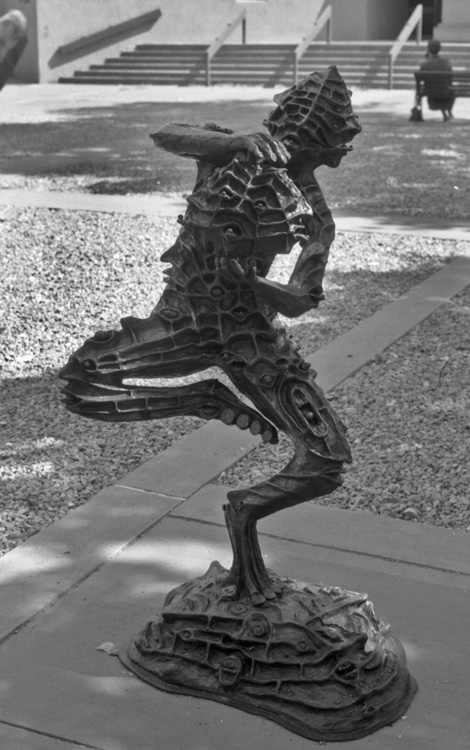
Since we've lived in Albuquerque I have often used a couple garden statues as test subjects for my old cameras.  One is in the botanic garden, and the other, a depiction of a mother and child, was in a corner of the sculpture garden behind the Art Museum.  When I walked through the Museum site yesterday with my Nikon FE I was surprised to find that the space formerly belonging to my usual subject was now occupied by a dancing head hunter.


It was kind of a shocking change to absorb.


The sculpture's location produces interesting lighting through the day, so I'll likely use the new one much as I did the previous subject.  This sculpture looks very different depending on the position from which it is viewed as each head has multiple faces.

Monday, August 19, 2019

Falcon Field Revisited

On previous visits to Phoenix I've often reserved a morning to visit the PIMA air museum in Tucson. With temps above 100 degrees, however, wandering around acres of concrete was just not a practical option. So, we made a shorter trip to Falcon Field in Mesa where most of the restored aircraft are in a couple big hangers.


With my last visit to the place in mind I loaded the Leica IIIa with TMAX 100 and attached the Jupiter 12 35mm, anticipating the opportunity to shoot the B-17 and some of the other big planes out on the tarmac.  As it turned out, the big planes were out flying around somewhere else, and we were confined to the dimly lit hangers.  This fine looking craft was at the front of the hanger.  I think it is a Stinson Reliant.

Wednesday, May 15, 2019

High Water

The Rio Grande is running high and fast thanks to Spring rains.  There is still quite a lot of snow in surrounding mountains, so the high water is likely to last well into Summer.


Near Albuquerque the river is seldom much above ankle deep, but this year the water is surging powerfully past the city and overflowing the banks to penetrate the bordering cottonwood forest.  Roads and paths beside the river have been transformed into swift flowing streams.  In low spots near the new stream banks the rising water gently lifts the leaf litter into an illusion of solid ground.


The high water is bound to be transformative for plant and animal populations along the river.  Cottonwood seedlings will have an unusual opportunity to gain a foothold.  The Yerba Mansa and the wolf berries will thrive and the mulberry trees will become heavy with fruit as the weather warms.  The porcupines will continue feasting on leaves and twigs high in the cottonwoods.  What of the small burrowing animals though?

We will be traveling toward the end of the May to Las Cruces. I will be interested in seeing how much of the high water makes it to the south.  In recent years, the Rio Grande there has been little more than a string of puddles, with farmers relying increasingly on pumping ground water for irrigation.  When we lived there south of Hatch fifteen or twenty years ago Spring floods seemed a regular occurrence. Water-blocked roads were a brief inconvenience, but it was always great to see the flocks of water birds appear suddenly to take advantage of newly replenished wetlands.

Saturday, March 30, 2019

Recalibrating

I've had some inconsistent results from my home film processing lately, so I decided to try to iron out some of the variables in the process. I got a new bottle of HC110 developer and a new digital thermometer from Freestyle along with a batch of TMAX and Tri-X film. I am thinking I will also do more stand and semi-stand developing as that makes time and temperature less important as well as providing some improvement in b&w tonal qualities. The last couple rolls I shot were processed normally in HC110 dilution B, so I'll try the next couple using semi-stand for comparison.


We have had some good ballooning weather lately.  This Stars and Stripes model came slowly down our street last Sunday at just over roof level.  I grabbed the Leica and walked along with the balloon thinking I might get some shots of a landing as that was pretty clearly what the pilot was aiming for.  However, there were really no likely landing spots on the course chosen by the wind, so about six blocks on the pilot gained some altitude and speed and left me behind.


A few days later I took my Retina Reflex loaded with another roll of TMAX 100 to the botanic garden.  I was the first one through the gate at 9:00 AM and it was nice to have the place to myself except for a few groundskeepers doing their watering and weeding.


Today is Cesar Chavez Day in Albuquerque, so I'm hoping to get to the celebration at the Hispanic Cultural Center with the Minolta X-700 and some Tri-X.   Lots of new photo opportunities on the horizon with the arrival of Spring.

Tuesday, September 04, 2018

Downtown


All five of my Kodak Retina cameras are post-war models that have excellent lenses.  The IIc is looks nearly new and works very well.  The others show more wear, but are still very capable shooters.  My goal is to spend some time with each of them over the next month.

Sunday, May 27, 2018

2926

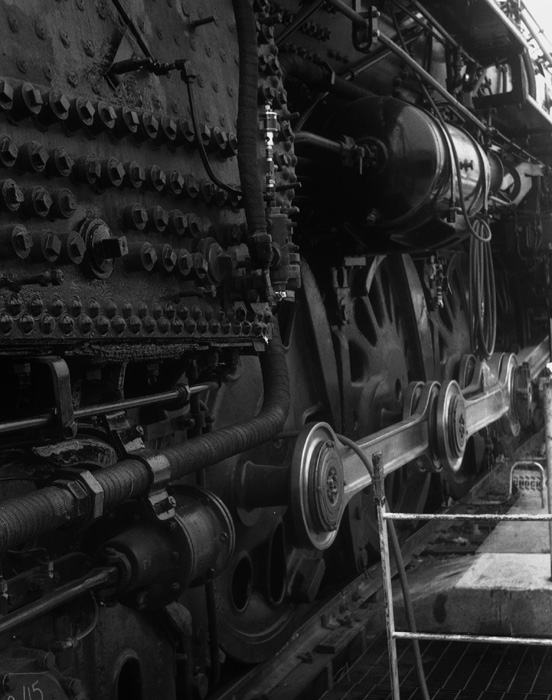
I've been watching the restoration of the 2926 locomotive for the ten years we've been in Albuquerque.  It looks like all the parts are back together.


On the day of my visit the task being worked on was making the whole thing water-tight.  That is quite a challenge as there are hundreds of old brass fittings that must withstand very high pressures.


The camera was my Fed-1g with the Fed 3.5/50 lens.

Thursday, March 09, 2017

Feeding the Panda

TMAX 100 is a film I have often shot in my box cameras, but it has been on back order for quite a long time at the places I usually go to get it.  I had one roll of 120 TMAX left in the refrigerator which I decided to shoot in my Ansco Panda.  I re-rolled the film onto a 620 reel and took a stroll by the Tingley Ponds with the Panda.  I'm wondering now if that was the last roll of this Kodak film that will see the inside of one of my old cameras.


The little Panda is my favorite box camera.  I think it would likely find more favor among today's remaining film shooters if it did not require re-rolling 120 film onto 620 reels.  That is not a very difficult or time-consuming process, but it seems enough to discourage a lot of potential users.

At first glance, it is difficult to understand why Ansco would choose a unique Kodak film format for any of its cameras as the company had its own film producing capability.  It seems very likely that the film format selection was tied to the fact that Ansco had merged with the German Agfa company in 1928 and the conglomerate's U.S.-based operations were seized in 1941 by the U.S. government and held as an enemy asset into the 1960s.  So, the decision process at the time of the Panda's appearance in 1946 was under the direction of government-appointed overseers who quite probably had a cozy relationship with Kodak which had many government war production contracts at the time.

Saturday, August 13, 2016

Kodak Brownie Flash Six-20

Kodak Brownie Flash Six-20
I found this Flash Six-20 at a yard sale a couple years ago.  It was missing the carrying strap, but otherwise seemed in shootable condition.  When I got the camera home, however, I found that there was a small misalignment in the metal case which made it very hard to reassemble after loading film.  I put it aside, and only got around to looking at it again recently when I was planning a visit to a car show at the National Museum of Nuclear Science and History.  Some determined jiggling of the parts showed that the camera could be used, so I rerolled some TMAX 120 onto the 620 spool.  The camera has only two adjustments: a choice of Instant or Bulb for the shutter setting, and focus settings of "5 to 10 Feet" and "Beyond 10 Feet".  The curved back film plane compensates pretty well for the limitations of the simple meniscus lens, though there is a little darkness in the corners of the images.

The car show consisted of many fine examples of the Ford Model T belonging to the members of the Albuquerque Model T club.  They parked them first in front of the Museum's B-29 and then drove them over in front of the B-52 for some additional photo ops.


I thought this little panel truck was particularly interesting.


Friday, November 21, 2014

autumn leaves

"I photograph to find out what something will look like photographed."
Garry Winogrand


Taken out of context, Winogrand's statement may appear flip and cynical.  I think, however, that he meant it quite sincerely.  He actually made similar statements on many occasions which alluded to photography as a way of investigating the world and the mind's perception of it.  The fact that Winogrand worked primarily in black and white is particularly relevant because of the often unexpected transformations which the extraction of color produce in a photographed scene.


Photographing leaves as they change color in the Fall is illustrative of the nuances of translating from color to monochrome.  Much of the immediate visual impact we experience in viewing Autumn foliage is due to the interplay of colors in the leaves.  Monochrome translation reveals that distinct hues may appear undifferentiated depending on surface reflectivity in the subject and on the chromatic sensitivity of films and lenses.  The challenge then for the monochrome photographer is to look beyond the immediate impact of Autumn's colorful displays to explore some of the other visual components of the observed scenes including form, texture and contrast.

Saturday, May 10, 2014

time travellers

I picked up this Zeiss Ikon Contessa 35 recently on eBay.  No one was bidding on it, apparently because the light meter was inoperative.  I ended up getting it for $21, which seemed pretty astounding to me.


We stopped by the New Mexico Museum of Natural History to view an exhibit of cyanotypes with samples from the collection as the subject matter.  The two preparators below gave us a nice over-view of their current projects.  She was working on the vertebrae of a giant sloth about twenty thousand years old.  He was slowly revealing the jaw of a small dinosaur from northern New Mexico with an age of about two-hundred-seventy million years.


Our lunch at a near-by diner was briefly interrupted by godzilla, but we were not in the mood to share.


I came across this giant of the bosque the next day during a walk near the National Hispanic Cultural Center.