
Showing posts with label Pentax Spotmatic. Show all posts
Showing posts with label Pentax Spotmatic. Show all posts
Thursday, March 12, 2026


Friday, July 26, 2024
One of My Hunters

Another image found in the recesses of my hard drive. I doubt I'll ever find the negative as it was made many years before I got my negative files in some kind of proper and retrievable order. There is likely a drugstore print in a box somewhere.
I took my first Red-tailed Hawk from California to Idaho and I had another there which I rehabed from a gunshot that blew off some wing feathers. Both birds were enthusiastic about bunnies and jackrabbits.
This shot was certainly from my Pentax Spotmatic as that was the only camera in the house for about twenty years.
Monday, February 12, 2024
Leah - Idaho - 1980

Margaret made a deep dive into the clutter on her desk and turned up this photo made beside the corral of our house in King Hill. I don't recall the details of this bow, but the size seems to suit her. I would have still been shooting my 30# Fred Bear brought from San Francisco. Must have been a drugstore print as I was not doing any film processing in those days, and certainly no scanning. The camera could only have been our Spotmatic.
Saturday, April 08, 2023
Idaho

We didn't have much of a plan in place when we arrived in Idaho. An uncle, retired from the Air Force, was living in Glenns Ferry beside the Snake River half way between Boise and Twin Falls, so we went there first. Not long after we got to Glenns Ferry I flipped over our Econoline van into a deep ditch. Luckily no one in the van was badly hurt, but it was going to take some time to repair the vehicle. So the plan became finding a place to live in town. We found a small rental belonging to the proprietor of the general store and moved in.
Although I have spent a couple days going through boxes of photos from our years in Idaho I did not find a lot that I was expecting to find. I also had only vague memories to go along with many of the pictures I did come across. Luckily, Margaret has a high-resolution memory that stretches easily back into the '70s and '80s. For instance, I said to her that I did not recognize the white cat in this picture.

"That's Pinky", she said, "the stray that adopted us."
"Was that the one that got trapped in the storage shed?", I asked.
"No, that was our cat."
"We had a cat?"
...and so on.
I found some places in the hills near Glenns Ferry to hunt jackrabbits with my Red Tail, just as I had done in California. There were great cliffs beside the River to both east and west of town where all kinds of raptors nested including hawks, falcons and eagles. When the next nesting season arrived I decided to free the Red Tail and take a couple young falcons to train. The house in town was not very convenient as a training base, so we ultimately moved up river about five miles to a house located on an old dairy farm, now converted to raising grains. The house was surrounded by fields irrigated with ditches, and it was an easy walk to the river. I could walk out of the house, step off the porch and send up a falcon to hunt.Raptor populations world-wide were starting to recover in the 1980s from a DDT-induced low. Falconry traditions and practitioners were vital to that recovery and a large number of the best falconers in the world lived in Idaho. At gatherings of the Idaho Falconers Association I met some of the greats who were champions of habitat restoration and captive breeding projects including Morley Nelson and Charles Schwartz. The guidance I got from them and other members of the group were key to my own achievement of becoming a competent falconer.

I also tried to pass along some of my own experience to my older daughter. We started her, as is the tradition, with a kestrel. Then she moved on to handling a tiercel (male) Prairie Falcon. I don't think I was a very good teacher, but Selena has always been an excellent student, and it seemed she gained something of value from that experience. The falcon -- we called him Mizar -- was a good flyer who mounted very high overhead and he became very expert at bagging Hungarian Partridges, Chukar and quail.
 |
| The Journal - Idaho Falconers Association, 1982 |

I did not do a lot of photography in Idaho. Falconry is a very demanding discipline, and along with that and making a gesture toward bringing in some income to support the family there was little time to devote to documenting my hobbies and obsessions. I worked at a variety of manual labor jobs which allowed me time for my birds. Those included working in a Grand View greenhouse, driving a cement truck, bucking hay bales , caretaking the Elmore County fairgrounds and working on commercial trout farms just downstream from Twin Falls. My birds shared their kills with us, and my rifle also brought us venison and a lot of rabbits.
Luckily, again, Margaret took on the task of making family pictures with the Pentax and she made many fine ones of our daughters and their friends. She also put the Pentax to good use while working as a reporter for the Glenns Ferry Pilot.

I do have a few more pictures of our time in Idaho and I'll share them in another installment of the story.
(I wrote a little more on this topic back in 2010 on my other blog.)
--------------------------------------------------------------------------------------
Tuesday, April 04, 2023
Greatest Hits!
My currently limited mobility has put a crimp in my photographic style. Rather than just run film through a camera to no good end, I thought I would try something different for a while. My software and my skills have seen a little improvement over the years, so I thought I might rescan some stuff from years past as a check on my progress. I also have a lot of small deckle-edge prints from the pre-digital age which I'm going to scan for the first time. To start off, here are a few thoughts on my most productive camera of all time.

At the time we bought the camera I was still playing with the idea of being a free-lance photojournalist. I bought a radio scanner which I installed in my '49 Studebaker pickup and chased fire engines around San Francisco. I managed to sell a few pictures to the Chronicle and the Examiner and pedaled a few to the wire services as well. One of those of the car squeezed between two trollies on Church Street ended up on the back page of Life and a couple other photo magazines.


None of that provided much of a living, however, so I eventually came to my senses and got a job as a social service caseworker for the City's welfare department.
One of my city job assignments was working a late shift at the San Francisco General ER. That gave me some time during the day to get out to San Bruno Mountain to take pictures of the hawks and owls and to exercise my Saluki's. I also got interested in falconry, and first trained a Kestrel and later a Red Tailed Hawk for hunting jackrabbits.
 |
| Gemma and her pup, Xenophon |
 |
| A baby in the nest high up in a eucalyptus. |
 |
| My first Red Tail |
I had good times hanging out in photography blinds on the mountain south of town. Our two daughters came along. My best coursing dog was hit and killed by a car. I was getting older and hadn't done a lot of things I thought were important. So, we loaded everybody and the Pentax in a Ford Econoline van and took off for rural Idaho. (To be continued...)
Saturday, December 12, 2020
Feathered Friends
On San Bruno Mountain south of San Francisco the Red-tailed hawks most often built their big nests high up in eucalyptus trees. I bought pole climbing irons at one of the surplus stores on Market street to get me up to where I could look into the nests.


Friday, December 11, 2020
California
I found some of my slides from our time in California taken in 1975 and 1976. The mounts say Kodachrome, Ektachrome and Technicolor.


In the seven years we lived in San Francisco I did not make many pictures of the city. Rather, I was drawn to record my efforts to make contact with Nature at the city's fringes. I don't recall showing the images to anyone before.
Thursday, June 14, 2018
macro abstract
A typical photo session for me often encompasses a couple miles of walking along the river. Limiting my field of view to a table top can offer as many opportunities for finding images, but at a different scale.


These images were all made with the Pentax SP and a +4 accessory lens screwed onto either the 1.4/50 or the 2.8/135. The TMAX 100 was processed in Rodinal 1:100 semi-stand for an hour. I liked the results ok, but medium format would likely have given me a little wider spectrum of tones.


These images were all made with the Pentax SP and a +4 accessory lens screwed onto either the 1.4/50 or the 2.8/135. The TMAX 100 was processed in Rodinal 1:100 semi-stand for an hour. I liked the results ok, but medium format would likely have given me a little wider spectrum of tones.
Thursday, April 27, 2017
film shooter

Monday, April 03, 2017
(semi) stand by me
I shot a roll today of Arista Edu Ultra 400 in the Spotmatic and processed it with semi-stand development in hc-110. I thought I might get a little less grain and contrast. I'm not sure the results were that much different from what I would have gotten from my usual hc-110b mixture, but getting any sort of images with just 4ml of developer in 640ml of water does seem impressive. I used a recipe for tri-x semi-stand from hjlphotos on tumblr.


 |
| Margaret's new dog, Roxie |
Saturday, April 01, 2017
Botanical
There are times when I find myself walking around with my camera and not making any pictures. I know then that it is time for a reset as I am not really seeing what is around me. Sometimes, it helps to change cameras, lenses, film or film formats. Deciding to focus on some particular subject matter also can be helpful, and I often end up choosing to look for botanical subjects. I may also jump-start the process by looking at some of the great practitioners of the botanical arts from the past that I particularly like, including Imogen Cunningham and her callas, the simple arrangements of Adolf De Meyer, Blossfeldt, Weston, Mapplethorpe -- there is no shortage of inspiring artists.


These photos were made in the cottonwood forest beside the Rio Grande and at Albuquerque's Botanical Garden.
The only 35mm film I had on hand for my Pentax Spotmatic was Arista Edu Ultra 400; it has nice tonal characteristics, but is a bit grainy for this subject matter. I processed the film in HC-110b.


These photos were made in the cottonwood forest beside the Rio Grande and at Albuquerque's Botanical Garden.
The only 35mm film I had on hand for my Pentax Spotmatic was Arista Edu Ultra 400; it has nice tonal characteristics, but is a bit grainy for this subject matter. I processed the film in HC-110b.
Tuesday, March 14, 2017
A morning at the zoo
I'm getting accustomed to my zoom lens which I use with the Spotmatic. I don't think I have the reflexes at this point to use it to its best effect, but it does allow a level of intimacy with my subjects which would be difficult to achieve otherwise.


I can't recall exactly when or where I got my Yashinon Zoom with the Pentax screw mount. I think I paid about fifteen bucks for it. The 75-230 zoom range gives it quite a lot of versatility. The optics are excellent. The 11-inch length and the weight make it a challenge to hand-hold. It is a lens that definitely requires some practice in using so that you don't focus when you want to zoom and vice versa.


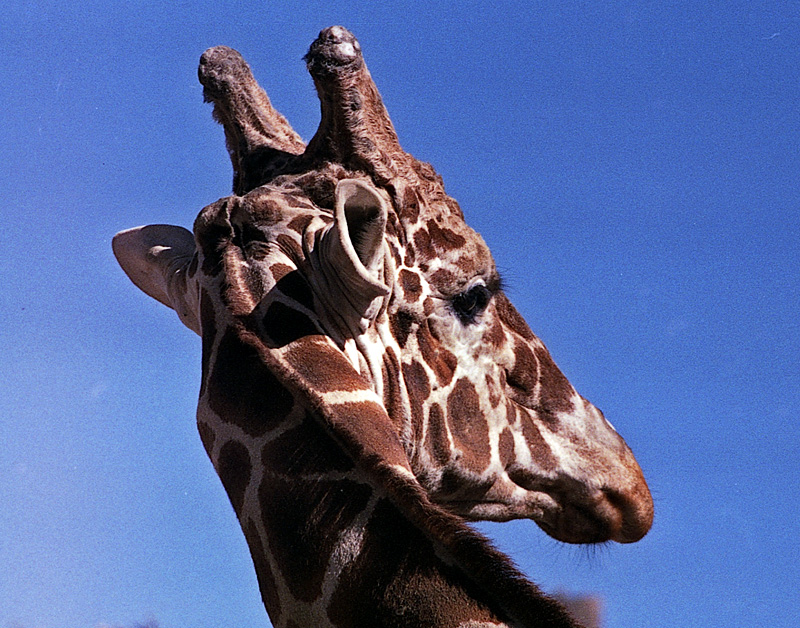

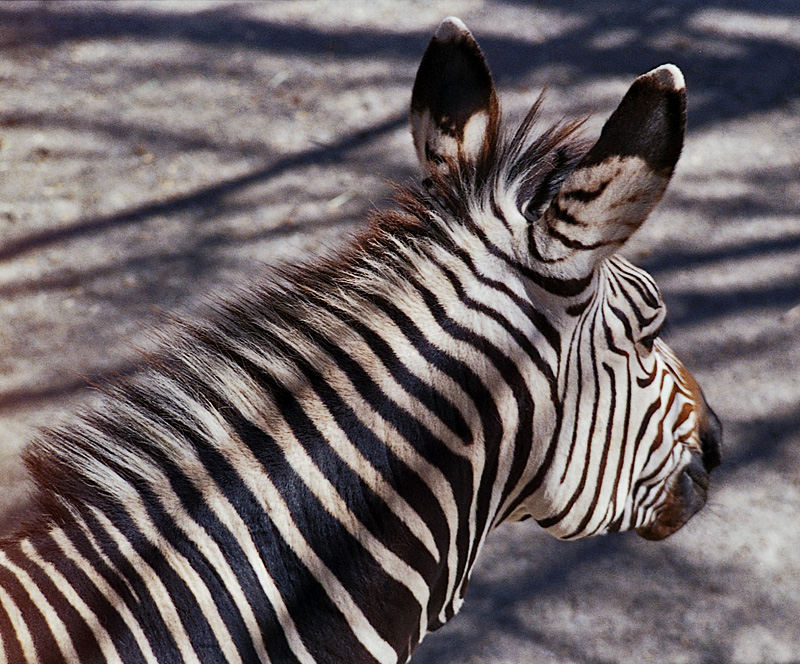


I can't recall exactly when or where I got my Yashinon Zoom with the Pentax screw mount. I think I paid about fifteen bucks for it. The 75-230 zoom range gives it quite a lot of versatility. The optics are excellent. The 11-inch length and the weight make it a challenge to hand-hold. It is a lens that definitely requires some practice in using so that you don't focus when you want to zoom and vice versa.


Friday, February 03, 2017
a perfect body

Here are some shots from the first roll through the camera. I've been shooting a Spotmatic for over forty-five years. Makes me wonder why I bothered with anything else.


This is not the best photo I've done of San Felipe de Neri, but it is interesting for me because it is the first I've done with my 24mm Super Takumar. I like the the depth and sharpness. There was very little light for the shot. I think I set the speed to 1 sec. and the aperture to about f5.6, though I couldn't really see what I was doing. I braced the camera on the back of a pew and hoped for the best. I'll go back to try this again.


Subscribe to:
Posts (Atom)