Showing posts with label Nikon FE. Show all posts

Monday, February 17, 2025

Bumps in the Road

 My Nikon FE has made some good pictures for me, but I haven't made a lot of use of it.  I decided to rectify that neglect with a trip to the zoo on a fine morning.  I made all the shots there with the Vivitar 3.5/70-210mm macro zoom.

  I grabbed a quick still life the next morning and then took a walk in Old Town with the Nikkor -P Auto 2.5/105mm.

When I got to Old Town I found that the meter's batteries had died, so I switched to manual exposure to finish off the roll of Fuji Neopan 400.  Back home, I processed the film in HC110b.  About a third of the zoo shots were blank frames.

The short series of shots from Old Town were ok, so I'm hoping the dying batteries accounted for the missing zoo shots.  I'll shoot another roll of the Neopan 400 to test that theory, and maybe also try developing in PMK to comapare with the HC110 results.

Thursday, March 21, 2024

Looking at Art in New Mexico

 Margaret and I spent a lot of time in galleries and museums in the last month.  The exhibition of Canadian Indigenous Art at the Albuquerque Art Museum was excellent.  A show of Black and White drawings and photographs at the New Mexico Art League was great fun.  

Margaret at Arts Thrive

Two exhibitions with great promise mostly brought disappointment.  The annual Arts Thrive benefit exhibit at the Albuquerque Museum had way too much art on the walls.  The Ways of Seeing exhibit at the New Mexico Museum of Art in Santa Fe assembled classics from three private photography collections, but what might have been a great experience was ruined for me by abysmal lighting.  

New Mexico Museum of Art, Santa Fe

 At the Santa Fe exhibit there were prints from many of Photography's great pioneers including Alfred Steiglitz and Ruth Berhard.  Gertrude Kasebier's small photogravure, "Blessed are thou amongst women", was so poorly lit that I was left wishing I had brought a flashlight.  In fact, all the galleries in the great old Santa Fe building  were dim and dingy looking.  The big palladium prints by David Michael Kennedy at least showed that there is still good work being done today in the State.

Tuesday, November 01, 2022

Zooming

We visited Albuquerque's Rio Grande Zoo on a fine Autumn morning.  My intention was to test a restored Vivitar 70-210 zoom lens.  The testing, as it turned out, ended up being more about  the operator and the camera, my Nikon FE.

Given some heavy morning shadows and a desire to avoid camera shake I made a lot of shots wide open.  That showed up as some softness in the images.  I don't think that said much about the capabilities of the lens however.  With the lens fully extended, the small central focal spot on the screen tended to black out and critical focusing became very difficult.  


When I was able to stop down in good light the added depth of focus easily overcame any small focusing errors and the result was nicely sharp images.


 I had better results in the past with a 75-230 Yashinon zoom.  I think, however, that may have more to do with the fact that the Yashinon was mounted on my Pentax SP.  So, I need now to go back and look at the different possible combinations of lenses, cameras and focusing screens so I can actually sort out the meaningful comparisons to be made between my zoom lenses.

Tuesday, October 05, 2021

Kentmere

The best part of Albuquerque's Balloon Fiesta for me is actually not the balloons, but the Flamenco dance performances in the Old Town Plaza Vieja which are staged by the National Institute of Flamenco.  I believe the small woman in the picture is Eva Encinias who founded the Institute as well as the unique Flamenco dance program at UNM.  The tall woman beside her is the head teacher at the Institute.

I shot a roll of Kentmere 100 and another of Kentmere 400 this time around.  Since I had two rolls of film to process I decided to try them both together using semi-stand processing in HC110 at 1:100 for an hour.  I was very pleased with the results which this choice yielded for the Kentmere 400.  The tonal qualities were very good and the grain was nearly undetectable.  I have mostly used PMK Pyro as a developer for Kentmere in the past with good results, but I thought the quality of the HC110 pictures made with my Nikon FE were just as good if not better.


The Kentmere 100 shot in my FED 1g rangefinder responded less well to the HC110 stand development, so I'll likely stick with PMK Pyro processing for that film which seems better able to handle the higher contrast of the slower speed film.


Tuesday, December 15, 2020

The Chess Set

   My first full-time job in San Francisco was in an office building on Mission Street.  Next door was a junk store in which I found an old bone chess set; I took ten dollars from my first paycheck to buy it.  My friend who was an artist painted a chess board for me on a square canvas.

I imagine a lot of small decorative objects were manufactured from bone prior to the widespread use of bakelite and other plastics early in the Twentieth Century.  The pieces in my chess set were turned on a lathe, with the small component parts threaded and then screwed together.

I've always liked the graceful design of my bone chess set and thought it would be a nice subject for some still life photographs.  So, nearly fifty years on, I'm beginning to work on that idea.


I only got a couple shots from the roll of Kentmere 100 that approached what I had in mind for portraying the chess set.  The +4 accessory lens I had for my Nikon was a little too strong for the job.  I'll try again with some equipment better suited to the task, and add a tripod so I can stop down for better depth of field.

I took the camera outside to shoot a few frames to get a better idea of how the Kentmere 100 was going to work with undiluted Kodak Xtol developer.  I thought the result was pretty good, though I'm wondering if the tonal range might be a bit better with 1:1 processing.

About ten years ago I did use the chess pieces as a subject when learning to use the Sketchup 3D drawing program.  My first results from that exercise were pretty crude, but I got a little better with practice and managed to make a desktop background picture of the two queens which I still have on my old 386 computer that I use for scanning and editing my photos.


I think the red and white color scheme for the opposing pieces was common in past centuries.  I will have to try some color film for the subject.

Monday, May 25, 2020

FP4+


I took my Nikon FE on a couple walks on both sides of the river.  I decided to try processing the FP4+ in L110 following the recommendation for time and temp at the Covington HC110 site.  Nine minutes turned out to be way too long and I got very dense negatives.  Luckily, FP4+ turns out to have very good latitude for a relatively slow film and I was able to rescue a few shots.


Thursday, August 22, 2019

Changeup

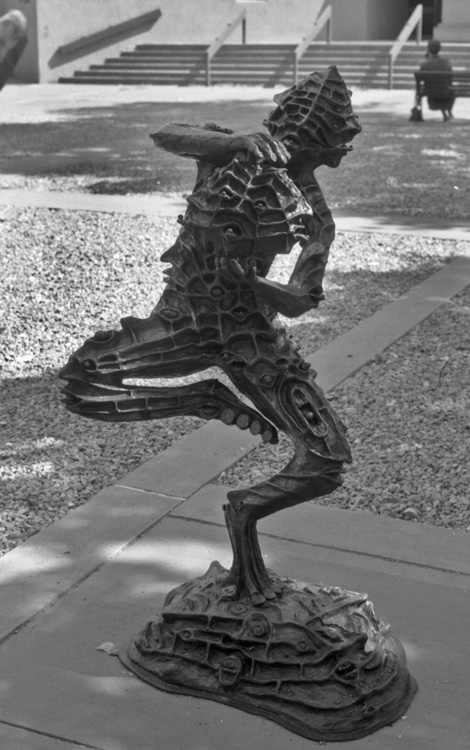
Since we've lived in Albuquerque I have often used a couple garden statues as test subjects for my old cameras.  One is in the botanic garden, and the other, a depiction of a mother and child, was in a corner of the sculpture garden behind the Art Museum.  When I walked through the Museum site yesterday with my Nikon FE I was surprised to find that the space formerly belonging to my usual subject was now occupied by a dancing head hunter.


It was kind of a shocking change to absorb.


The sculpture's location produces interesting lighting through the day, so I'll likely use the new one much as I did the previous subject.  This sculpture looks very different depending on the position from which it is viewed as each head has multiple faces.

Wednesday, May 15, 2019

High Water

The Rio Grande is running high and fast thanks to Spring rains.  There is still quite a lot of snow in surrounding mountains, so the high water is likely to last well into Summer.


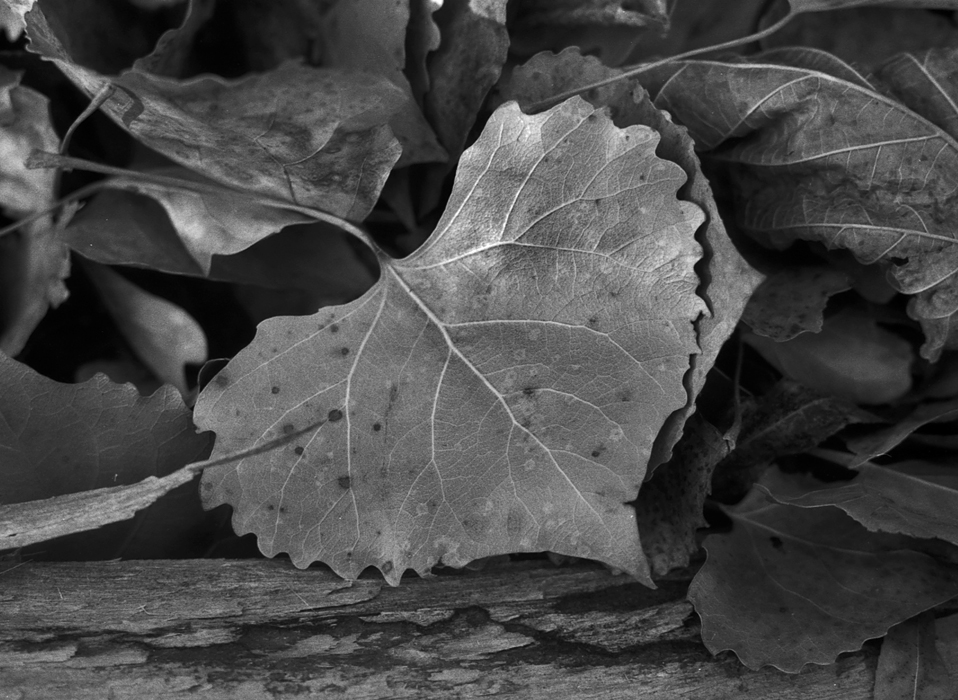
Near Albuquerque the river is seldom much above ankle deep, but this year the water is surging powerfully past the city and overflowing the banks to penetrate the bordering cottonwood forest.  Roads and paths beside the river have been transformed into swift flowing streams.  In low spots near the new stream banks the rising water gently lifts the leaf litter into an illusion of solid ground.


The high water is bound to be transformative for plant and animal populations along the river.  Cottonwood seedlings will have an unusual opportunity to gain a foothold.  The Yerba Mansa and the wolf berries will thrive and the mulberry trees will become heavy with fruit as the weather warms.  The porcupines will continue feasting on leaves and twigs high in the cottonwoods.  What of the small burrowing animals though?

We will be traveling toward the end of the May to Las Cruces. I will be interested in seeing how much of the high water makes it to the south.  In recent years, the Rio Grande there has been little more than a string of puddles, with farmers relying increasingly on pumping ground water for irrigation.  When we lived there south of Hatch fifteen or twenty years ago Spring floods seemed a regular occurrence. Water-blocked roads were a brief inconvenience, but it was always great to see the flocks of water birds appear suddenly to take advantage of newly replenished wetlands.

Sunday, December 16, 2018

The Best of the Bunch

Left to my own devices I would likely not have acquired my Nikon FE.  It was a generous gift from an online photographer friend.  The design and construction of the camera are right up there with Leica in regard to quality.  That becomes immediately apparent when you pick up the camera and crank the winding lever; the movement is extraordinarily smooth.  And, there is a vast number of Nikon lenses available to the camera.  My resolve to work more with the FE was further bolstered recently when I figured out that I could use my nice old 105mm Nikkor-P Auto f2.5 lens on the FE by just flipping up a tab on the lens mount.  So, I put aside a couple other projects, loaded some TMAX 100 in the camera, and took a stroll through the neighborhood.


With half the roll of TMAX remaining the next day I mounted the Nikkor 1.8/50mm and took a walk beside the river.  That turned out to be a less than fair trial for the camera and lens as I had Margaret's very active dog, Roxie, tethered to one arm.  So, the equipment performed rather better than I did.  Still, I saw a lot of nice subjects that I'll get back to again soon.  The cottonwood forest is carpeted now with a dense layer of dry leaves.  The river this time of year is full of migrating bird life.  There were five Sandhill Cranes on a nearby sandbar when we stepped out of the trees.  Two raucous ravens across the river drew my attention to a Bald Eagle perched high in a cottonwood's bare branches.


I processed this roll of TMAX in HC-110, dilution H.  That formula uses half the dilution-B concentrate of developer and requires twice the time to develop.  The outcome is a bit less contrast than one gets from dilution-B.  It worked as expected, though better in some instances than others.  I'm thinking that for the next roll of TMAX I'll try going back to dilution-B with a developing time of six minutes at 20C rather than the seven I have been using lately.  The guides I always consult for this sort of thing are the HC-110 Developer Resource Page and the Massive Dev Chart.

Thursday, November 08, 2018

Cate and Roxy


My old Nikon F2 came with a highly regarded Nikon 105mm lens, but I thought I might not be able to use it on my Nikon FE because the lens had an old-style mount.  However, I found a little button on the camera mount that let me flip the little meter coupling tab out of the way.  You can then mount the lens and manually adjust the shutter and aperture, and the dof preview button can be used for stop-down metering.  I'm looking forward to getting to know this lens better.