Showing posts with label aircraft. Show all posts

Tuesday, May 20, 2025

Look Up

 I was pleased to see that Sunday's paper contained a glossy insert announcing that the Kirland AFB airshow was returning to Albuquerque after a six year absence.

Pentax Spotmatic
Looking back through my collection of aircraft photos the only one I can find from Kirtland dates back to 2011.  I recall being a bit put off by the huge crowd of people at that one.  I'm planning on getting to this upcoming one, however, as there have been many fewer such opportunities in recent years.


Everyone in my family were all aviation enthusiasts, due mostly to my Uncle Jack's military flying career which took him through three wars, including being shot down in two of them.  When he came home to recover from wounds sustained in the crash of his DC-3 in Sicily he spent some time recuperating at Fort Lewis and then was given a job ferrying planes around the country.  One of my earliest memories is seeing the whole family run outside when Jack would fly over our West Seattle home and waggle his wings at us on the way somewhere in a Black Widow or a Lockheed Lightning.

Between wars Jack often worked as a flight instructor and he gave flying lessons to my grandfather, my mother and my stepfather.  I got to spend a lot of time in the air with him as well, though without making it to a flying license.  Most of our flights together were in float planes that got us into remote Cascade lakes.  He did nearly always give me a chance to steer on those trips, including this one in an Aeronca.  I think that shot was made shortly before the Korean War where Jack flew Sabre Jets.

Jack's military career came to an end in Vietnam when the Viet Cong brought down his Medevac chopper.  As in Sicily he managed to get everyone to the ground alive, but his right leg was badly injured.  That story along with a summary of his whole flying history is nicely told on the Warhawk Museum webite.

Monday, August 19, 2019

Falcon Field Revisited

On previous visits to Phoenix I've often reserved a morning to visit the PIMA air museum in Tucson. With temps above 100 degrees, however, wandering around acres of concrete was just not a practical option. So, we made a shorter trip to Falcon Field in Mesa where most of the restored aircraft are in a couple big hangers.


With my last visit to the place in mind I loaded the Leica IIIa with TMAX 100 and attached the Jupiter 12 35mm, anticipating the opportunity to shoot the B-17 and some of the other big planes out on the tarmac.  As it turned out, the big planes were out flying around somewhere else, and we were confined to the dimly lit hangers.  This fine looking craft was at the front of the hanger.  I think it is a Stinson Reliant.

Wednesday, August 29, 2018

Fly-in

I took a drive over on Albuquerque's west side on Saturday with no particular destination in mind.  Passing the Double Eagle airfield I noticed that there were a lot of cars parked near the entrance.  It turned out I had stumbled on a fly-in airshow.


I had a couple frames left on a roll of Kentmere 100 in my Retina IIa, so I shot those and then loaded a roll of Fuji 200 color.  If I had known where I would end up from the beginning, I might have chosen to bring along an slr and a couple lenses, and maybe a medium-format camera.  However, I can't complain about the performance of the Kodak rangefinder and its fine Xenon lens.


The half-dozen sleek little planes that were lined up beside the runway put on a nice aerobatic show, complete with smoke trails.


I think this is the third light plane show I have seen at the west side field.  The previous show featured rides in a Ford Trimotor, which I believe is due back in Albuquerque in November.

Sunday, February 25, 2018

The Wild Blue Yonder

Things  come together in strange ways at times.  A few nights ago a woman arrived at our place a little early for a neighborhood meeting.  We talked for a bit about her recent trip to England which included a visit to one of the Brit air museums accompanied by her 94-year-old uncle who had been a WWII Spitfire pilot.  She said the weather was disagreeable, and it was disappointing to her that no one at the museum acknowledged her uncle's presence or his contribution.   So, not a great success.


The next day I dropped by a local thrift store and  found in a box marked "Free" a 58 page book about the history of the Spitfire.  It was full of  marvelous vintage pictures of the iconic fighter along with a thorough description of each of the many variants of the aircraft produced from 1936 to 1952.


In addition to the photos, there is a wealth of illustrations detailing distinguishing features of the evolving design, along with front, top, bottom and side view plans as well as many of the unit insignias of interest to modelers.  The book was copyrighted 1980 and was produced by Squadron/Signal Publications.  It turns out that the company produced a large number of similar books about historic aircraft, and many can be found on line, often at a price of about $10 each.  Certainly one of my better thrift store acquisitions.


Well, on the next day the sun made an appearance after several days of clouds and even a few snow flakes.  So, I headed across town to the National Museum of Nuclear Science and History with its outdoor exhibit space which has a nice little collection of Cold War aircraft.  I took along the Leica IIIa mounted with the Summitar lens and loaded with Kentmere 100 film.  All of my old cameras eventually make at least a few pictures of vintage aircraft, and it seemed like a good opportunity to use the Summitar for that purpose before I send it back to its owner.


What caught my eye as I pulled into the Museum parking lot was a new addition to the aircraft collection, an early model of the MiG-21, a Mach 2.0 Soviet fighter first produced in the 1950s.


The fuselage of the MiG had been positioned next to a recently restored F-16.  I think it will not be long before the plane is fully reassembled, so I'll look forward to returning soon for some more pictures.  I was not particularly pleased with the combination of Kentmere film and Rodinal on this occasion, so I'm thinking I'll try the same subject with Pyro developer next time.  Of course, I had no complaints about the Summitar which turned in its usual stellar performance.


All of the planes on display and most of the other equipment in the outdoor area of the museum have new coats of paint and look marvelous.  The museum has also made some impressive additions and improvements to the indoor exhibits including a mock-up of a war-time Los Alamos lab, and there is currently a really nice exhibit of engineering technology from classic Greek and Roman times.

Wednesday, April 26, 2017

Paint

Many of my old cameras have visited the aircraft displays at the National Museum of Nuclear Science and History in Albuquerque.  None of the Cold War Era planes is in flying condition, but the three bombers and the F-16 have recently been repainted and look like new.  Now, the Museum is undertaking a fund raising campaign to pay for repainting the last two planes in the collection, the F-105D Thunderchief and the A-7 Corsair II.  The INDIEGOGO page on the restoration project features an excellent presentation about the history of the two aircraft.

My pinhole picture of the F-105D was in a recent photo show at the museum, and the print was donated for sale by  the museum.


The picture I did of the A-7 Cosair II is one of my favorite shots from my Argus C3.

Wednesday, April 19, 2017

Feeding the 828 cameras

I took my Kodak Flash Bantam across town to the Nuclear Museum.  As usual I spent most of my time there admiring the small collection of aircraft behind the facility.  The three Cold War era bombers all have new paint jobs and look much as they would have while in service.


There is now a bomb casing under the wing of the B-29 which is the same as that used for the Fat Man A-bomb dropped on Nagasaki in 1945.


There are still a few B-52 bombers being flown today. The plane's maiden flight was made in 1952 and it is projected to remain in service for two more decades.


I have mostly just rolled a strip of 35mm film with no backing paper onto the little 828 metal reels that fit in the Flash Bantam.  With the frame counter window blocked, that has worked pretty well for the most part, but on this occasion I decided to try rerolling some 35mm film along with backing paper.


I have a strip of 838 backing paper which I salvaged from an old roll bought on ebay.  I used that as a template and cut out a strip for use from a saved 120 Acros roll.  I inked in the frame numerals along with some leading dots.  That gave me framing for eight exposure, just as in the original.


Scissoring out the backing paper was simple.  Getting the strip of film in place inside the dark bag requires some patience.  Usually, the beginning of the film strip is taped to the backing and the trailing "exposed" end is left free.  I found it helpful to tape the trailing end first to keep it in place and then inserted the tab in the spool and rolled the film and backing toward the "start" end.  I had to repeat this process a couple times as I got some buckling of the film when I tried to tape it at the "start" end.  I found it helpful to completely roll up the film onto the second reel and then unroll it back to apply the tape to avoid buckling.  Being able to see the frame numerals through the camera's back window was certainly nicer than guessing at the required number of winder turns.  However, having just eight exposure available seemed very limiting, and probably explains much of why the 828 format went away.

My 828 Cameras

Whatever method one chooses to get film into one of the 828 cameras the process is going to be a bit labor intensive.  Winding unbacked film onto an 828 reel lets me get 15 to 20 shots per load, but I have experienced a few instances of blockage and tearing.  The diameter of the 828 reels is very small, and tightly winding the stiff film strip creates a highly tensioned coil spring which can get out of hand.
    I'm thinking my next experiment with this format will be to use a hybrid method, taping a couple of inches of backing paper to the beginning and end of the film strip.  It seems like that would provide a more secure way to attach the film roll to the reels and maybe avoid some of the problems that come with using a completely unbacked film strip.

 More information about preparing film for use in 828 cameras:

Sunday, April 09, 2017

Vintage Weekend

Albuquerque was treated to a visit from a Ford Tri-Motor this weekend.  The "Tin Goose" was a regular visitor to the city in the 1920s and '30s.  I had never seen one in the air before, so it was a real thrill to see it flying.


Quite a few people took advantage of the opportunity to make a 15 minute flight  in the Tri-Motor.  My guess is that people boarding the plane in the 1920s would have been more formally dressed for the occasion -- the men in coats and ties and the women with hats and gloves.


I made these pictures with Amelia Earhart's favorite camera, the Kodak Duo Six-20.  I had a bit of a problem with flim flatness, but managed to salvage a couple shots I liked from the roll of Fuji Acros processed in Rodinal 1:50.  I  also made some color shots with the Olympus Infinity Stylus, so will post some of those when I get them scanned.

--------------------

Tri-Motor Color 

Saturday, November 15, 2014

Kodak Bantam RF

I recently acquired a Kodak Bantam for a ridiculously low price on ebay.


Mine looks pretty much like new, and everything works more or less as it should.  Aside from the Bantam name and the 828 film format the RF model had almost nothing in common with the  Bantam strut folders which first appeared in the mid-1930s.  Kodak continued producing the 828 folders for a few years after WWII; the name was then passed on to a new line of fixed lens, bakelite-bodied cameras designed by Arthur H. Crapsey.


The Bantam RF design and the supporting Kodak publicity reflected and helped define the '50s aesthetic.


As I had done with my Flash Bantam, I covered the ruby window on the back of the camera and taped a 24-exposure strip of 35mm film onto the 828 reels.  One nice innovation in the RF model is a roller-based frame spacing mechanism which eliminates the guess-work in advancing the film by counting turns.  The removable back presented a bit of a challenge in the process of film loading inside a dark bag, but I think it will be less of a problem with subsequent rolls.  I exposed the first roll of film through the camera at one of my regular test sites, the National Museum of Nuclear Science and History.

F-16 - new paint job and accessories

USS James K. Polk Submarine Sail - surfaced

B-52B Stratofortress

Monday, September 01, 2014

Labor Day Ride

We enjoyed a morning ride on the motorcycle along Albuquerque's west side to the Double Eagle II airfield.  The terminal there has a great little restaurant on the second floor with a view of the field, the nearby volcanoes and, in the distance, the Sandia Mountains.


The Bombing Range Cafe, the airport and several thousand surrounding acres are located on the former site of a practice site for training bombardiers during WWII.  For me, the cafe evoked memories of a similar coffee shop on the lake end of Renton Field south of Seattle where my family often started float plane fishing expeditions in the '50s.


On the way back we stopped briefly to enjoy a flight experience on a smaller scale at the Maloof Air Park.  There were some great flying models on display and we got to watch some expertly flown, including a quiet and fast ducted fan electric model that was really impressive.


The camera of the day was my little Kodak Flash Bantam, loaded with a strip of 35mm Tri-X.

Monday, July 14, 2014

A couple cars and a diagnosis

My compact Olympus XA often gets to ride along in a pocket when I'm out for a walk with no particular photographic objective in mind.  The 1938 Chevrolet was parked at the west end of the Plaza Vieja early on Friday morning.  The owner was sitting on a nearby bench; he said he had owned the car for about 35 years.  


The XA also often gets to go along as a backup when I'm out to make pictures with one of my big 6x9 folders like the Monitor which only have a capacity of eight frames per roll of 120 film.  The XA also allows me to shoot easily in low light environments without the need for a tripod which is really essential with the long-lensed Monitor.  The spiffy sports car was in the shop where Saturday's car show was held.  I'm guessing it is a Ferrari 328, but I could be wrong.


The XA had also accompanied the Monitor when I visited the Nuclear History Museum earlier in the week.


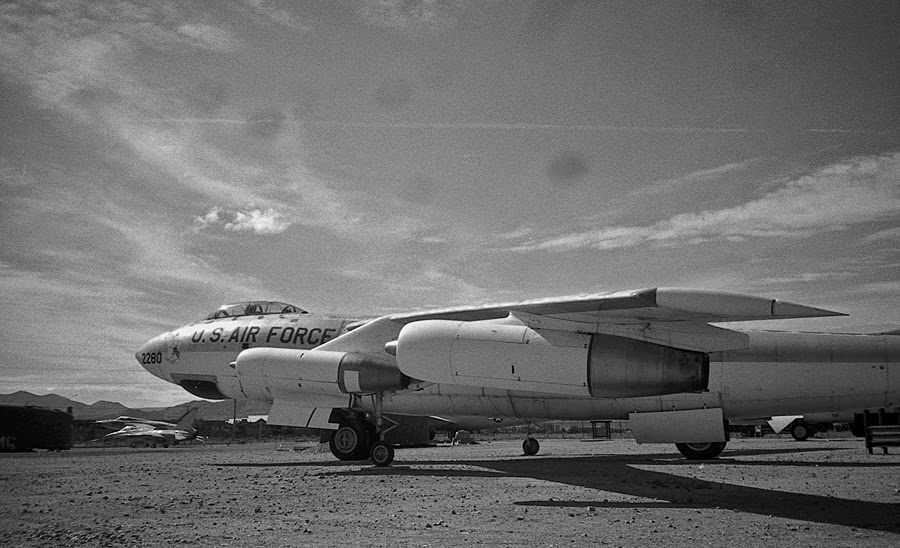
When I scanned the aircraft shots, which had a lot of sky in the background, I noticed that the upper third of the image contained a number of round dark spots which can be seen clearly in the B-47 image.  The spots were present and in the same position in all the images shot that day.  This was clearly something going on in the lens.  The XA shutter has no bulb function to allow keeping the shutter open, so I was only able to examine the front and rear elements and found no trace of anything that could have caused the spotting


I was relieved to find that images made before and after the Museum visit did not have the spots on the negatives.  My fear when I had first noticed them in the aircraft pictures was that fungus had invaded the lens.  In fact my first XA was a victim of such an infection, and there is no easy way to correct that issue in the XA outside of an Olympus repair facility.  My conclusion at this point is that the spots were the result of condensation on the inner lens surfaces, which evidently dried up after the session with the aircraft.

Friday, July 04, 2014

F-16

The Nuclear History Museum has added an F-16 to its aircraft collection. 


It seemed a good excuse to exercise my Kodak Monitor 620.  I had neglected the camera for some time and decided that it was time to rectify that.  I adjusted the infinity focus on the camera, and I restored the 620 film carrier which I had previously removed in an ill-conceived effort to force it to use 120 film.  


It is hard to believe that the F-16 is already a forty-year-old design.  Maybe it's just me.


wikipedia

Monday, September 09, 2013

copper chopper


My Patent Etui is performing well, but requires some care in use.

As with any of the ruby-windowed cameras, it is important to only open the frame counting view port briefly while advancing the film, and that must be done away from direct sunlight.  Even with strong reading glasses it can be difficult to discern when the numerals crawl into sight in the window.

Since I was shooting with the Rollex rollfilm adapter and not planning on using the ground glass for focusing, I left the adapter's dark slide at home and just put a strip of black tape over the slot where the slide is inserted to avoid any light intrusion that way.  I also put a strip of tape over the hinge on the Rollex, though the back closes up very tightly, and the cloth curtains over the film spools also seem to be doing their job of keeping out any stray light.  The bellows have remained light-tight, thanks to the application of some dabs of black fabric paint to a few pinholes.

Getting the image properly framed is something of a challenge with the Patent Etui.  The little reflex finder has a mirror that is slightly deteriorated, though it does allow accurate framing with care.  The wire frame finder with the rear flip-up pin provides a very poor guide to framing, certainly not adequate to ensure full-frame display of the final image.

The fine Tessar lens easily makes up for any of the inconveniences of shooting the camera.  I shot the whole roll at 1/250 and f-22 in bright sun at the air show, and every exposure was tack sharp.

Saturday, September 07, 2013

Fly-in


We enjoyed a light plane air show this morning at Albuquerque's Double Eagle Airport.