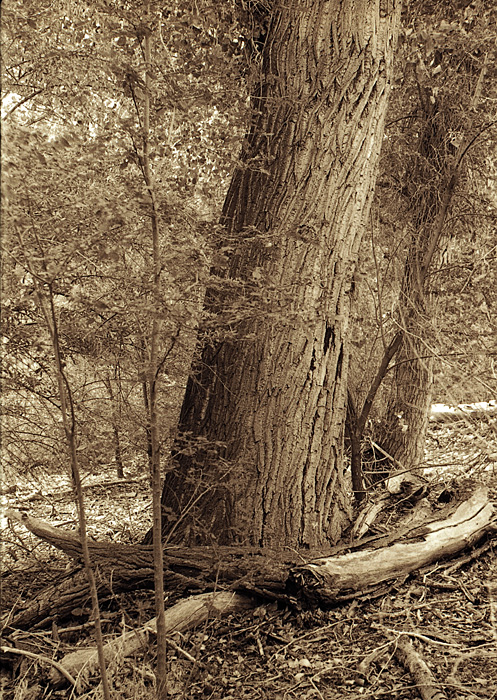
I used the second half of my roll of Acros in the Retina I during a walk through the riverside woodland. The sky was hazy and produced nice light in the cottonwood forest, but presented a challenge for the little viewfinder. Most of the shots required an aperture of f8 or f5.6; that worked ok for subjects at a range of ten or fifteen feet, but anything closer got rendered sharply mostly by luck. The Retina I has a very smoothly operating shutter release, so I was comfortable shooting it as slow as 1/25, but that still did not get me acceptable and predictable depth of focus.
Had I given a bit more thought to my equipment and where I was taking it, I could have brought home quite a few more good shots. For instance, I have a couple of accessory rangefinders that could have given me sufficient precision in focusing on my subjects. An even better solution would have been to mount the Retina I on a tripod, allowing the possibility of shooting at the smallest aperture of f16. At a focal distance of three feet that provides a depth of focus of about a foot, while at a distance of six feet the sharp focus zone has a depth of over four feet. All of that information is made available on the dof scale on the bottom of Retina I. Next time, I'll pay closer attention.
All of which is not to say that I considered the experience a failure. I learned something, and I spent a couple hours wondering through the cottonwood forest admiring the lush mid-summer vegetation, oblivious to the cares of the world. Then, I went home and spent about six hours processing the film, scanning the negatives, editing the pictures and writing up my ideas about the experience. All good.
Showing posts with label Kodak Retina I (Type 010). Show all posts
Sunday, August 06, 2017
Saturday, August 05, 2017
Old Town
I decided recently that I would like to shoot some 100 speed black and white film in 35mm, which I have not done in some time. I bought several different brands from B and H Photovideo including a couple rolls of Acros, and I loaded one of those into my Retina I. I devoted the first half of the roll to a sunny day walk through Albuquerque's Old Town.
The Retina I is the smallest and simplest of my Retina cameras. It has a reliable Compur-Rapid shutter and an excellent 3.5/50 Kodak Ektar lens.
My Retina I is a post war model. There are many small variations in the viewfinder types, but the features are essentially the same as the first one produced in 1934 which was designed to accommodate the 35mm cartridge developed by August Nagel. The history of the long Retina line is thoroughly presented in the Kodak Retina Wikipedia page.
The Retina I is the smallest and simplest of my Retina cameras. It has a reliable Compur-Rapid shutter and an excellent 3.5/50 Kodak Ektar lens.
My Retina I is a post war model. There are many small variations in the viewfinder types, but the features are essentially the same as the first one produced in 1934 which was designed to accommodate the 35mm cartridge developed by August Nagel. The history of the long Retina line is thoroughly presented in the Kodak Retina Wikipedia page.
Tuesday, August 23, 2016
Kodak Retina I (Type 010)
The original Retina, introduced in 1934, was the first camera to
use the modern 35mm film cartridge. The Retina I appeared in 1936 and
the line continued on for two decades with a series of model changes.
My camera is a Type 010, built in Kodak's Stuttgart plant between 1946
and 1949; it is distinguished from the pre-war Type 148 by the presence
of a barrel-shaped focus knob rather than the small conical one on the
earlier camera. The lens mount is a unit focus design in which the
entire lens and shutter assembly moves in and out when the focus ring is
rotated. The Retina I cameras had Compur or Compur Rapid shutters and
were equipped with either Xenar or Ektar lenses. Without a rangefinder,
focusing was by estimation. A circular depth of field calculator on
the base of the camera could be consulted to determine depth of focus at
different apertures.
My Retina I was originally equipped with the Schneider Kreuznach Retina-Xenar lens, but it was badly fogged. I bought a junker of the same model but with the Anastigmat Ektar lens and used it to replace the damaged lens on the camera. That turned out to be something of an ordeal as the whole lens and shutter assembly has to come out in order to fine-tune the infinity focus. The only way to check the accuracy of the infinity adjustment is to reassemble the camera, so I felt fortunate to only have to go through procedure twice before getting it right. I probably would not have tackled the job at all were it not for the availability of some excellent instructions provided on the web site of the Retina expert, Chris Sherlock.
I have several models of the Retina line; the Retina I is the oldest and simplest, and it is a bit slower to shoot than the others because of the manual shutter cocking and the knob film advance. The basic simplicity of the Retina I is part of its charm, however, and the high-quality design and construction makes it a pleasure to handle. The Retina I is similar in regard to features and quality to the Zeiss Ikonta 35 and the Voigtländer Vito II from the same post-war era. I would find it impossible to distinguish photos shot by one from the others, or to pick a favorite among them.
Some photos from the Retina I:
My Retina I was originally equipped with the Schneider Kreuznach Retina-Xenar lens, but it was badly fogged. I bought a junker of the same model but with the Anastigmat Ektar lens and used it to replace the damaged lens on the camera. That turned out to be something of an ordeal as the whole lens and shutter assembly has to come out in order to fine-tune the infinity focus. The only way to check the accuracy of the infinity adjustment is to reassemble the camera, so I felt fortunate to only have to go through procedure twice before getting it right. I probably would not have tackled the job at all were it not for the availability of some excellent instructions provided on the web site of the Retina expert, Chris Sherlock.
I have several models of the Retina line; the Retina I is the oldest and simplest, and it is a bit slower to shoot than the others because of the manual shutter cocking and the knob film advance. The basic simplicity of the Retina I is part of its charm, however, and the high-quality design and construction makes it a pleasure to handle. The Retina I is similar in regard to features and quality to the Zeiss Ikonta 35 and the Voigtländer Vito II from the same post-war era. I would find it impossible to distinguish photos shot by one from the others, or to pick a favorite among them.
Some photos from the Retina I:
Thursday, January 05, 2012
Ektar
The only Kodak Ektar lens in my collection is attached to a rather modest camera, the compact folding Retina I.
Kodak used the Ektar name to designate a whole class of professional-level lenses of the highest quality, all of them featuring unit focusing. The simplest of the line was probably the 3.5/50mm lens on my Retina I, basically a Tessar type with four elements in three groups. Ektar lenses with more complex designs were standard on the medium format Medalist, the Signet 35, and the Bantam Special which used 828 roll film.
I haven't made a habit of New Year's resolutions in the past, but this year I am determined to more fully explore the potential of some of the fine cameras in my collection which have not got the attention they deserve. Consider this post a first installment on that proposal.
Thursday, September 29, 2011
Albuquerque Texture
Subscribe to:
Posts (Atom)


