Showing posts with label cars. Show all posts

Saturday, August 15, 2026

Verichrome Pan

 I shot a roll of Verichrome Pan with an expiration date of 1981 in my Kodak Duo Six-20 folding camera.  This was the best of the shots from the roll.


 I thought the film actually performed pretty well considering its age.  I shot it at the box speed of 125 ASA and processed in HC110b for 7 minutes.  However, I had a lot of trouble managing the camera, my Kodak Duo Six-20 folder.

I normally choose to shoot a faster 400-speed film with this type of camera because that allows the use of smaller apertures and more leeway for focus errors.  Shooting the Verichrome Pan on a cloudy day meant having to open up to f/4.5 or f/5.6 which required more accurate focus estimation than what I was often able to achieve.  I also had a lot of trouble seeing the frame numerals through the camera's ruby windows.  In trying to get enough light on the window I managed to put. some ugly bright smudges on the images.

So, a disappointing outing with one of my favorite cameras.  I'll try to give it another chance soon with some newer and faster film.  

Tuesday, March 10, 2026

From The Archive

 I spent the afternoon retrieving scanned files from an old backup hard-drive.   Some of the files go back to 2001.  A quick look tells me my memory is going to be taxed recognizing some of the places and subjects.  

I do recall this cloudy April 6th of 2013 when I found some old cars lined up along the curb in the Old Town Plaza.  Captured with my Argus C3 and the Sandmar 35mm lens.


For this subject, Google Search is a big help in retrieving some details:

* * * 

"The car featured prominently in the center of the image is a 1958 Chevrolet Impala Sport Coupe. 

Key Details of the 1958 Impala
    •    Debut Year: 1958 was the inaugural year for the Impala nameplate, which was originally introduced as the top-of-the-line trim for the Chevrolet Bel Air line.
    •    Design Features: This model is known for its pillarless coupe design, quadruple headlights, and distinctive triple taillights. The specific color of the car in the image appears to be Silver Blue Poly.
    •    Performance: These classic cars were often powered by a 348-cubic-inch "W" engine or a 283ci V8, with some high-end versions featuring "Tri-Power" (three two-barrel carburetors).
    •    Historical Significance: It was a "one-year-only" body style, as the Impala was redesigned for the 1959 model year, making the '58 a highly sought-after collector's item. "
  

 * * *

  More to follow...

Sunday, November 23, 2025

Slow Walking EM

 Another fine day for a leisurely stroll through Albuquerque's Old Town.


Ken Rockwell judges the EM to be Nikon's worst camera.  I beg to disagree.  I like the Nikon EM for its compactness, light weight,  aperture-priority automation, and the fact that it can use all my fine Nikon lenses.

I recently had a total disaster with a bad batch of PMK Pyro developer, so this roll of Kentmere 100 was processed in some reliable old Rodinal 1:50.

Tuesday, May 27, 2025

A Few More

 From the Olympus Pen-FT


I always enjoy the yearly Albuquerque Museum car show, but it is exhausting to walk up and down those long rows of closely packed cars, and the acres of chrome is blinding and often defeats my cameras.  I'm more comfortable photographing the cars in their natural curbside environment.


Wednesday, May 07, 2025

Easing into Film Photography

 The gift of a '90s era Nikon N8008s got me to thinking about how someone might be introduced to film photography who comes from a generation that has known only digital.  I have suggested meeting that challenge by starting off with the simplest of film cameras.  An alternative might be to work backward from the point where film cameras like the N8008s were digital in all but the recording medium.

By the start of the 1990's film camera makers were offering a lot of choices in cameras with fully automated control of focusing, film advance, speed and aperture adjustment, all under the supervision of miniaturized electronic circuits. The camera from that period I am most familiar with is the tiny fixed-lens Olympus Infinity Stylus which slipped in a pocket as easily as the bar of soap it resembled.

For photographers with bigger ambitions and pocketbooks, Nikon and others put interchangeable lenses into the mix. That came with a cost in complexity and weight.  The N8008s, for instance, requires four double-A batteries to power interchangeable lens focus operation along with the continuous digital display of all control settings. In compensation, the user could choose a fully automated point-and-shoot mode, or opt for full control over each aspect of the process, including shutter and aperture-priority, single or multiple exposures with a single button press, and a variety of metering styles. 

I test drove the N8008s with a roll of Arista 200 over two days in familiar surroundings: Old Town Albuquerque and the Rio Grande where our dog, Roxie, likes to run and splash in the river water.


The AF Nikkor 35-70mm Zoom which came attached to the camera of course was unsurprisingly excellent in image production.  While I have never really warmed to zooms, the very smooth operation of this compact lens and its easy support of frame-filling compositions makes it a real pleasure to use.

I can't justify musing further about the N8008s based on a singe roll experience, so will just suggest exploring the subject further with real Nikon experts like John Smith, aka Fogdog, and James Tocchio at Casualphotophile.

Thursday, September 05, 2024

Back to the Rail Yards (and beyond)

 There is some intense construction activity at this large building behind those which accommodate the Sunday farmers' market.  I believe it to be the one destined to house the new film-making school.


 My purpose on a Tuesday morning was to visit the Wheels Museum which occupies a long, low building at the south end of the Rail Yards.  The narrow, high-ceiling rooms are not particularly well suited to housing the bulky transportation machinery on display.


 The collection contains plenty of documents and images to satisfy those with an interest in the fine details of the region's transportation history.  For most visitors though I think the personal memories triggered by the vehicles on display are the main attraction.


 The Dodge Power Wagon was my trigger. It seemed very like one of a long string of vehicles in which I travelled in 1959 from near Seattle to Leticia in southern Colombia.  That adventure, which has often come to mind lately, started with a single-engine plane taking off from the Bellevue airfield, and progressed to other large and small aircraft, some river launches and a series of ever-smaller dugout canoes which eventually got me to the headwaters of a minor tributary of the Amazon River in southern Colombia.

After landing at Leticia's airfield in a two-engine Curtiss C-46 my three companions and I hitched a ride into the little Amazon port town, seated in the Power Wagon's bed with all our gear.  I vividly recall our entry into the town right after a tropical downpour which left the dirt road under two feet of water.  A number of the town's residents stood in front of their modest homes watching us pass by, up to their knees in water.

Michael Tsalickis Obituary (2018) - St. Petersburg, FL - Tampa Bay Times

 The Power Wagon belonged to Leticia's most prominent resident, Mike Tsalickis, an American expatriate who had founded a business there exporting wild animals and tropical fish. Mike generously gave us space in his warehouse to hang our hammocks, as well as free run of his house. He also was a great help in introducing us to the region and assisting with arrangements to get to our final destination on the Rio Miriti-Parana where we filmed an indigenous harvest celebration.

The Tsalickis business seemed at the time to be a very successful enterprise.  Mike often staged publicity pictures of himself wrestling in the river with large Anacondas, but the  wild animal trapping and fish catching was actually accomplished by villagers throughout the region, including many indigenous people. Cages and tanks at the Leticia facility held the captives until they could be transported to Miami, usually in WWII-era surplus bombers. That all went well for about two decades and resulted in a great many municipal improvements to the town promoted by Mike, including the building of a hospital and expansion of the airport.

The Tsalickis empire was eventually brought to an end, partly by the decision of the Colombian government to forbid the export of native animals. Also, the real economic engine of the region by then was the illicit drug trade which paid much higher wages than did wild animal trapping.  Mike and his family moved back to Florida where he started a shipping business.  Unfortunately for Mike, one of his warehoused shipments of lumber was found also to contain 9,000 pounds of cocaine.  A jury found Mike culpable of involvement in the drug smuggling and he got twenty years in a federal prison.

Sunday, August 04, 2024

The Ulrimate 35mm Folder

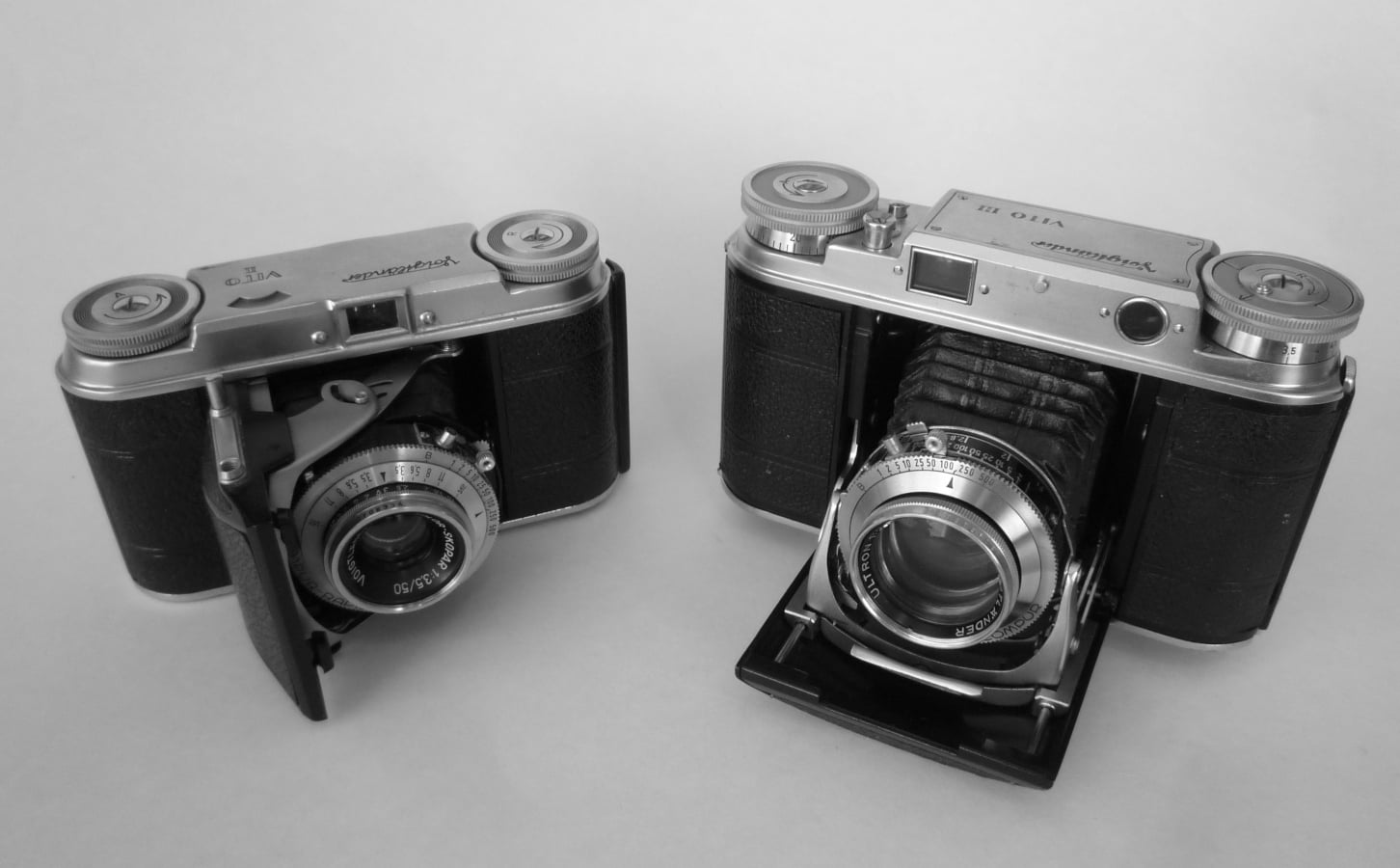
 The Vito III was a contemporary of Kodak's Retina line and the last folding camera made by Voigtlander.  I was attracted to the Vito III by my previous long familiarity with its model II predecessor.

Vito II and Vito III

The five-element f/2 50mm lens is one of the finest produced by any maker in the 1950s.


Once the Synchro Compur shutter is cocked, the film advance knob and shutter release are easily accessed with the right hand.

Focusing is quick and easy on the left.

While the controls are quite logically laid out, having the viewfinder window to the right seems best suited to a user with a dominant left eye, and I find myself glancing at the camera back prior to making each shot to make sure I know the correct placement.  I suppose with enough use I would get used to that feature, but it has been a challenge given the left side location of virtually every other rangefinder camera I have used over the years.

LIke the Vito II the III lacks strap lugs; that seems of little consequence with the little Vito II, but the size and weight of the Vito III make a carrying strap seem like it would have been a good idea.

Quibbling aside, the confidence instilled by the Ultron easily motivates picture making with the Vito III.  Here are some pictures from a roll of Kentmere 400 recently put through the camera:


That's my T100 in the background.

The Mediterranean Conservatory at the Botanic Garden

Monsoon clouds over the Sandia Mountains

Saturday, June 29, 2024

The Stylus Epic

 I decided I really needed to put more film through my Olympus Stylus Epic so I loaded a roll of Kodak UltraMax 400 and carried the camera in my pocket for a week, with walks through Old Town and the UNM campus.

Dane Smith Hall


A lawn art statue representing the UNM Lobo mascot

I had not been on the campus in some time and it seemed a lot bigger than I remembered it.  I visit the Plaza Vieja in Albuquerque's Old Town at least weekly and it is much less of a challenge to my limited mobility. 


As usual on a Friday morning there was a long line of restored classic cars in front of the church.

1938 Chev

upholstery talk


All of the cars are ones I had seen and photographed before, except for the little blue Mercury Comet, perhaps the most modest model to carry the Mercury name; I think this was an early one.

The camera seems to work perfectly.  Its only issue is a small light leak, and a narrow stip of electrical tape easily deals with that.  The Stylus Epic is even smaller than the compact Infinity Stylus and the 4-element 2.8/35mm lens is a bit more sophisticated than the earlier mju's 3.5/35mm, though I don't see a significant difference in the quality of the pictures between the two.  I actually prefer the handling of the earlier Infinity Stylus, but it may be I am just more familiar with the older camera because I have put a lot of film through it over the last fifteen years.

Saturday, June 01, 2024

The Mamiya 6

 The Mamiya 6 meduim-format folding rangefinder camera was made over a period of fifty years with many model variations.  In spite of that long history, high quality construction and unique features it is curiously rare on web sites devoted to vintage cameras.

From the front the Mamiya 6 resembles other popular medium-format rangefinders of the same era such as the Zeiss Ikonta and the Soviet Iskra.  A top/rear view shows what sets the Mamiya apart from all others in its class.  The thumb wheel to the right adjusts focus by moving the film plane rather than the front lens standard. Also visible in the same view is the switch to the left which permits either 6x6 or 6x4.5 formats.  The flip-open ruby window only needs to be used to position the first frame; frame spacing from there on is automatic.


 The format switch changes the aspect ratio in the viewfinder and also releases the double exposure lock.  To actually ready the camera for either format, one opens the back, slides out the removable pressure plate and flips a couple barn doors to the appropriate position.  The 120 roll film can than be threaded through the exposed rails and the pressure plate slid back into taking position.

I have so far only shot one test roll with the camera in Albuquerque's Old Town.  Everything seems to be working perfectly.  The film was Fomapan 100 which I developed in Rodinal 1:50.  The  Olympus D. Zuiko 3.5/75mm lens performed well as expected.


An overview of the Mamiya 6 history and features can be found at the Camera-Wiki site.