Showing posts with label Pentax Spotmatic SP. Show all posts

Thursday, January 04, 2024

Time Flies

 The arrival of wintering Sandhill Cranes is usually heard before it is seen. Their strange, trilling calls carry for great distances in the winter blue sky. It is a sound that came from the sky a million years before the first humans appeared anywhere on the planet.

I have seen fewer cranes this year in the usual places I find them.  I attribute that to the fact than no corn was planted this year at the Los Poblanos Open Space. It took me a week of walking around the Open Space fields and through the riverside forest to get close enough for a few shots of the birds with my longest telephoto.


Wednesday, September 13, 2023

Portraits

 We awoke to heavy clouds and wet streets.  It seemed a perfect day to visit the Rio Grande Zoo with my Spotmatic and the 75-230mm Yashinon zoom.  The big old lens retains good sharpness even wide-open, but the lens' f/4.5 aperture and the not-too-bright screen of the SP makes finding the perfect focus point a challenge.  With the zoo animals always in motion, one is never sure if the decisive moment made it onto the film.  At the end of my visit I was really uncertain what my scans would reveal.  As I pulled out of the zoo's parking lot in my truck I switched on the radio, and there was Dave Brubeck playing Take Five !  I took it as a good omen.


Complaint

Pretender

Snack

Bird Watching

The cheetah insisted on color, so I switched to my little Lumix digital and posted the results on my other blog.

Wildlife photography really demands a good digital camera.  Even confined in the zoo, the subjects are always in motion.  Fast focus, auto-exposure, quick cycling, burst shooting and unlimited capacity greatly enhance the chances of catching the moments you want.  I'm thinking it is time I sell some of my little-used film cameras and invest in a digital to shoot at the zoo. (Also, the price of color film has gone way beyond what I am willing to pay.)

Sunday, April 24, 2022

Zoom at the Zoo

I have made pictures I like at the zoo with quite a variety of old film cameras.  In terms of productivity, the champ is my Pentax SP with the Yashica Auto Yashinon Zoom 1:4.5 f=75mm~230mm.  I've used the big old zoom for little else, but at the zoo where the subject distance is largely under control of the animals the zoom gets me the tight compositions that I am looking for.   The maximum 4.5 aperture provides a slightly dim image in the viewfinder; that, along with the limited depth of field at 230mm, makes focusing on moving targets challenging.  However, with proper focus and an adequate shutter speed the resolution of the lens leaves little to complain about.


Savannah Dreams


Matilda will be a year old on July 20th.


* * *
The Wikipedia page on the Hippo is worth a look:

... After the elephant and rhinoceros, the hippopotamus is the third-largest land mammal and is the heaviest extant land artiodactyl. Despite their physical resemblance to pigs and other terrestrial even-toed ungulates, the closest living relatives of the Hippopotamidae are cetaceans (whales, dolphins, porpoises, etc.), from which they diverged about 55 million years ago ...

Saturday, March 27, 2021

Like New

I decided to try some of the expired color film I recently acquired.  I am not usually optimistic about the chances of getting predictable results from old color film, but this Fuji 400 was only a few years past its expiration date and it had been in frozen storage.  I loaded the roll into my Spotmatic SP, made a few shots on a walk in the Sandia Mountains, and then finished up with a morning stroll around our neighborhood.


I processed the film in Cinestill C-41 for six minutes at 95C and can't see any issues with the pictures attributable to the film's age.  I have one more roll of the Fuji, and several of Kodak Gold which is considerably older, but it has also been properly stored.


No film test of course is complete without a picture of the cat.

Friday, July 24, 2020

Colores de Quarai

The Quarai site is close up to the south end of the Manzano Mountains, so it catches a little more rain than the other two Salinas Pueblo Missions as the clouds pile up against the mountains.  In mid-July there is a large amount of coyote gourd starting to produce gourds, and the groves of cottonwood and other trees provide a lot of welcome shade.  I suspect the trees were not a prominent feature of the landscape when the pueblo was still populated back in the 17th Century.  People who rely on wood for cooking and warmth cannot usually afford the luxury of ornamental shade trees.


Roxie enjoyed making a couple new friends, and she was especially well-behaved on the leash during our walk through the Quarai site.


This model of the Quarai Mission church and convent was constructed and restored quite a long time ago.  The architectural studies of the Salinas Pueblo Mission sites are also mostly quite old.  Given the present day availability of 3D drawing software it seems like it would be pretty easy to create much more interesting re-creations of the site.  Archaeologists have begun to use drones and 3D software to document sites and their excavation, but not so much for constructing 3D models of the complete structures.

ClipPix ETC

This interesting little cemetery chapel is in Punta de Agua just before the turnoff to Quarai.

Thursday, July 23, 2020

Colores de Abó


I shot part of a roll of Fuji 200 in my Pentax Spotmatic at the Abó ruins in the morning and finished it off at Quarai in the afternoon.  Knowing that my C-41 kit was pretty anemic at this point I decided to drop off the film for processing on the way home at the one place in town that still develops color film.

I was a little surprised to find the the local lab's results had all the same deficits as I have been seeing in my own C-41 results at home.  The negatives looked to be one or two stops under-done, and there were quite a few white spots to be stamped out in Photoshop, along with some red stains bleeding in from the spaces between frames.

The Unicolor and Cinestill C-41 kits I use are out of stock at all the on-line sites I have looked at, and that seems to be expected to persist until the Fall.  I have poked around on the net to get some insight on the shortages and quality issues, but have not come up with any explanations.

* * *

Two more from the Abó site.  The little Vivitar Ultra Wide and Slim does a nice job of blending the subject and its environment.


Sunday, April 19, 2020

El Malpais

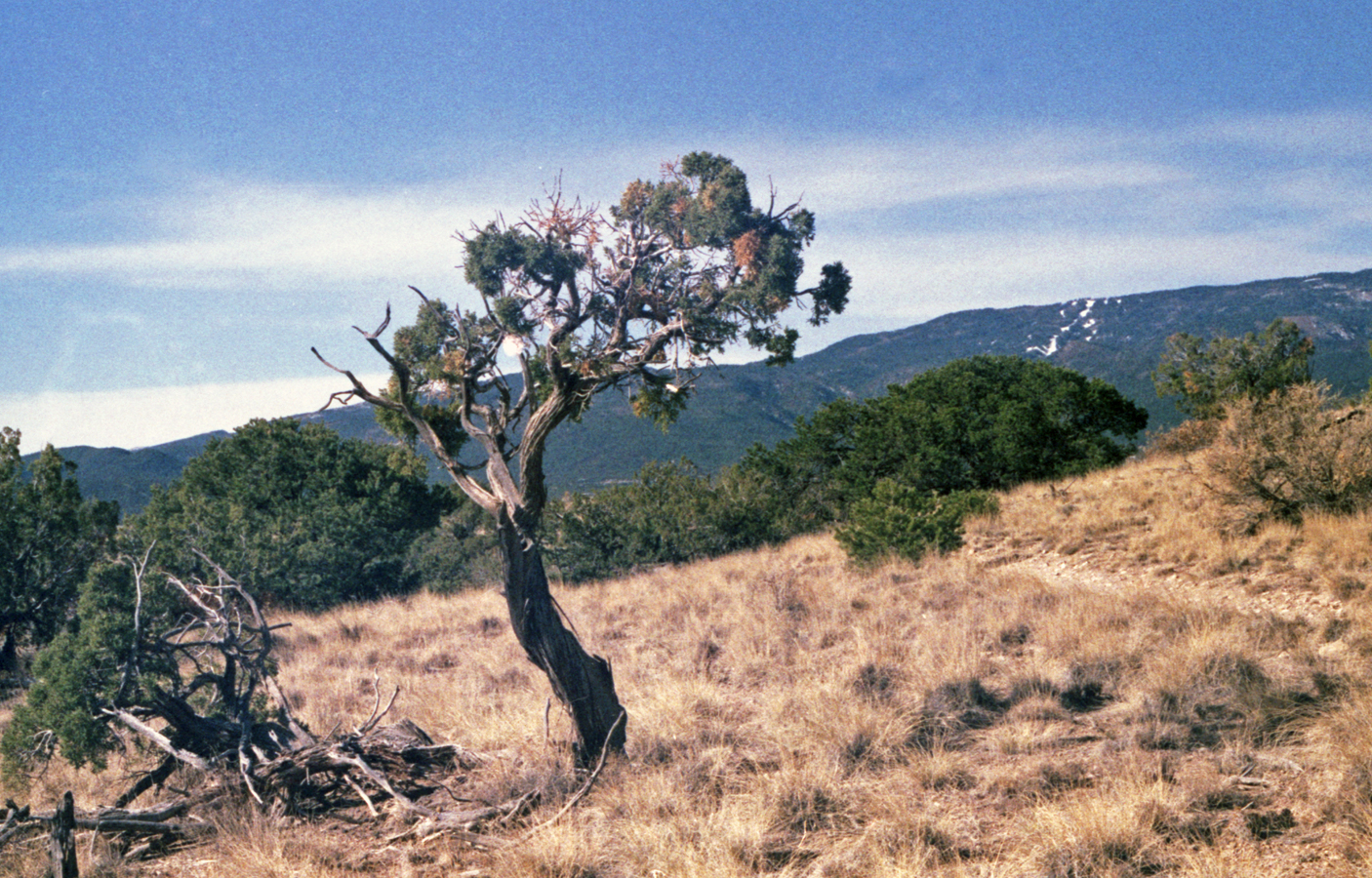
We decided we needed a bit of an escape from the city, so we drove a hour west from Albuquerque to Grants and then turned south into the Malpais National Conservation Area.  The campgrounds and picnic areas are closed, but the hiking trails remain accessible.  We parked at the Zuni-Acoma trailhead and walked for a couple hours through a landscape of volcanic flows, sandstone bluffs and  twisted old junipers.


Saturday, June 01, 2019

black and white

I'm liking my initial results from Arista.Edu Ultra 100, though I think can do better with some adjustments in exposure and processing.


Tuesday, April 16, 2019

Saguaro

We spent a couple days in Tucson.  It seems to have a dynamic economy and it makes Albuquerque look rather shabby by comparison.  Margaret commented that Tucson seemed like another country.  The highpoint for me, as is often true, was the nearby wilderness areas.  We enjoyed a sunny morning visit to the west portion of the Saguaro National Park.


I have always enjoyed the drive into Phoenix from the north because of the views of the saguaros there.  The saguaro forest just west of Tucson is something else again because of the density of the huge cacti which cover whole mountainsides.


"An adult saguaro is generally considered to be about 125 years of age. It may weigh 6 tons or more and be as tall as 50 feet. The average life span of a saguaro is probably 150 - 175 years of age. However, biologists believe that some plants may live over 200 years."
- from the NPS Web Site


There were a lot of blooming ocotillo cactus and a few wildflowers, but we were a bit too early to see the blossoming of the saguaro.  A day's visit was certainly too brief to explore the park with my camera.


Cholla

Nopal

Saguaro Carcass
My original plan for the trip was to carry two cameras, the meterless H3v mounting my 24mm Takumar and the Spotmatic SP with the 135mm Mamiya-Sekor.  On the fourth frame through the H3v, the mirror jammed up against the rear lens group of the 24mm.  I should have known that would happen as the early H3v has the same problem with the Takumar 1.4.  Luckily, a bit of fiddling with the focus unjammed the camera and I was able to finish off that roll and another in the SP.