Showing posts with label No.3A Folding Pocket Kodak. Show all posts

Thursday, November 03, 2022

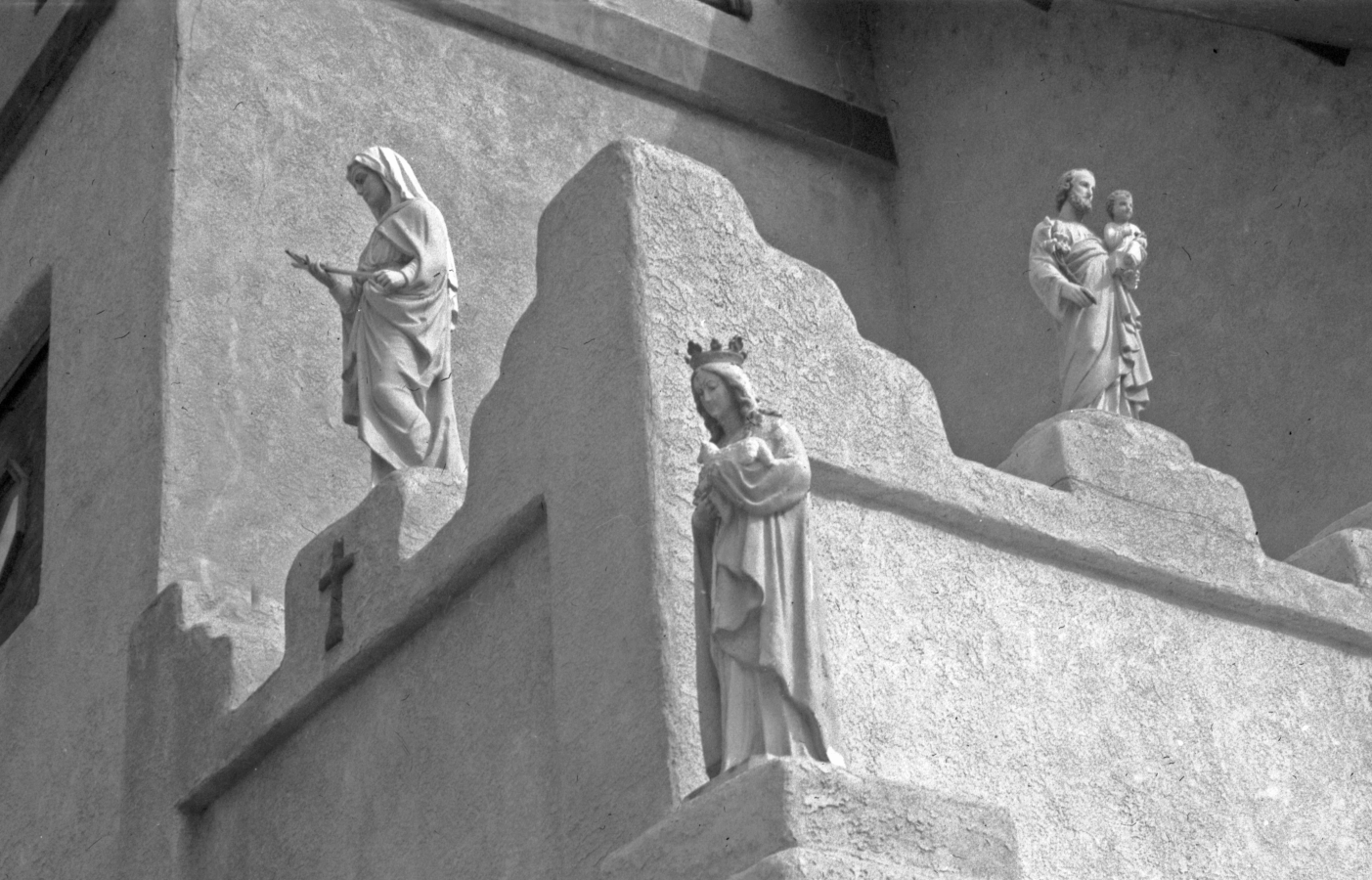
San Ignacio

 I took two cameras to photograph the interesting little San Ignacio church about a mile from our home.

The No.3A Folding Pocket Kodak was again loaded with a sheet of postcard-size photo paper.  I made an eight second exposure at f64 under a lightly overcast sky.  I developed the paper negative in HC110b, stopped in some water with a little vinegar and fixed for about five minutes.


I also shot a roll of Fomapan 400 in my Bentzin Primar Folder.  I was pleased with the results from the film and the sharpness obtained from the Meyer Gorlitz Trioplan lens.  However, the open frame viewfinder on the folder will need some adjustment so that it more closely shows what will end up on the film.



Update
*********************
I have made some small changes to the images in this post, increasing the contrast slightly.  I recently got my old Dell XP computer running again, so am getting back to using my preferred CS2 and Silverfast programs.  I have also made an effort to better match the screens on my Windows and MAC computers. 

Tuesday, October 18, 2022

The Rip Van Winkle of My Collection

This folding camera has been sitting on a shelf since it was given to me about fifteen years ago.  It is a No.3A Folding Pocket Kodak; this model was built from 1903 to 1915.

Although the covering over the aluminum body is in poor shape the bellows had only a couple small holes requiring repair.  The shutter works well and the lens, a Bausch & Lomb Rapid Rectilinear, is clear except for a little separation at the outer edge.

The swiveling reflex viewfinder flips the image horizontally, but it is big and bright compared to those on later Kodaks.

The "Pocket" part of the camera's name is a little over-optimistic as folded up it measures 9½ x 4¾ x 2 inches.

The Kodak Automatic Shutter is self cocking and features speeds from one second to 1/100 plus B and T; it is actuated by a lever or by a pneumatic bulb remote.  Aperture sizes using the Universal System are marked 4,8,16,32,64 and 128.  Those values translate to the current conventional f-stop values of 8,11,16,22,32,and 64.

The most immediate impediment to making pictures with a working 3A Kodak these days is the unavailability of 122 roll film which Kodak stopped making about fifty years ago.  It is possible to use simple spacers to fit still available 120 film, but that will not produce the 3¼×5½ inch postcard-size images the camera was designed for. I decided to go for the one-shot alternative of making paper negatives with a piece of photo paper cut to postcard size.

120 vs. 122

Since cutting of the light-sensitive photo paper and negative processing must be done in the dark, some sort of darkroom is a requisite.  The 4' x 4' floor space of my bathroom seemed not a good candidate, but fellow film photographer and craftsman extraordinaire, Bob Eggers, offered the use of his nicely equipped laundry/darkroom.

In fact, Bob took care of the paper cutting and negative processing, and I really only had to load the preflashed paper in the camera, set the aperture to 16, aim at my favorite subject and press the shutter release for about two seconds.

Voila !

Bob sandwiched the exposed paper with an unexposed piece in a contact frame and exposed it briefly under the light of his enlarger.  Then it was a nice experience to watch the image slowly appear in the developing tray, something I hadn't seen happen in fifty years.  The process was repeated on the spot to produce a positive pint.

Not my best portrait of Margaret, but a fine reawakening for my old 3A Kodak.


-------------------------
Update
I turns out that a camera like my 3A Kodak was part of the Shackleton expedition to the Antarctic.  The story was pieced together in the Flickr photostream of SBA73.

Tuesday, November 22, 2016

Jack London's Camera

A friend picked up this camera at a yard sale in Truth or Consequences, NM some years ago and gave it to me.


The No. 3-A Folding Pocket Kodak was made from about 1903 to 1915.  It was pretty close to state-of-the-art with a shutter going up to 1/100 and a two-element Rapid Rectilinear lens.  The camera produced a postcard-sized negative on 122 roll film.  In the picture below, the 122 reel is on the left.  Next to that in order is a 116 reel from my 1-A Special, a 120 reel and a 35mm cartridge.


Now, I'm pretty sure that the camera in my possession is not Jack's because the last patent number inside the back is 1909.  However, it does appear to be the same or very similar to the camera London can be seen holding in a picture that appeared today in the NY Times Lens blog.  The picture was snapped in 1904 while London was in the process of being arrested by Japanese military authorities for taking unauthorized pictures during the Russo-Japanese War.


While the details are a little hard to discern, you can see in a zoomed-in view that there are great similarities to my No. 3-A, including the rounded form, the two slim struts at the front which hold the lens board, and the pneumatic bulb shutter release which juts down to the left from the camera's front.  There is also the possibility that London's camera is the slightly smaller No. 3 Kodak which used 118 film, based on a comparison of the camera's length to the length of London's right hand.  My 3-A model is 9.5 inches long which seems to me a little more than the camera London holds.


My own No. 3-A would need a little restoration work before it could make pictures.  It has a small tear in the bellows.  The lens is clear and the shutter seems to work well.  The 122 roll film for the No. 3-A has not been available for many decades, but adaptations for shooting still-available 120 roll film are not terribly difficult.  I'm thinking maybe I should give it a try.