Showing posts with label Ansco Panda. Show all posts

Monday, May 20, 2019

Museum Car Show

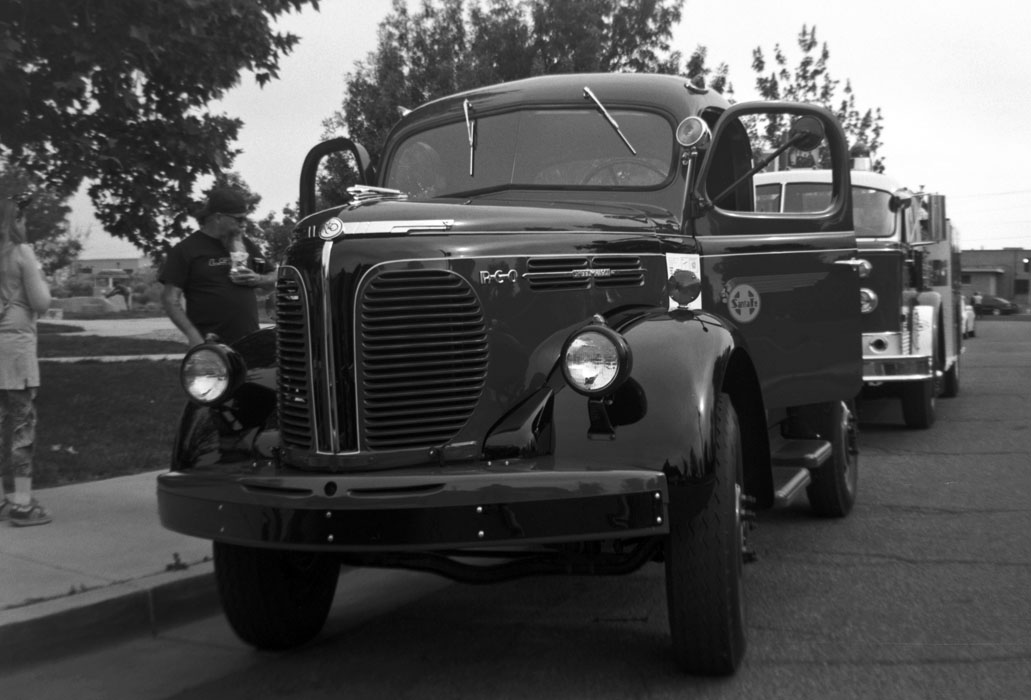
I took two cameras to photograph the yearly Albuquerque Museum car show.   First up was the Ansco Panda, my favorite box camera.  My plan was to use Fuji Acros in the camera, but the sky was overcast, so TMAX 400 seemed the better choice.  (Click the images to view full size.)


The Panda seems to me to be the perfect camera for shooting car shows.  It is small enough to stuff in a jacket pocket and the camera's short focal length provides a wide angle perspective I like.  Having to re-roll 120 film onto the 620 reels needed by the Panda is only a minor inconvenience.

Thursday, March 09, 2017

Feeding the Panda

TMAX 100 is a film I have often shot in my box cameras, but it has been on back order for quite a long time at the places I usually go to get it.  I had one roll of 120 TMAX left in the refrigerator which I decided to shoot in my Ansco Panda.  I re-rolled the film onto a 620 reel and took a stroll by the Tingley Ponds with the Panda.  I'm wondering now if that was the last roll of this Kodak film that will see the inside of one of my old cameras.


The little Panda is my favorite box camera.  I think it would likely find more favor among today's remaining film shooters if it did not require re-rolling 120 film onto 620 reels.  That is not a very difficult or time-consuming process, but it seems enough to discourage a lot of potential users.

At first glance, it is difficult to understand why Ansco would choose a unique Kodak film format for any of its cameras as the company had its own film producing capability.  It seems very likely that the film format selection was tied to the fact that Ansco had merged with the German Agfa company in 1928 and the conglomerate's U.S.-based operations were seized in 1941 by the U.S. government and held as an enemy asset into the 1960s.  So, the decision process at the time of the Panda's appearance in 1946 was under the direction of government-appointed overseers who quite probably had a cozy relationship with Kodak which had many government war production contracts at the time.

Wednesday, January 07, 2015

xpro

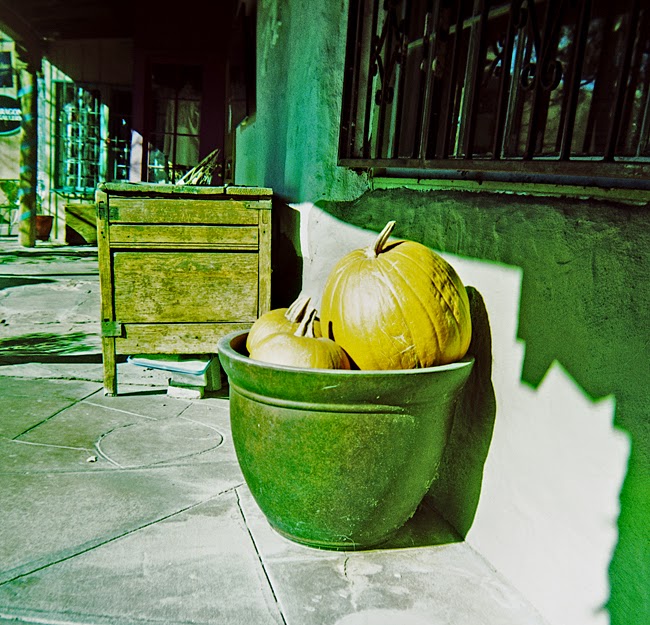
A local pro gone digital gave me a big bunch of film about five years ago.  I used up most of it except for a couple rolls of Provia slide film which I chucked in the bottom drawer of my refrigerator.  Since I've started doing my own color recently, it seemed like the time had come to try cross processing the Provia.


I loaded the film in my Ansco Panda and shot up the roll between my place and the Old Town Plaza.


The outdoor shots were all over-exposed and green tinged.  The indoor shots showed much less of a color shift.  I'm not a big fan of cross processing, but it was an interesting experiment.  I might just try the remaining roll of Provia for some interior or night shots.

Sunday, July 27, 2014

Shooting Pandas

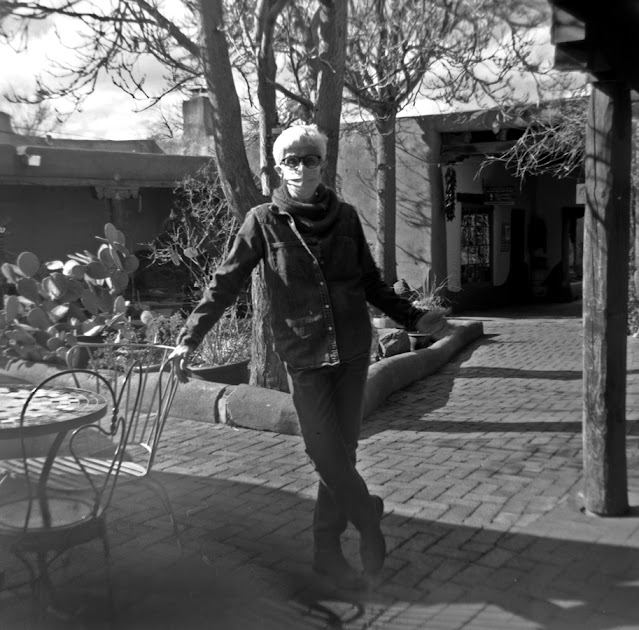
I loaded some Fuji Acros into my Ansco Panda and got out early enough two days in a row to take advantage of the morning light.


Because box cameras offer no possibility of any adjustments to accommodate light conditions, I think they tend to make the photographer more attentive to the existing nuances of light and shadow.  With a box camera in hand, I find myself looking more for instances of the play of light and shadow that brings out the character of the subject.  The central sharpness of the box camera's meniscus lens and the blurred periphery also help to emphasize the central subject matter.  The Panda provides a unique wide-angle perspective which is not available in any other box camera that I am aware of.


Wednesday, December 04, 2013

Ojito

I had a fine walk yesterday in the Ojito Wilderness about forty minutes north of Albuquerque.


Tuesday, January 22, 2013

Piedras Marcadas

Warmer weather in Albuquerque prompted me to ride over to the Piedras Marcadas section of the Petroglyph National Monument.


The rock art along the volcanic ridge west of town is mostly in the Rio Grande style from the Pueblo IV period, spanning the 14th to the 17th Centuries.  At that time the Puebloan people were abandoning the big ceremonial centers like Chaco Canyon in the Four Corners region.  They concentrated along the Rio Grande valley in large agricultural settlements and the rock art reflected the flourishing of the Kachina cults.  Images of horses show that the period overlapped the Spanish invasion.

Saturday, January 19, 2013

Cold Snaps


We had a week of very low temps in Albuquerque.  Margaret decided we needed to get over to the Tingley Beach ponds to feed the ducks and geese.  It is always a bit of a challenge to get by the pair of big geese that dominate the shoreline.

It seems to me that the central third of the image produced by the Panda's simple lens is about as sharp as most of my multi-element lenses.  By achieving the proper relationship in the composition between foreground and background it is possible to achieve images which are hard to distinguish from those made by much more sophisticated cameras.

The other key elements to success with the Panda are making sure the lighting conditions match the exposure latitude of the film in the camera, and to keep the camera steady while making the exposure.  With some care you can brace the camera adequately by putting the string lanyard around your neck and pushing down on the camera while bracing it against your body.  When possible, bracing the camera solidly against some stable support is even better.  The shutter action on the Panda is quite a bit smoother than most simple box cameras, and it does seem a bit snappier too, though probably not quite up to a fiftieth of a second.

Friday, January 18, 2013

Winter Break


With few people on campus during the holidays it was a nice opportunity to walk around and focus on forms, spaces, stairways and passages as they were envisioned by the architects and builders.

The Ansco Panda is not the camera of choice for classic architectural work.  The single-element meniscus lens produces blurry borders and shows quite a lot of pincushion distortion.  Still, I think those faults can be turned to features with a bit of thought and some judicious cropping if need be.