Showing posts with label Kodak Brownie Hawkeye Flash. Show all posts

Friday, February 04, 2022

Brownies

We had a couple inches of snow overnight in Albuquerque.  It seemed like a good excuse to make some pictures for February's International Brownie Camera Days.  I found one more roll of Acros in the refrigerator, rolled it onto a 620 reel and loaded it into my Brownie Hawkeye Flash.  I shot half the roll on a walk around the neighborhood, and finished it off with some shots of Roxie in the yard using the No.13 close-up attachment.


I'll try to get out with a couple more of my Brownies in the remainder of February.
(February is also Black History Month.)

Sunday, January 16, 2022

Cat Interrupted

 The modular construction of the Kodak Brownie Hawkeye Flash makes it easy to disassemble for cleaning or modification.  The easiest and most common mod is to reverse the lens front-to-back.  With the lens unmodified, the minimum distance for sharp focus is about eight feet. Flipping the lens brings the minimum for sharp focus down to about 3.5 feet.  However, only the center of the image will be seen to be sharply rendered, while the periphery becomes progressively blurred.

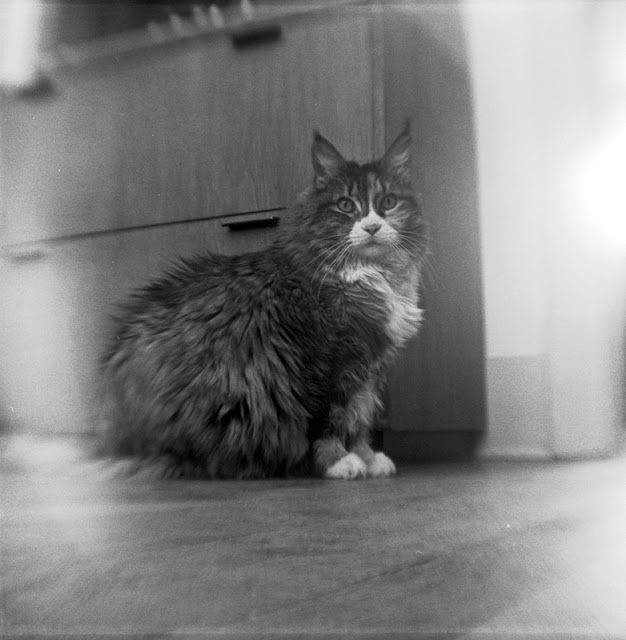
I loaded a roll of slightly expired Tri-X into my Brownie Hawkeye Flash and made twelve exposures in the house in about five minutes.  Because of the low light I set the camera to use the shutter's time mode to permit an exposure of an estimated one second; the camera was braced solidly on the floor to avoid camera movement.  The first shot caught Ruthie, my cat, unawares at her water bowl.  She was a bit irritated with that intrusion and threatened to leave the room.  I apologized, convincing her to stay, and she composed herself and assumed a more dignified pose.

In addition to the peripheral defocusing the flipped lens also seems to have an increased tendency to flare with back lighting.  

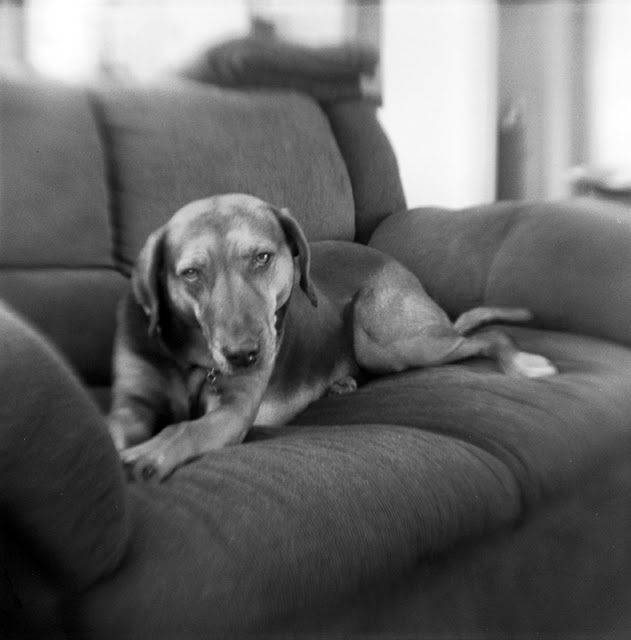
I took the camera into the living room and made a couple shots of Roxie with the camera braced on a chair .  Her skepticism about the process seems emphasized by the sharpness of the eye closest to the center of the image compared to the slight blur of eye closer to the edge. 

Friday, January 14, 2022

Walking the Dog

 I have made thousands of pictures with well over a hundred cameras, so no real need to make more.  However, I enjoy the process as much as the end product. I took along a Kodak Brownie Hawkeye Flash box camera yesterday while walking the dog.

The film was a roll of slightly expired Tri-X, developed in HC-110b.

Tuesday, May 18, 2021

Mesilla

We spent a few days visiting with friends and family in Las Cruces.  Our motel was close to the little town of Mesilla, so it just took a couple minutes to drive there on a Friday morning to visit the plaza and shoot a roll of film in my Brownie Hawkeye Flash.

The town clings tenaciously to its past; things change, but more slowly than in most places.  The economy is still closely attached to the land, and traveling south or west quickly brings visitors to fields of onions and vast pecan orchards irrigated only with ground water.  The Rio Grande is mostly dry long before it gets to Mesilla; the acequias that run through town contain only sand.


The Kodak Tri-X Pan Professional film I shot in Mesilla was rated at ISO 320; that would be a bit fast for a sunny day in the Brownie Hawkeye Flash, but it seemed like the twenty-seven years beyond the expiration date would likely have tempered the sensitivity of the film sufficiently to allow use in the old box camera.  I processed the film as recommended in the data sheet in the film box and I thought the results were pretty good.

Tuesday, March 10, 2020

Flipped

Kodak Brownie Hawkeye Flash with reversed lens.


Thursday, January 30, 2020

Our Lady of Mt. Carmel

I recently found this little chapel on the north side of Albuquerque along with a small cemetery across the street.  It seemed a good subject for my Brownie Hawkeye Flash.


     Muestra de muerte, 
     espíritu de vida,
     aquí cuerpo yace,
     con su alma ida.
         - Nasario García

I see I am a bit out of practice with my box brownie.  You really can't get closer than eight feet with the unmodified camera.  With the No.13 close-up attachment the minimum distance is down to 3.5 feet.  I tried a yellow filter on a couple shots, but that gave me a bit too much contrast for the Acros which I processed in Rodinal 1:50.  Still, the effort seemed a useful exercise.  I think I'll go back with my BHF that has the lens flipped, and maybe try some fp4.

Monday, March 04, 2019

Goodbye to Old Friends

Not these two.  They're in good shape and sticking around.


Those were the only shots I liked out of a roll of 12 shots from my Brownie Hawkeye Flash box camera.  The rest were shot outdoors in mostly sunny conditions, but they looked underexposed by one to three stops.  That is an unlikely outcome with any box camera loaded with 100-speed film as such conditions should actually result in slight overexposure.  

Here is the problem:


I'm not sure how long that bottle of Rodinal has been sitting in my refrigerator.  It could be six or eight years.  Acros and Rodinal has long been a favorite of mine for medium format work, but it looks like the end of the line for this combination.  Fuji has stopped making Acros.  I still have a few rolls left, but anything left out there is going to be prohibitively priced from here on in, and I'm going to move on.  I could get a replacement bottle of Rodinal easily enough, but I think I'm better off using a couple other developers that I like including PMK Pyro and HC-110, both of which also have good shelf life.

The reason the two portrait negatives were closer to appropriate density is that I braced the camera on a tripod and shot with a cable release with a best-guess exposure in the neighborhood of a quarter second.  So, the modified BHF got the job done well enough.

Once I've used up my last rolls of Acros I'll likely shoot TMAX 100 in my simple cameras most often.  There are plenty of other choices still available, though, so still some room for experimentation.

I find myself also dealing with some other changes in the way I handle film.  I recently refurbished an IMAC by cleaning it up and adding some memory.  The computer has a very nice 21-inch display and it seems about as fast and responsive as my laptops running Windows 7, Window 10 and Linux Mint.  I'm using the IMAC now for most of my on line activity, so that means I only have to turn on my old Windows XP desktop to scan negatives using PhotoShop and SilverFast.  Down the line I'll probably have to look for a scanner and some software compatible with the IMAC.  I'm currently taking a stab at learning to use the free GIMP photo editing program, but it has what seems like a nearly impenetrable user interface.  Such is life, I guess.

Tuesday, July 11, 2017

What's The World Coming To?

I found myself driving down Menaul close to noon so I decided to stop in at one of my favorite lunch spots.  I pulled my truck into a parking space in front of Blake's Lotaburger.


There was a good-sized crowd in the place, but nobody waiting at the counter.  I stepped up and ordered the usual:
     "Corn dog, small fries and a small drink."

Without a trace of emotion the counter person replied:
     "We don't have any corn dogs; they've been taken off the menu." 

I was stunned.  First Trump, now this.

Sunday, March 19, 2017

The Kodak Brownie Hawkeye Flash

I was given one of these cameras by my family when I was about twelve. It came in a Kodak yellow, black and red box along with a flash gun, a soft plastic shield for the reflector, and about a half-dozen big flashbulbs. I don't specifically recall any photos that I made with the camera; I'm sure they were quite forgettable as I was definitely not a photo prodigy. A half century later I've developed a few more skills as a photographer, and I've come to realize finally at this late date that the Hawkeye Flash was possibly the finest camera of its type ever produced.


The camera shared nearly all of its basic features with every other simple box camera from the preceding fifty years, but the design, construction, materials and functions represented the ultimate evolution of the box camera idea. The brilliant waist-level finder was one of the brightest put in a simple camera, the bakelite case was nearly indestructible, and the smooth, rounded form along with the gracefully fluted sides made the camera a pleasure to hold. The most superlative feature, though, was the extraordinary lens, a simple meniscus design. Somehow – in a way I certainly don't understand – the single lens which is located behind the camera's one-speed shutter is able to produce images of astounding sharpness.

El Paso


Dead Man's Curve
Kodak offered an unusually ample selection of accessories for the Hawkeye Flash. In addition to the plug-in flash gun, there were "Portra" close-up lenses and filters that could be pushed on over the black lens ring on the camera's front. The filters provided some control over tonal values that helped to darken skies and bring out cloud forms, or they could lighten foliage or enhance the complexion of people in the photos. The filters were also useful for giving a degree of control over exposure in a camera with no adjustment for aperture or shutter speed.
    The commonest close-up lens, the No. 13, allowed the photographer to get to within about 3.5 feet of the subject - ideal for portraits and other close studies. It has also been suggested that adding the close-up lens provided some correction of aberrations of the simple meniscus design of the main lens.
 

Margaret

The camera, while advanced in many ways, was not perfect. While it had a time release function activated by the slide opposite the shutter, there was no cable release to help avoid camera movement during a long exposure. There was also no tripod mounting receptacle. Probably the biggest weakness in the camera, however, was a rather stiff shutter which tended to jar the camera when released, causing a blurred image if extraordinary care was not exercised in bracing the camera against the body or some handy object. Of course, it is not terribly difficult to rig up some kind of jury-rig tripod mount.   A few people with good DIY skills have added cable release and tripod sockets to their Hawkeye Flash cameras.  If you are not the handy type, Randy Smith of Holgamods can add the cable release and tripod socket to your Hawkeye Flash, as well as providing a number of other functional and cosmetic enhancements to the camera.


Chase Bank Building, Phoenix
Another irritant for Hawkeye Flash users is the fact that the camera was designed to use now-obsolete 620 film. Some of the Kodak post-war medium format cameras simply cannot be adapted to using the still-available 120 film rolls without extraordinary modifications, or re-rolling of the film onto 620 reels. Fortunately, that is not the case with the Hawkeye Flash; most you will find in junk shops and on ebay will contain a 620 spool which can be placed in the take-up position. Usually, you can just insert a roll of 120 film in the supply side, thread it into the 620 spool on the take-up, and you are ready to shoot. Occasionally, some cameras will be a bit tight for a 120 roll on the supply side, but this is easily remedied with some sharp nail scissors or clippers to trim down the spool ends flush with the backing paper.

Forrester Ave., Albuquerque
The Hawkeye Flash is such a sturdy camera that you may be able to use if straight-away, but most are going to require a little cleaning to restore complete functionality. The only tool required is a phillips-head screwdriver. There is a possibility that the bakelite screw holes will be stripped of their threads in the process, but a little glue on the screws will fix that when it is time to reassemble the camera.
    It is not usually necessary to remove the screws on either side of the top viewing screen; they are hard to take out and will probably be hard to put back. Just take out the screws above and below the lens ring on the front. Then, carefully lift the silver panel and remove the glass lens protector, the plastic retainer mount, and the front viewfinder lens for cleaning. You can reach in to clean the underside of the top viewfinder lens with a cotton swab.
    The camera's lens and the shutter are accessed from inside the camera back. Remove the two phillips-head screws, take out the film holding frame and remove the lens and spring washer for cleaning. It might be a good idea to swab a little lighter fluid on the shutter mechanism at the same time. Be sure to replace the lens and washer in the proper order and orientation, and take care to properly seat the film holding frame. That's about it. Your camera is good for another fifty years, and maybe a couple more owners.


Some Hawkeye Flash Links:

Tuesday, October 23, 2012

Rotary Shutters

Becoming familiar with the operation of the Univex Mercury II got me looking into the history of the rotary shutter in photography.  It is a shutter type that has been common since photography's very early days and there is a lot on the web about it.  I'm just going to summarize some of my more interesting web finds here with links to the sources.

Most box cameras are equipped with rotary shutters; they are simple and extremely reliable, and give an exposure time of 1/30-1/60 second.  Here is an illustration of the shutter in my Kodak Brownie Hawkeye Flash; the shutter is held open with the "B" setting to give a clear view of the parts.


The round black hole is the aperture allowing light into the lens. When the shutter release is activated, the cover paddle is lifted and the kidney-shaped opening in the circular shutter plate rotates past the aperture, with the time of its passage being determined by the spring tension and the length of the kidney-shaped hole. At the end of the cycle, the paddle flips back down to cover the opening and the shutter disk rotates back to the starting position.

I picked up an old windup Kodak motion picture camera in the 1960s.  Even though it was about 30 years old when I got it, the camera ran very smoothly.  I didn't give the mechanics of it much thought at the time, but it very likely had a rotary shutter like all the mechanical movie cameras of the time.


The rotating shutter mechanism in a modern sound-synched movie camera is usually a half circle set to operate at 24 frames per second and giving an exposure to each frame of about 1/50 second.  The purpose of this timing is not only to achieve the correct exposure, but also to yield the illusion of smooth, natural movement when the images are projected.  The animated gif below from Wikipedia illustrates the action of the motion picture shutter; the film is advanced one frame during the closed phase of each rotation.

Joram van Hartingsveldt
Perhaps inspired by motion picture technology, Heinz Kilfitt designed the Robot, a 35 mm motorized-advance still camera  in about 1930.  A very nice article about this long-lived precision camera is at the Dieselpunks  site.


By locating the shutter just behind the lens, Kilfitt was able to achieve a very compact camera design that gave a relatively large, square image measuring 24x24 mm.


"The rotary shutter and the film drive are like those used in cine cameras. When the shutter release is pressed, a light-blocking shield lifts and the shutter disc rotates a full turn exposing the film through its open sector; when the pressure is released the light-blocking shield returns to its position behind the lens, and the spring motor advances the film and recocks the shutter. This is almost instantaneous. With practice a photographer could take 4 or 5 pictures a second. Each winding of the spring motor was good for about 25 pictures, half a roll of film. Shutter speed was determined by spring tension and mechanical delay since the exposure sector was fixed. The Robot I had an exposure range of 1 to 1/500 s plus the usual provision for time exposures."

The rotary shutter reached an apex of sophistication in 1963 when Olympus introduced the Olympus-Pen F, a half-frame single lens reflex design by Yoshihisa Maitani. 

Wikipedia
It seems remarkable that Maitani could fit a focal plane rotary shutter and a Poro prism slr viewfinder into a camera of such diminutive size.  Much of the success of the effort was due to the development of an exceedingly thin and lightweight titanium shutter disk which allowed a top speed  of 1/500 second.

U.S. Patent Office

In some ways the Universal Camera Corporation Mercury camera was even more remarkable than the earlier Robot and the later Pen F.  The large diameter focal plane shutter devised by George Kende was extremely robust and accurate, achieving a reliable top speed of 1/1000 second.  The relative simplicity of the shutter design facilitated low-cost construction and made the Mercury much more likely to be successfully repaired and renovated by the DIY enthusiast.

U.S. Patent Office
The shutter in my Mercury II was sluggish when I received it.  A little lighter fluid applied with a small brush was all that was needed to bring it back to life, and the resultant pictures show it to be operating as designed.