Showing posts with label Albuquerque Art Museum. Show all posts

Wednesday, August 05, 2026

Transformations

This image is from a broken glass plate negative made at Cobb's Studio in Albuquerque in 1916,  The Albuquerque Museum's Archivist, Jill Hartke, included it in an exhibit about the various kinds of damage which are sustained by these old glass plate negatives over the years.  In this case she carefully assembled the broken pieces and scanned the result.

As Hartke notes in a Youtube video about the damage to this image and others that were scanned for the show, the damage actually produces something new and interesting beyond what might have been present in the original negative.  I think what she may have had in mind was the Zen-inspired idea of Wabi-Sabi or Kintsugi.  

As explained in Wikipedia, 

 This traditional Japanese art is called Kintsugi (golden joinery) or kintsukuroi (golden repair). Artisans mend broken ceramic pieces using a natural tree-sap lacquer dusted or mixed with powdered gold, silver, or platinum. Rather than hiding the damage, the method highlights the cracks to treat breakage as a proud part of the object's history.

 I'm comfortable with that idea, but I was also curious about what AI tools might be available to restore damaged images to something close to how they originally appeared.

A quick search turned up ai.nero.com/photo-restore, and a few minutes work produced several levels of restoration:


I thought the free-trial AI program did a pretty good job of what it was asked to do.  Definitely not Wabi-Sabi, but I suspect there are AI tools available which could get much closer to the kind of subtle refinements consistent with the ancient tradition.  

Sunday, May 10, 2026

A Bright Future

 I look always look forward to this yearly exhibition at the Albuquerque Museum.  It is a delight to see what excellent photographic work is being done by these high school students, and this 2026 show may be the best yet.


 The compositions were uniformly sophisticated and the execution to the final prints was near faultless.  I especially liked this imaginative panoramic collage by Ava Greenwood, Cibola HS, Grade 11.


 The exhibition was divided into "Digital" and "Non Digital".


I was not surprised when I overheard a visitor ask "What is Non-Digital?".   Was this referring to digital as opposed to film-based analog photography?  Does the Non-Digital term include the reproduction of the image using traditional or alternative printing methods such as cyanotypes?

My only complaint about the Focus On Youth project is that there is little in the way of explanation of the instructional and technical processes that contribute to the success of this excellent annual show.  It would be nice to see that kind of additional information included in a thorough online presentation. 

------------------

UPDATE

The monthly Third Thurday event will feature the Focus on Youth exhibition. 

Saturday, June 01, 2024

The Mamiya 6

 The Mamiya 6 meduim-format folding rangefinder camera was made over a period of fifty years with many model variations.  In spite of that long history, high quality construction and unique features it is curiously rare on web sites devoted to vintage cameras.

From the front the Mamiya 6 resembles other popular medium-format rangefinders of the same era such as the Zeiss Ikonta and the Soviet Iskra.  A top/rear view shows what sets the Mamiya apart from all others in its class.  The thumb wheel to the right adjusts focus by moving the film plane rather than the front lens standard. Also visible in the same view is the switch to the left which permits either 6x6 or 6x4.5 formats.  The flip-open ruby window only needs to be used to position the first frame; frame spacing from there on is automatic.


 The format switch changes the aspect ratio in the viewfinder and also releases the double exposure lock.  To actually ready the camera for either format, one opens the back, slides out the removable pressure plate and flips a couple barn doors to the appropriate position.  The 120 roll film can than be threaded through the exposed rails and the pressure plate slid back into taking position.

I have so far only shot one test roll with the camera in Albuquerque's Old Town.  Everything seems to be working perfectly.  The film was Fomapan 100 which I developed in Rodinal 1:50.  The  Olympus D. Zuiko 3.5/75mm lens performed well as expected.


An overview of the Mamiya 6 history and features can be found at the Camera-Wiki site.

Sunday, March 10, 2024

Some Black & White from the Pentax ME

 I walked around the neighborhood with my Pentax ME loaded with a roll of Kentmere 400, and then revisited the current exhibition of Canadian Indigenous Art at the Art Museum.


I was pleased to get some usable images of the masks on film given the dim light in the Museum.
 

The black & white worked well for the shot of the visitors, but the masks really needed color.  Luckily, I had my little Canon digital in my pocket, so I made shots of the indigenous art collection with that camera, and they are posted on my other blog.

Thursday, March 16, 2023

Danny Lyon at the Albuquerque Museum

 The Albuquerque Museum has brought a lot of great exhibits to the city in the years we have lived here.  Journey West: Danny Lyon is the best yet. Lyon has had a home in New Mexico since 1970 and many of the pictures are from that period of his career, but the show is really a retrospective including images from throughout his long life as a photographer and film maker.  The museum's publicity picture for the exhibit is a good example of his content-rich, empathetic and action-packed style.

For the featured exhibits the museum always offers some free 5x8-inch reproductions for people to take, so I brought home five from the Lyon show including his best known, Crossing the Ohio River, Louisville, Kentucky (1960). 

Seeing that rider looking back over his shoulder always brings to mind García Lorca's Canción de Jinete (Rider's Song).

  Córdoba.
  Lejana y sola.

  Jaca negra, luna grande,
  y aceitunas en mi alforja.
  Aunque sepa los caminos
  yo nunca llegaré a Córdoba.

  Por el llano, por el viento,
  jaca negra, luna roja.
  La muerte me está mirando
  desde las torres de Córdoba.

  ¡Ay qué camino tan largo!
  ¡Ay mi jaca valerosa!
  ¡Ay que la muerte me espera,
  antes de llegar a Córdoba.

  Córdoba.
  Lejana y sola.

***************

  Córdoba.
  Far away and alone.

  Black pony, big moon,
  and olives in my saddle-bag.
  Although I know the roads
  I'll never reach Córdoba.

  Through the plain, through the wind.
  black pony, red moon.
  Death is looking at me
  from the towers of Córdoba.

  Ay! How long the road!
  Ay! My valiant pony!
  Ay! That death should wait me
  before I reach Córdoba.

  Córdoba.
  Far away and alone.

  (trans: Stephen Spender and J.L. Gili)

*******************

Danny Lyon's blog is Bleak Beauty.

An interview of Lyon by Susan Meiselas covers much of his career.

The Magnum interview.

Many examples of Lyon's work can be found at the International Center of Photography.

***************

The curators did a nice job of summarizing the exhibit at a presentation on opening day.  That is Danny and his wife, Nancy, in the front row.


***************
UPDATE:

I have visited the exhibit three times now.  I think it is a very good exhibit, but to fully appreciate Danny Lyon's work one really needs to see the pictures in the context of his complete photo essays as expressed in his books.  The pictures individually are good, but his work is pointed toward getting across often complex messages about society which need some concentrated attention and thoughtful consideration of details, themes and time frames.

Danny Lyon over the years has focused his attention and his art on marginalized groups.  He shows in detail how the members of such groups are dehumanized by the greater society.  His essays and books are calls to action.  For instance, in his book, Conversations with the Dead,  he shows that the correctional system of the U.S. is a continuation of the traditions of slavery and a system that reinforces and perpetuates the behaviors that it is supposedly designed to combat.

Tuesday, March 07, 2023

Venturing Out

 A weekend of fine weather prompted me to get out with my Vivitar Ultra Wide & Slim loaded with some well-expired Agfa APX 100.


To compensate for the age of the APX 100 I developed it in Rodinal 1:25 for a couple minutes over the recommended time.  The sunny morning park shots looked fine , but the dark interiors produced very thin negatives requiring some careful photoshopping.

Wednesday, October 26, 2022

5222

 I retrieved some Kodak Double-X(5222) of unknown age from my refrigerator drawer and shot it in my Olympus XA. I started the roll on a walk by the river and finished it up at the Albuquerque Art Museum where there was a landscape exhibit including some big camera obscura works by Shi Guorui.


I shot the roll at ASA100 and processed the film in hc110b for 6 minutes.  The negative density and the grain looked good, but the gray tones were kind of muddy.  I probably would have been better off shooting at box speed and allowing less time in the developer.  The real expert in 5222 is jon caradies who shoots that film almost exclusively and processes it in D-23.


My little Olympus XA has an excellent lens and it works fine in bright outside light, but the dim rangefinder makes low light shooting a frustrating experience.  

Wednesday, May 18, 2022

Time Travel

 After finishing the twelve black and white shots in the Argoflex Forty I made another circuit of the Albuquerque Museum car show with my Olympus Infinity Stylus (mju) loaded with Kodak Gold 200.  The little Olympus has a lot to recommend it for such events.  It is easily slipped in a pocket.  The 35mm lens is very sharp.  The auto-focus and auto-exposure seldom miss their mark.


The two-block walk back to my car found me two classics in the wild, a T-Bird and a Lotus.


Monday, May 16, 2022

The Show

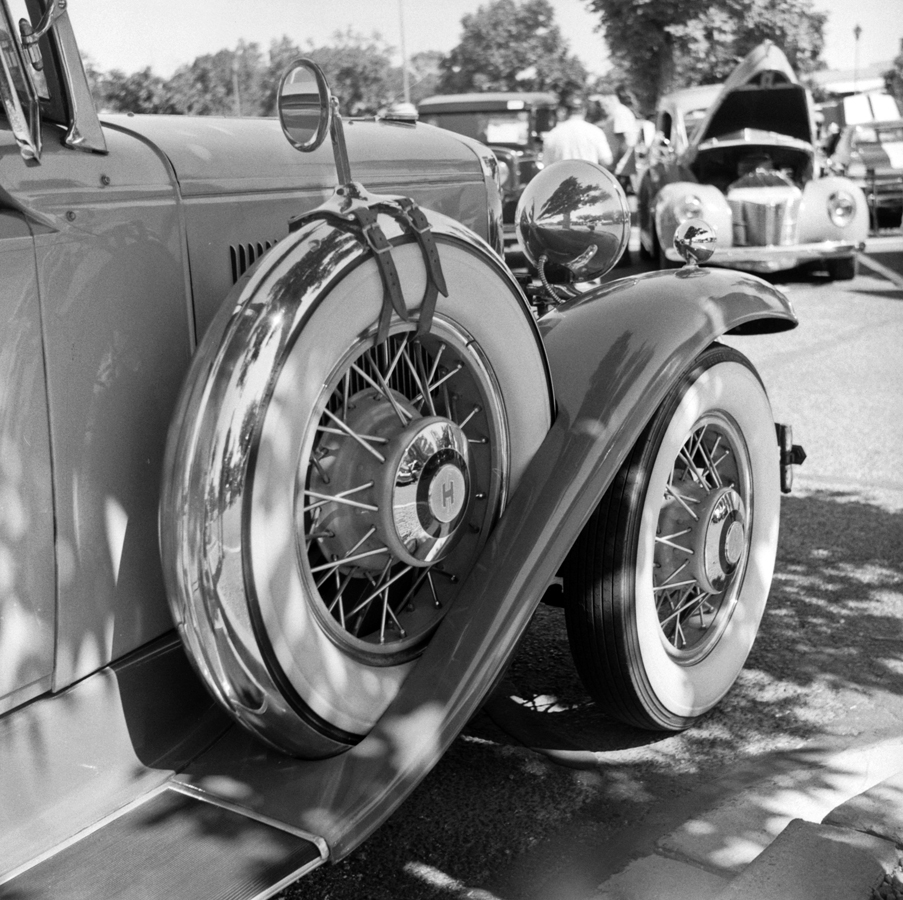
 On a Sunday in May the parking lot and the street in front of the Albuquerque Art Museum are populated by the automotive treasures of the area.  There are an equal number of opportunities and challenges for photographers at the event.  The sun is always very bright and it shines on acres of chrome, producing dazzling reflections interspersed with deep shadows.  The cars, probably around a couple hundred, are packed side by side in each parking lane.  The free show draws a big crowd and it is often difficult to get an unobstructed view of the cars.


I think I logged a couple miles up and down the lanes over a couple hours, so I was glad I chose my lightweight Argoflex Forty to make my pictures of the show.  Quite a few people asked me about the camera.  One fellow took a picture of me and the Argoflex.  Most seemed somewhat surprised to find it was still possible to make pictures with such an instrument.