Showing posts with label No.1A Pocket Kodak. Show all posts

Thursday, April 11, 2024

Historic Albuquerque

 I was at my usual place in front of the computer soon after sunrise when I noticed the nice light that illuminates our street this time of year.  I threw on some clothes and went out on the sidewalk with my No.1A Pocket Kodak and a tripod.  I made a couple shots on a roll of Fomapan 400 of the house across the street and a couple of our place as well.

The two story Henry Mann house was built in 1905.  When we first came to the neighborhood about fifteen years ago, the house was surrounded by about an acre of garden space.  About half of that area is now occupied by three concrete block houses that don't have nearly the character of their old neighbor.

Our little house on the opposite corner was originally a four-room bungalow with a screen porch in front.  It was built about one hundred years ago.  Sometime along the way the porch was incorporated to enlarge the living room, and another flat-roofed section was added to the back to provide a separate kitchen and another small bedroom.

Saturday, June 17, 2023

Summer Shooting

One needs to get out early in the day now to find tolerable shooting conditions.  My walk around Tingley Ponds took me up close to noon and I only had the energy to snap one picture on Kentmere 400 in my No.1A Pocket Kodak.


I took an early morning walk around Old Town and managed to finish off the roll.


All the pictures were made at the minimum aperture of f45 and the maximum shutter speed of 1/50.  In spite of the camera's simplicity it always makes nicely sharp pictures as long as I use a tripod.  A couple adapter disks allow me to easily use 120 film to get images with a panoramic format.

Thursday, October 14, 2021

Using 120 Film in 116 Cameras

I have made quite a few pictures with my 116 cameras using 120 film with only minimal adaptations.  I loaded the 120 film roll into the cameras and rolled it onto the 116 reel, advancing 8 and one half turns to get to the first frame with the ruby window covered.  Two and a half turns between frames gets you five pictures from the 120 roll.  The process is particularly easy with the No. 1A Pocket Kodak because the boxy internal structure holds the feed reel in place with no need to directly engage the end disks of the reel.  Rolling the film onto the big 116 reel leaves the film edges exposed, so it is necessary to use a dark bag to open the camera, remove the reel and load the film onto the processing reel to go into the film developing tank.

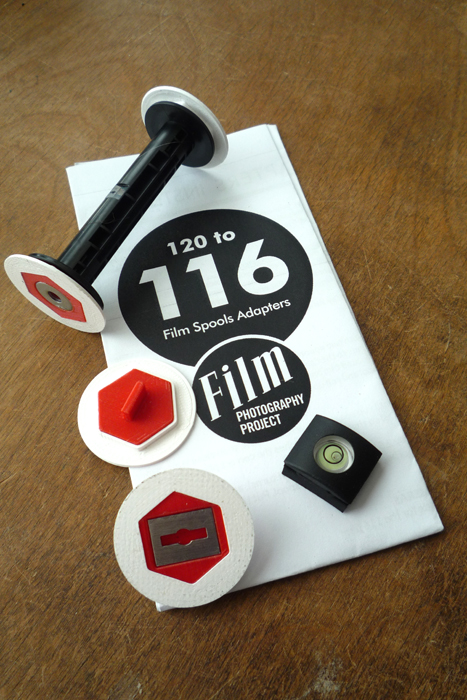
While this simplest procedure mostly works, a few glitches can degrade the results.  The film rolls onto the take-up reel rather loosely and it can drift sideways, causing some misalignment of the image on the film.  An easy fix for that problem is to acquire some 120 to 116 film adapters like the ones sold by the Film Photography Project.

The adapters allow a tight fit of the 120 roll of film into the camera as well as the use of a standard 120 take-up reel.  That solves the problem of film misalignment, and the spacers also produce sufficient tautness on the film to help keep the film flat at the film plane.  The red adapter disks from the kit can be used alone to hold the film reels, but I found it helpful to insert them into the white holders to facilitate positioning the reels in the camera.  The tabs on adapters are a loose fit in the reel slots, so I put a small bit of tape over the tabs to keep them on while inserting them into the camera.

I found the small bubble level on ebay for just a few dollars.  Since the old folders have no accessory holders I just attached the level to the top deck of the camera with a piece of double-sided tape.

I have not seen any problem with film flatness even without a 120 mask for the film plane.  It would be helpful to accurate composition though to make a mask for the viewfinder.

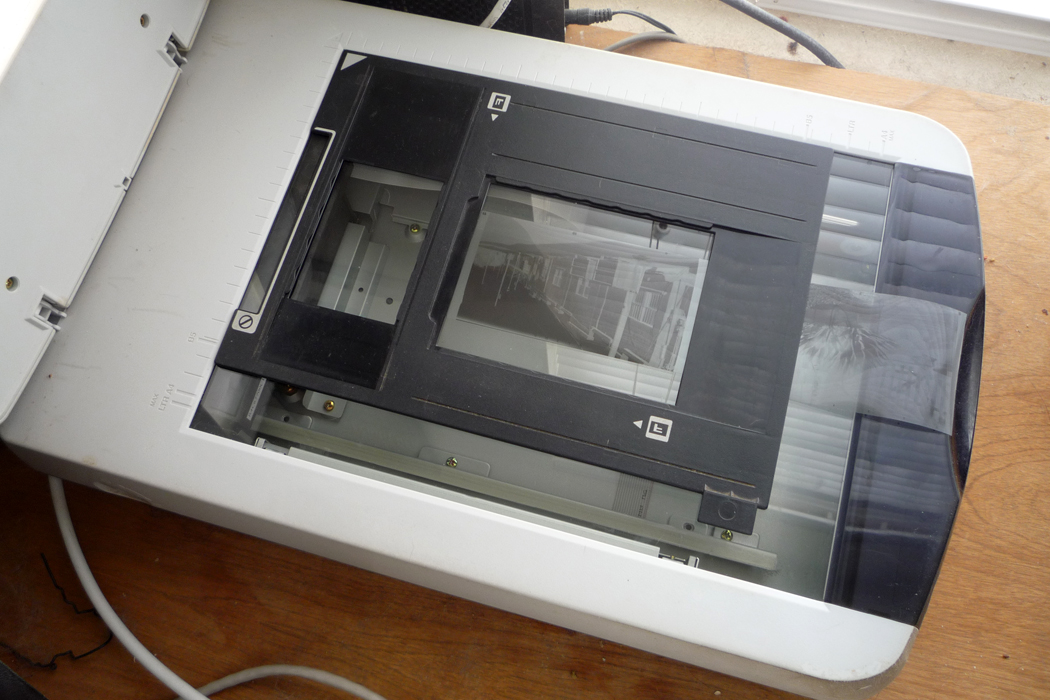
Scanning the long negatives can be a bit of a challenge.  My old Epson Perfection 2450 flatbed scanner has a film holder with a 4x5 frame, so I make use of that to hold the  negatives in place by placing them directly on the scanner's glass and laying the film holder on top of the film.  With the emulsion side of the film toward the glass, the upward curve of the film helps to avoid Newton rings on the scanned images.

I shot Fomapan 100 in my last outing with the 1A Pocket Kodak using a tripod and cable release to ensure steadiness.  Most exposures were at 1/25, with apertures of f22 or f32.  I developed the film semi-stand in Rodinal 1:100 for one hour.


Wednesday, August 04, 2021

A Walk in the Park

 I shot another roll of expired Tri-X in the No.1A Pocket Kodak on a morning walk through our nearby park.  My main objective was to test a strategy for correctly spacing the frames.  I decided after advancing the film by an initial eight and one half rotations to get to the first exposure I would then give two and one half turns to get to the second frame.  From there the plan was to decrease the film advance by one quarter turn for each subsequent frame with the hope of getting six or more shots on the roll of 120 film.


Well, the first two frames looked just right.  After that the pictures started to run into each other and I ended up with just muddled fragments of images on the rest of the roll.  Not the hoped for outcome, but it was a fun outing in which I learned something, and I thought the bits and pieces still showed some of the nice qualities which the Kodak Anastigmat lens can produce.


In addition to the frame spacing problem, I also ended up having to square up most of the images in Photoshop as a result of grossly tilted horizons.  For that, I'm blaming the use of the tiny reflex finder which seems to aggravate my tendency to misperceive which way is up.  So, for my next outing I'll try using the open frame finder which I usually tape onto the top of my folders, as well as a revised film advance routine.

The one thing I'm pleased to report was not a problem was focal distance estimation.  Snapping pictures under the full Summer sun with a top shutter speed of 1/50 and 400 speed film, the correct aperture setting is f45.  Having consulted a dof calculator before setting out, I knew that the hyperfocal distance for the 127mm lens at that setting was seventeen feet, and that everything from 8.5 feet to infinity would be sharply focused.  For some of the closer shots and with the aperture a stop or two wider the available depth of focus was still well within my margin of error for distance estimation.

Monday, August 02, 2021

New from the No.1A Pocket Kodak


I thought the camera performed well, though I am clearly out of practice with it.  Film advancing with 120 in this 116 camera has to be estimated.  I gave it 2-and-one-half turns between frames which yielded just five frames from the roll.  I should be able to get 6 frames if I graduate the advance properly.

The combination of expired Tri-X and HC-110b was a little disappointing.  I got better results with the previous roll of Tri-X in Rodinal at 1:50.  


I came across the tourist from Trumpland in downtown Albuquerque on a Sunday Morning, luckily on a short leash.

The ragtop was part of the regular informal Friday morning car show in the Plaza Vieja.


The No.1A Pocket Kodak has been the best performer among my collection of old folders, so I'm going to stick with shooting it for a while and do a little experimenting with different films and developers.

Monday, March 07, 2016

Shooting the 1A Pocket Kodak

The No.1A Pocket Kodak was in production from 1926 to 1931. Mine is an Autographic model with a Kodex No.1 shutter having speeds of 1/25, 1/50, T, and B. The Kodar lens is a three-element anastigmat design with apertures from f7.9 to f45. After pulling out the bellows to the locking point, focus is achieved by turning a thumbwheel so that the distance indicator on the bed is moved to the estimated distance from camera to subject. The viewfinder is a magnified brilliant design that swivels for either vertical or horizontal framing. There are two tripod mounts and a cable release socket.

Kodak's 1A cameras all used 116-size film which yielded 2.5" by 4.25" negatives. That format was discontinued in 1984, but one can shoot with the cameras using still-available 120 roll film. As the 120 film is a quarter inch narrower than 116, pictures made with it will have a panoramic appearance with the image extending out to the film edges and having a length of 4.25".

It is possible to use 120 rollfilm in the No.1A Pocket Kodak with no special modifications. The pressure plate in the camera back has corner cutouts that will easily accomodate the narrower width of the 120 reel, and the box-like structure of the body of the camera holds the supply and take-up reels securely in place. The tongue of paper backing leader should be secured with one full turn to hold it tightly. The supply-side reel is placed in the other end, and the camera can then be closed up. At that point, the ruby window on the camera's back must be covered with black tape as the narrow 120 film would otherwise be fogged. The film advance key is then turned eight-and-one-half rotations to bring the film into position for the first exposure. For the next and subsequent exposures, two-and-one-half rotations of the advance key will provide proper framing with no image overlap. Using this method, six frames will just fit on a roll of 120 film. (Film and backing paper thickness as well as leader length varies from one brand to another, so some experimenting with advancing to the first frame should be done with the film you intend to use.)

The one remaining problem is avoiding unwanted light exposure on the film when removing it from the camera. Since the 116 take-up reel is wider than the 120 film, the film edges remain exposed and vulnerable; the easiest way to deal with that is to unload the film and get it into a developing tank in complete darkness. If the film is to be processed by someone other than the photographer it can be rerolled in darkness from the 116 reel back onto an empty 120 reel. Below are some sample photos from the camera using 120 rollfilm.   * * *   More results from the camera are posted on my blog.


Hello to Angela from Stripey the Cat.

Monday, November 21, 2011

No.1A Pocket Kodak

A walk in the Rio Grande Bosque.


My 1A Pocket Kodak was built for 116-format film, but it seems to work fine with still-available 120 rollfilm. The only hitch is that you have to keep the red window covered and roll on the film without reference to the numerals on the film backing. I normally can get six exposures on a roll of 120 by advancing the winding knob 2-and-one-half turns between shots. I got a little off this time because Acros seems to have a shorter leader than the Kodak film, and I ended up with just five exposures. Next time, I'll start the Acros with an initial six turns instead of the eight-and-a-half I give the Kodak to get to the first frame.

Friday, July 29, 2011

Two-wheel Albuquerque

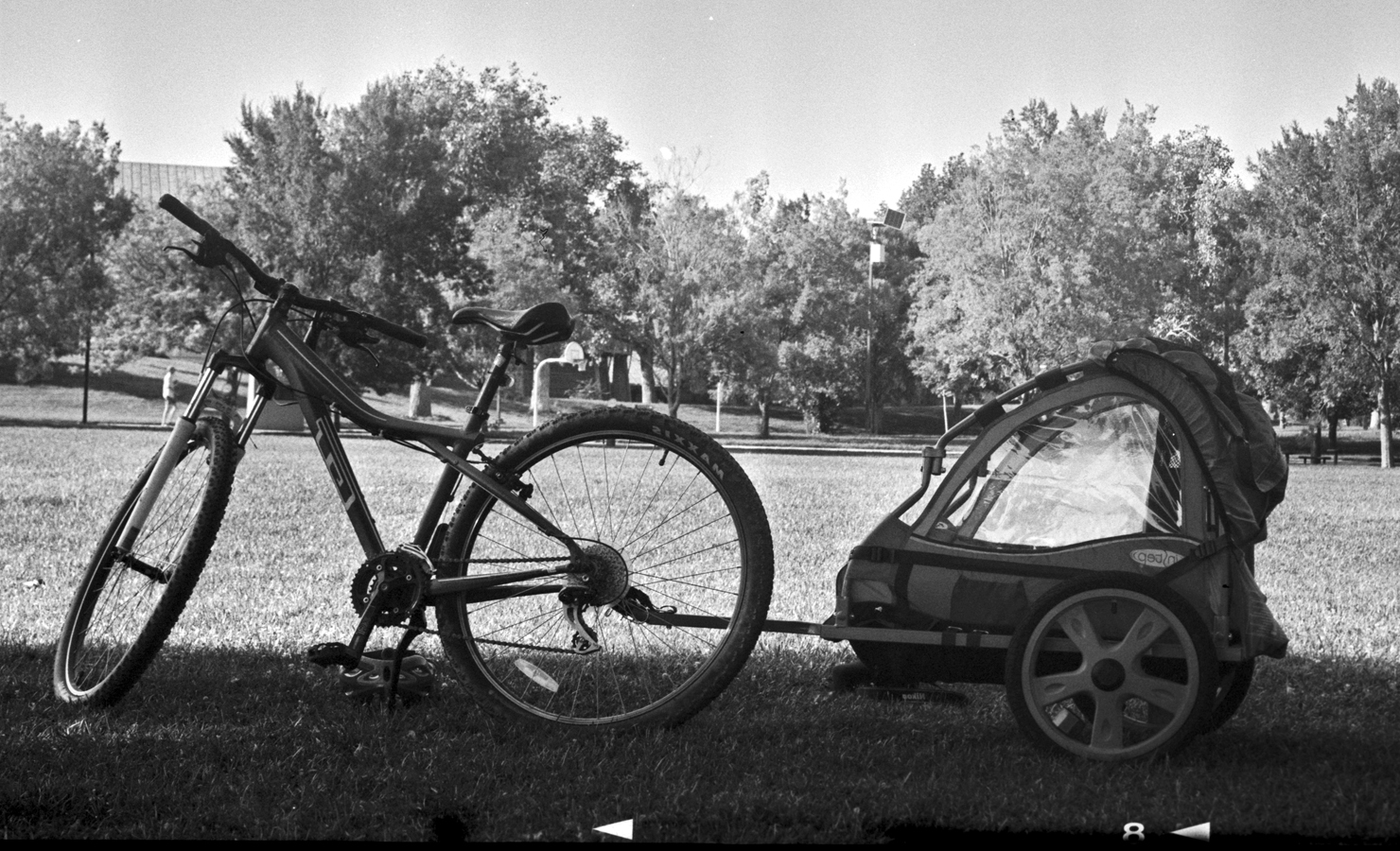
More from the No.1A Pocket Kodak. Getting the most from the 127mm lens requires a steady hold. A tripod is best, but I find I can get by most times by bracing the camera on my knee or on the ground.


We are finally getting some monsoon skies which encourage me to get back out on the street with my cameras.

Monday, May 09, 2011

No.1A Pocket Kodak


I eliminated the last of the pinholes in my Pocket 1A bellows and shot a roll of TMAX 120 at the Zoo yesterday. I liked the results except for the fact that I let a bit too much sky into the pictures and the flare degraded the images a little. The last shot on the roll of some filter tanks near the elephant enclosure gives a better idea of the nice resolution of the f-7.9, 131mm Kodar lens. The detail images are 100% enlargements scanned at 1200 dpi.


Exposure was f-32 at 1/50 on TMAX 400, developed in HC-110, dilution H.

1A Zoo


Sunday, April 24, 2011

Rio Rancho B&W

I put a roll of 120 through my No.1A Pocket Kodak at the car show. This picture of a '48 Fleetline was the only one I liked of the six frames.


Shooting a 127mm lens handheld at 1/50 is really pushing the envelope. I used a cable release to cut down on camera jiggle, but one needs a solid support to get the most from this camera. I also need to take care of that leak along the bottom of the image.

Wednesday, January 26, 2011

Shooting 120 in the No.1A Pocket Kodak


Stuffing this rather large Kodak folding camera into a pocket is a challenge most won't want to take on. However, making pictures with it turns out to be surprisingly painless. A Google search on the subject of using 120 film in cameras designed for the big A116 format will turn up quite a few solutions, most involving rather extensive camera modifications. I tried out of few of those myself with my No.1A Folding Pocket Special.


The basic black 1A Pocket model came along about two decades after the red bellows Special, and it incorporated some significant design changes that are not really apparent until you open up the camera. The most important of those is a boxy inner portion that holds the supply-side spool in place without the need for pins to engage the spool ends. The happy result for present-day users is that currently available 120 rollfilm can be used with no mechanical modifications to the camera. In modern terms, the solution is in the programming rather than in the hardware.