Showing posts with label HC-110B. Show all posts

Thursday, December 11, 2025

Testing The Limits

While the Anscoflex II offers some control beyond that available from other simple cameras, the possibilities are still considerably less that those offered by more sophisticated designs.  The control features of the camera must also be used with some care and discretion.

What I found while working through the twelve available frames on some Kentmere 400 was that the close-up lens and the yellow filter cannot be simultaneously employed.  So a close-up with the filter compensating for bright sun with fast film is not an option.

I also found with the ruby window removed for improved frame numeral visibility that I needed to carefully avoid exposing the film's paper backing to any hint of direct sunlight.  The first half of this roll of film looked good in terms of exposure, but there were some washed out frames further down the roll.

So a deliberate and thoughtful approach to using the Anscoflex II along with stationary subjects enhance the likelihood of success.  I found that trying to grab shots of our active dog out in the yard was a bit beyond the boundary of success.


Saturday, December 06, 2025

Winter Light


The little Nikon EM and its Series E lens gets little love from many Nikon enthusiasts, but it has always performed well for me.

I'm currently using a composite of the above images as the desktop background on my old iMac.

Thursday, December 04, 2025

Yashica YE

I learned the rudiments of street photography early in the 1960s with a borrowed Yashica YE.  I thought it might be fun to get one to relive those days. There are quite a few available in Japan, however the uncertainties of what import fees might be tacked on to the price made the possibility seem slim of finding one that I could afford.  Then, I saw one listed in the U.S. at a bargain price, so of course I had to buy it.


The Yashica YE worked well, though the nice qualities of the images are due mostly to the Leica Elmar lens that I had mounted for this first test roll.  It would be nice to find one of the Yashicor lenses that normally came on the YE, but they seem to be priced at about three times what I paid for the camera.

The Japanese camera industry made amazing progress in the 1950s as the country recovered from the devastating effects of WWII.  Nikon lenses became an instant hit after David Douglas Duncan used them in Korea, and the Leica and Contax copies made by several companies demonstrated top-notch craftsmanship.

In the picture to the right the Yashica YE is in the middle, the German Leica IIIa is at the bottom, and the top camera is a Leotax Elite.  The top two are very similar in construction and appearance and demonstrate the Japanese camera companies' effort to one-up the German orginal with the addition of  thumb levers for film advance. While those levers enhanced functionality they also increased the camera sizes, and they introduced some construction complexity which make DIY repairs more challenging.

The Yashica YE actually started out being produced by Nicca as the Nicca 33, but that company was bought by Yashica which continued making the camera with very little changes.  In spite of the good quality of these Leica rangefinder copies, however, they all soon disappeared from view, eclipsed by the appearance of the single lens reflex designs produced in both East and West.

Wednesday, November 26, 2025

The Ruby Window Solution

At first glance the Anscoflex II may look like a caricature of a camera.  However, it does have a number of unique and useful features.  Most significant of those features is the extraordinarily brilliant viewscreen -- brighter than any other regardless of origin or price.  The Anscoflex II has a two-element lens rather than the single-element meniscus found in many simple cameras.  There is also a supplemental close-up lens which can be levered in position for shots in the 3.5 to 7 foot range.  Another lever moves a yellow filter in front of the taking lens, which adds some control over exposure as well as darkening over-bright skies.

All of the simple cameras with ruby windows allowing proper frame spacing for paper-backed medium format film including the Anscoflex II present a problem for users.  Those ruby windows worked fine when a lot of those simple camera were new.  However, in the intervening years film makers have quit making the numerals on the backing paper with enough contrast to show up well through the ruby windows.  As a result it can be very difficult to see the framing numerals well enough to properly center the frame, and overlapping frames are a constant danger.

There is a simple solution to the dark window problem.  You can just remove the ruby window, leaving a hole in the camera back through which the framing numerals are easily seen.  The ruby coloring was really only an advantage long ago when films were less sensitive to red light.  Letting through the full spectrum onto the backing paper these days is not a problem as long as the length of exposure is kept short.  That can be ensured with a small strip of black tape covering the window except when the film is being advanced. 


 I was pleased to get 12 perfectly spaced frames on this roll of Kentmere 400.  With my simple cameras I most often use 100-speed film for proper sunny day exposure.  In this instance with the faster film I flipped the lever to place the yellow filter over the lens when the subject was mostly in full sun, and flipped back to the uncovered lens for shaded subjects.

Butkus has the Manual.

Sunday, September 14, 2025

The Nikon-S in Old Town

 Early on Saturday morning Old Town was full of people who had come to see some singing and dancing as a lead-up to Mexican Independence Day on the 16th.  My Nikon S was loaded with Kodak Tri-X.


I did not get the exceptionally nice tonal qualities which I expect from Tri-X.  The highlights were washed out and the mid-tones were muddy.  The pictures made in shadow were better, so I think the lack of a lens hood was partially responsible for the problem.  However, it seems more likely that the HC-110b processing was somehow the main issue.

Sunday, August 24, 2025

Coffee and a Burrito

 We visited Bike In Coffee which is at an old farm west of downtown Albuquerque.  We drove there, but many people do get there along the bike trail that parallels I-40.  I shot most of a roll of Kentmere 400 in the Zorki 6 with the collapsible Industar 22.

The camera and lens performed fine, but I don't shoot the camera enough to be used to the unconventional location of the rewind button which is right next to the shutter release.  I managed to lose about a quarter of the shots by pressing the wrong button.

Still a nice morning outing and I always find a lot of picture opportunities at the place.


Margaret wants to go back on a Thursday when the bluecorn pancakes are featured, so I'll likely have some more pictures of the place soon.

Friday, July 18, 2025

Medium Format

 Of my twin-lens cameras the one I enjoy shooting the most is the Yashica-Mat.  It has a very bright finder, a fine lens and it is light in weight.  When I decided to use the camera recently I thought I would maximize the advantage of the big negatives with some 100-speed film.  However, when I looked in the refrigerator film drawer I found that the closest to that I could get was an ancient roll of Ilford SFX 200.


I decided to give the film an extra stop of exposure to compensate for the sixteen years it had gone past its expiration date.  That seemed to be about the right match for the HC110b processing, judging by the results.  

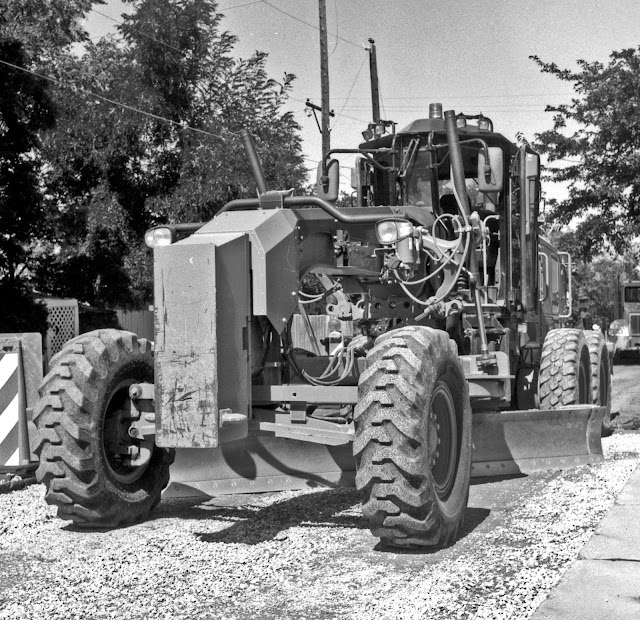
I started off by documenting a bit of an ordeal we are currently experiencing.  The street that runs by the south side of our house in the process of repaving.  The work starts off noisily about 6AM daily; that has been going on for about three weeks, and it looks like the job is about halfway to completion.

The upside is that it is pretty interesting to watch the big machinery being operated close-up.  Also, the early start of the workday is understandable given the near-100 degree temperatures we have had recently.  (Some shots through that window with my little Lumix digital camera are posted on my other blog.)

I finished off the roll during a couple walks through Old Town.

Plein Air

South Plaza

I made several shots of this gorgeous 1948 Chevrolet, but could not quite capture the excellence of the restoration.

I think I would be very uncomfortable driving around in such a car, fearful of damaging such a perfect and expensive project.

Monday, February 17, 2025

Bumps in the Road

 My Nikon FE has made some good pictures for me, but I haven't made a lot of use of it.  I decided to rectify that neglect with a trip to the zoo on a fine morning.  I made all the shots there with the Vivitar 3.5/70-210mm macro zoom.

  I grabbed a quick still life the next morning and then took a walk in Old Town with the Nikkor -P Auto 2.5/105mm.

When I got to Old Town I found that the meter's batteries had died, so I switched to manual exposure to finish off the roll of Fuji Neopan 400.  Back home, I processed the film in HC110b.  About a third of the zoo shots were blank frames.

The short series of shots from Old Town were ok, so I'm hoping the dying batteries accounted for the missing zoo shots.  I'll shoot another roll of the Neopan 400 to test that theory, and maybe also try developing in PMK to comapare with the HC110 results.

Tuesday, December 10, 2024

More About Still Life

Still life art (Google)

A work of art that depicts inanimate objects, such as fruit, flowers, or dead game. Still life art can be a celebration of material pleasures, or a reminder of the brevity of human life. The term originated in the Middle Ages and Ancient Greco-Roman art, and became a distinct genre in the late 16th century.

I am mostly happy with the conservative definition offered by Google, and that describes what I am looking for when I search for still life examples.  In practice, though, I take a looser approach beyond the traditional strictures, often looking to express a feeling of stillness.  I have also often here presented pictures of found arrangements which I have identified as belonging to the genre.


Still, I try to stray not too far from the historical approach which implies a composition with a  purposeful arrangement of objects.  The plural is important, I think, as a delineator to establish a difference between still life and macros, close-ups and product shots.  To represent an arrangement, it seems that at least two elements are required. Online photo sharing sites tend to feature offerings which mostly depict isolated items including flowers or other natural or manufactured objects.

Recently, while looking for sources of inspiration I came across a conversation about still life at Rangefinderforum.com which started sixteen years ago and has continued intermittently since then.  The images and words of participants show that nearly all struggle to define the character of their efforts as well as to master the relevant photographic techniques.

Most of my own efforts to create still life compositions have found their way to my Still Life Album at Flickr.