The Albuquerque Museum puts on an evening event on the third Thursday of each month. The theme for September was Lowriders. Five convertibles were parked on the lawn in front of the museum. Inside were a variety of family activities and a bar. A musical program matching the theme was presented in the outside theater.
I shot the cars with my Olympus XA loaded with some Arista Edu Ultra 100. I'm not sure where I got the film, but I was pleased with the way it looked after semi-stand processing in HC-110 at 1:160 dilution.
Tuesday, October 01, 2019
Wednesday, September 25, 2019
Plate Cameras
My plate cameras are awkward to use compared to just about anything else in my collection. There is a lot of guesswork in framing an image with either the wire frame or the little reflex finders. For precise focus and framing you need to mount the camera on a tripod to use the ground glass back, and then switch that out with the film holder to make the exposure. I don't use the plate cameras with enough regularity to get comfortable with their peculiarities. Still, I find myself getting around to using them because of the unique character of the images they produce.
The Bentzin Primar is my favorite among my plate cameras because of its compactness and sturdy construction. The old Compur shutter is simple and reliable. The uncoated Tessar lens is very sharp, though it tends to flare a bit if brought too close to the sun.
I took the Primar to the botanic garden late in the morning. The Rada film back was loaded with one of my last rolls of Fuji Acros. The first shot of the figures at the base of the fountain was made in the shade of some big trees with the aperture wide open at f4.5.
I developed the Acros semi-stand in Rodinal at 1:100 dilution for 45 minutes with 30 seconds initial agitation and two inversions after 20 minutes.
I'm going to stick with the Bentzin Primar for a while. I think I'll use a roll of TMAX 400 for the next session to give myself a better chance of getting the focus and exposure right.
Thursday, September 19, 2019
Focus
I decided to make another attempt to properly collimate the f3.5 Anastar lens on my Kodak Reflex II. The process can be accomplished by focusing at infinity on a ground glass at the focal plane, or by holding open the shutter and using an slr to focus through the camera's objective lens on a target at the film plane.
Four little set screws in the black rim around the objective are loosened so that the lens can be rotated to obtain the sharpest image at infinity focus. Once that was accomplished I loaded some Fomapan 100 and made 12 exposures in a variety of situations to challenge the camera's focal accuracy.
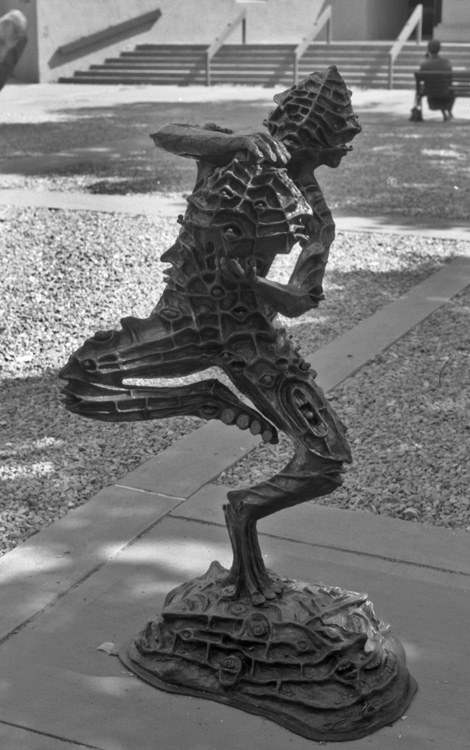
The shots of Ho Baron's Head Games sculpture were close up at f4.
I think I've got it right this time. I'm pleased to have the Reflex II working properly as it is a favorite among my twin lens reflex cameras. The Kodak tlr is relatively easy to work on, the view is bright, the shutter is reliable and the coated lens is very sharp.
Tuesday, September 10, 2019
Robert Frank
Interesting that the picture accompanying Robert Frank's obituary in the NY Times shows him holding up an Olympus mju. I would like to know more about the context of that photo which was made by Dodo Jin Ming. I see in a search on the subject that the photographer did a book on the later life of Frank. Pictures of Frank show him sticking with film photography into those later years. I believe he shot The Americans in the 1950s with a couple Leicas.
point and shoot
I've been carrying around my Vivitar Ultra Wide & Slim lately. I don't think the little camera weighs more than about an ounce, and it fits in a pocket while still leaving room for my flip phone and some spare change. With its wide-angle lens, fixed focus, aperture and shutter speed, the only adjustment required is in the photographer's perception of how a potential composition might fit within the camera's capabilities.
Friday, September 06, 2019
Roxie's World
Roxie likes our walks in the neighborhood and trips to the dog park. What she lives for, though, is our visits to the river. She runs full out back and forth across a ten acre sandbar, and she is in and out of the water at least a dozen times.
Thursday, August 29, 2019
Sanctuary
I visited the National Hispanic Cultural Center this morning with my Yashica-Mat. I was surprised to find a couple roosters hanging out in the back courtyard. One was pecking around under a big cottonwood, but the other was lying down beside a food dish and it looked pretty lethargic. A couple staff people showed up and explained that the roosters had gotten into a fight the day before. There were no obvious signs of injury, but this one was clearly pleased to get some personal attention. They said the two roosters just showed up one day. The staff started feeding them, and they became very tame.
Monday, August 26, 2019
PMK Pyro
I stopped using PMK Pyro developer a while ago after noticing that there was a big hunk of white precipitate at the bottom of the Solution-B bottle. I thought I might need to get another PMK kit, but I first did a little searching on line about the issue. What I turned up was a video by Chris Crawford about using the staining developer, and he mentions in it that the precipitate is the normal result of a super-saturated solution and that it has no adverse effect in the development process. So I loaded a roll of TMAX 100 into the Minolta X-700 and headed down to the Art Museum's sculpture garden for a test run.
I revisited the piece in the West Sculpture Garden that was featured in my previous post. A map I picked up in the lobby shows that sculpture's title is Head Games and the artist is Ho Baron, who is based in El Paso.
I rated the TMAX at 80 ASA, but would have been better off with a full stop of over exposure as the negatives were all thin. Slow film and a cheap zoom lens turned out to be a poor choice for early morning shadows and interior shots.
I'm not sure who made the zoom lens; it says "Sears" and "Korea". The 35mm to 135 is a handy range, and in normal lighting the sharpness is good as can be seen in the shot below of Allan Houser's Prayer.
So, I'm pleased to still have PMK Pyro available. I don't know that I'll like the developer for use with TMAX over other choices, but I've seen some nice results with the combination and it seems worth further investigation.
Thursday, August 22, 2019
Changeup
Since we've lived in Albuquerque I have often used a couple garden statues as test subjects for my old cameras. One is in the botanic garden, and the other, a depiction of a mother and child, was in a corner of the sculpture garden behind the Art Museum. When I walked through the Museum site yesterday with my Nikon FE I was surprised to find that the space formerly belonging to my usual subject was now occupied by a dancing head hunter.
It was kind of a shocking change to absorb.
The sculpture's location produces interesting lighting through the day, so I'll likely use the new one much as I did the previous subject. This sculpture looks very different depending on the position from which it is viewed as each head has multiple faces.
Labels:
Albuquerque Art Museum,
garden sculpture,
HC-110B,
Nikon FE,
Tmax 100
Monday, August 19, 2019
Falcon Field Revisited
On previous visits to Phoenix I've often reserved a morning to visit the PIMA air museum in Tucson. With temps above 100 degrees, however, wandering around acres of concrete was just not a practical option. So, we made a shorter trip to Falcon Field in Mesa where most of the restored aircraft are in a couple big hangers.
With my last visit to the place in mind I loaded the Leica IIIa with TMAX 100 and attached the Jupiter 12 35mm, anticipating the opportunity to shoot the B-17 and some of the other big planes out on the tarmac. As it turned out, the big planes were out flying around somewhere else, and we were confined to the dimly lit hangers. This fine looking craft was at the front of the hanger. I think it is a Stinson Reliant.
Saturday, August 17, 2019
Photography in the Phoenix Art Museum
![]() |
| Photo by Margaret |
One of the highlights for me during visits to Phoenix, even in mid-summer, is to pay a visit to the photography exhibit in an upper tier gallery at the Phoenix Art Museum. The pictures shown there are drawn from the vast archives of the Center for Creative Photography in Tucson. The selection of pictures on this occasion was entitled Mexican Photographers, Mexican Views, which "features more than 60 photographs created solely by Mexican artists that offer an intimate view into 20th-century Mexico and the country’s shifting national identity."
![]() |
| by Lola Alvarez Bravo |
At least half the photographs were made by Mexican women photographers. I was familiar with the work of most, but it was a real treat to see prints on paper and I also enjoyed making the acquaintance of some artists whose work was new to me.
![]() |
| by Graciela Iturbide |
Much of the work on display dates back to the first half of the Twentieth Century. Several of the photographers started their careers as assistants to Manuel Alvarez Bravo, including his wife Lola. Like their mentor, the women often focused on recording Mexico's astoundingly beautiful indigenous people and their cultures.
New to me was the work of Mariana Yampolsky. Her pictures reflect an extraordinary life journey. She went to Mexico from Chicago in 1945 shortly after receiving her Bachelor of Fine Arts degree to do print making at the Taller de Grafica Popular. Three years later she took up photography under the guidance of Lola Alvarez Bravo, and in 1954 she became a Mexican citizen.
![]() |
| by Mariana Yampolsky |
As is evident in Margaret's picture of the gallery, most of the prints are small compared to today's standards, and they are often more darkly toned than we are accustomed to seeing now. The result is that many cannot be fully appreciated as reproductions in books or on line. At the gallery you really have to stand close to the prints and even lean in a bit to grasp the delicate subtleties of tonality and the compositional innovativeness.
Discovering what is possible through photography has always been one of the major rewards of the art for me. While I have mostly focused on showing scanned images of my film negatives on line, I enjoyed making some prints for an exhibit recently, and that along with the Phoenix exhibition reminded me how important it is to be able to see prints which fully reveal an artist's intentions.
Tuesday, August 13, 2019
Salt River Crossing
In our past visits to family in Phoenix we have always opted to take the quickest route from Albuquerque, passing through Flagstaff and then south on Highway 17. This time we decided to take a more leisurely path, striking south from Holbrook and heading down along Arizona's east side through Show Low and Globe.
The spectacular Salt River Canyon is located mid-way between Show Low and Globe. Two bridges span the river there; the single lane steel bridge built in 1933 is now just for pedestrian traffic
We retraced the same path on the way home and enjoyed an escape from the summer heat of Phoenix in the higher elevations north of Globe. We stayed on Highway 60 through Show Low which ultimately got us to Socorro, New Mexico, just an hour from Albuquerque. Rain followed us much of the way, and the temperature dropped to a low of 59 degrees as we passed the Very Large Array.
The Highway 60 two-lane road traverses a great variety of terrain including pine forested mountain slopes and arid grasslands. The trip was a little longer than going through Flagstaff, but the added time seemed insignificant because of the sparse traffic and the great scenery.
Monday, July 29, 2019
rescued
I found this Kodak Retina IIa at the Fairgrounds Flea Market. It is identical to one I already had in regard to both function and appearance. The shutter, lens, rf, film advance and counter all seemed fine. There was no way I could leave it stranded there on the table among a pile of junkers given the $10 price.
I loaded a roll of Kentmere 100 in the camera and shot it on visits to the river and to Old Town. The last shot of my cat at home was wide open at f2. I developed semi-stand in HC-110.
Subscribe to:
Posts (Atom)