Showing posts with label Rodinal 1:50. Show all posts

Friday, September 18, 2026

A Solid Performer

 Reading people's accounts of discovering and using the Argoflex Forty, the consistent theme found in  all is the surprising excellence of the images from this fundamentally simple camera.  What is often overlooked is the quality of the camera's design and construction.  That is especially apparent if this 1950s Argus is compared to the many earlier pseudo-tlr cameras.  Some of my pre-war brilliant-screen cameras make nice images too, but their metal bodied construction seems very flimsy compared to the solidity of the bakelite Argoflex.


Saturday, May 16, 2026

Perspective

Much of the appeal of pinhole images for me resides in the great depth of field afforded by the small aperture of the pinhole.  The novelty of the images thus produced is due to the fact that our eyes do not have the capacity to maintain sharp focus fron inches to miles in a single glance.  Images of that character can be produced by sophisticated lens design and at great expense, but the direct simplicity of the pinhole yields unassailable authenticity.

Friday, December 19, 2025

More from the Duaflex

 Another sunny December day and another roll of film in the Kodak Duaflex.  This time it is some Arista Edu Ultra 200 of indeterminate age.  The box does not seem to have an expiration date.  I got it some time past from Free Style.   I suspect this is repackaged Fomapan as the pre-soak came out of the tank very blue.  All of the shots were made with a light yellow filter over the lens.  Processing was in Rodinal 1:50.  


See some more about the first model Kodak Duaflex and its designer in an article on my old website.

Wednesday, December 17, 2025

The Duaflex in Old Town

New Mexico is having an exceptionally warm and sunny winter.  Good conditions for one of my sunny day cameras, the Kodak Duaflex.  I loaded it with Kentmere 100 and took a walk around Old Town.

I processed the film in Rodinal.  That works well with most 100-speed films, but not so much this time.  I had to adjust tonalities significantly in Photoshop.  I am going to try again,  maybe with 400-speed film, along with a yellow filter for the bright sun scenes and processing in HC110.


Sunday, November 23, 2025

Slow Walking EM

 Another fine day for a leisurely stroll through Albuquerque's Old Town.


Ken Rockwell judges the EM to be Nikon's worst camera.  I beg to disagree.  I like the Nikon EM for its compactness, light weight,  aperture-priority automation, and the fact that it can use all my fine Nikon lenses.

I recently had a total disaster with a bad batch of PMK Pyro developer, so this roll of Kentmere 100 was processed in some reliable old Rodinal 1:50.

Tuesday, December 31, 2024

Back to Pinhole

 I found a shutter on ebay to replace the broken one on my pinhole camera.  It is a Vario like the old one and it works perfectly.  To celebrate I loaded a roll of Arista 100 and went to Tingley Beach to give the camera a trial run.


My sunlit exposures were in the four to seven second range, which seemed about right judging by the negative density.  Arista may be Fomapan by a different name and it requires rather extreme compensation for low light work because of reciprocity failure. Not a problem on this occasion however given the Spring-like weather we have been enjoying.

Shooting the pinhole was a good opportunity to refresh my ability to foresee what would actually end up on the film.  The endless depth of focus of the pinhole means focus is not an issue, but there is some guesswork in framing the subject given the ultra-wide view and the lack of a viewfinder with corresponding coverage.

Ready for the New Year

Both Arista and Fomapan yield pretty nice images, and the good contrast of the numerals on the backing paper is superior to about any other available 120 film.  The reciprocity failure issue needs careful attention, but there is a good chart available online to assist with that.

Update:

Some of the pictures from my second roll through the rebuilt camera had poor contrast and flare stripes right through the center.  It seemed likely that the cause was reflections off the interior of the threaded lens mount.  I've covered that surface with some black paint, so we'll see how that looks in the next roll.

Monday, August 19, 2024

More from the Felica


The Felica is compact and easy to carry.  The focusing and exposure adjustments are limited, but adequate for dealing with a pretty good range of circumstances.  I haven't yet made much use of the built-in yellow filter, so I'll try to look for opportunities for using it with my next roll through the camera.

Saturday, August 10, 2024

Coming to Grips with Classic Kitsch

 I only shot a roll or two of film in my Anscoflex II when I acquired it in 2012.  The camera was interesting because of its unique design features, but in operation it seemed a little too simple for actual photographic purposes.  Recently, however, I have seen some pretty sharp images from the camera posted in the PSEUDO TLR group on Flickr.  So, I loaded a roll of Fomapan 100 and started it off with another walk around the neighborhood.

cornered

The close-up lens option considerably enhances the camera's versatility, though the reputed 3.5-7 foot range may be a bit optimistic.  With the normal meniscus lens selected the f/11 aperture provides a good range of focus from 10 feet to infinity.

bungalows

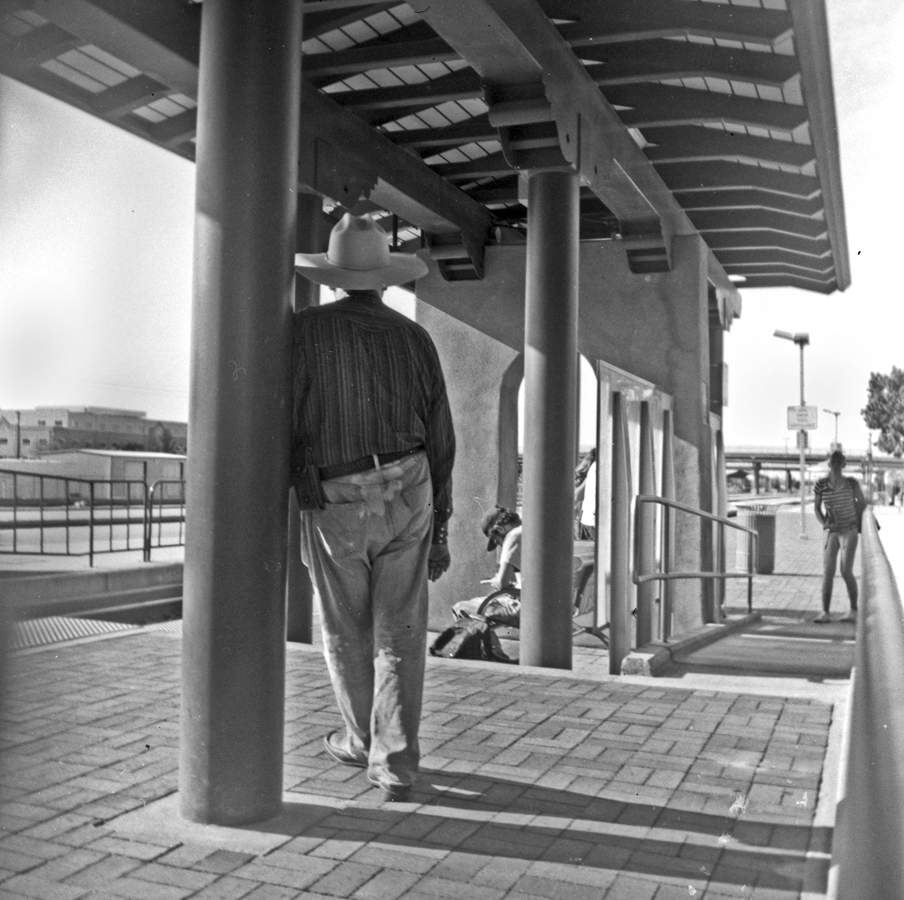
I got out the next morning to finish off the twelve frames at the Albuquerque RailRunner station.

Albuquerque Station

Arrival

Southbound

The close-up lens and the yellow filter definitely extend the practical capabilities of the Anscoflex II.  The ratcheting film advance is novel, but clunky and slow in operation.  The large and brilliant viewfinder screen puts the camera into a class of its own, unrivaled in the world of film cameras.

Like all the brilliant-finder cameras beginning with the Voigtlander Brilliant, the Anscoflex II has a massive biconvex magnifying lens under the viewscreen.  In addition to that, however, this camera also has a very large-aperture front-facing viewfinder lens which further illuminates the on-screen image.

While most of the modern-day popularity of the Anscoflex II is likely due to the capacity for making through-the-viewfinder (ttv) digital images, the superb view also greatly enhances the task of composition prior to committing the image to film.

I enjoyed my recent outing with the Ancoflex II and I'll likely take another spin with it some time soon.

Thursday, August 08, 2024

Back to Basics

 I have been wanting to get back to shooting some of my simple cameras, so I thought to start with my Vredeborch Felica.  Though hardly bigger than my Ansco Panda, it sports adjustments for distance, speed and aperture.  The lens looks to be a simple meniscus type, but the curved film plane helps with sharpness out to the edges.

I got out into our yard before getting caught up in my usual morning routine at the computer and shot up all twelve frames on the roll of Fomapan 100 in about twenty minutes. 


The thing that makes taking pictures fun with these simple cameras is that they always produce images that exceed expectations if some care is taken in choosing subjects that are a good match for film speed and the camera's capabilities.  In addition to which, in this case, it is fun to say "Vredeborch Felica". *

* From Ask Oracle:

Felica is a name with a rich history and diverse origins, primarily associated with the Latin word "felix" meaning "happy" or "lucky." It has been used as a given name for both girls and boys throughout history, though it is more common for girls today. The name holds a sense of joy, prosperity, and good fortune, making it a popular choice for parents seeking a name with positive connotations.

Felica is easy to write and pronounce, with a pleasant sound and a timeless feel. It has a few common nicknames like Fely, Fee, and Lica, adding a touch of familiarity and endearment. While not as common as some other names, it still holds a unique charm and a connection to historical figures and literary characters.

and

From Camera-wiki.org:

Vredeborch was a camera maker based in Nordenham, a town on the German North Sea coast. The name of the company come from the Vredeborch castle (Friedeburg in standard German; Peace Castle in English) established at the beginning of the city's history, circa 1407. The company Vredeborch GmbH was founded in 1945. Several of its cameras were sold under names given by other distributors. It stopped camera-making in 1970. 

(They made a lot of medium format camera models in twenty-five years.  I wonder if anyone has collected all of them. )

Saturday, June 01, 2024

The Mamiya 6

 The Mamiya 6 meduim-format folding rangefinder camera was made over a period of fifty years with many model variations.  In spite of that long history, high quality construction and unique features it is curiously rare on web sites devoted to vintage cameras.

From the front the Mamiya 6 resembles other popular medium-format rangefinders of the same era such as the Zeiss Ikonta and the Soviet Iskra.  A top/rear view shows what sets the Mamiya apart from all others in its class.  The thumb wheel to the right adjusts focus by moving the film plane rather than the front lens standard. Also visible in the same view is the switch to the left which permits either 6x6 or 6x4.5 formats.  The flip-open ruby window only needs to be used to position the first frame; frame spacing from there on is automatic.


 The format switch changes the aspect ratio in the viewfinder and also releases the double exposure lock.  To actually ready the camera for either format, one opens the back, slides out the removable pressure plate and flips a couple barn doors to the appropriate position.  The 120 roll film can than be threaded through the exposed rails and the pressure plate slid back into taking position.

I have so far only shot one test roll with the camera in Albuquerque's Old Town.  Everything seems to be working perfectly.  The film was Fomapan 100 which I developed in Rodinal 1:50.  The  Olympus D. Zuiko 3.5/75mm lens performed well as expected.


An overview of the Mamiya 6 history and features can be found at the Camera-Wiki site.