Showing posts with label Kodak Tmax 100. Show all posts

Saturday, September 19, 2020

Normalcy

 In the Plaza Vieja it is a line of restored classics, with the owners sitting in the shade nearby.

Thanks mostly to the determined leadership of the governor, New Mexico has done pretty well in holding down infection levels compared to its neighbors on either side.  In Albuquerque the rate per 100,000 is just 2.6.  There are some trouble spots in the southeast corner including Chavez County which has a rate ten times higher.  In Lea County nextdoor with a rate of 13 per 100,000 a Republican legislator is trying to sue the State for preventing the reopening of public schools there because of the spike in cases.

Sunday, August 23, 2020

TMAX

This is the first roll of Kodak TMAX 100 that I have shot in some time.  It is hard to beat for its rich tonal range and fine grain, but  I have been irritated by the price increases for Kodak films.  I probably need to get over that if I am going to keep trying to be a film photographer.


Friday, December 13, 2019

What's in your pocket?

If the year is 1948 and you are a G.I. in occupied Germany you might have a nice little Zeiss Ikon Ikonta 35 in your pocket which could have been purchased at your Base PX.


If that G.I. was a real photographer he might also have supplemented the camera purchase with some useful accessories such as a clip-on rangefinder and a light meter.


My own Ikonta 35 turned up in a Las Cruces pawn shop a half century after it was built.  It was one of the first cameras I acquired when I finally got back to film photography.  That was a particularly fortuitous find because of the Opton Tessar lens which showed me what that historic lens design could accomplish when attached to even a relatively simple camera.
    I subsequently acquired a Zeiss Ikon Contaflex with exactly the same lens, and shortly thereafter a Kodak No.1 Autographic Special folder with a Bausch & Lomb Tessar dating back to 1917.  The early Tessar on the Kodak was uncoated, but still made great pictures as they all do.
    The exposure meter and the rangefinder atop my Ikonta 35 turned up recently in a box of photo gear that was given to me by a friend.  It seemed a good excuse to get out with the camera and the accessories to test the kit.


The fifty-year-old light meter worked perfectly.  Meter designers of that era still had not come up with the idea of match-needle readings, so the user had to turn the dial so that the ASA setting coincides with the displayed light value.  Then, an f-stop and shutter combination could be selected from the other side of the dial, and those settings would be transferred to the camera.
    A label on the meter's back says "DeJur-Amsco Corporation, New York, NY, Made in U.S.A."  The meter design, except for the black bakelite case, is identical to an early Zeiss Ikophot.


My usual routine with cameras like the Ikonta 35 or the Vito II is to set the focus to around ten feet and the aperture to f16 which gives me enough depth of focus in good light to yield a sharp picture at anywhere from six feet to infinity.  For a low light close-up you must fall back on your ability to accurately judge distances, and successes become a bit hit-or-miss.  So, for pictures like that low-light shot of the door with the holiday wreath, the little AKAMETER accessory rangefinder comes in very handy.


The view through the little eyeport of the AKAMETER is a bit dim after half a century, but the rangefinder is still highly accurate.  That said, there is still some judgment required to transfer the distance setting shown by the rangefinder dial to the camera as the numeric distance scales on both are not finely graduated.  So, the easiest way to get a good close-up is probably to just set the rangefinder and the camera focus to the same setting -- say 4 feet -- and to then move back and forth slightly to bring the split images into alignment as you might with a coupled rangefinder or even with an slr.
    I'm thinking all of the above probably seems awkwardly archaic to anyone who has come of age in the digital era, but it really doesn't require much time to develop the necessary skills to bring the old cameras and their accessories back to a useful life.

Monday, December 09, 2019

VLA

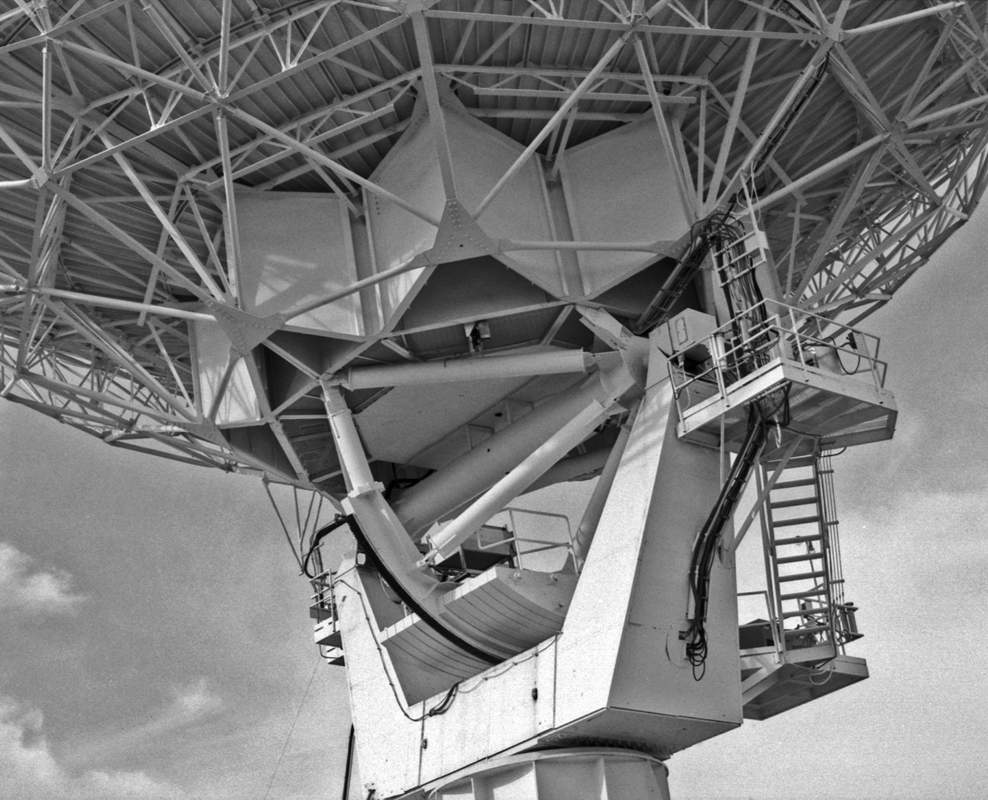
We drove an hour south to Socorro to attend a robotics competition in which our granddaughter was a participant.  It seemed a logical extension of the trip to go an hour further west to the Very Large Array radio telescope site.  There are 27 dish antennas; each is 82 feet in diameter and weighs 230 tons.  A rail system allows dispersal of the antennas in a Y-shaped configuration with a span of 22 miles.


I shot three rolls of film in about two hours.  These were on TMAX 100 in a Canon F-1 with a Canon FD f/1.4-50mm lens.  The film was processed in Freestyle's L110 film developer at 1:31 dilution.  I also shot a roll of Fuji 200 color in the same camera which I'll get to in a day or so.  A roll of Arista Edu Ultra 200 shot in my Zorki 2C was a total loss due to a defect in the film (Scratches running the full length on the non-emulsion side).  I'm looking forward to returning to the site soon with more and better film and a variety of cameras and lenses.

Thursday, November 21, 2019

Adventures in Photography

I found myself with some free time late in the morning, so I decided to walk over to Old Town with my Leica IIIa to which I had attached the Industar 22 lens, a Soviet copy of the collapsible Elmar.  I finished up the roll of TMAX 100 that was in the camera, making some pictures on the street, at the park and at the Art Museum.  New Mexico's mid-day light is often too harsh for photography, but on this day some scattered clouds softened the light enough to get some shots.


The photographs I made were not very exciting, but it still turned out to be a great photo walk.  I ran into Marco Wikstrom who is a member of our New Mexico Film Photographers group as well as a participant in the co-op which runs a photography gallery in Old Town.  I walked with him to the gallery which he was going to open for the day.  We looked at his photos which he has on exhibit now, and we talked about a couple of his current projects which include an upcoming trip to New Zealand.


On the way home I cut through Tiguex Park and came upon our friend Lana who was a neighbor and the first friend we made when we move to Albuquerque over ten years ago.  Lana and a friend were walking their dogs.  She recalled that I had made a picture of her and her dog, Buddy, some time ago and asked if I would make some more to bring things up to date.  So I did.

Buddy
When I got home I rewound the film back into the cassette in preparation for development; the film strip got caught at the end and broke, and the shutter by its sound was clearly not working right.  I removed the lens, set the shutter to Bulb and when I released the shutter I could see that there was a folded over piece of film stuck under the shutter curtain.  I managed to fish that out with some pliers, and everything seemed to be working properly after that.

I have been getting some thin negatives from my home development, so I decided to process semi-stand in 5ml of HC-110 in 650ml of distilled water.  It is hard to mess up with that combination and the negatives looked ok, but I may abandon HC-110 even though it has been a long-time favorite.  

In looking around on the web I have found that a lot of people are reporting problems with a number of Kodak developers including TMAX, HC-110 and Xtol.  Kodak has apparently had to make changes in the chemical components of the developers which has degraded both longevity and effectiveness.  Fortunately, there are alternatives.  I have Rodinal and PMK Pyro for black and white, and I am happy enough at present with Cinestill C-41 for color work.  I may also try LegacyPro LMAX from Freestyle which is said to be identical to TMAX developer before it was altered.

Tuesday, October 29, 2019

Exercising the Signet 35

I thought these recent b&w images from the Signet 35 were interesting, though the combination of TMAX and hc-110 did not yield the quality I have gotten from it in the past.  The photos from this roll also introduced too many variables and are not useful for comparison with the last outing with the Signet 40.


I'm going to shoot another roll in the Signet 35 with the same film and lighting conditions as the last Signet 40 pictures to see if I can better compare the performance of the two Kodaks.

Monday, August 26, 2019

PMK Pyro

I stopped using PMK Pyro developer a while ago after noticing that there was a big hunk of white precipitate at the bottom of the Solution-B bottle.  I thought I might need to get another PMK kit, but I first did a little searching on line about the issue.  What I turned up was a video by Chris Crawford about using the staining developer, and he mentions in it that the precipitate is the normal result of a super-saturated solution and that it has no adverse effect in the development process.  So I loaded a roll of TMAX 100 into the Minolta X-700 and headed down to the Art Museum's sculpture garden for a test run.


I revisited the piece in the West Sculpture Garden that was featured in my previous post.  A map I picked up in the lobby shows that sculpture's title is Head Games and the artist is Ho Baron, who is based in El Paso.


I rated the TMAX at 80 ASA, but would have been better off with a full stop of over exposure as the negatives were all thin.  Slow film and a cheap zoom lens turned out to be a poor choice for early morning shadows and interior shots.


I'm not sure who made the zoom lens; it says "Sears" and "Korea".  The 35mm to 135 is a handy range, and in normal lighting the sharpness is good as can be seen in the shot below of Allan Houser's Prayer.


So, I'm pleased to still have PMK Pyro available.  I don't know that I'll like the developer for use with  TMAX over other choices, but I've seen some nice results with the combination and it seems worth further investigation.

Tuesday, March 19, 2019

This is not a test

At least it is not a test of the camera or the lens.  The Leica IIIa is ... well, a Leica.  The Jupiter-8 is a superlative 6-element Sonnar design which the Russians appropriated along with the whole Zeiss establishment as reparations after WWII.


The question to be addressed is that of compatibility.  There is a lot of angst expressed in on line forums about slight differences in the lens mount to focal plane distances between Leicas and their Soviet counterparts.  People report making precise measurements with their micrometers and even shimming their Soviet lenses to compensate for the perceived problem.  So, when I confront a matchup of my Leica with a new Soviet lens, I make sure I shoot at a variety of distances to assure myself that both the lens and the camera are performing up to the expected standards.  The following shots are from a roll of TMAX shot on a recent neighborhood walkabout.


I'm not seeing a problem.  In fact, I've shot several Russian lenses with the Leica including FED, Jupiter and Industar models in 50mm and 35mm focal lengths without any loss of sharpness that is apparent to my eyes.  There may be a real problem lurking out there and maybe I'll encounter it one day, but I'm not likely to lose any sleep over the possibility.  I also have failed to find any apparent difference from the results I get when the Soviet lenses are mounted on the Soviet cameras they were built for.


I've had a Jupiter-8 lens for my Contax-copy Kiev IIa for a long time.  That lens is about ten years older than my recently-acquired Leica-Thread-Mount Jupiter, but it is also an excellent performer.  I haven't used it much, partly because I usually prefer to get out with the the Jupiter-12 35mm lens on the Kiev.  However, The Kiev also does not offer the same level of compact precision as the Barnack Leica.
     Besides adding a nice tactile dimension to the shooting experience, the Leica's slick operation instills confidence while also providing some practical enhancement to my shooting results.  For instance, that buttery-smooth film advance mechanism yields a strip of exposures that are very narrowly separated and perfectly spaced, with the result that I can often get 25 frames from a 24-shot roll even with the long tapered leader the Leica requires.

The bottom line for me on the issue of the compatibility of the Leica and Soviet lenses is that the combination provides a practical and economical way to the Leica experience.  If the Leica were my only camera, I would be more concerned with the likelihood that there could be a problem with lenses with a focal length greater than 50mm.  Obviously, I have a lot of other choices of cameras if I feel the need to use long lenses.