
Showing posts with label Kodak Tri-X. Show all posts
Showing posts with label Kodak Tri-X. Show all posts
Wednesday, March 11, 2026


Sunday, September 14, 2025
The Nikon-S in Old Town
Early on Saturday morning Old Town was full of people who had come to see some singing and dancing as a lead-up to Mexican Independence Day on the 16th. My Nikon S was loaded with Kodak Tri-X.


I did not get the exceptionally nice tonal qualities which I expect from Tri-X. The highlights were washed out and the mid-tones were muddy. The pictures made in shadow were better, so I think the lack of a lens hood was partially responsible for the problem. However, it seems more likely that the HC-110b processing was somehow the main issue.

Thursday, April 21, 2022
Miles gone by
I revisited the southernmost section of the Petroglyph National Monument. It has been quite a while -- five years? ten? -- I'm not sure. Memories of the place were sparked by a recent discovery of the photographic work of David Grant Noble who spent about forty years documenting ancient ruins and rock art of the Southwest. I'm not sure how I missed seeing Noble's excellent pictures sooner; I only became aware of them because the Maxwell Museum has scheduled an exhibit and artist talk in May. I was pleased to find a couple copies of Noble's book, In the Places of the Spirits, in the Albuquerque Library.

I was also delighted to find that Craig Childs has published several books since I read House of Rain twelve years ago. I decided to start catching up with Childs by reading Tracing Time; Seasons of Rock Art on the Colorado Plateau. Childs' approach to thinking about the ancient cultures of the Southwest is informed by familiarity with the academic research, but it is fundamentally the product of a unique personal immersion in the region's arid environment.

One of the topics Childs deals with in Tracing Time is the destruction of the ancient petroglyphs and pictographs. In previous books he made the case for leaving any traces of past cultures completely undisturbed. In this later work he suggests that those who deface and destroy ancient rock art are motivated by assertions of power and ownership which likely were behind similar destruction in ancient times. It is not uncommon to find rock art panels with many layers of pecked or painted designs laid down over centuries. The difference, of course, is that the destructive process has been greatly speeded up by exponential population growth along with greatly more efficient tools of destruction including firearms, spray paint and off-road vehicles.

Over the years I have maintained this blog I have at regular intervals acknowledged the idea that my photographic efforts would be enhanced by a more focused and deliberate approach, as opposed to just walking for miles and recording interesting sights I came across. My journey back to Mesa Prieta yesterday was a concrete expression of that strategic option, brought about now by necessity. I just can no longer wander for miles at a time to indulge an urge to record serendipitous discoveries. I'll likely get back to National Petroglyph Monument again soon, and also hope to visit some of the many other rock art sites within a day's drive from Albuquerque.
I am also thinking I will try to narrow my choice of cameras to a few which are likely to produce reliable results to match my current photographic ambitions. I exposed my recent roll of slightly expired Tri-X in my Mamiya C330, first on a walk beside the river, and then during my visit to the rock art site. What I found in the process was that it would have been wise to quickly review the camera's manual before setting out as I encountered some problems with lens swapping which I was not prepared for. The C330 is the most versatile tlr available, but the controls are decidedly unintuitive.


Friday, February 11, 2022
More work for the Brownies
We took a walk around the neighborhood with the Kodak No.2 Folding Autographic Brownie.

Kodak applied the Brownie name to quite a variety of cameras. This was one of the more capable ones with zone focusing and multiple shutter speeds and apertures. The Rapid Rectilinear lens is quite good.

The Henry Mann House is just across the street from our place. It was built in 1905. The heavy wooden gate is a block north of us next to a big adobe brick house that also looks to be quite old.


Friday, January 14, 2022
Walking the Dog
I have made thousands of pictures with well over a hundred cameras, so no real need to make more. However, I enjoy the process as much as the end product. I took along a Kodak Brownie Hawkeye Flash box camera yesterday while walking the dog.

Thursday, September 23, 2021
Exploring the Bosque
I took a long walk with my 1A Pocket Special in the riverside forest at the east end of the Paseo del Norte bridge. I saw some bike riders and skaters on the paved path that parallels the river, but no other people after that.

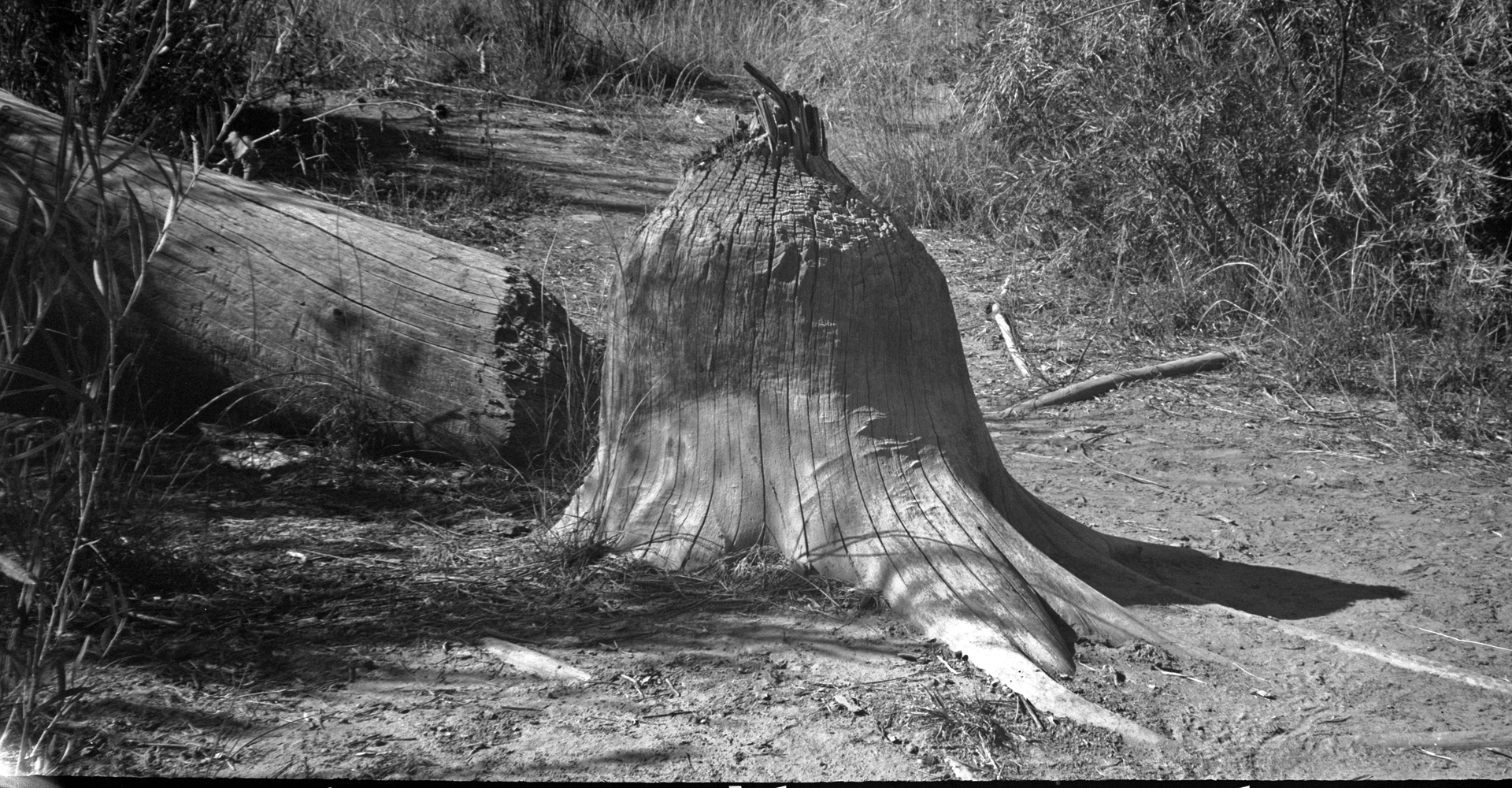

I got six-and-one-half frames from this roll of Tri-X using some expired 120 Tri-X. I think the century-plus camera has performed very well, but it is starting to show its age; there are some small light leaks appearing on the negatives and the ancient leather covering is disintegrating. I think I will give the camera a well-deserved rest and move on to using a couple of my other, newer 116 Kodaks along with the very helpful 116 to 120 adapters.
Wednesday, August 11, 2021
Restorations
Here are a couple more shots from my Friday morning session in Old Town with the Kodak No.1A Folding Special. The images were cropped to compensate for poor framing, but I like them because they show the nice qualities which the Bausch and Lomb Rapid Rectilinear lens can deliver. I was also happy with the tonal range produced by the combination of the expired Tri-X and processing in HC110e.


Here are comments on the design by Rudolf Kingslake, a Director of Optical Design at Eastman Kodak Company from his book, Lenses in Photography, 1951 (p.122-123):
The Rapid Rectilinear Lens -- By 1866 lens theory had developed sufficiently to indicate how the two components of a duplet could be corrected for spherical aberration even though they were bent into the meniscus shape necessary for a flat field, the symmetry being relied upon to eliminate coma, distortion, and lateral color. The result was the f/8 Rapid Rectilinear...
The aperture scale on my 1A Special shows a value of "4" as the widest aperture setting, however that is because the scale is using the Universal System values in use by Kodak at the time. In that system the mid-scale value of 16 is the same as the f/16 value in the system now in use. The next lowest value in the Universal System is expressed as 8 to indicate twice the exposure value of the previous setting. And, the last Universal System value on my camera is 4, but that actually corresponds to f/8 in the current system of aperture values which are expressed as a ratio of focal length to aperture diameter.

Saturday, August 07, 2021
From the Kodak 1A Folding Pocket Special
A newcomer to the Friday morning car klatch in Old Town stirred some interest.

I think this car started out as a '36 Plymouth, but it has been extensively modified.


The camera was built to use 116 film which yielded 12 shots that measured 2.5 x 4.25 inches. While the camera seems big and awkward by today's standards, Kodak ads touted it as an exceedingly compact instrument. In fact, the 1A and the even bigger 3A cameras were what was used by the early photojournalists like Jack London and Jimmy Hare.

 I have only shot 120 roll film in my 116 cameras and that requires a bit of ingenuity in loading and advancing the film. The big 116 spools are held in place by spring-loaded pins. To use the camera with 120 film spools I made a film holder from an Adox plastic film can and foam spacers. When operating the camera, the ruby window is covered and the film is advanced by two-and-one-half turns of the advance key to achieve adequate spacing, yielding five or six frames per roll. It is also possible these days to acquire 3D-printed spacers to properly hold the 120 film spools in position.
Turn-of-the-century cameras are interesting because camera control features tended to vary a lot from one manufacturer to the next. The shutter on this camera, for instance, includes a frame counter that was actuated by the shutter release, which was best operated with a pneumatic bulb. The aperture settings are designated by the U.S. standard of the time rather than the current f-stop ratio values.

The focusing scale has settings only for 6, 10, 25 and 100 feet. Turning the thumb wheel brings a pin into position which serves as a stop when the lens/shutter mount is pulled forward. Because of the short length of the scale, distances between the indicated stops cannot be easily determined and set, so bright shooting light and small apertures are helpful to achieving proper depth of field.

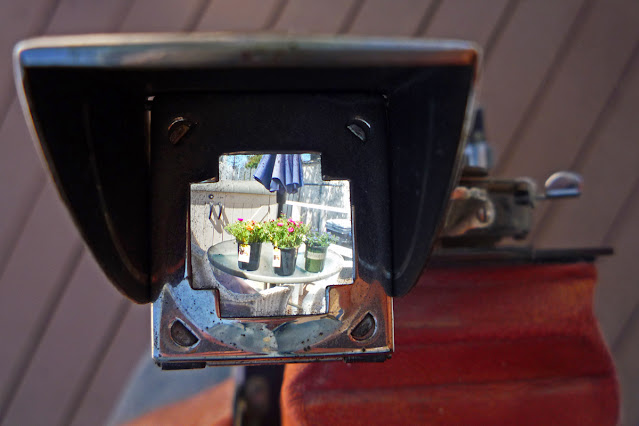
One very nice feature of the 1A Special was a reflex finder that was very large and bright compared to those of later Kodak folders. Mine is especially easy to use thanks to the replacement of the original deteriorated mirror by a mirror sliced from an old Polaroid camera.


Friday, July 23, 2021
Summer at the Zoo
My Patent Etui plate camera went with me for a morning stroll through Albuquerque's Rio Grande Zoo.

I used a roll from the recently acquired batch of expired/frozen Tri-X which I processed back home in Rodinal 1:50. The morning light was subdued by some California smoke. The Zoo was pretty crowded with children and parents, due no doubt in part to the presence of a newborn hippo. I walked by the hippo pond a couple times, but the closest I got to seeing the newborn was an image on the phone of one of the attending volunteers. Plenty of other exhibits to see, of course.


The Rollex film back for the camera is the most practical way to make pictures with it, but it does add some bulk to very compact Patent Etui. The ten-shot film packs were a better fit and very popular in the 1920s and '30s, but I think Kodak quit producing them in the 1980s. Knowing I would have the eight 6.5 x 9 frames of Tri-X shot well before my zoo visit was complete I also took along my Mercury II CX loaded with a roll of expired Fuji 400 color. I managed to use most of that at the Zoo and will try to process it and post the results later this week.
Tuesday, January 28, 2020
The Bosque in Winter
The cottonwood forest beside the river seems to be in a state of sleep this time of year.


Shooting the Hikari 2002 is a nice way to make use of my Pentax-M lenses. The roll of Tri-X was developed in LegacyPro L110 at 1:31 dilution for 6.5 minutes at 20C. I might give the next roll another thirty seconds, but I thought the L110 nicely handled the grain in this instance. Semi-stand development would likely reduce the contrast a bit.


Shooting the Hikari 2002 is a nice way to make use of my Pentax-M lenses. The roll of Tri-X was developed in LegacyPro L110 at 1:31 dilution for 6.5 minutes at 20C. I might give the next roll another thirty seconds, but I thought the L110 nicely handled the grain in this instance. Semi-stand development would likely reduce the contrast a bit.
Friday, October 11, 2019
KW Patent Etui
I've been doing a little repair work on my two Patent Etui plate cameras. Both had some pinholes in the bellows which some black fabric paint took care of. Soon after I got my first one I dropped the back and broke the ground glass. I purchased a replacement glass panel, but did not know how to put it in place. A couple years later I got to looking more closely at the back and realized that I just needed to take out the four little screws in the back corners which released the glass and the two little brackets that hold it in the frame.


Both cameras seem to be working well now. I'm going to order some 120 film which I will use with the Rollex roll film back.
These pictures were made on some expired Tri-X in my Minolta X-700.


Both cameras seem to be working well now. I'm going to order some 120 film which I will use with the Rollex roll film back.
These pictures were made on some expired Tri-X in my Minolta X-700.
Monday, April 01, 2019
Cesar Chavez Day
I rode my bike over to the Hispanic Cultural Center on Saturday. Albuquerque has been celebrating Cesar Chavez Day for about twenty-six years. This year's event was well attended, honoring the farm worker organizer and also the rise of many women to positions of leadership at all levels of government.

I tried shots of the Chavez poster from several angles, deciding finally on this image reflected in the windows of the Cultural Center. The day's speeches were interspersed with dancers and singers.

No event in Old Town or Barelas is complete without this fellow officiating en dos idiomas.

Of course, at least one mariachi group is also mandatory.

The star performer was this little girl who danced for her mother and Cesar Chavez.

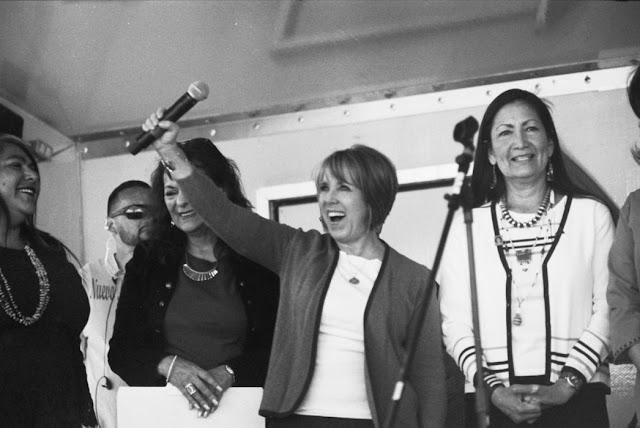
Our new mayor, Tim Keller, made a brief appearance at the beginning of the celebration, but the ladies owned the stage. Michelle Lujan Grisham, the newly elected Governor of New Mexico, is always the shortest person in any assembly of politicians, but she has a personality at least seven feet tall. The woman under the fedora to the right is Dolores Huerta, native New Mexican, co-founder of the United Farm Workers and keynote speaker for the Cesar Chavez Day celebration.

Next to the Governor in this shot is Deb Haaland, one of two Native American women who made it into the U.S. House of Representatives this year.
Quite a day for New Mexico.
I shot two rolls of Tri-X at the celebration, but brought home fewer pictures than I had hoped for due to some apparent malfunction of the Minolta X-700. Most of the photos were under-exposed and some in full sun were grossly so. Not sure if the problem is electrical, mechanical or the the result of creeping senility -- possibly a combination of all three. The manual says that in aperture-priority mode the camera should work properly with about any Minolta lens, but I'm wondering if using the old MC 135 lens may be a source of problems. I'll work with the issues as I really like the camera and the set of lenses I have for it.
My plan was to develop one roll in the usual HC110b and the other using semi-stand development. When I saw the results of the first roll, however, I decided to forego the stand dev as the complications left no room for meaningful comparison. I still feel I'm making some progress at sorting out variables in the results of my photo efforts, but it is slow going.
----------
Update:
I shot a test roll with the camera to systematically compare results from the three lenses I have for the Minolta X-700. The camera works fine in all three shooting modes with the normal and wide-angle lenses. The shots from the 135mm lens degraded in quality as I moved through the roll. On closer examination I see that the aperture stop-down mechanism is sluggish, probably due to dirt on the aperture blades and other moving parts. I'm not sure I have the energy available to tackle the dismantling of the lens a second time. I have gotten some satisfaction from figuring out the problem and verifying that the camera and two of the lenses are working properly.

I tried shots of the Chavez poster from several angles, deciding finally on this image reflected in the windows of the Cultural Center. The day's speeches were interspersed with dancers and singers.

No event in Old Town or Barelas is complete without this fellow officiating en dos idiomas.

Of course, at least one mariachi group is also mandatory.

The star performer was this little girl who danced for her mother and Cesar Chavez.

Our new mayor, Tim Keller, made a brief appearance at the beginning of the celebration, but the ladies owned the stage. Michelle Lujan Grisham, the newly elected Governor of New Mexico, is always the shortest person in any assembly of politicians, but she has a personality at least seven feet tall. The woman under the fedora to the right is Dolores Huerta, native New Mexican, co-founder of the United Farm Workers and keynote speaker for the Cesar Chavez Day celebration.

Next to the Governor in this shot is Deb Haaland, one of two Native American women who made it into the U.S. House of Representatives this year.

Quite a day for New Mexico.
I shot two rolls of Tri-X at the celebration, but brought home fewer pictures than I had hoped for due to some apparent malfunction of the Minolta X-700. Most of the photos were under-exposed and some in full sun were grossly so. Not sure if the problem is electrical, mechanical or the the result of creeping senility -- possibly a combination of all three. The manual says that in aperture-priority mode the camera should work properly with about any Minolta lens, but I'm wondering if using the old MC 135 lens may be a source of problems. I'll work with the issues as I really like the camera and the set of lenses I have for it.
My plan was to develop one roll in the usual HC110b and the other using semi-stand development. When I saw the results of the first roll, however, I decided to forego the stand dev as the complications left no room for meaningful comparison. I still feel I'm making some progress at sorting out variables in the results of my photo efforts, but it is slow going.
----------
Update:
I shot a test roll with the camera to systematically compare results from the three lenses I have for the Minolta X-700. The camera works fine in all three shooting modes with the normal and wide-angle lenses. The shots from the 135mm lens degraded in quality as I moved through the roll. On closer examination I see that the aperture stop-down mechanism is sluggish, probably due to dirt on the aperture blades and other moving parts. I'm not sure I have the energy available to tackle the dismantling of the lens a second time. I have gotten some satisfaction from figuring out the problem and verifying that the camera and two of the lenses are working properly.
Saturday, December 08, 2018
Moving Along ...
I managed to properly adjust the infinity focus on the 135mm MC Tele Rokkor-QD. Much to my surprise, I was also able to screw in the front logo ring with no great difficulty.

I attached the lens to my yard sale Minolta X-700 loaded with Tri-X and took it to Cate's chess match. The dim florescent lighting forced me to shoot wide open at slow speeds, so it was not the best environment to show off the good quality the lens is capable of delivering. However, I thought the camera and the lens performed pretty well under the circumstances.


I like the 135mm focal length for this type of event. I am able to shoot with enough distance to avoid interfering with the action, and yet am able to fill the frame with the subject. I'm looking forward now to trying the lens under more favorable conditions.
Subscribe to:
Posts (Atom)