Showing posts with label 828 film. Show all posts

Friday, July 07, 2017

Argus History: the Model M

I'm looking forward to getting some color pictures from my little Argus Model M.  Thanks again to James Harr I have a couple strips of unperforated 35mm Konica 160 which I have rolled up in trimmed 120 backing paper.  With a single shutter speed of about 1/30 and an aperture range of 6.3 to 12.7 I think the camera should be able to easily handle a good variety of picture opportunities.  Meanwhile, I'll repost an article which originally appeared on my web site about the camera.

* * *


Argus Model M - Designer: Gustave Fassin

The Argus Model M made its appearance in 1939, the same year as the phenomenally successful Argus C3. The streamlined design of the ultra-compact Model M presented a considerable contrast to the heavy and boxy C3 rangefinder and seemed at the time to be a good candidate for rounding out the Argus offerings which included the highly successful A and C line of 35mm cameras as well as the Argoflex medium format twin-lens box camera. As it turned, however, the Model M was in production for only about a year.

Two factors contributed to the early demise of the Model M. The first was a temporary setback. Kodak stopped producing 828 roll film during the war, leaving buyers with little film available to feed the 828-format cameras. More importantly, perhaps, the imagination of the camera buying public had been captured by the idea of 35mm cartridge and the cameras that used that format which were offered with a large number of available features including fast lenses, high-speed shutters, coupled rangefinders, and a normal film capacity as high as 36 frames per roll.


The little Model M could produce a negative exactly the same size as the larger 35mm cameras, but that only gave eight full-frame exposures on a roll of Kodak paper-backed 828. Doors on either side of the frame could be flipped in to yield twice the number of half-frame exposures.  A transparent green mask in the viewfinder showed the borders of the half-frame image. The Anastigmat Triplet lens was of good quality, but had a maximum aperture of only f-6.3.  The simple shutter was limited to a single instant speed of about one-thirtieth of a second and a Time setting. Even with this limited feature set the construction was probably a little too complicated to meet the $7.50 price point the company was looking for with the Model M.


After WWII when 828 roll film again became widely available, Argus decided to further simplify the construction of the basic Model M design by replacing the collapsible lens with a fixed barrel, and the three element lens gave way to a two-element design. The half-frame capability was also eliminated. The resulting hybrid was sold by Argus from 1947 to 1949 under two names: the Model 19 and the Minca 28. The problem with those design decisions was that they threw the little Argus 828 camera into a large pool of cheap, small-format cameras. Argus ultimately sold the production dies for their 828 camera to a Philadelphia company and it remained on the market for a few years under the names Delco 828 and Camro 28.

There is a curious fact about the Argus Model M that provides some insight into its original design and possibly into the ultimate market failure of the camera. That is the dimesions of the negative which, as mentioned above, is identical to the standard 35mm frame. Kodak's 828 roll film is the same width as 35mm film, but the roll film does not have the double row of sprocket holes, meaning that the full 828 frame would normally offer about 30 percent greater negative area than 35mm. So, why did Argus decide to give up a substantial portion of that available film area using a smaller 35mm-size frame and thereby sacrifice some image quality?

The answer to the frame size mystery can be found in 1939 magazine ads for the Model M. In those ads we find that the Model M is built to use "...new 35mm. Arguspan film or specially spooled Dufaycolor film for natural color shots." It is not surprising that Argus would avoid promoting the 828 Kodak film which would fit in its camera and instead tout two brands made by other companies with which it had marketing agreements. What is most interesting, though, is that the film recommended by Argus is specified to be "35mm". Arguspan may have been actually produced by Ansco prior to the war; it yielded 12 exposures per roll and cost 35 cents. Dufaycolor, produced first in France and later in England, was orginally marketed primarily as a motion picture film and most probably had the same continuous borders of sprocket holes as any other standard 35 mm film. So, the Model M was designed from the beginning to use paper-backed 35mm film with sprocket hole borders which dictated a narrower frame width than standard 828 roll film. Furthermore, the supply of Dufaycolor was likely drying up by the mid-1940s as it was superseded by the more advanced color film processes embodied in Kodachrome and Technicolor. So the Argus gamble to take advantage of an alternative film supply in the end turned out to be a bad bet for the future of the little Argus M.


Aside from a missing Argus logo, my Model M looks nearly perfect, but it turned out to have some problems. The pictures from the first roll were all out of focus, and the negatives were riddled with light leak streaks. I disassembled the camera and found that the spongy packing in the collapsible lens mount was deteriorated and loose. The packing material was both letting some light by, and it also prevented the lens from fully extending to the proper focal length. I removed the lens mount packing material, reassembled the camera and loaded up another roll of Kentmere 100. The extended mount seemed to be making a good seal, but I layed on some black tape just in case. The second roll of film I put through the camera showed no light leaks or focus problems, and my expectations for the Anastigmat triplet lens were fully met. The images produced by the properly functioning camera were sharp from edge to edge. There is a small amount of vignetting in the corners of full-frame pictures, but I believe that is not from a lens fault, but rather from the shadow of the large coil spring which holds the lens mount in the extended position.


A useful lesson I learned from using the Model M is that it is possible to use 35mm film in 828 cameras without backing paper. I cut a tab on the 35mm film end and then rolled the film onto the little 828 reels and put it in the camera, making sure that it was advancing properly. Of course this must all be done in a dark bag, and the framing windows on the camera's back must first be covered with black tape. When attempting this for the first time, it seemed like there was a small chance of success due to the springy nature of the film. However, both rolls of film I've shot so far in the camera went through without a hitch, and one can get twice the number of frames from a single film loading than the camera was originally intended to produce.

Thursday, July 06, 2017

Bantam punches above its weight

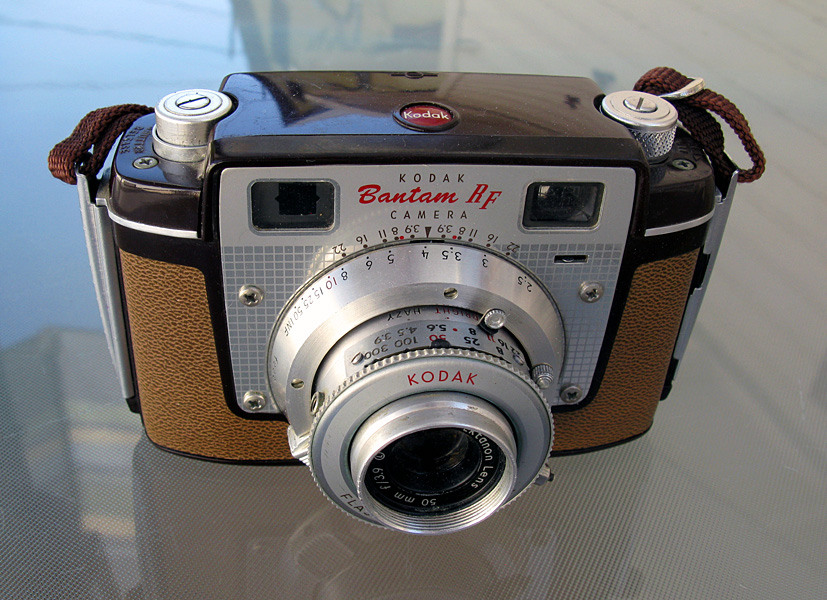
I rolled up a strip of 35mm color film in some trimmed 120 backing paper and shot it in my Kodak Bantam RF.  This is only the second roll I have put through the little 828 rangefinder.  I continue to be impressed by the quality the Ektanon lens is able to deliver.
    The Bantam RF, produced between 1953 and 1957, was second only to the Bantam Special in features and design.  Some simpler 828 models stayed in production in the UK until 1963.  Kodak, however, continued to market 828 film for two more decades.  That is a level of customer support and continuity which we are not likely to see again.


Negotiating Central Ave., Albuquerque's main East-West corridor, has become quite a challenge due to solid walls of traffic barriers required by the construction of a new rapid transit system.  The year-long project was initiated by Mayor Berry without consulting the electorate.  It could turn out to be a good thing for the city in the long run, of course, but appreciation of the Mayor's legacy may be delegated to some future generation.  Meanwhile, the Chamber of Commerce has being doing what it can to be supportive, presenting the Mayor recently with a Public Safety award -- this in a City with soaring rate of drug addiction and crime, and the Number One rating in the country for auto theft.  The citizens are only mildly amused.

Saturday, May 20, 2017

Kodak Pony 828

The 828 was the first in a long line of Pony cameras produced by Kodak in the post-war era.  It was a stunning departure from previous ideas about camera design, using new synthetic materials and jet-age streamlining.  When introduced in 1949 the camera carried a price tag of $29.95.  That seems cheap by today's standards, but when you take into account subsequent inflation, the original price is the equivalent in today's value to nearly $500.  So, Kodak was not in the business of selling cheap cameras.  They, like the other big manufacturers of the time, were really out to sell the idea of mass-produced prosperity.

Included in the Pony's sleek and ergonomic design was an extraordinarily big, bright viewfinder.  The camera's shutter/lens assembly could be telescoped inward to allow easy pocketing of the little camera.  The three-element Anaston lens was coated and produced pretty good sharpness, certainly more than adequate for its intended purposes.  With a top shutter speed of 1/200 and an aperture range from f4.5 to f22, the camera can still easily handle fast 400-speed film.  Most of these features would be passed along to other cameras in the developing Pony lineup which was switched to the more popular 35mm format.  The width of the 828 film is the same as 35mm, and it is not terribly difficult to roll a strip of 35mm film onto the 828 reels if one wants to try the camera today.  The small size and light weight of the Pony 828 make it a pleasure to carry and shoot.


The last shot illustrates the Pony's one design flaw which I have encountered.  The red-hued light leak is the product of an easily broken small plastic tab which is a part of the latch mechanism.  The camera will still seem to close tightly, but the missing portion of the tab may let in a bit of light.  Most newly acquired Pony 828 cameras are also likely to need some cleaning of the shutter, lens and viewfinder.  That is a pretty simple procedure which is very well illustrated at the Camera Collecting and Restoration web site.


I bought a Pony 828 used at the UW bookstore in 1961, just a couple years after Kodak ceased production of the camera.  I think I only shot a couple of rolls of film in it at the time.  I'm enjoying getting to know the Pony better all these years later.

Wednesday, April 19, 2017

Feeding the 828 cameras

I took my Kodak Flash Bantam across town to the Nuclear Museum.  As usual I spent most of my time there admiring the small collection of aircraft behind the facility.  The three Cold War era bombers all have new paint jobs and look much as they would have while in service.


There is now a bomb casing under the wing of the B-29 which is the same as that used for the Fat Man A-bomb dropped on Nagasaki in 1945.


There are still a few B-52 bombers being flown today. The plane's maiden flight was made in 1952 and it is projected to remain in service for two more decades.


I have mostly just rolled a strip of 35mm film with no backing paper onto the little 828 metal reels that fit in the Flash Bantam.  With the frame counter window blocked, that has worked pretty well for the most part, but on this occasion I decided to try rerolling some 35mm film along with backing paper.


I have a strip of 838 backing paper which I salvaged from an old roll bought on ebay.  I used that as a template and cut out a strip for use from a saved 120 Acros roll.  I inked in the frame numerals along with some leading dots.  That gave me framing for eight exposure, just as in the original.


Scissoring out the backing paper was simple.  Getting the strip of film in place inside the dark bag requires some patience.  Usually, the beginning of the film strip is taped to the backing and the trailing "exposed" end is left free.  I found it helpful to tape the trailing end first to keep it in place and then inserted the tab in the spool and rolled the film and backing toward the "start" end.  I had to repeat this process a couple times as I got some buckling of the film when I tried to tape it at the "start" end.  I found it helpful to completely roll up the film onto the second reel and then unroll it back to apply the tape to avoid buckling.  Being able to see the frame numerals through the camera's back window was certainly nicer than guessing at the required number of winder turns.  However, having just eight exposure available seemed very limiting, and probably explains much of why the 828 format went away.

My 828 Cameras

Whatever method one chooses to get film into one of the 828 cameras the process is going to be a bit labor intensive.  Winding unbacked film onto an 828 reel lets me get 15 to 20 shots per load, but I have experienced a few instances of blockage and tearing.  The diameter of the 828 reels is very small, and tightly winding the stiff film strip creates a highly tensioned coil spring which can get out of hand.
    I'm thinking my next experiment with this format will be to use a hybrid method, taping a couple of inches of backing paper to the beginning and end of the film strip.  It seems like that would provide a more secure way to attach the film roll to the reels and maybe avoid some of the problems that come with using a completely unbacked film strip.

 More information about preparing film for use in 828 cameras:

Monday, February 08, 2016

Shooting the Kodak Flash Bantam

The Kodak Flash Bantam is a strut folder and one of the company's finest cameras in a line that originated from a simple design by Walter Dorwin Teague in 1935. By 1947 when the Flash Bantam appeared on the market, the shutter allowed speeds of 1/25 to 1/200 plus B and T. The four-element Anastar f4.5 lens had an anti-reflective coating and provided sharpness comparable to anything available at the time. The flip-up viewfinder is very bright and easy to use, and when folded down contributes significantly to the little camera's pocketability. The lens is fully focusable by estimation.

Kodak stopped producing 828-format film in 1985, but it is still easily possible to use the 828 cameras today, including the Kodak Bantams and the Argus M. Expired rolls of 828 film are often available on eBay and some new custom-rolled is sometimes available too. In either case, the film is a bit pricey, particularly since the little 828 rolls yield only eight exposures. Some ambitious enthusiasts cut down and re-roll 120 film to fit the 828 spools; while that nicely reproduces the original experience of using the camera, it is pretty labor intensive. A much easier alternative is to use standard 35mm film with no backing paper. The sprocket holes on the 35mm film will protrude slightly into the image, but the ease of use and increase in film length will compensate for the slight loss of image area.
 
The method I arrived at for using 35mm in my Flash Bantam requires two of the original 828 metal spools. I trim the protruding film leader square and tape it to one of the reels. The film is placed in a dark film changing bag and rolled onto the reel. The film is then cut loose from the cassette and taped onto the second reel, at which point it can be loaded into the camera which has had the back window previously taped to prevent exposure of the unbacked film in the camera. Advancing the film between exposures is done by rotating the winding wheel one-and-one half full turns for the first six or eight exposures, and one full turn for the remaining exposures. A 24-exposure roll of 35mm film will yield 15 to 20 frames per roll using this method. I develop and scan my own b&w film, but it is also possible to use commercial processing by putting the film back in the dark bag, taping the film end to the stub of film sticking out of the cannister and rolling it back in.

In addition to securely covering the frame window on the back of the camera, there are a couple other very simple camera modifications to the Flash Bantam which will greatly enhance the use of the camera with 35mm film, and also improve the images that will be captured by the coated Anastar lens. The little movable pawl that engages a toothed wheel allowed easy frame positioning with the original 828 film, but it is not needed and is a nuisance when loading and advancing 35mm film. To keep the pawl from slipping into the film sprocket holes you can easily introduce a small piece of foam rubber between the pawl's lever and an over-hanging tab on the camera body.
Some of my first 35mm film images from my Flash Bantam were lacking in contrast and showed a hot spot in the middle of the image. The image problem looked initially like lens flare, but the real origin was reflection at the time of exposure off the plastic framing window on the back of the camera. The simple fix was a strip of black paper cut to fit between the springs behind the pressure plate; if made the width of the camera back it will cover the shiny screw heads there as well as the reflective inner surface of the plastic window.
In shooting the Flash Bantam it is a good idea to aim a little high with the viewfinder in order to properly center the image between the film's sprocket holes.

My Flash Bantam needed just some cleaning of the lenses and a little squirt of electrical contact cleaner into the shutter to get it working properly. An excellent tutorial on Flash Bantam shutter repair can be found at the Camera Collecting and Restoration site.

A manual for the very similar Bantam 4.5 can be found at the Butkus site.

Numerous examples of images made with the Flash Bantam are available on the blog.