Thursday, September 23, 2021

Exploring the Bosque

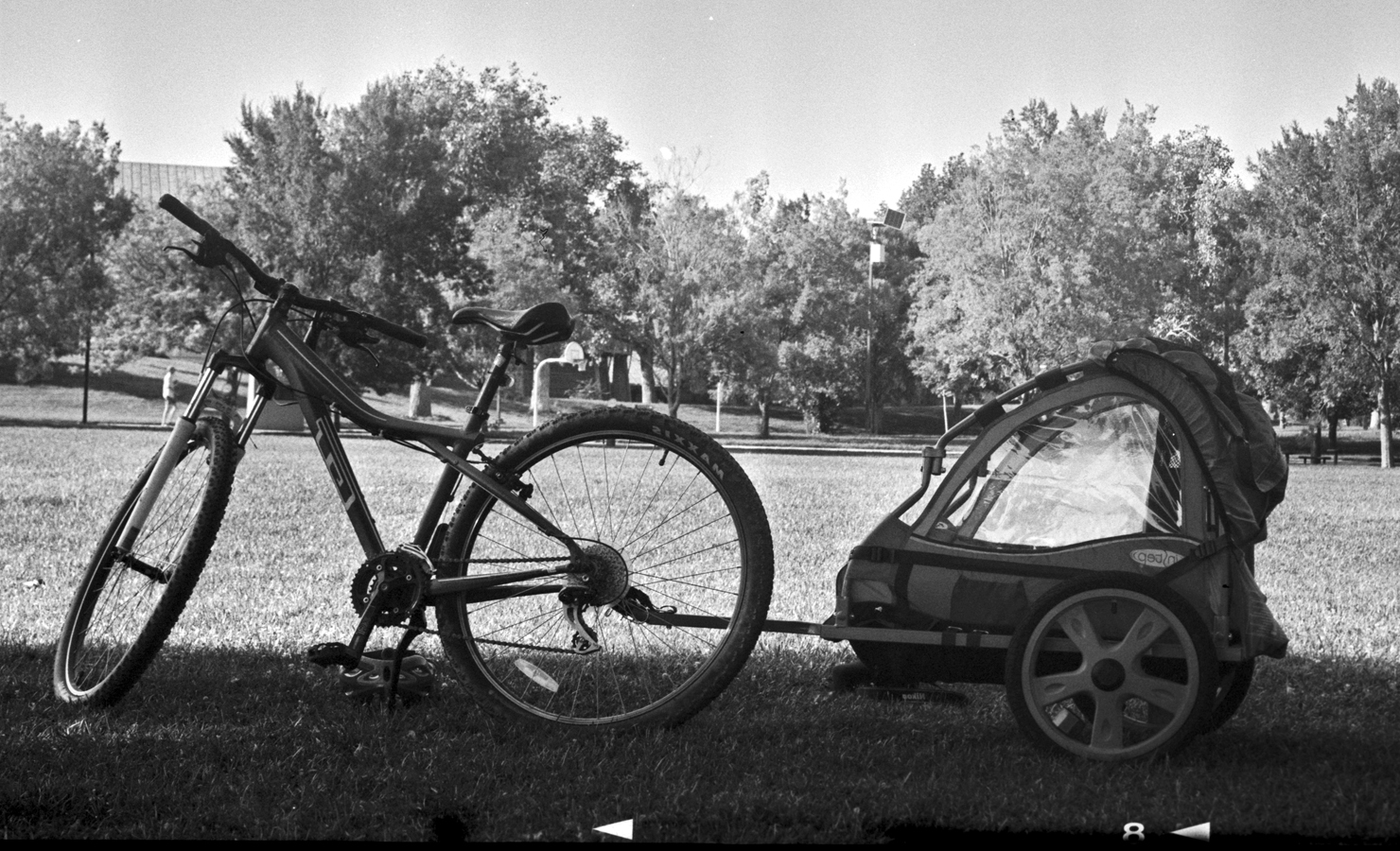
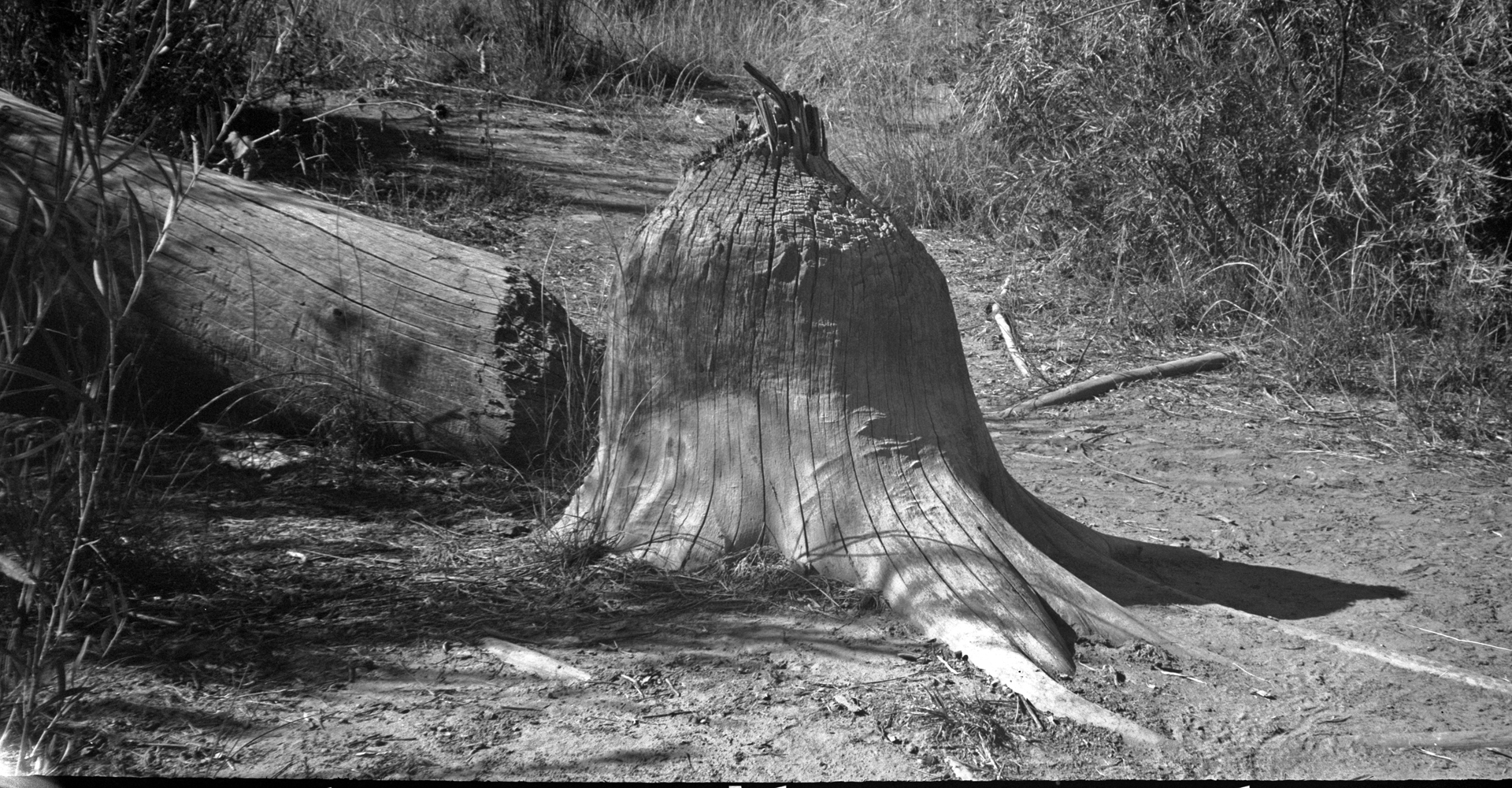
 I took a long walk with my 1A Pocket Special in the riverside forest at the east end of the Paseo del Norte bridge.  I saw some bike riders and skaters on the paved path that parallels the river, but no other people after that.  


I got six-and-one-half frames from this roll of Tri-X using some expired 120 Tri-X.  I think the century-plus camera has performed very well, but it is starting to show its age; there are some small light leaks appearing on the negatives and the ancient leather covering is disintegrating.  I think I will give the camera a well-deserved rest and move on to using a couple of my other, newer 116 Kodaks along with the very helpful 116 to 120 adapters.

Tuesday, September 21, 2021

Fomapan 400 Revisited

 I wasn't happy with some images on Fomapan 400 shot recently with my 1A Pocket Special and put them aside.  I started playing around with them again in Photoshop this evening and discovered that some rather radical adjustments to contrast, highlights and shadows revealed that there was quite a lot of useful detail available in the negatives.


The adjustments to the images got me a lot closer to what I want from my black and white medium format pictures in regard to sharpness and tonal range.  I'm thinking now that I need to take a close look at my Silverfast settings when I do the initial scans of the Fomapan 400 negatives.


The 116 to 120 adapters from the Film Photography Project look like they are going to make using 120 film in the 1A Pocket Special a lot more practical.  I also spent some time today in getting a better handle on advancing the film blindly since the red window is not of any use.  It seems that if I am careful in the advance process I could get as many as seven frames from a roll of 120.

Thursday, September 16, 2021

Fomapan

 I spent an hour at the Botanical Garden with my Kodak Reflex II.  I shot a roll of Fomapan 400 with the continuing hope that one of my usual developers would yield results that I can live with.  I processed this roll in PMK Pyro.


The negatives were very thin, looking like they could have used a couple more stops exposure or quite a bit more time in the developer.  

Meanwhile, Adorama had a half-price sale on Across II, so I picked up five rolls.  I also still have a few rolls of expired Tri-X that I like.  I'll play around with my few remaining rolls of Fomapan, but I'm not real optimistic about the prospects of getting what I want in regard to grain and tonal values.

Saturday, September 11, 2021

116 to 120

 I tagged along with a fellow New Mexico Film Photographer on a visit to the Old San Ysidro Church and Cemetery in the community of Corrales.  


We managed to get to the place shortly after sunrise and found some very nice light.  I was pleased to get seven frames from a roll of 120 in my 116-format Kodak No.1A Folding Pocket Special.  Unfortunately, the film rolled crookedly onto the take-up spool, so all the shots were a bit cockeyed.  I had taped the film backing to the take-up spool to try to avoid that, but to no avail.

When I first began using this camera I had put some foam padding on the end caps to keep the 120 ilm from getting off track.  That reel got lost along the way, and I don't have any suitable material on hand to duplicate that arrangement.  I decided I would try some 116 to 120 3D-printed adapters which would let me use actual 120 film spools on both ends.  I ordered the adapters from the Film Photography Project at a cost of $20, and I should have them in about a week.  

Tuesday, September 07, 2021

Gekko MW 100 plus

 I shot a roll of the expired Gekko film in my Kodak Signet 35 and developed in HC110b for five minutes as indicated by the chart on the inside of the box.  The grain seemed pretty pronounced for 100-speed film, and it took some heavy adjustments in Photoshop to approach the correct tonal balance.


The box says "Made in Europe".  I found some claims that the Gekko is repackaged EFKE, but no evidence to support that assertion.  I thought perhaps I might use the suggested development times for dozen films listed inside the box to help identify the film.  However, nothing in the Massive Dev Chart fits that profile.

I think I'll next try using Rodinal, maybe with a bit more development time to compensate for age.  Stand development might help to smooth the grain a bit.

Thursday, August 26, 2021

Sundown in Old Town

 I took a walk around Old Town late in the afternoon with the idea that the low sun would illuminate some compositions for me.  The Genos Rapid box camera handled the idea pretty well, but my processing of the Fomapan 100 still leaves something to be desired.


Fomapan is the only medium format film these days which is priced at a level I'm willing to pay, so I'm hoping I'll hit on a developer that will let me approach the quality I have gotten in the past from TMAX or Acros.

Saturday, August 14, 2021

A Morning at the Zoo

 I was one of the first visitors through the gate of the Rio Grande Zoo on Friday morning.  I was alone for much of the hour circuit of the exhibits.  As it turned out, there were also few animals to be seen as most had yet to be let into their outdoor spaces.  I decided to head back toward the exit by way of the Africa section and found to my delight that the hippos and their month-old baby were in the pond.


I think it has been determined that the baby is a female.  I believe that she weighed about fifty pounds at birth.  She is playful and active and seems completely comfortable in her aquatic environment.  While I watched, the mother several times swam under the bridge over the pond, and there was a good deal of thrashing and bellowing underneath as she was apparently letting the big male know that he was expected to remain in the small section of the pond well away from the little one.


The cheetah's enclosure is near the hippos and they were also active, possibly inspired by the cool morning air.

I gave the expired Fuji 400 an extra stop of exposure and some extra time in the Cinestill C-41 to compensate for the film's age and the fact that this was the 13th roll through this processing kit.  The aperture-priority automation of the Pentax ME makes it a very pleasant camera to shoot; all these shots were made with the SMC Pentax-A f/2.8 135mm lens.

The camera's well-placed controls, bayonet lens mount and compactness makes it a quick shooter.  To appreciate the small size of this advanced slr it is worthwhile to compare it to my Leica IIIa; the body dimensions are nearly equal.  Of course, that is a tribute to the pioneering Barnack design,  as well as to the Japanese innovators who brought the 35mm format into the latter half of the Twentieth Century.

Wednesday, August 11, 2021

Restorations

Here are a couple more shots from my Friday morning session in Old Town with the Kodak No.1A Folding Special.  The images were cropped to compensate for poor framing, but I like them because they show the nice qualities which the Bausch and Lomb Rapid Rectilinear lens can deliver.  I was also happy with the tonal range produced by the combination of the expired Tri-X and processing in HC110e.


The Rapid Rectiliner lens, also known as the Aplanat, dates back to 1866.  As can be seen in this illustration from Wikipedia the design features four elements in two groups arranged symmetrically on either side of the aperture.


Here are comments on the design by Rudolf Kingslake, a Director of Optical Design at Eastman Kodak Company from his book, Lenses in Photography, 1951 (p.122-123):

The Rapid Rectilinear Lens -- By 1866 lens theory had developed sufficiently to indicate how the two components of a duplet could be corrected for spherical aberration even though they were bent into the meniscus shape necessary for a flat field, the symmetry being relied upon to eliminate coma, distortion, and lateral color.  The result was the f/8 Rapid Rectilinear...

The aperture scale on my 1A Special shows a value of "4" as the widest aperture setting, however that is because the scale is using the Universal System values in use by Kodak at the time.  In that system the mid-scale value of 16 is the same as the f/16 value in the system now in use.  The next lowest value in the Universal System is expressed as 8 to indicate twice the exposure value of the previous setting.  And, the last Universal System value on my camera is 4, but that actually corresponds to f/8 in the current system of aperture values which are expressed as a ratio of focal length to aperture diameter.

Saturday, August 07, 2021

From the Kodak 1A Folding Pocket Special

 A newcomer to the Friday morning car klatch in Old Town stirred some interest.

I think this car started out as a '36 Plymouth, but it has been extensively modified.

These shots are from my No.1A Folding Kodak Special with a four-elements-in-two-groups Rapid Rectilinear lens.  The outer covering of my camera is quite deteriorated, but the shutter works fine and there are no pinholes in the red bellows.

The camera was built to use 116 film which yielded 12 shots that measured 2.5 x 4.25 inches.  While the camera seems big and awkward by today's standards, Kodak ads touted it as an exceedingly compact instrument.  In fact, the 1A and the even bigger 3A cameras were what was used by the early photojournalists like Jack London and Jimmy Hare.

Turn-of-the-century cameras are interesting because camera control features tended to vary a lot from one manufacturer to the next.  The shutter on this camera, for instance, includes a frame counter that was actuated by the shutter release, which was best operated with a pneumatic bulb.  The aperture settings are designated by the U.S. standard of the time rather than the current f-stop ratio values.

The focusing scale has settings only for 6, 10, 25 and 100 feet.  Turning the thumb wheel brings a pin into position which serves as a stop when the lens/shutter mount is pulled forward.  Because of the short length of the scale, distances between the indicated stops cannot be easily determined and set, so bright shooting light and small apertures are helpful to achieving proper depth of field. 

One very nice feature of the 1A Special was a reflex finder that was very large and bright compared to those of later Kodak folders.  Mine is especially easy to use thanks to the replacement of the original deteriorated mirror by a mirror sliced from an old Polaroid camera.


I have only shot 120 roll film in my 116 cameras and that requires a bit of ingenuity in loading and advancing the film.  The big 116 spools are held in place by spring-loaded pins.  To use the camera with 120 film spools I made a film holder from an Adox plastic film can and foam spacers.  When operating the camera, the ruby window is covered and the film is advanced by two-and-one-half turns of the advance key to achieve adequate spacing, yielding five or six frames per roll.  It is also possible these days to acquire 3D-printed spacers to properly hold the 120 film spools in position.

Wednesday, August 04, 2021

A Walk in the Park

 I shot another roll of expired Tri-X in the No.1A Pocket Kodak on a morning walk through our nearby park.  My main objective was to test a strategy for correctly spacing the frames.  I decided after advancing the film by an initial eight and one half rotations to get to the first exposure I would then give two and one half turns to get to the second frame.  From there the plan was to decrease the film advance by one quarter turn for each subsequent frame with the hope of getting six or more shots on the roll of 120 film.


Well, the first two frames looked just right.  After that the pictures started to run into each other and I ended up with just muddled fragments of images on the rest of the roll.  Not the hoped for outcome, but it was a fun outing in which I learned something, and I thought the bits and pieces still showed some of the nice qualities which the Kodak Anastigmat lens can produce.


In addition to the frame spacing problem, I also ended up having to square up most of the images in Photoshop as a result of grossly tilted horizons.  For that, I'm blaming the use of the tiny reflex finder which seems to aggravate my tendency to misperceive which way is up.  So, for my next outing I'll try using the open frame finder which I usually tape onto the top of my folders, as well as a revised film advance routine.

The one thing I'm pleased to report was not a problem was focal distance estimation.  Snapping pictures under the full Summer sun with a top shutter speed of 1/50 and 400 speed film, the correct aperture setting is f45.  Having consulted a dof calculator before setting out, I knew that the hyperfocal distance for the 127mm lens at that setting was seventeen feet, and that everything from 8.5 feet to infinity would be sharply focused.  For some of the closer shots and with the aperture a stop or two wider the available depth of focus was still well within my margin of error for distance estimation.

Monday, August 02, 2021

New from the No.1A Pocket Kodak


I thought the camera performed well, though I am clearly out of practice with it.  Film advancing with 120 in this 116 camera has to be estimated.  I gave it 2-and-one-half turns between frames which yielded just five frames from the roll.  I should be able to get 6 frames if I graduate the advance properly.

The combination of expired Tri-X and HC-110b was a little disappointing.  I got better results with the previous roll of Tri-X in Rodinal at 1:50.  


I came across the tourist from Trumpland in downtown Albuquerque on a Sunday Morning, luckily on a short leash.

The ragtop was part of the regular informal Friday morning car show in the Plaza Vieja.


The No.1A Pocket Kodak has been the best performer among my collection of old folders, so I'm going to stick with shooting it for a while and do a little experimenting with different films and developers.