Showing posts with label stand development. Show all posts

Wednesday, August 04, 2021

A Walk in the Park

 I shot another roll of expired Tri-X in the No.1A Pocket Kodak on a morning walk through our nearby park.  My main objective was to test a strategy for correctly spacing the frames.  I decided after advancing the film by an initial eight and one half rotations to get to the first exposure I would then give two and one half turns to get to the second frame.  From there the plan was to decrease the film advance by one quarter turn for each subsequent frame with the hope of getting six or more shots on the roll of 120 film.


Well, the first two frames looked just right.  After that the pictures started to run into each other and I ended up with just muddled fragments of images on the rest of the roll.  Not the hoped for outcome, but it was a fun outing in which I learned something, and I thought the bits and pieces still showed some of the nice qualities which the Kodak Anastigmat lens can produce.
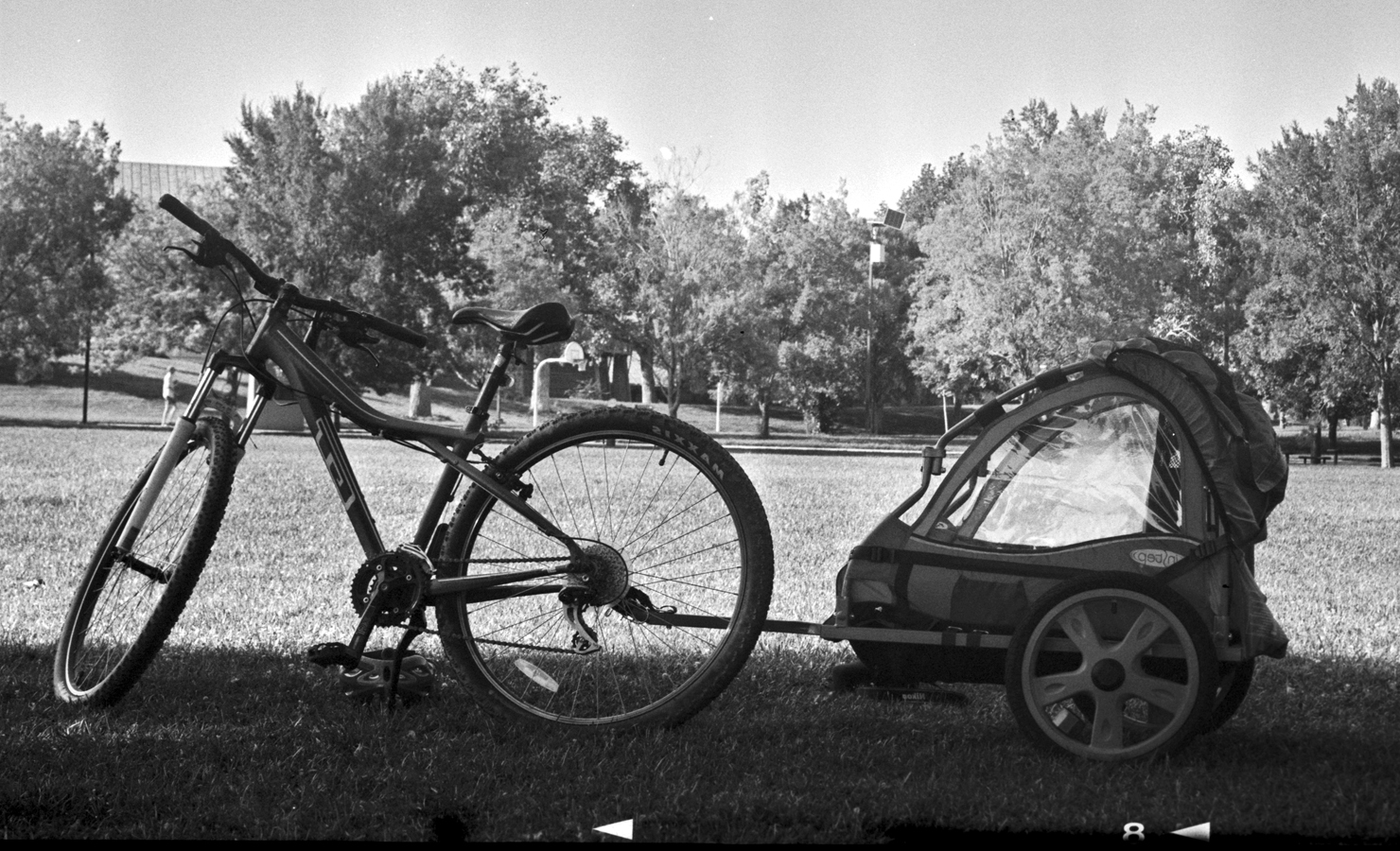

In addition to the frame spacing problem, I also ended up having to square up most of the images in Photoshop as a result of grossly tilted horizons.  For that, I'm blaming the use of the tiny reflex finder which seems to aggravate my tendency to misperceive which way is up.  So, for my next outing I'll try using the open frame finder which I usually tape onto the top of my folders, as well as a revised film advance routine.

The one thing I'm pleased to report was not a problem was focal distance estimation.  Snapping pictures under the full Summer sun with a top shutter speed of 1/50 and 400 speed film, the correct aperture setting is f45.  Having consulted a dof calculator before setting out, I knew that the hyperfocal distance for the 127mm lens at that setting was seventeen feet, and that everything from 8.5 feet to infinity would be sharply focused.  For some of the closer shots and with the aperture a stop or two wider the available depth of focus was still well within my margin of error for distance estimation.

Friday, December 18, 2020

P30 Hits a Pothole

 I found a couple rolls of Ferrania P30 in my refrigerator donated by a generous friend.  I decided to give it another go after looking at my first experience with this slow, high-contrast, fine-grain film.  The first time I shot this film was in a camera with which I was unfamiliar; I didn't know what to make of the results.  Taking a second look, I decided the stuff looked promising.  I loaded the film in my 1955 FED 1g, a Leica clone from the Soviet era.


Not far into the roll of film, the advance started getting erratic.  I skipped some frames trying to get past the problem, but it only got worse.  Halfway through the roll the advance locked up.  I called it a day, and went home to process the P30 in Rodinal 1:100, stand development.

There is nothing actually wrong with the 1g.  The issue is the difference in the height of the modern film cartridges from the height of the reloadable cassettes designed for the FED 1g and similar FED and Zorki cameras from the same era.  My solution up to now has been to lay a penny on top of the film cassette to compensate for the lesser height of the modern film cassettes.  As the current experience demonstrates, this is not the ideal solution.

So, I disassembled the camera in order to clean out the chewed up film bits.  I wiggled the advance mechanism a bit to get it turning again and lubricated the advance gear train with some light oil.  That got things working pretty smoothly, so I reassembled the camera and looked for a better way to align the film in the camera.  What I came up with was a plastic washer the same diameter as the film cassette and about the right thickness to to hold the film cassette down to allow the film to travel through the camera without jumping off the sprockets.

I've got one more roll of P30.  I'll load it up in the 1g and try shooting a stop faster to see if I get better highlight and shadow detail.

Sunday, June 16, 2019

Stand Development

Stand development doesn't necessarily produce better results than many other techniques, but it is certainly simpler and less costly.  These images on Kentmere 100 were stand developed with 5ml of Rodinal in 500ml of distilled water, a 1:100 dilution.  That yields a developer cost of about sixteen cents per roll.  To that you have to add in the cost of fixer, distilled water and shipping charges, but the total per roll is still nearly negligible.


Time and temperature requirements for most processing procedures usually require quite precise control.  Those variables in stand development however are not critical.  In this case, I just used the developing solution at room temperature without recourse to a thermometer.  The developer was poured into the plastic film tank and the timer was set for thirty minutes after thirty seconds of initial agitation.  After that, I did not touch the tank until the buzzer sounded, at which point I agitated the tank for a few seconds and then left everything to sit for another thirty minutes.


Another nice feature of the stand development process is that no allowance need be made for different films or film speeds. It doesn't matter if you are using a slow, fine grained film like Kentmere 100 or something faster like Tri-X.


I have gotten similarly nice results from stand development using HC-110, and the cost is even slightly less as I have been able to use just 4ml of developer in 640ml of water for a dilution of 1:160.


There are a lot of recipes for stand development available on the web which advise small differences in total time and dilutions, but it seems the results are little different.  A good overview of the process is given at the hjlphotos site.

Tuesday, January 05, 2010

snowsuit


This is my first try at stand development. I was pleased that it turned out reasonably well using Tmax 100 in Rodinal at 1:160 for 75 minutes. I've gotten nicer results from 1:50 at the recommended time, however, so I don't know if it is really worth experimenting further with this technique.