Thursday, July 04, 2019

The Church of Ansel

We spent a couple days in Taos.  I've been there several times over the years we have lived in New Mexico, but I've never taken the time before to explore the place with my cameras.  I decided on this occasion that I would devote a chunk of time to one subject, the San Francisco de Asis church south of town.  Ansel Adams and Paul Strand immortalized the place early in the last century.  It seemed a nice opportunity to see what they saw and to develop some appreciation of how they approached the subject and how they interpreted it.


The first thing that struck me was that the church is a lot smaller than it appears in the pictures made by Adams and Strand.  They both used large format cameras that allowed them a lot of control over surface textures, depth of focus and perspective.  Their results may seem deceptive today, but it is also possible to argue that emphasizing a kind of monumentality in their portrayals was true to the impression people would have had of the structure when it was built two centuries ago.  My own pictures of the place were made with a relatively simple box camera with few controls, and partly for that reason they reflect a more contemporary and ephemeral view of the site.


I started taking pictures of the church at 6:00 AM when the sun was low and not yet too bright.  That favored the estimated focus, the two apertures, and the shutter that is limited to 1/25 or 1/50 sec. in the Vredeborch Felica box camera.


After I exposed the twelve frames available on the roll of 120 Fuji Acros rollfilm in the Felica I switched to shooting Arista Ultra Edu 100 in my Pentax ME, mostly using the 28mm f2.8 SMC Pentax M.  The final portion of the two hours I spent at the church were given over to shooting Kodak ColorPlus 200 in my Olympus Infinity Stylus.  It will be interesting to compare the results from those two cameras to what came from the Felica box.  Of course, the light later in the morning was very different, and there were some additional characters on the set including several cats and one devout parishioner.

Coincidentally, the day after we got home, the Albuquerque Art Museum offered a morning screening of the PBS biography of Ansel Adams made some years ago, I think.  It was worth watching, mostly because of the brilliant commentary by John Szarkowski.  Photographers watching the film will grit their teeth during the constant zooming and panning of Ansel's images by the cinematographers.

Thursday, June 27, 2019

One-Eighty

I finally got around to shooting the C330 twin lens reflex with the 180mm lens.  That focal length on a 35mm camera would be a substantial telephoto, but on the 6x6 C330 it is still just in the portrait lens category.


     While the big 180 lens set adds to the already hefty size and weight of the camera I found that taking the time to get used to handling the camera was an effort well spent.  The accessory grip helps free up the right hand for adjusting focus and tripping the shutter.  The eye-level finder also makes the outfit more responsive to fluid photo scenes.


I probably won't make a lot more use of the 180mm lens set on the C330, but I am getting more comfortable with using the camera, and I'm looking forward to using it more often.

Saturday, June 22, 2019

Nine O'Clock

I took a morning walk on the grounds of the Rio Grande Nature Center.  The sun was already high in the sky by nine, so I was glad I had loaded some TMAX 400 film which copes well with contrasty lighting.  The big Mamiya C330 would have performed better for me if I had brought along a tripod, but the Porroflex finder let me make some shots that that would have required some athletic contortions with the waist-level finder.


The C330 is unique in its capacity to focus and frame the image as close as 7 inches due to the bellows focusing and a moving bar in the viewfinder which shows the user how to vertically adjust the camera to compensate for the difference in views between the viewing and taking lenses.  At the same time, it is also necessary to pay attention to a scale in the viewfinder which indicates exposure compensation associated with the extension of the bellows.  For instance, with the bellows extended to focus on a subject about a foot from the camera, it is necessary to increase the aperture two stops to get proper exposure.


People in the Southwest have been keeping track of the sun's movements for a long time.  See teofilo's annual solstice blog post today about The Mesoamerican Context for Chaco Astronomy.

Sunday, June 16, 2019

Stand Development

Stand development doesn't necessarily produce better results than many other techniques, but it is certainly simpler and less costly.  These images on Kentmere 100 were stand developed with 5ml of Rodinal in 500ml of distilled water, a 1:100 dilution.  That yields a developer cost of about sixteen cents per roll.  To that you have to add in the cost of fixer, distilled water and shipping charges, but the total per roll is still nearly negligible.


Time and temperature requirements for most processing procedures usually require quite precise control.  Those variables in stand development however are not critical.  In this case, I just used the developing solution at room temperature without recourse to a thermometer.  The developer was poured into the plastic film tank and the timer was set for thirty minutes after thirty seconds of initial agitation.  After that, I did not touch the tank until the buzzer sounded, at which point I agitated the tank for a few seconds and then left everything to sit for another thirty minutes.


Another nice feature of the stand development process is that no allowance need be made for different films or film speeds. It doesn't matter if you are using a slow, fine grained film like Kentmere 100 or something faster like Tri-X.


I have gotten similarly nice results from stand development using HC-110, and the cost is even slightly less as I have been able to use just 4ml of developer in 640ml of water for a dilution of 1:160.


There are a lot of recipes for stand development available on the web which advise small differences in total time and dilutions, but it seems the results are little different.  A good overview of the process is given at the hjlphotos site.

Saturday, June 01, 2019

black and white

I'm liking my initial results from Arista.Edu Ultra 100, though I think can do better with some adjustments in exposure and processing.


Wednesday, May 22, 2019

Cars in Color

After finishing the roll of TMAX 400 in my Ansco Panda I made another trip through the museum car show with the Minolta Hi-Matic 7s loaded with Kodak ColorPlus 200.


All the Hi-Matic shots were made with the camera in full-auto exposure mode.  The camera was built to accommodate a 1.35v Mercury battery.  Not having that, I used a 1.5v and adjusted the ASA down to 125.  The exposure values shown in the camera's viewfinder matched those of a reliable handheld meter, but I still got a bit of underexposure in the negatives.  I think there are some 1.4v batteries available that might give better results, so I'll try to track down a source.
     I'm not sure how the coupled meter adjusts both the speed and the aperture.  The shutter release has quite a long throw, so I suspect the mechanism works in a somewhat similar fashion to the way exposure is handled by the Olympus RC, although the Oly offers only shutter-priority and full-manual modes.


The full-auto mode in the Hi-Matic 7s is not entirely to my liking due to the fact that the meter reading in the viewfinder only displays an EV value, so you do not know the exact aperture and shutter settings that are being selected by the system.  Theoretically, you can set the Hi-Matic's shutter and let the camera adjust the aperture, but I'll need to get a battery with the proper voltage to make sure that everything is working as designed.  Of course, full-manual operation is also an option, but the narrowness and closeness of the setting rings on the lens makes that process a bit awkward.

Monday, May 20, 2019

Museum Car Show

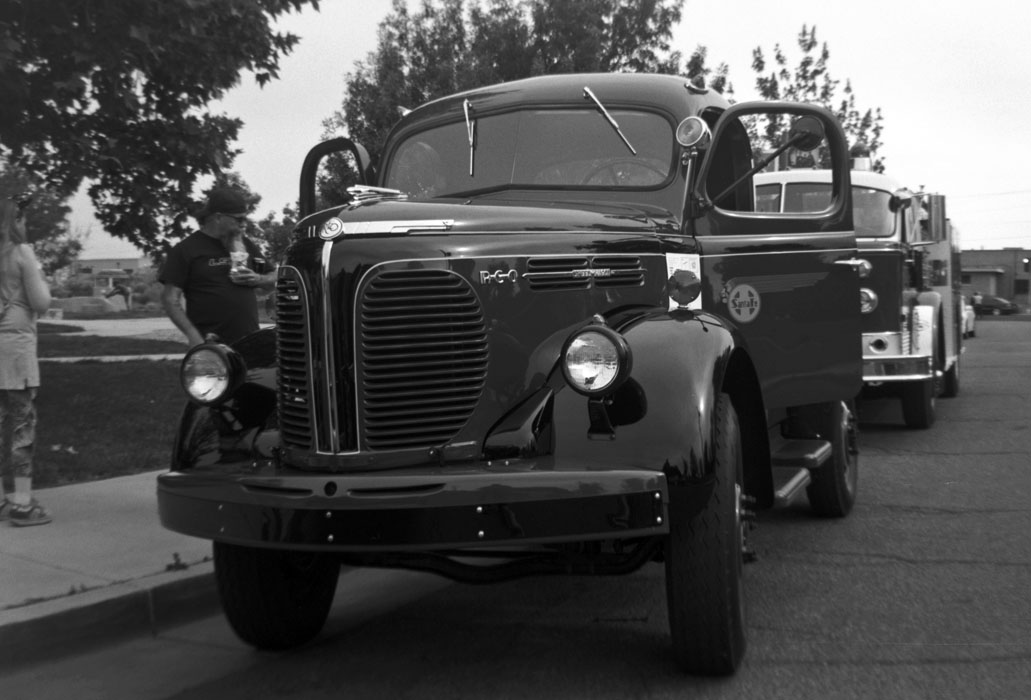
I took two cameras to photograph the yearly Albuquerque Museum car show.   First up was the Ansco Panda, my favorite box camera.  My plan was to use Fuji Acros in the camera, but the sky was overcast, so TMAX 400 seemed the better choice.  (Click the images to view full size.)


The Panda seems to me to be the perfect camera for shooting car shows.  It is small enough to stuff in a jacket pocket and the camera's short focal length provides a wide angle perspective I like.  Having to re-roll 120 film onto the 620 reels needed by the Panda is only a minor inconvenience.

Wednesday, May 15, 2019

High Water

The Rio Grande is running high and fast thanks to Spring rains.  There is still quite a lot of snow in surrounding mountains, so the high water is likely to last well into Summer.


Near Albuquerque the river is seldom much above ankle deep, but this year the water is surging powerfully past the city and overflowing the banks to penetrate the bordering cottonwood forest.  Roads and paths beside the river have been transformed into swift flowing streams.  In low spots near the new stream banks the rising water gently lifts the leaf litter into an illusion of solid ground.


The high water is bound to be transformative for plant and animal populations along the river.  Cottonwood seedlings will have an unusual opportunity to gain a foothold.  The Yerba Mansa and the wolf berries will thrive and the mulberry trees will become heavy with fruit as the weather warms.  The porcupines will continue feasting on leaves and twigs high in the cottonwoods.  What of the small burrowing animals though?

We will be traveling toward the end of the May to Las Cruces. I will be interested in seeing how much of the high water makes it to the south.  In recent years, the Rio Grande there has been little more than a string of puddles, with farmers relying increasingly on pumping ground water for irrigation.  When we lived there south of Hatch fifteen or twenty years ago Spring floods seemed a regular occurrence. Water-blocked roads were a brief inconvenience, but it was always great to see the flocks of water birds appear suddenly to take advantage of newly replenished wetlands.

Saturday, April 27, 2019

Moving up to a ten dollar camera

I haven't used my yard sale Nikon EM much since acquiring it about four years ago.  The main reason for that is that I have a couple of other very good Nikons including an FE and an F2.  The EM does have some nice features, though, and I'm going to try to use it more.  The camera is compact and light weight.  With the Series E 1.8/50mm lens mounted it is easy to carry and even shoot one-handed.

With the nice Spring weather we've been having I was pretty sure I would find a Friday morning car show in progress in the Old Town Plaza.