Showing posts with label Kodak TMAX 400. Show all posts

Thursday, April 10, 2025

TMAX

 I haven't felt like paying the price for Kodak TMAX for the past five years, but I did recently find a roll of expired TMAX 400 in a refrigerator drawer to load into my Minolta X-700.  The thirteen years past the expiration date did not seem to significantly affect the results.

New Mexico Museum of Natural History

Albuquerque Art Museum

Tiguex Park (west end)

Rio Grande

Bosque

Tiguex Park (east end)

Good bye to cataracts

Tuesday, June 08, 2021

Yerba Mansa

 Summer along the middle Rio Grande is announced by the blooming of the Yerba Mansa.  This year the season started a little early, probably thanks to warm temperatures and some welcome rains.

The dense patches of fleshy green leaves blanket acres of the boggy cottonwood forest floor.  The plants do well in the deep shade, but the blossoms are thickest where a bit of direct sunlight reaches them during the day.


The seed forming flowers are actually the small petals clustered on the central cone structure.  The likely function of the showy white bracts is to attract sphinx moths and other night-roaming pollinators.  In addition to the production of copious amounts of seeds, the plants also spread with dense mats of runners near the soil surface.


While the towering cottonwoods are dominant, they share the space with many other shade-tolerant species including Mulberries, Russian Olive, and Wolf Berries.


These first pictures of the year were made with my Nikon F on TMAX 400 film.  I look forward to visiting the Yerba Mansa several more times as they mature during the summer with other cameras.  I am  also pleased to see that the small Yerba Mansa which I planted a couple years ago beside the house look like they might finally produce a few flowers.

(See: The Yerba Mansa Project)

Ignore this pic.  It is for another post elsewhere.


Sunday, February 07, 2021

Nikon FG-20

 The Nikon FG-20, dating from 1984, is compact and light-weight like the Nikon EM which preceded it.  While the FG-20 shares many features with the EM it has a full range of manually selectable shutter speeds in addition to an auto-mode for the electronic shutter.  Like the EM, the relatively inexpensive FG-20 will allow use of most of the great bayonet-mount lenses made for the earlier F-Series cameras.


The Nikon FG-20 does not offer the smooth precision in operation of the earlier pro-line F cameras, but it is rugged and reliable.  The previous owner of this example bought the camera used in the 1980s and shot it well into the '90s.  It then sat in in a camera bag unused for about twenty years.  When I got the camera, I removed the two long-dead batteries, installed new ones and the camera came to life and seems to be operating nearly like new.


The Nikon FG-20 came to me in its original big camera bag along with a full set of accessories including documentation, filters, electronic flash and a motor winder.  There was also a 2.8/28mm Zykor MC Auto lens and a Vivitar Series 1, 3.5/70-210mm Macro Focusing Zoom which focuses down to four feet.  There is some fungus creeping in from the periphery of the Zoom's front lens; it doesn't look like that is affecting image quality at present, but it would be nice to get it removed before it gets any further.  The motor winder had some ancient corroded batteries left inside and is not currently functional.  I likely won't get around to using the flash or the winder, even if I can get them working.

Saturday, June 22, 2019

Nine O'Clock

I took a morning walk on the grounds of the Rio Grande Nature Center.  The sun was already high in the sky by nine, so I was glad I had loaded some TMAX 400 film which copes well with contrasty lighting.  The big Mamiya C330 would have performed better for me if I had brought along a tripod, but the Porroflex finder let me make some shots that that would have required some athletic contortions with the waist-level finder.


The C330 is unique in its capacity to focus and frame the image as close as 7 inches due to the bellows focusing and a moving bar in the viewfinder which shows the user how to vertically adjust the camera to compensate for the difference in views between the viewing and taking lenses.  At the same time, it is also necessary to pay attention to a scale in the viewfinder which indicates exposure compensation associated with the extension of the bellows.  For instance, with the bellows extended to focus on a subject about a foot from the camera, it is necessary to increase the aperture two stops to get proper exposure.


People in the Southwest have been keeping track of the sun's movements for a long time.  See teofilo's annual solstice blog post today about The Mesoamerican Context for Chaco Astronomy.

Monday, May 20, 2019

Museum Car Show

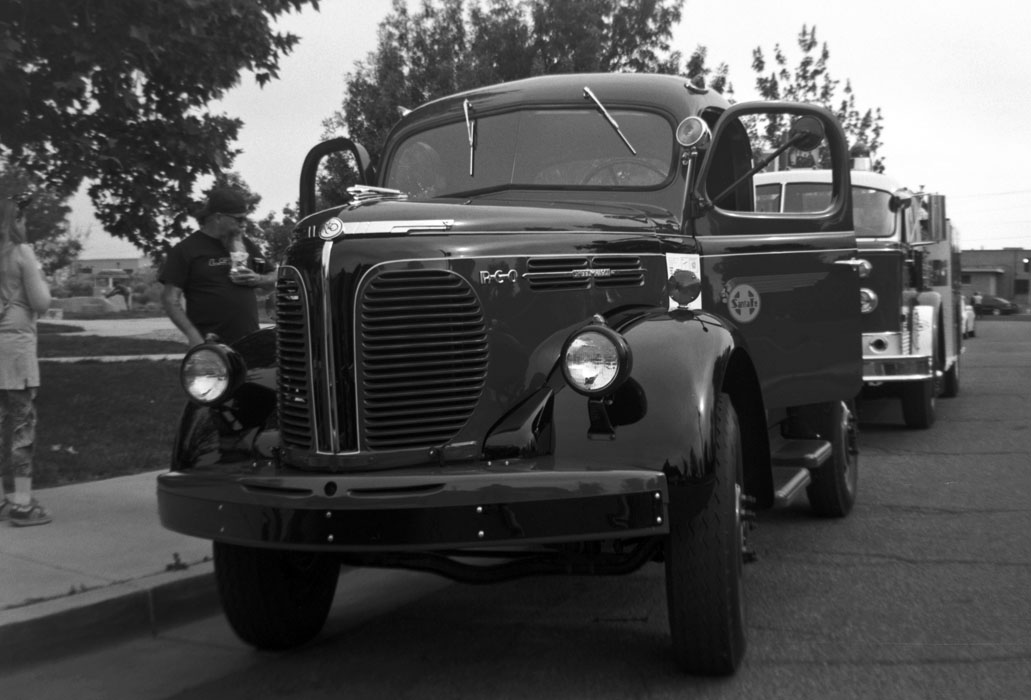
I took two cameras to photograph the yearly Albuquerque Museum car show.   First up was the Ansco Panda, my favorite box camera.  My plan was to use Fuji Acros in the camera, but the sky was overcast, so TMAX 400 seemed the better choice.  (Click the images to view full size.)


The Panda seems to me to be the perfect camera for shooting car shows.  It is small enough to stuff in a jacket pocket and the camera's short focal length provides a wide angle perspective I like.  Having to re-roll 120 film onto the 620 reels needed by the Panda is only a minor inconvenience.

Tuesday, January 01, 2019

Snow

A sunny day illuminated the Sandia Mountains graced with a six-inch layer of snow.  I took the dog and my Kodak Reflex II tlr loaded with TMY 400 for a walk up the Embudito Trail.  I got a couple overlapping frames on the roll, but the camera otherwise performed pretty well until I reached the eighth frame.


I was able during the first half of the walk to let the dog loose while I concentrated on making pictures.  When I started running into people and their dogs I had to put the dog back on the leash, and that pushed beyond the boundaries of success with an old tlr.


Near the top of the trail I decided to try a close-up shot.  I got the film advanced to the eighth frame, but my slightlly impaired  vision, the dog pulling on the leash and numb hands ended my photo session.  I stared cranking the focus without really seeing or feeling what I was doing and managed to completely screw off both lenses which dropped into the snow.  While that was it for the tlr, I thought I might still grab a few shots on the way back down the mountain with the Olympus Infinity Stylus I had in my pocket.  Looking at the time, however, I saw that it was 3:30 PM.  I was supposed to be sitting down to dinner with freinds at 4:30 and we were at the top of a long, slippery trail and a drive across town.  So, I just hooked up the dog and we made as close as I could get to a lightning descent.


The next day, after consulting Rick Oleson's exploded-view drawing  and the berndtmn camera repair page, I spent a couple hours reinstalling and collimating the lenses on the Reflex II.  I'll load a roll of Acros to see if I got the focus properly set.  Most of the snow was burned off the Sandias after another day of sunshine, but we look to be in for another big storm starting on New Years Day.

Wednesday, October 31, 2018

Twin Trouble

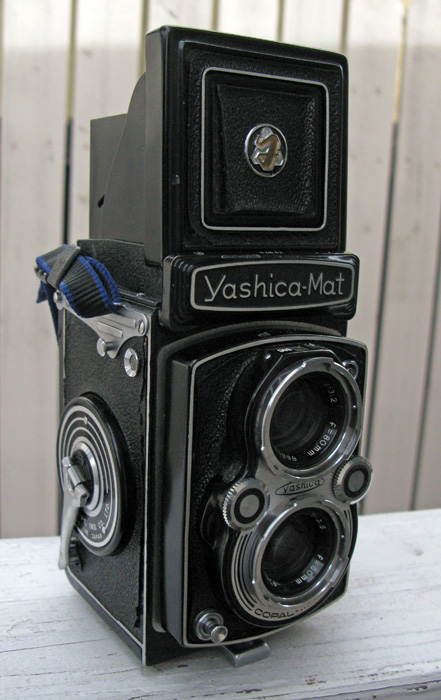
I took my Yashica-Mat twin-lens reflex to Chaco about a year ago hoping to do some pictures of the ruins, but the film advance jammed on the first shot.  I tried another roll recently on a walk through Albuquerque's Old Town and found that it still has a problem with the shutter release and the film advance.  I was able to get past the problem with some jiggling of the focus control, but a good cleaning and adjustment is clearly called for.  I found a good service guide on the web, so will try to motivate myself to tackle the job some time in the future.  I have several good tlr cameras in addition to the Yashica-Mat, but the Lumaxar lens on the Yashica is a stellar performer.