Sunday, October 29, 2017

Fall

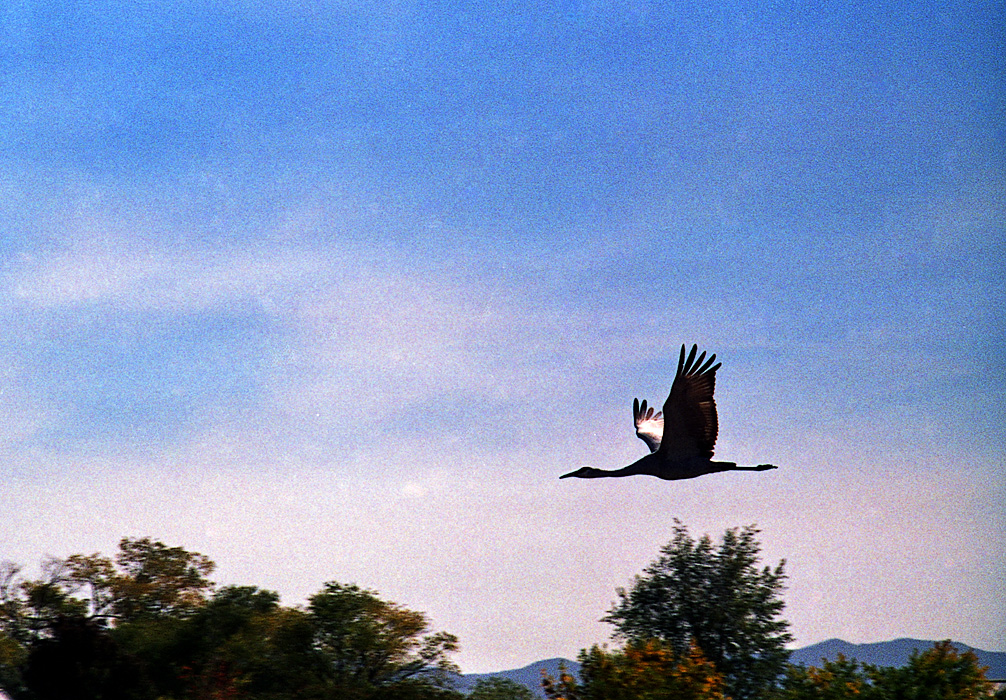
This is always the best time of the year in the Southwest.  The tourists have gone back to their own reality, allowing the natural rhythms of the days and seasons to reemerge.


The Sandhill Cranes reappear in the open spaces around the city  as the harvest is underway. By the end of November they will congregate in the shorn fields by the hundreds.


Mornings in the city are cool and quiet, welcoming to walkers, cyclists and the small ceremonies and rituals of daily life.


Friday, October 27, 2017

Lost

I shot a roll of Rerapan in the Ihagee Auto-Ultrix hoping that the new (and pricey) film would help me sort out the capabilities of the little 127 camera.  That didn't quite work out as planned.  The camera developed some light leaks which showed up in about half the images. 


I cropped out the light leaks in the shot of doll.  I thought the combination of Rerapan and HC-110 was not very successful, but the lens does seem adequately sharp when the focus is accurate.  The shots I've made so far with the camera may actually represent the best I am going to get from it.  I'll take another stab at it when I've sorted out the light leak issue.
    I've seen som nice work done with Rerapan.  I think I'll try processing the remaining roll in Rodinal.  The film comes in a nice little black plastic tube which will be useful for protecting 127 cartridges.  I'll be able re-use the backing paper with my bulk Portra 160 and possibly with other film types if my film slitter works properly.

Tuesday, October 24, 2017

Phoenix

I am always invaded by a sense of unreality when I get to Phoenix.  I was there for a few days recently to attend a wedding.  The disorientation was even greater on this occasion as on arrival we ran into a massive traffic jam occasioned by a an accident on I-17 which slowed our progress into town to a crawl.


After a day or so, and following some contact with our family there, I get a bit more comfortable with the place.  However, when I drive down the long streets and avenues, the thought creeps back into my mind that I am in some kind of alternate reality.
    It seems there is just one dominant idea of the good life in the great sprawl that comprises Phoenix and it is replicated every few miles in each community that you pass through.  Each place has a strip mall with the same collection of chain stores and fast food joints which serve as a facade for endless tracts of ranch-style homes punctuated by long-stemmed palms.


My observations and my imagination lead me to the idea that the residents of Phoenix  are uniformly detached from any connection to national and international political concerns, directing their attention instead to sporting events and the acquisition of large motorized toys.  That is likely an unfair judgment, but it is hard to shake the idea that Phoenicians conceive of the rest of the world as a kind of fairy tale to which they have only a remote connection.


I have to admit that ignoring the rest of the world is an understandable strategy if you feel that you have little or no real control over the course of world events.  And, of course, there are a lot of nice things to be found in Phoenix.  We rented a beautiful three-bedroom house for just a hundred bucks per day -- about what we would normally pay for a hotel room.
    There is also the fact that Phoenix is an island in a vast and amazing desert.  The saguaro  cactus lend a somewhat exotic look to the land, but the endless grass-covered rolling hills, dotted with junipers and cut by shallow arroyos and steep canyons make me feel at home.  It is a part of the landscape that stretches from the Snake River to the Rio Grande in which I chose to live out the better part of my life.

The camera I took to Phoenix and used to photograph the little carnival near where we stayed was a Zorki 2-C.  A friend gave me one about ten years ago; it had a mismatched bottom plate.  I bought another on line for parts for next to nothing that turned out after a little cleaning  to to be better than the first.  I have made a lot of pictures with the 2-C which has a very smooth film advance and an accurate shutter.  I have collapsible FED and Industar lenses for the Zorki that are very sharp and compact, and I also often use a Jupiter 12 wide-angle with an accessory finder.

Thursday, October 12, 2017

Ultrix Progress

My little Ihagee 127 folder is performing pretty well.  The lens and shutter seem to be working as they should.  Greater familiarity in using the camera has increased my confidence in it.  At this point, the main limitation I am facing is with the film.  The expired bulk Portra 160 always provides interesting results, but it would be nice to have a little more predictability in order to further assess the capabilities of the camera.  I had hoped to try out some new film using my diy film spitter, but I have yet to perfect its operation  I considered buying  a slitter that I have seen on line, but then saw a negative review of it.  I'm thinking now that I may just spring for some of the pricey 127 film that is available in order to give myself a better baseline for camera and film performance.


Monday, October 09, 2017

Shooting Balloons

My strategy for making pictures during the Balloon Fiesta is to have a couple cameras loaded and ready to go, and then to wait for a balloon to fly over my house.  That has actually worked out pretty well in the nine years we have lived in Albuquerque.


The strategy is helped out by a neighborhood early warning system consisting of all the local dogs who start a chorus of barking as soon as the balloons come in sight.  If the windows are open, you can also hear overhead what sounds like loud, heavy breathing as the pilots pulse their burners to stay airborne.


Most of my pictures so far during this year's Fiesta have been made with my Yashinon f4.5 zoom lens which has a range of 75-230mm.  It it an old lens, so pretty long and heavy, but it is sharp and handy for lots of public events where you cannot always control your positioning and perspective.


Afternoon entertainment is scheduled daily in Old Town throughout the nine days of the Balloon Fiesta.  Students from the International Institute of Flamenco performed in the gazebo at the Plaza Vieja on Tuesday.  I got there late and found myself about 50 feet from the action, so was glad to have the zoom mounted on my Spotmatic SP.  The light filtering into the gazebo through the trees was impossible to meter, so I just set the lens to f8 and shot until I got to the end of the roll.


Saturday, October 07, 2017

Day One

Albuquerque's 2017 Balloon Fiesta got off to a great start with clear skies and gentle breezes.


I spotted this balloon from my front yard as it drifted south, about eight miles from the takeoff field.  I grabbed two cameras and walked a couple blocks to where it was making its descent on the street beside the Natural History Museum.


The pilot maneuvered with surprising precision to where the ground crew could grab the trailing lines and guide the balloon into a parking lot.


With the gondola firmly planted on the pavement, a vent was opened to collapse the envelope.  In a few minutes, the crew had everything folded up and stowed in the chase truck.

These pictures were made with my Olympus Infinity Stylus.  I shot an additional half roll of film in my Spotmatic of this balloon in flight, so I'll likely post those pictures in a day or two when I should have a few more pictures of the event.  The balloons will be launched at daybreak for the next week, weather permitting.  There is also quite a lot of collateral action connected to the Fiesta in nearby Old Town.  I'm looking forward to a Flamenco dance performance in the Plaza Vieja tomorrow.

Thursday, October 05, 2017

Ihagee Auto-Ultrix 127

I found a small folder on ebay recently which produces 4x6 cm images. That is the size of images on 127 film which Kodak first produced in 1912 and called the Vestpocket format.  The camera, a Ihagee Auto-Ultrix, is smaller than most of my 35mm cameras, but the negative from it is twice the size.  The Auto-Ultrix is extremely well made and features helical focusing, a three-element anastigmat lens and a good range of shutter and aperture settings.


The Auto-Ultrix, in addition to exquisite European craftsmanship, also features several other important design enhancements over earlier folding cameras including a self-erecting lens and a bright pop-up viewfinder which is a big improvement over the tiny reflex finders on many Kodak folders.  While some Auto-Ultrix folders were equipped with top-notch Tessars and Compur shutters, mine has a three-element anastigmat lens in a dial-set Pronto shutter which is self-cocking, with a top speed of 1/100.  The shutter and lens are actually quite good, but the placement of the shutter release lever makes the camera rather awkward to operate without a cable release.

The ebay listing for my camera did not specify the film format and there was no easy way to judge the camera's size.  The happy result for me was that only a couple other people bid on the camera and I was able to obtain it for just $24 plus shipping, about a quarter of the typical price for this type of camera.  Here is an image of the camera paired with my Kodak No.1 Special which illustrates the diminutive dimensions of the Auto-Ultrix:


The first pictures I got from the Auto-Ultrix were disappointingly unsharp.  I thought the problem might be a misadjusted lens, but careful examination and cleaning revealed no problem of that sort.  The next roll showed a few better images, but still left much to be desired. I decided the problem was most likely a combination of unfamiliarity with the camera and some poor technique related to slitting and re-rolling film for the 127 format.  For my third roll of film in the camera I chose to use some of my expired bulk Portra 160 and that resulted in some images that got me closer to my original expectations for the camera.


Still some work to do to get the quality I think this camera will produce, but I'm optimistic at this point.  This is my first example of a Ihagee  camera.  The company produced the Auto-Ultrix in several sizes, as well as a number of other innovative designs including the first single lens reflex, the Exakta, in 127 and 35mm formats.  A thorough history of the company, The Ihagee Story, is available on line.

Friday, September 29, 2017

Random Acts of Photography

My FED 3 is bigger and heavier than most of my otheer Soviet cameras; it's about the same in those regards as the Kiev IIa.  While the FED 3 can't be slipped into a pocket like the earlier Barnack-style FEDs and Zorkis, it does have a number of advanced features which makes it an attractive shooter.


The feature that most immediately grabs the attention of the Soviet camera enthusiast will be the ease of loading the FED 3 with a back that removes to allow cassette insertion with no film leader cutting or fussy threading of the film as in the Barnack-style cameras.  There is also a built-in take-up reel which allows easy attachment of the film leader, and it doesn't fall out on the floor when you open the camera as is the case with the Kiev IIa. 
    My FED 3 looks almost new.  The fast-working lever advance snaps smartly back when released.  The relatively quiet shutter works well at all speeds.  The combined viewfinder/rangefinder window is brighter than most of my other old rf cameras.  The weak spot is the focal plane shutter with its cloth curtains, which seem to develop pin holes even more readily than most of the other Soviet film cameras.  A liberal application of black fabric paint will often remedy the situation, but it is prudent to check thoroughly for pinholes prior to any use of the camera.

The interesting light of a Fall morning got me out on the street early with the FED 3 loaded with a roll of Kentmere 100.  I managed to finish off the roll on a zigzagging walk to the First Street Rail Runner station.  Back home, I processed the film with semi-stand development in HC-110.  I was not very impressed with the performance of the Industar 61 lens; it seemed no better to me than any of my other normal Sovent lenses, but the camera performed perfectly so I'll likely get out again soon with it and one of my other lenses.


Sunday, September 10, 2017

A work in progress.

Acros in the Foth Derby produced only a couple images at the end of the roll I thought to be of acceptable quality. Most of the others were kind of fuzzy and low contrast, and four in the middle featured a broad, blank stripe. I haven't fully sorted out the issues, but I suspect I did a poor job of rolling up the film in the backing paper. I think the film buckled and interfered with the travel of the focal plane shutter curtains.


Albuquerque and New Mexico are still struggling to get beyond of the 2008 financial collapse.  The Intel plant which gave the local economy a boost in the beginning of the century is down to a skeleton crew.  The city's main industry at this point seems to be tattoo parlours.


Rude Boy offers a varied menu.  I'm going to take a pass on Tuesdays, which appear to feature a dead cockroach.  The coffee shops and restaurants around UNM which cater to the local student crowd seem to be surviving the disruption of the rapid transit construction on Central Ave., but many of the other businesses are on shaky ground.

Thursday, September 07, 2017

erasing the past

Few days go by without some major data destruction being reported in the press.  One such exploit that has not gained much notice was recently perpetrated by the photo sharing site, Photobucket.  With no prior warning to long-time users of the service, the company suddenly invalidated off-site links to any images stored on Photobucket.  Overnight, web links to thousands -- perhaps millions -- of images were broken.  The images which had been linked to on forums, web sites and blogs were all replaced with a notice, "Please update your account to enable 3rd party hosting".  Visiting the link at the bottom of the notice reveals that the cost of enabling 3rd party hosting will be $399.99. 

Simultaneously with the link breakage, Photobucket also disabled users' ability to download full album collections, hindering recovery of images from the site.  Images can still be downloaded individually, but it is a laborious process and downloading linked images requires additional steps which are not immediately apparent.  It is highly likely that a very small percentage of the users affected will submit to this extortionary gambit by the company.  The inevitable outcome will be the permanent erasure from the web of massive amounts of visual data.

Other companies have closed their doors on the web and data losses have often been the result.  What stands out in the case of Photobucket is the deliberate and highly organized manner in which the company attacked the integrity of the web to shore up the bottom line of a failing company.  The self-promotional material on the site still makes big claims about being a premier destination for photo sharing, but the reality is that the company has been a poor choice for such services for a decade.  It has probably remained viable only because of the extraordinary gains in efficiency and economy produced by general technological advances in the same period.

I started using Photobucket in 2006 around the time that digital photography and the sharing of imagery on line was really taking off.  The company at that time, like many others, was offering free on line photo storage and image linking.  That was  an attractive option for bringing digital images into text-based forum sites that did not usually have the capacity for storing and handling large quantities of data.  The business model which made the process viable was on line advertising.  People clicked on ads embedded in the web sites and a trickle of income was generated.

By the time I moved to Albuquerque in 2008 the links to photos stored on Photobucket were performing so poorly that a decision to stop storing photos there was a no-brainer.  Google's Blogger site had made image storage available to bloggers and there were other free photo sharing sites like Flickr that were bigger and faster than Photobucket.  So, I did move on, but a lot of image links from my previous two years of blogging remained attached to Photobucket.

Since Photobucket cut links to my images I have gone through my albums there to download some of the photos that I particularly valued and stored them in a folder on my own hard drive.  I have subsequently uploaded a few of those images to my blog to repair broken links.  However, I likely won't find the time or energy to repair all the damage to my first two years of blogging.
--------------------
Update 9/13/17:
I went to the Photobucket site today to retrieve an image file to repair a broken link.  The site is littered with malware including pop-ups that will take control of your browser to attempt to extort money from visitors to the site.  Not worth the risk in my opinion.

Wednesday, September 06, 2017

Acros


I have used Fuji Acros film mostly with my medium format cameras with Rodinal for development.  That has been a favorite combination for a long time. The film's fine grain and tonal qualities always bring out the best of whatever equipment I have used.  I chose recently to try out the film with a good 35mm slr which facilitates exploring selective focus.  I also decided to try developing in HC-110, dilution B.
    I thought the results were pretty good; it is a little difficult to compare with previous medium format results.  I decided that I should probably have given the film another minute in the developer over the 5.5 minutes that The Massive Dev Chart recommends.  I'm going to try that, but I'll probably go back to Rodinal 1:50 for the next roll to provide an opportunity for comparison in small format.