I have been walking around Old Town with my cameras since we moved to Albuquerque about sixteen years ago. A lot of little shops have come and gone in that time, but the character of the place has largely endured.


I have been walking around Old Town with my cameras since we moved to Albuquerque about sixteen years ago. A lot of little shops have come and gone in that time, but the character of the place has largely endured.
The folk dance group, Baila Baila, puts on an elaborate show each year in Old Town during the Balloon Fiesta with children in traditional Mexican costumes and a lot of makeup. The large number of participants offers many opportunities for photographers.


I had a fresh roll of Arista Edu 100, so I decided to shoot it in my Vivitar Ultra Wide & Slim and process it semi-stand in RO9 (Rodinal) at 1:100 for an hour. I thought that should give me good control of contrast and tonality. Wrong. The pictures were excessively contrasty and the tendency of the vuws to vignette was emphasized. Here are the best ones from the roll.


While this simplest procedure mostly works, a few glitches can degrade the results. The film rolls onto the take-up reel rather loosely and it can drift sideways, causing some misalignment of the image on the film. An easy fix for that problem is to acquire some 120 to 116 film adapters like the ones sold by the Film Photography Project.
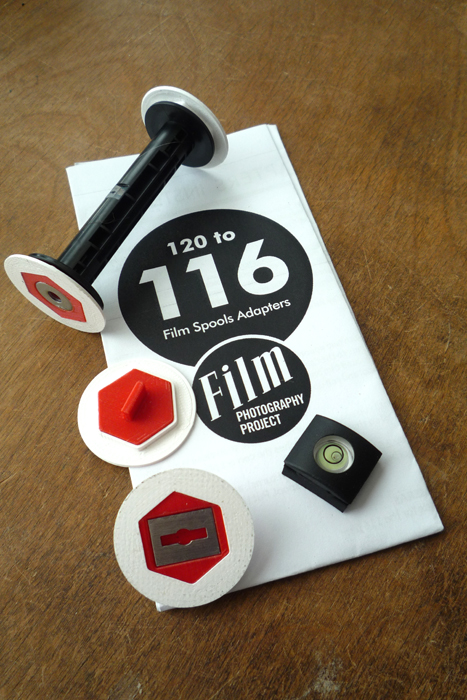
I found the small bubble level on ebay for just a few dollars. Since the old folders have no accessory holders I just attached the level to the top deck of the camera with a piece of double-sided tape.
I have not seen any problem with film flatness even without a 120 mask for the film plane. It would be helpful to accurate composition though to make a mask for the viewfinder.
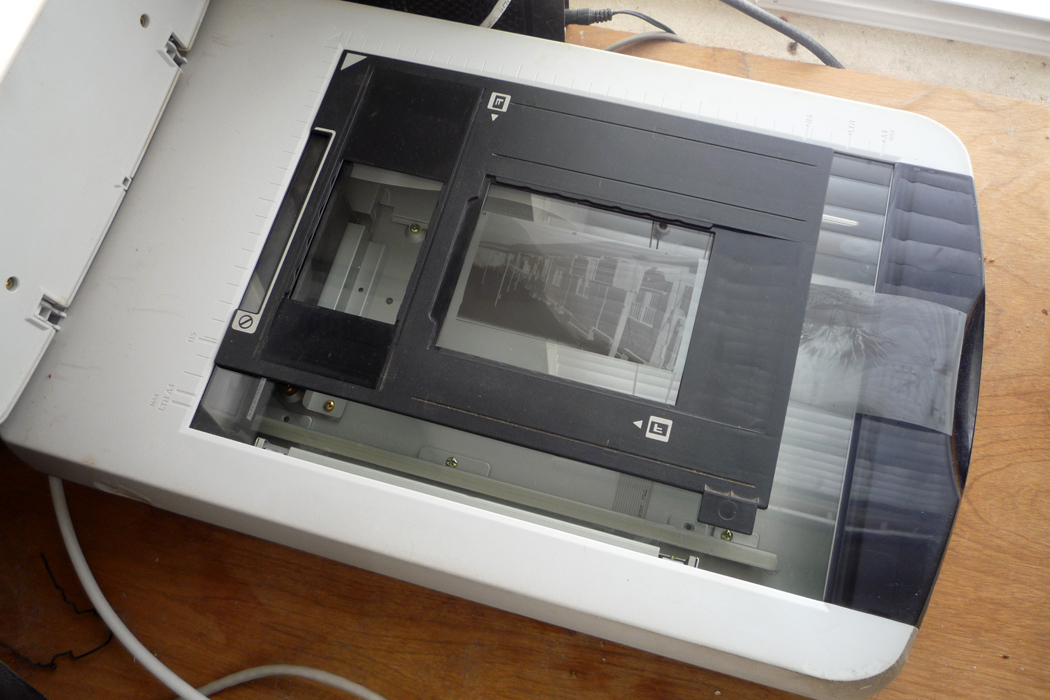
Scanning the long negatives can be a bit of a challenge. My old Epson Perfection 2450 flatbed scanner has a film holder with a 4x5 frame, so I make use of that to hold the negatives in place by placing them directly on the scanner's glass and laying the film holder on top of the film. With the emulsion side of the film toward the glass, the upward curve of the film helps to avoid Newton rings on the scanned images.


Verichrome Pan is one of those films a lot of old guys would like to see on the shelves again. It yielded a rich tonal range and very fine grain that very few modern films can match. Kodak stopped making VP 120 about twenty-five years ago, but it ages well and there is a pretty good chance of getting some images with it even from a roll that is well expired. The two rolls I was given recently are definitely in that category; the one that recorded this set of pictures had a use-before-date of Dec. 1973. I decided to shoot the film in my Kodak No.1 Autographic Special folder that was built around 1917.


All the exposures were at 1/100 and f8 in bright morning sun, two stops wider than the 125 ASA box speed. The negatives were pretty light, so a stop or two more probably would have been better. I processed semi-stand for fifty minutes in Rodinal 1:100.

The bellows on my No.1 Special seems fine, but a small light leak has shown up in previous outings with the camera. This time I ran some black electrical tape all around the back, and that seems to have solved the problem. Given the fine performance the camera delivered on this last occasion, I think it deserves another go with some fresh film.
I took walks through my usual haunts including the neighborhood, the riverside bosque, and the botanic garden with my Kodak Retina Reflex.


I shot the roll of Kentmere 400 at box speed and developed semi-stand in L110 with just 4ml in 640ml of water. I thought the Kentmere in this instance did not show quite the tonal range I have gotten from processing with the L110 dilution B or with PMK Pyro.


