Sunday, January 30, 2022

Fancy Boxes


I have never developed a good working relationship with my Box Tengor cameras.  Zeiss Ikon gave them features which are seldom matched by other box cameras, and they are certainly stylish.  While the aim was to give users enhanced capabilities in a relatively simple and inexpensive camera, that objective cannot be realized without applying a rather rigorous technical discipline in use.

The camera's weak point is the slow shutter (at best, a 30th of a second), combined with a rather awkward shutter release. What that means is that it is unlikely you will realize the resolution advantage of the two-element Frontar lens unless you use a cable release with the camera mounted on a tripod.  The reflex viewfinders are a bit bigger and brighter than those of many pre-war box cameras, but provide nowhere near the compositional help of the brilliant finders of the post-war era.

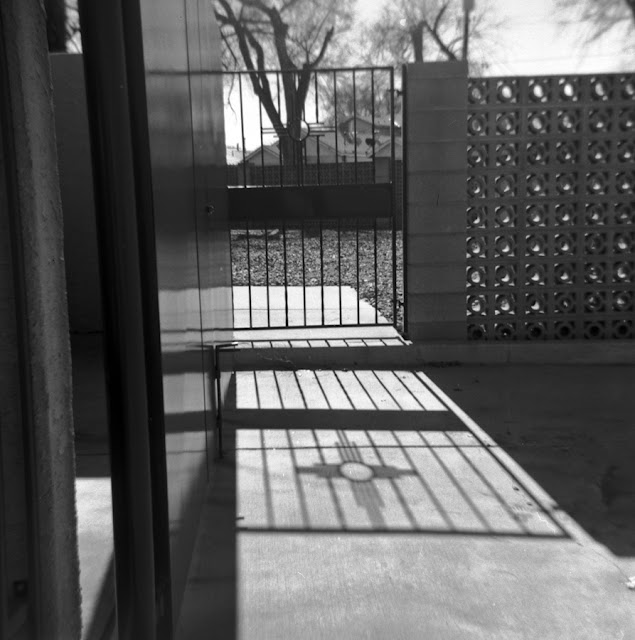
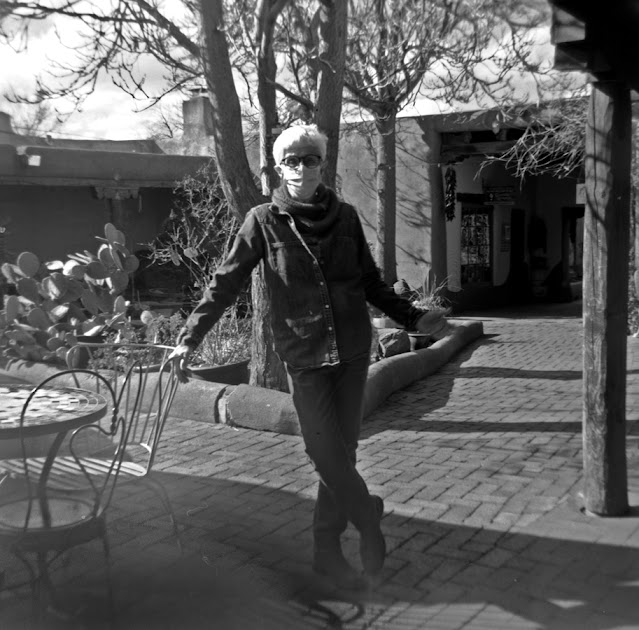
Well, I knew all of the above when I took my Box Tengor 56/2 for a couple of walks recently, but I ignored my own advice and shot handheld in sometimes challenging light.  Getting the depth of field right for the subject requires an exact pairing of discrete focal and exposure settings which often escaped me.  Still, I thought some of the pictures from the roll of Acros showed a hint of the camera's capabilities.  I'll take another stab at using one of the Box Tengors soon, though I've now shot my last roll of Acros, and that will introduce another variable into the test regime.


Tuesday, January 25, 2022

Six from the Duaflex

I have the first model of the Kodak Duaflex.  It lacks some of the features of later models, but it is still a reliable and capable performer.

A Road to the Volcanoes

Zia

Adobe Wall

Crane

El Sol

Parked

Kodak Duaflex

Sunday, January 16, 2022

Cat Interrupted

 The modular construction of the Kodak Brownie Hawkeye Flash makes it easy to disassemble for cleaning or modification.  The easiest and most common mod is to reverse the lens front-to-back.  With the lens unmodified, the minimum distance for sharp focus is about eight feet. Flipping the lens brings the minimum for sharp focus down to about 3.5 feet.  However, only the center of the image will be seen to be sharply rendered, while the periphery becomes progressively blurred.

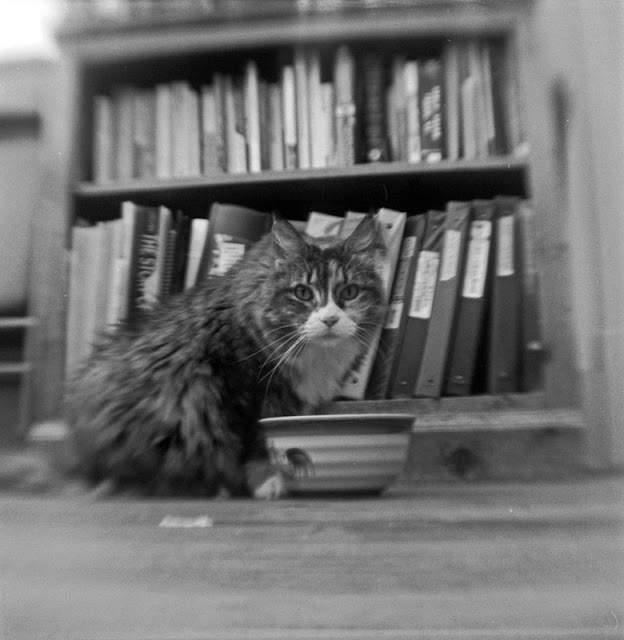
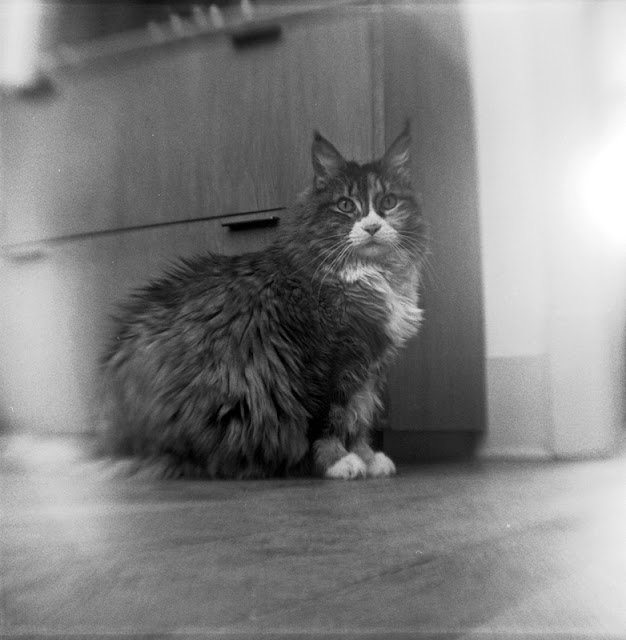
I loaded a roll of slightly expired Tri-X into my Brownie Hawkeye Flash and made twelve exposures in the house in about five minutes.  Because of the low light I set the camera to use the shutter's time mode to permit an exposure of an estimated one second; the camera was braced solidly on the floor to avoid camera movement.  The first shot caught Ruthie, my cat, unawares at her water bowl.  She was a bit irritated with that intrusion and threatened to leave the room.  I apologized, convincing her to stay, and she composed herself and assumed a more dignified pose.

In addition to the peripheral defocusing the flipped lens also seems to have an increased tendency to flare with back lighting.  

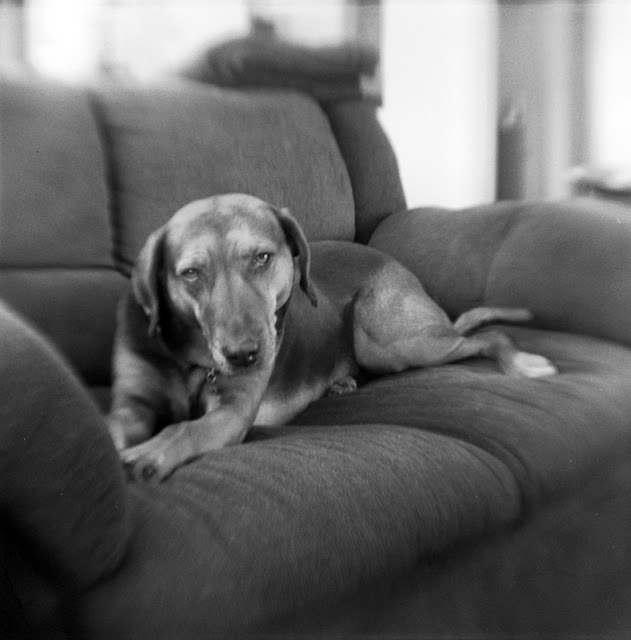
I took the camera into the living room and made a couple shots of Roxie with the camera braced on a chair .  Her skepticism about the process seems emphasized by the sharpness of the eye closest to the center of the image compared to the slight blur of eye closer to the edge. 

Friday, January 14, 2022

Walking the Dog

 I have made thousands of pictures with well over a hundred cameras, so no real need to make more.  However, I enjoy the process as much as the end product. I took along a Kodak Brownie Hawkeye Flash box camera yesterday while walking the dog.

The film was a roll of slightly expired Tri-X, developed in HC-110b.

Thursday, October 14, 2021

Using 120 Film in 116 Cameras

I have made quite a few pictures with my 116 cameras using 120 film with only minimal adaptations.  I loaded the 120 film roll into the cameras and rolled it onto the 116 reel, advancing 8 and one half turns to get to the first frame with the ruby window covered.  Two and a half turns between frames gets you five pictures from the 120 roll.  The process is particularly easy with the No. 1A Pocket Kodak because the boxy internal structure holds the feed reel in place with no need to directly engage the end disks of the reel.  Rolling the film onto the big 116 reel leaves the film edges exposed, so it is necessary to use a dark bag to open the camera, remove the reel and load the film onto the processing reel to go into the film developing tank.

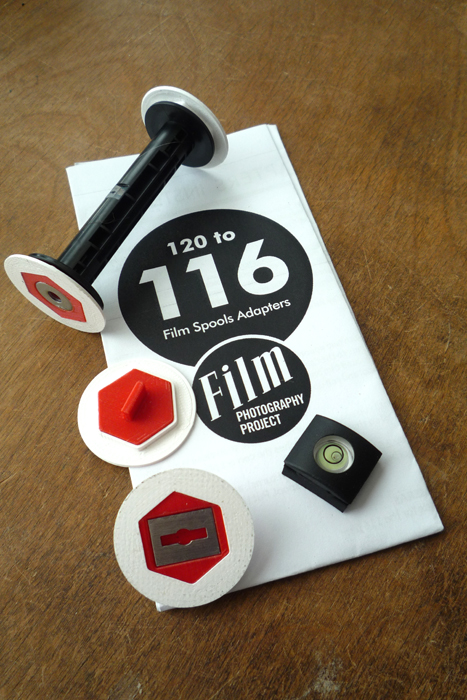
While this simplest procedure mostly works, a few glitches can degrade the results.  The film rolls onto the take-up reel rather loosely and it can drift sideways, causing some misalignment of the image on the film.  An easy fix for that problem is to acquire some 120 to 116 film adapters like the ones sold by the Film Photography Project.

The adapters allow a tight fit of the 120 roll of film into the camera as well as the use of a standard 120 take-up reel.  That solves the problem of film misalignment, and the spacers also produce sufficient tautness on the film to help keep the film flat at the film plane.  The red adapter disks from the kit can be used alone to hold the film reels, but I found it helpful to insert them into the white holders to facilitate positioning the reels in the camera.  The tabs on adapters are a loose fit in the reel slots, so I put a small bit of tape over the tabs to keep them on while inserting them into the camera.

I found the small bubble level on ebay for just a few dollars.  Since the old folders have no accessory holders I just attached the level to the top deck of the camera with a piece of double-sided tape.

I have not seen any problem with film flatness even without a 120 mask for the film plane.  It would be helpful to accurate composition though to make a mask for the viewfinder.

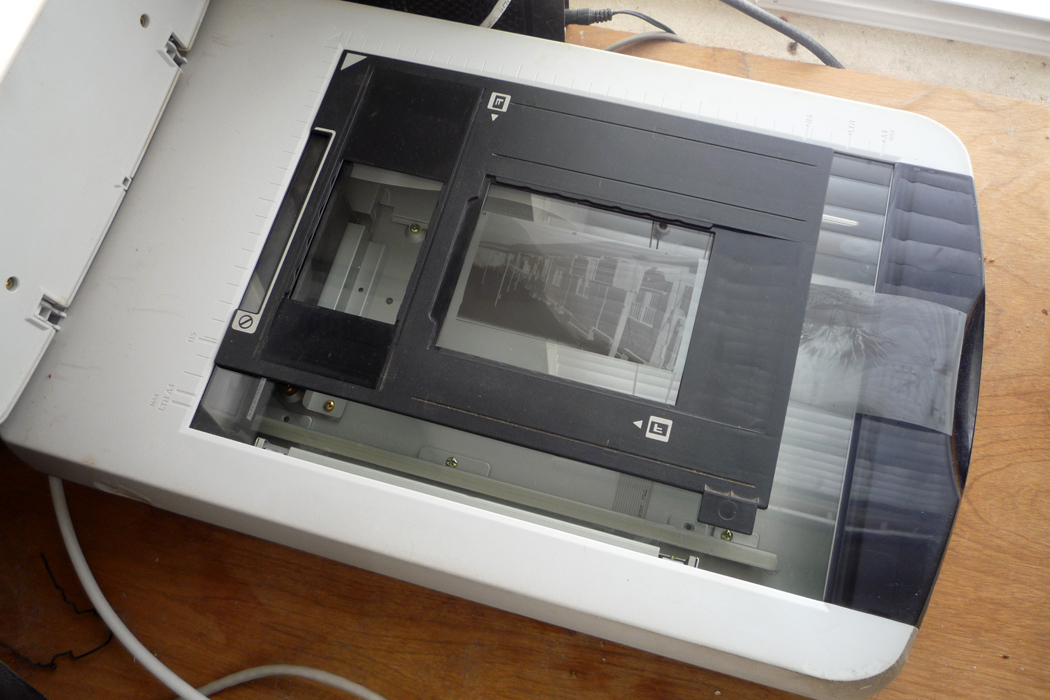
Scanning the long negatives can be a bit of a challenge.  My old Epson Perfection 2450 flatbed scanner has a film holder with a 4x5 frame, so I make use of that to hold the  negatives in place by placing them directly on the scanner's glass and laying the film holder on top of the film.  With the emulsion side of the film toward the glass, the upward curve of the film helps to avoid Newton rings on the scanned images.

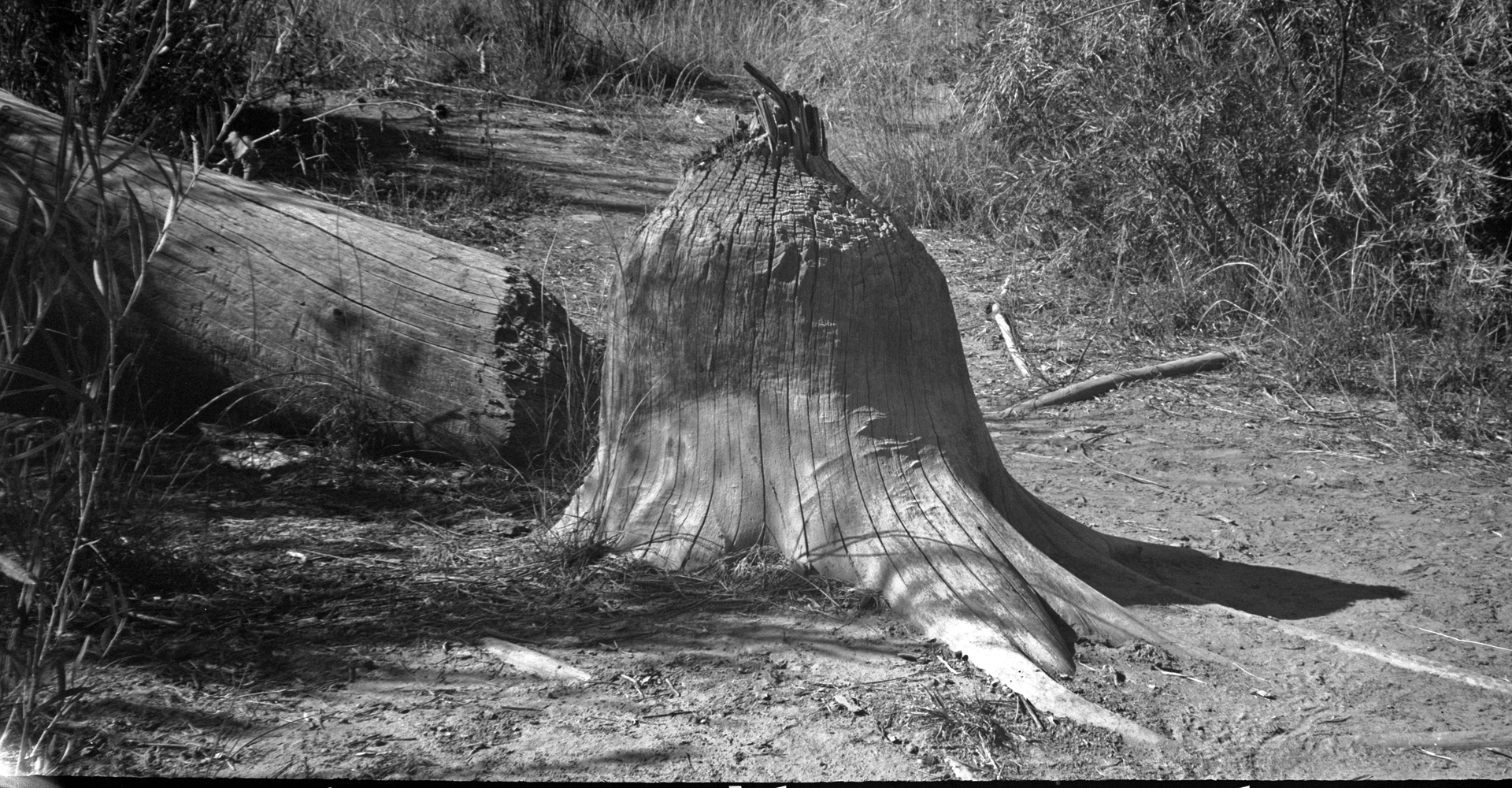
I shot Fomapan 100 in my last outing with the 1A Pocket Kodak using a tripod and cable release to ensure steadiness.  Most exposures were at 1/25, with apertures of f22 or f32.  I developed the film semi-stand in Rodinal 1:100 for one hour.


Tuesday, October 05, 2021

Kentmere

The best part of Albuquerque's Balloon Fiesta for me is actually not the balloons, but the Flamenco dance performances in the Old Town Plaza Vieja which are staged by the National Institute of Flamenco.  I believe the small woman in the picture is Eva Encinias who founded the Institute as well as the unique Flamenco dance program at UNM.  The tall woman beside her is the head teacher at the Institute.

I shot a roll of Kentmere 100 and another of Kentmere 400 this time around.  Since I had two rolls of film to process I decided to try them both together using semi-stand processing in HC110 at 1:100 for an hour.  I was very pleased with the results which this choice yielded for the Kentmere 400.  The tonal qualities were very good and the grain was nearly undetectable.  I have mostly used PMK Pyro as a developer for Kentmere in the past with good results, but I thought the quality of the HC110 pictures made with my Nikon FE were just as good if not better.


The Kentmere 100 shot in my FED 1g rangefinder responded less well to the HC110 stand development, so I'll likely stick with PMK Pyro processing for that film which seems better able to handle the higher contrast of the slower speed film.


Sunday, October 03, 2021

Acros 100 II

I can't say that the new Acros is the same as the old, but it is nice stuff in terms of grain and tonalities.  I processed these shots in Rodinal 1:50.  My old Silverfast scanning software does not have an Acros profile, so I tend to skip around to find one that produces what I want from the negatives.


Duotone

Ringtone

I bought five rolls of the Acros 100-II from Adorama where it was on sale at about half the current price, probably due to the fact that it was close to the expiration date.  I have several rolls left, so I'll likely try the film in additional developers includiing PMK and HC110.

Thursday, September 23, 2021

Exploring the Bosque

 I took a long walk with my 1A Pocket Special in the riverside forest at the east end of the Paseo del Norte bridge.  I saw some bike riders and skaters on the paved path that parallels the river, but no other people after that.  


I got six-and-one-half frames from this roll of Tri-X using some expired 120 Tri-X.  I think the century-plus camera has performed very well, but it is starting to show its age; there are some small light leaks appearing on the negatives and the ancient leather covering is disintegrating.  I think I will give the camera a well-deserved rest and move on to using a couple of my other, newer 116 Kodaks along with the very helpful 116 to 120 adapters.

Tuesday, September 21, 2021

Fomapan 400 Revisited

 I wasn't happy with some images on Fomapan 400 shot recently with my 1A Pocket Special and put them aside.  I started playing around with them again in Photoshop this evening and discovered that some rather radical adjustments to contrast, highlights and shadows revealed that there was quite a lot of useful detail available in the negatives.


The adjustments to the images got me a lot closer to what I want from my black and white medium format pictures in regard to sharpness and tonal range.  I'm thinking now that I need to take a close look at my Silverfast settings when I do the initial scans of the Fomapan 400 negatives.


The 116 to 120 adapters from the Film Photography Project look like they are going to make using 120 film in the 1A Pocket Special a lot more practical.  I also spent some time today in getting a better handle on advancing the film blindly since the red window is not of any use.  It seems that if I am careful in the advance process I could get as many as seven frames from a roll of 120.

Thursday, September 16, 2021

Fomapan

 I spent an hour at the Botanical Garden with my Kodak Reflex II.  I shot a roll of Fomapan 400 with the continuing hope that one of my usual developers would yield results that I can live with.  I processed this roll in PMK Pyro.


The negatives were very thin, looking like they could have used a couple more stops exposure or quite a bit more time in the developer.  

Meanwhile, Adorama had a half-price sale on Across II, so I picked up five rolls.  I also still have a few rolls of expired Tri-X that I like.  I'll play around with my few remaining rolls of Fomapan, but I'm not real optimistic about the prospects of getting what I want in regard to grain and tonal values.