A weekend of fine weather prompted me to get out with my Vivitar Ultra Wide & Slim loaded with some well-expired Agfa APX 100.


A weekend of fine weather prompted me to get out with my Vivitar Ultra Wide & Slim loaded with some well-expired Agfa APX 100.
One of the bright spots of my temporary housebound condition has been the opportunity to better get to know the work of Ansel Adams. While recognizing Adams' historical accomplishment in landscape work, I had never found it a great source of personal inspiration. That changed recently during a small gathering of the New Mexico Film Photographers.
I had suggested that each of the meeting attendees bring along a book of photographs by one of their favorite photographers. Bob Eggers brought Singular Images, a collection of Adams' Polaroid work made in the 1950s and '60s that was featured in a 1974 exhibit at the Metroplitan Museum of Art in New York.
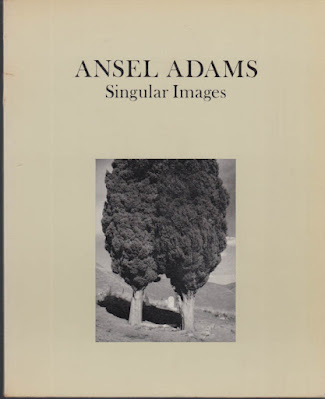
I was aware of Adams' long association as a consultant with Polaroid, but had never taken the trouble to look at the products of that connection. Seeing the 53 images in the book was an extraordinary revelation; I went home and immediately ordered a soft-cover copy.
As stated in the listing of prints, "Plates 1 through 40 are reproduced from original Polaroid Land prints of various types. Remaining plates are reproduced from enlargements made from Polaroid Type 55 positive/negative Land film with the exception of plate 45 which is an enlargement from a Polaroid Type 105 positive/negative Land film." All of the Met exhibit images in the book including the polaroids can be found on the Metropolitan Museum website, though the quality of the book reproductions is decidedly superior.
The Polaroid images resemble Adams' work with large format in several ways including his intimate familiarity of the characteristics and potential of his materials and gear. However, the Polaroids differ significantly in the choice of subjects, the emphasis on close work, and perhaps most importantly in Adams' ability to express his vision in a miniature format. Even in the smallest Polaroid prints measuring just 73mm x 97mm the images appear as strong in their tones and textures as in Adams' monumental large format work. The most impressive example of that miniaturized monumentality for me was the 1954 image of Baker Beach near the Golden Gate Bridge.

Immediately following the Baker Beach shot in the book are half a dozen portraits which show Adams' talent for such work in a way I had never seen. In fact I had a rather poor opinion of his portrait work up to that time. It seemed to me that Adams' images of people often made them appear of no more significance than the stumps and rocks in their immediate vicinity, lacking in expression or character. In the Polaroid close-ups his subjects' personalities come alive; the picture of Margaret Bourke-White holding her cat is especially charming.
Perhaps it is just a quirk of my own peculiar neuronal connections, but the picture which struck me most forcefully on first view was the 1957 image of a church and an abandoned car. The sharpness and tonal richness of the image are extraordinary, but what really grabs attention is the compositional blending of foreground and background. I was immediately reminded of Christina's World by Andrew Wyeth. That is perhaps a comparison unfair to both artists, but one which I found compelling.

The dog heads for the closet whenever I bring out a camera. I coax her out with a treat and then have to allow her up on the couch to get her to pose for a photo session.


I went with a friend to visit the south end of the Petroglyph National Monument west of Albuquerque. We were disappointed to find that the entire length of the east-facing slope is now blocked with a strand of steel cable and signs saying the area is closed to allow restoration of the vegetation. That will likely reduce some foot traffic in the area, but does not offer any protection from vandalism as one can simply step over the wire.
Nevertheless, we honored the signs and stayed on the right side of the fence for the mile or two past the rock art panels. I didn't want to return on the same path, so suggested we climb the slope past the end of the barrier and walk back along the canyon rim. I was pleased to actually accomplish that given my rather poor mobility, and even more pleased to find a fine example of rock art along the rim consisting of the common concentric circles design accompanied by a turtle. That made what had tuned into a five mile hike seem worthwhile.

We descended from the mesa down the gentler west slope to get back to my truck. About half way down we came across this interesting rippled volcanic pavement that was laid down about 150,000 years ago by oozing eruptions along the Rio Grande Rift.

I felt unfatigued the next day and, suspecting I had not gotten any good quality images due in part to the excessive brightness of the noonday sun, I loaded the dog in the truck early in the morning and drove back to the mesa. I returned to the mesa top along the easy west slope and was looking out atop the rimrock toward the mountains in about half an hour.
Turning north to follow the rim to the site of the petroglyph panel, I stepped on a rock about knee height and suddenly felt the achilles tendon in my left leg stretch to the breaking point. I ended up about ten feet downslope on my back. My pinhole camera and the tripod were back where I had fallen. The Nikon F was still on its strap around my neck; I did not discover until later that the camera's rewind lever had snapped off.
Lying on my back and looking up at the blue New Mexico sky my first thought, of course, was to wonder if I would be crawling the mile back to the truck. I was unable to flex my left foot, but I did manage to get myself into a standing position. I found that I could walk -- very slowly -- by keeping the left foot flat. I did have to scoot on my butt down one rocky slope to the sandy arroyo that parallels the west face of the mesa. Soon after we reached the arroyo a coyote started barking at me and the dog; it sounded a lot like laughter.

I think we reached the truck in about an hour. Working the clutch was quite a challenge, but we made it home safely. I ordered a replacement rewind lever from ebay for the Nikon F. The leg will likely need some expert attention before I can get back to reshoot that rock art.
I decided recently that I have not given adequate attention to the possibilities offered by selective focus. The main components of that technique to restrict depth of focus are lens focal length and aperture. With that in mind I mounted the Nikkor-P Auto f:2.5/105mm on my Nikon F loaded with a roll of Arista Ultra Edu 100. I shot most of the roll at 1/1000 which allowed a wide aperture even in the bright New Mexico sunlight.


I cannot recall ever feeling the need to use very high shutter speeds for the purpose of stopping motion blur. What this experience has shown me, however, is that 1/1000 or higher along with the associated wide apertures can offer much better control over the separation of foreground and background and better emphasis of the primary compositional interest. Of course it is also important to pay attention to the capacity of the lens being used to perform at wide apertures.
While I've mostly focused on pinhole work over the past couple weeks the Olympus 35RC also rode along in a jacket pocket.

The film in the Olympus was Arista Ultra Edu 200, which I shot at 100 ASA with the intention of development in PMK Pyro for the best tonalities and grain.

The roll of Arista included a series of hipshots made on a busy Saturday morning in Old Town.


The diminutive size and quiet shutter of the Olympus 35RC make it the ideal camera for street work, but it would have been better in this instance to have loaded some faster film which allows better depth of field and faster motion stopping shutter speeds. In the past my go-to film for this task was Tri-X. I'm thinking now that it would be interesting to try pushing the Arista 200 in development to 400 ASA or faster, perhaps in HC110.


Some blue sky and bright sun prompted me to load some Fomapan 100 in my pinhole camera. I then headed down Central to the motels near where Route 66 crosses the Rio Grande. The area is undergoing rapid development and the few remaining motels are being surrounded by multi-story apartments and shops. The El Vado, closest to the river, was built in 1937 and restored in 2018 with the help of a 2 million dollar grant from the city.


