One of the bright spots of my temporary housebound condition has been the opportunity to better get to know the work of Ansel Adams. While recognizing Adams' historical accomplishment in landscape work, I had never found it a great source of personal inspiration. That changed recently during a small gathering of the New Mexico Film Photographers.
I had suggested that each of the meeting attendees bring along a book of photographs by one of their favorite photographers. Bob Eggers brought Singular Images, a collection of Adams' Polaroid work made in the 1950s and '60s that was featured in a 1974 exhibit at the Metroplitan Museum of Art in New York.
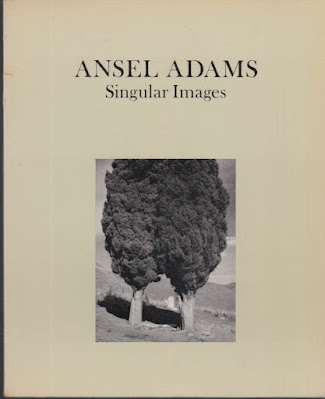
I was aware of Adams' long association as a consultant with Polaroid, but had never taken the trouble to look at the products of that connection. Seeing the 53 images in the book was an extraordinary revelation; I went home and immediately ordered a soft-cover copy.
As stated in the listing of prints, "Plates 1 through 40 are reproduced from original Polaroid Land prints of various types. Remaining plates are reproduced from enlargements made from Polaroid Type 55 positive/negative Land film with the exception of plate 45 which is an enlargement from a Polaroid Type 105 positive/negative Land film." All of the Met exhibit images in the book including the polaroids can be found on the Metropolitan Museum website, though the quality of the book reproductions is decidedly superior.
The Polaroid images resemble Adams' work with large format in several ways including his intimate familiarity of the characteristics and potential of his materials and gear. However, the Polaroids differ significantly in the choice of subjects, the emphasis on close work, and perhaps most importantly in Adams' ability to express his vision in a miniature format. Even in the smallest Polaroid prints measuring just 73mm x 97mm the images appear as strong in their tones and textures as in Adams' monumental large format work. The most impressive example of that miniaturized monumentality for me was the 1954 image of Baker Beach near the Golden Gate Bridge.

Immediately following the Baker Beach shot in the book are half a dozen portraits which show Adams' talent for such work in a way I had never seen. In fact I had a rather poor opinion of his portrait work up to that time. It seemed to me that Adams' images of people often made them appear of no more significance than the stumps and rocks in their immediate vicinity, lacking in expression or character. In the Polaroid close-ups his subjects' personalities come alive; the picture of Margaret Bourke-White holding her cat is especially charming.
Perhaps it is just a quirk of my own peculiar neuronal connections, but the picture which struck me most forcefully on first view was the 1957 image of a church and an abandoned car. The sharpness and tonal richness of the image are extraordinary, but what really grabs attention is the compositional blending of foreground and background. I was immediately reminded of Christina's World by Andrew Wyeth. That is perhaps a comparison unfair to both artists, but one which I found compelling.


