Showing posts with label book review. Show all posts

Thursday, January 29, 2026

A Decade of Discovery

I was looking for something to support my bedtime reading habit.  Not finding anything interesting at the local library website, I turned to openlibrary.org and entered "photography criticism" in the search box.  That got me to Light Readings: a photography critic's writings, 1968-1978 by Allan D. Coleman.

The decade of articles collected in the book were first published in The New York Times, the Village Voice and Popular Photography. Coleman seemed a familiar name and it seems like I must have seen some of the columns as I was in New York in the late 1960s.  I don't recall any of the dozen pieces I've read so far.  

My lack of good familiarity with Coleman is a symptom of my general failure to take advantage of the great photographic resources which were available at the time.  There was really no end of museum and gallery exhibits on photography.  I can really only recall going often to the Museum of Modern Art, and I took no advantage at all of the opportunities for learning from the great people who were teaching courses in New York in those days.

I have since gotten familiar with a lot of the artists in photography that Coleman's columns discuss.  It is great fun to read about many of those people in Coleman's interviews and critiques. His style is spare and perceptive and there a lot of good stories I had not seen before about the New York photography scene in the 1960s and 1970s.

Coleman's historical and social comments are mostly right on.  One instance in which he misses the mark is in a discussion of holography.  I do recall the hype about that 3D imaging technology, but Coleman's prediction that it would be the art form of the future really didn't pan out.

I imagine that Coleman's columns were accompanied by examples of the photographic work he was discussing, but they did not make it into the scanned copy of the openlibrary book.  It is easy enough to supplement the reading with quick online searches for the images.  I also have books by some of the photographers.

I was particularly pleased to find that one of Coleman's articles dealt with the career of Roy DeCarava, whose work I have always admired, mostly through the collection illustrated in the Friends of Photography book edited by James Alinder and with a lengthy introduction by Sherry Turner DeCarava. Coleman's article provides a good overview of DeCarava's style and the difficulties he encountered in obtaining appropriate recognition as a Black artist.

************

UPDATE:

It turns out there is a selection of photos buried in the middle of the online book.  Still helpful, though, to do a quick search in a second tab for examples of the artists discussed.

Also,

I found another document online with a selection of A.D. Coleman's writing that includes some of the columns from the Light Readings book, but covering a longer time period.  It is in a format that is a bit easier to read than the openlibrary scan.

An
A. D. Coleman Reader
Published Writings 1968-2017

Prepared for the Forum on Contemporary Photography
Department of Photography, Museum of Modern Art

September 19, 2018

Friday, March 03, 2023

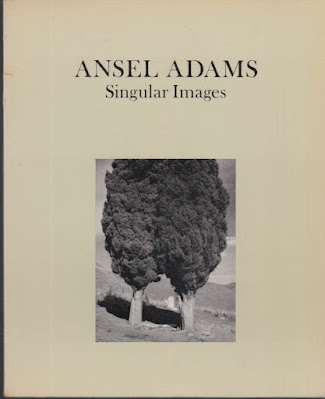
Singular Images

 One of the bright spots of my temporary housebound condition has been the opportunity to better get to know the work of Ansel Adams. While recognizing Adams' historical accomplishment in landscape work, I had never found it a great source of personal inspiration.  That changed recently during a small gathering of the New Mexico Film Photographers.

I had suggested that each of the meeting attendees bring along a book of photographs by one of their favorite photographers. Bob Eggers brought Singular Images, a collection of Adams' Polaroid work made in the 1950s and '60s that was featured in a 1974 exhibit at the Metroplitan Museum of Art in New York.

I was aware of Adams' long association as a consultant with Polaroid, but had never taken the trouble to look at the products of that connection. Seeing the 53 images in the book was an extraordinary revelation; I went home and immediately ordered a soft-cover copy.

As stated in the listing of prints, "Plates 1 through 40 are reproduced from original Polaroid Land prints of various types. Remaining plates are reproduced from enlargements made from Polaroid Type 55 positive/negative Land film with the exception of plate 45 which is an enlargement from a Polaroid Type 105 positive/negative Land film." All of the Met exhibit images in the book including the polaroids can be found on the Metropolitan Museum website, though the quality of the book reproductions is decidedly superior.

The Polaroid images resemble Adams' work with large format in several ways including his intimate familiarity of the characteristics and potential of his materials and gear.  However, the Polaroids differ significantly in the choice of subjects, the emphasis on close work, and perhaps most importantly in Adams' ability to express his vision in a miniature format. Even in the smallest Polaroid prints measuring just 73mm x 97mm the images appear as strong in their tones and textures as in Adams' monumental large format work. The most impressive example of that miniaturized monumentality for me was the 1954 image of Baker Beach near the Golden Gate Bridge.

Immediately following the Baker Beach shot in the book are half a dozen portraits which show Adams' talent for such work in a way I had never seen.  In fact I had a rather poor opinion of his portrait work up to that time.  It seemed to me that Adams' images of people often made them appear of no more significance than the stumps and rocks in their immediate vicinity, lacking in expression or character.  In the Polaroid close-ups his subjects' personalities come alive; the picture of Margaret Bourke-White holding her cat is especially charming.

Perhaps it is just a quirk of my own peculiar neuronal connections, but the picture which struck me most forcefully on first view was the 1957 image of a church and an abandoned car.  The sharpness and tonal richness of the image are extraordinary, but what really grabs attention is the compositional blending of foreground and background. I was immediately reminded of Christina's World by Andrew Wyeth. That is perhaps a comparison unfair to both artists, but one which I found compelling. 


* * *

For a completely different approach to Polaroid photography, see the work of painter/photographer, Harold Joe Waldrum.