I went to Old Town on Saturday with the collapsible Industar 22 on my Zorki 6. A little rain and cloudy skies gave me some nice light for the Gekko 100 film.


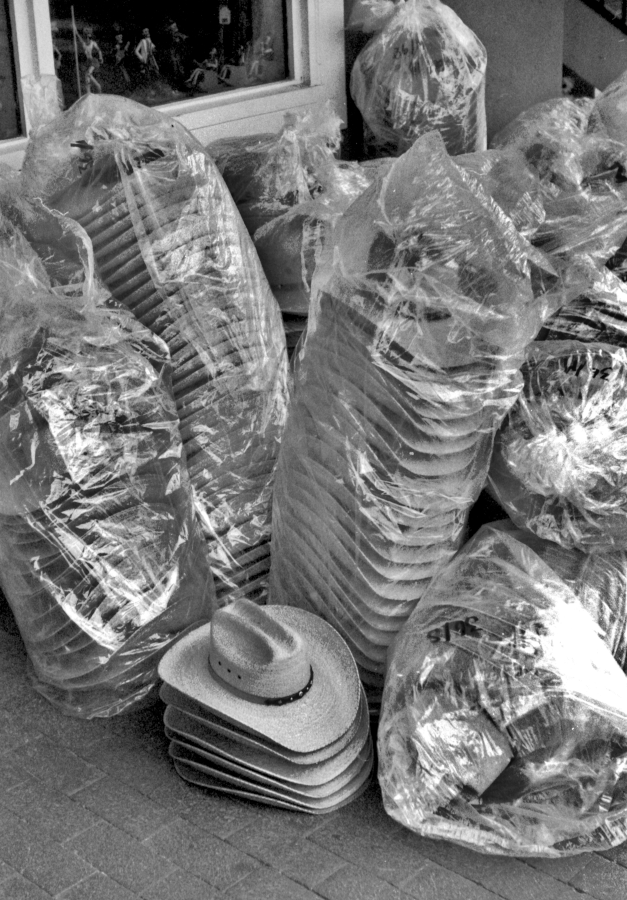


I went to Old Town on Saturday with the collapsible Industar 22 on my Zorki 6. A little rain and cloudy skies gave me some nice light for the Gekko 100 film.
A slightly overcast sky provided some nice light for an early morning walk through the neighborhood with the 35mm Jupiter 12 lens on the Zorki 6.


I've just about got the Zorki 6 sorted out. I put a plastic washer on top of the film cartridge and the images showed no tilt in the film gate. I'm not entirely sure that was the right solution, however. I noticed that I really also needed to push the film leader firmly downward on the take-up spool. So, I may just try that next time without the washer.


The Ilfotec DD-X was also a gift from a friend from about a year ago. I finally got around to trying it out because I noticed that it is one of the developers Ilford recommends for Kentmere, one of my favorites. So that is on the schedule too.

I used my Jupiter 8 lens on the Zorki 6 on this occasion. It is a Sonnar copy and maybe the best of the bunch of my Soviet lenses. I wish it had click stops for the aperture like the Industar 61-LD, but I can't complain otherwise. My plan is to move next to trying the Zorki 6 with the Jupiter 12 and either the collapsable FED 50 or the Industar-21. Those are both Elmar copies and seem just as sharp to my eyes.

I think the Zorki 6 is handsomely designed. It is probably not functionally superior to a lot a lot of similar rangefinder cameras, but I think that it incorporates a lot of the best features of the long Soviet Barnack line and it was the last model before the slr takeover. And, last but not least, thirty bucks!

 |
| Lee Marmon - ca.1990 - photographer unknown |
There is no arguing the fact that Lee Marmon, a native son of the Laguna Pueblo, had easy access to his Native American subjects which made them comfortable in front of his camera. Contrary to the assertions made in the exhibit, however, there is very little real difference between his photographic approach and techniques and those of Curtis and Lummis.
The exhibit material implies that Curtis and Lummis were condescending toward their Native American subjects, and that they misrepresented them as members of a disappearing race. I don't recall reading anything said by either that portrayed their subjects with any negativity. Curtis endured great hardship in documenting all the tribal groups he could find and never realized any significant income from his efforts. Lummis lived in the Isleta Pueblo and clearly enjoyed the trust and affection of his neighbors.
As for the portrayal of the American Indians as in danger of disappearance toward the end of the 19th Century, I think we can cut Curtis and Lummis some slack. The indigenous people of the country had by that time been subjected to a couple centuries of genocidal warfare. Additionally, it has become increasing clear that well into the Twentieth Century there was a concerted effort undertaken jointly by the government and religious organizations to stamp out indigenous languages and cultures by ripping the children away from their families and confining them in prison-like boarding schools. (Marmon ran away from the Albuquerque Indian School.)
The charge that Curtis and Lummis posed their subjects, sometimes using artificial lighting, simply overlooks the realities of 19th Century photography. Curtis and Lummis made their photographs on glass plates using large and cumbersome view cameras. Spontaneous snapshots of everyday life were not a practical option, though Lummis actually got pretty close to that with some of his cyanotypes.
Marmon made most of his pictures of Pueblo people in outdoor settings and had no need for artificial lighting. He did often use a somewhat cumbersome press camera, but it was loaded with film that was vastly more sensitive than those 19th Century glass plates of his predecessors. Marmon used flash for his commercial celebrity portrait work as was the custom in those days.
Curtis certainly did go to some lengths to portray his subjects mostly in traditional regalia which was not often seen outside ceremonial activities. But, guess what; most of Marmon's pictures of his people show them wearing traditional garb and jewelry which they clearly donned for the occasion. Not unsurprisingly, as the exhibit material points out, Marmon never had a negative thing to say about the photographic approaches of Curtis and Lummis. In fact, Marmon was doing his best to emulate the posing conventions of his day which were not all that different from the approaches of Curtis and Lummis.
It seems to me it should be possible to recognize what is unique and valuable in Marmon's accomplishments without trying to turn Curtis and Lummis into villainous antagonists in a way that Marmon himself never endorsed.
I took my Bentzin Primar plate camera to the Plaza Vieja to catch the old cars and a couple of the old car guys.


 |


The roll of Fomapan 400 was processed in HC110b. I was pleased with image quality from the low-cost Fomapan, but found I was really out of practice in using the plate camera. Both the wire frame finder and the little reflex viewer provide a somewhat vague idea of where the camera is pointed, and achieving sharp focus by estimation is always tricky at less than the smallest apertures. It took some careful cropping of the negatives to get some reasonable compositions.


Getting some experience with the camera has helped me to avoid pressing the rewind release button instead of the shutter release.
A small vertical misalignment of the rangefinder image was corrected by just slightly tightening the front ring of the rf window.
One issue remains to be corrected. The film is slightly tilted as it goes over the film gate. I think the cause of that is the slight height difference between modern 35mm film cartridges and those made in the Soviet Union. My FED 1g had the same problem, and the fix was to put a narrow plastic washer on top of the film cartridge.


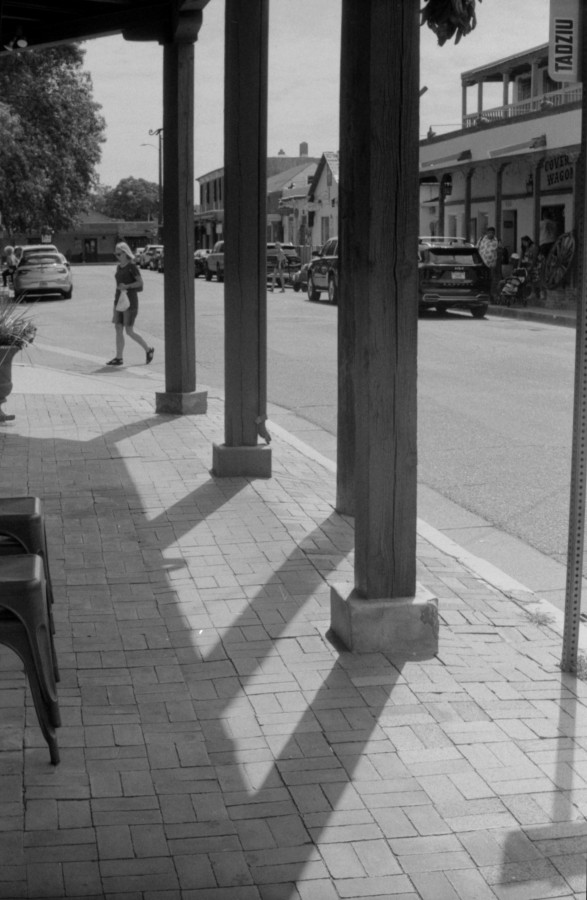

The roll of Kentmere 400 was shot in Albuquerque's Old Town. I processed the roll in HC110b for six minutes at 22F and got good negative density.
The lens for the Old Town shoot was my Industar 61-L/D; it seems to me to perform about the same as the Industar 26M that came with the camera. Next, I'll try the Jupiter 8 2/50.
I'm getting a little more comfortable with using VueScan and GIMP-2.10 on my old IMAC, but neither offers the fine-tuned image adjustments formerly available on my XP desktop running Silverfast and Photoshop CS2.
I'm happy so far with the camera. The controls are nicely placed, the flip-open back is convenient, and the diopter viewfinder adjustment is very welcome to my old right eye. I don't miss slow speeds and 1/500 is plenty fast for me; plus the thus-simplified shutter is bound to be more reliable.
We went to a backyard jazz concert this evening. A woman we had not seen in ten years was in the audience. She was the person who adopted one of the cats who hung out in our backyard at our first home in Albuquerque. I wrote a tribute to that cat, Spot, when he went off to his new home. He was just one of quite a few, all of whom were ultimately adopted. Well, we did keep one, Ruthie, who I have photographed many times. And, of course, we also came to town with two others, Richard and Rio. Anyway, it seemed like a good excuse to celebrate all the cat friends in our life.
 |
| Spot |
 |
| Stripey |
 |
| momma cat |
 |
| Sister |
 |
| Rio & Richard |
 |
| Ruthie |
I have had my eye on the Zorki 6 for a long time. The flip-open back makes film loading easier than in the previous Barnack-style models, as well as facilitating lens collimation. Another feature that is particularly attractive to me is the diopter adjustment for the viewfinder. When an ebay posting came up with a $30 pricetag, there was no hesitation on my part.

I decided to test the camera at the Albuquerque Rail Yards which becomes a farmers and crafts market on the weekends. Thanks to the generosity of Jim Grey I was able to use a roll of Agent Shadow 400 to get the job done. The camera seemed to perform faultlessly. The Industar 26M was smooth in operation and its click-stop aperture is a nice feature.
 |


There was a small light leak apparent in the bottom corners of the images, but I think that will be easily remedied with a small foam strip. I'm looking forward now to trying some of my other FED, Jupiter and Industar lenses with the camera.
I sat down at my computer to scan the roll of film when we got home from the Rail Yards and discovered that my old Dell Windows XP machine which I have used for years for scanning and image editing would not boot. A visit to the computer repair shop produced a diagnosis of a dead motherboard. That came as quite a shock, and I spent the better part of the next day sorting out hardware and software choices. As it turned out, I was able to connect my Epson 2450 Photo scanner to my old 2010 IMAC. I tried a MAC-compatible version of Silverfast scanning software, but it seemed impossibly slow and awkward to use.
I finally settled on Viewscan for scanning and it seems pretty close to my old Windows version of Silverfast in terms of features and speed. For image editing I currently only have GIMP-2.10. That program seems to have all the needed operational features, but in use they are totally unintuitive. I'll eventually learn enough about GIMP to get most of what I want from an editor, but I'm going to start looking hard for a version of Photoshop CS2 that will run on the IMAC. So, while I briefly had some doubts that film photography was going to continue being an option for me, it seems I am still in the game.


