Tuesday, April 29, 2014

to pinhole or not to pinhole

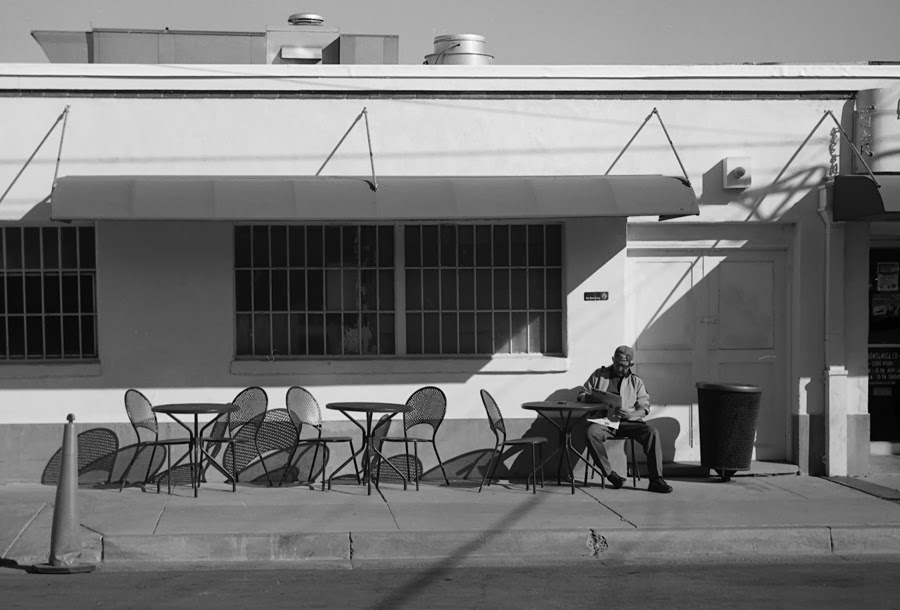
I loaded some Fuji 200 color into my point-and-shoot pinhole and took a walk in the neighborhood.  It was the first time in quite a while that I had made pinhole images.

My new truck, a '96 Toyota T100 4WD. 

I thought I might use up the roll in a couple sessions, but I was surprised to find that I had all twenty-four frames accounted for in about an hour.


I spent about a year shooting mostly pinhole some time ago.  I used a medium format camera and shot only black and white.  I was pleased with my results in the end, but also felt I had reached my limits with the medium and went back to shooting my regular old film cameras.


In evaluating my work with the pinhole, I discovered that the things I liked about the images were mostly not unique to pinhole cameras or technique.  Most of the effects could also be accomplished with cameras with lenses: small apertures, great depth of field, extreme wide angle, diffraction flare, low-angled perspective, near-far effects, motion blur.  In fact, a lot of that showed up in images made with the little Vivitar Ultra Wide and Slim with which I have made a lot of pictures.


Still, pinhole brings all those things together, and it is fun to try to bring it under control and to make it all work effectively.  It is also a good way to learn a lot of technique that carries over into lens-based photography.


Pinhole also has the virtue of producing unexpected and surprising results even when you think you have all the variables accounted for.  It can lead you into exciting and unexplored territory.


Every pinhole camera I have worked with has its own quirks, and it takes some time to learn how to aim and compose with some confidence.  Exposure in good daylight is pretty simple; one second gets it about right for me nearly every time.  In low light, the game gets trickier as films vary considerably in their capacity to record images with very long exposure times.


Part of the reward of pinholing is making your own equipment.  It can be as simple as a matchbox and a bit of foil.  However, using a real camera body can facilitate the process quite a bit as that takes care of film transport, light tightness, and can even provide an easy-to-operate shutter.


Perhaps the main advantage of shooting pinhole is that it lets you put aside preconceptions of how images should be made or how they should look.  It frees you to have fun and learn at the same time.

Tuesday, April 22, 2014

More from Crow Canyon

The Navajo people may have resided in the area of Crow Canyon for several centuries.  They probably left it to move westward around 1700.  By that time, the Spanish had reestablished their control of the area after the suppression of the Pueblo Revolt.  


This hunting scene shows that the Navajo were hunters of big game including elk, bison and big horn sheep.  It seems as if the animals are being driven into a large net to the right.  Long, knee-high nets were used by high desert peoples for trapping jackrabbits.  This is the only example I have seen  of such a large-scale effort.  It is hard to believe that large animals could have been captured in this manner, but the figures that appear to be holding the net seem to be the right scale.

Monday, April 21, 2014

Buick


There is often an informal car show on Saturday mornings in Albuquerque's Old Town.

Sunday, April 13, 2014

Navajo History

We were pleased recently to have the opportunity to visit the Crow Canyon petroglyph site in northwestern New Mexico.  The twenty-mile dirt road into the site is well maintained to support access to the area's oil and gas wells.  However, it is a long enough journey to discourage casual visitors, and we saw no other people in the morning we spent exploring the canyon.


Crow Canyon is well-known to rock art enthusiasts, and photographs are easy to find on the web.  Most descriptions accompanying the pictures reference the symbolic connections to the Navajo pantheon.  None I have come across, however, take note of the extraordinarily sophisticated technology on display in the rock art panels.


The bows depicted are all examples of the highest order of bow-making expertise, having a reflex, recurve design that implies composite construction with materials including wood, antler, horn, sinew, and hide glue.


It is possible that the Athapaskan ancestors of the Navajo brought their knowledge of reflex and recurve bow design with them as they made their centuries-long migration from the far north.  In the arctic regions of the New World, there were no suitable wooden staves of sufficient length to make single-component self bows, so composite designs were a necessity.  Old World archers also developed radically-reflexed designs for their bows, but the impetus in that case was more oriented toward the functional advantage conferred by a compact form for use by mounted warriors and hunters.  Navajo adoption of a mobile horse culture facilitated by the Spanish invasion may have yielded a similar preference for a compact and powerful bow design.

Specific details of Navajo archery are hard to come by on the web.

  • The fundmentals of bow design are well explained in the Wikipedia page about Bow Shapes.
  • Bow construction and usage are nicely described at a Czech site in the article, Plains Indians Bows.
  • A well-written capsule history of the Navajo people by J. W. Sharp is available at DesertUSA : The Athapaskan Speakers.
  • Chris Loendorf at the UofA has done some work on comparing southwest bow types. He suggests that while different Native American groups used recurved bows, it was the Athapaskan people who first brought the design to the southwest. The only web link I have to his work is through a subscription-only site run by Academia.edu, but there is a messaging link there by which he can be contacted.

Saturday, April 12, 2014

Spring...


... means car shows.


The first big show of the season took place on the grounds of Albuquerque's Balloon Museum.  It was sponsored by the Classic Chevy Club.


I didn't stay to see which car took the top honors.  The real show stealer for me was the 1934 Studebaker.  I had photographed it before, a few years ago, with my Pentax K1000 at the yearly Art Museum car show.


My camera at the show this time was my Mamiyaflex II, loaded with TMAX 400.
The tulips were shot at the Botanical Garden with the Vivitar Ultra Wide & Slim, loaded with Fuji 200.

Friday, March 28, 2014

eBay Phenomenon

With four days to go on the bidding, this Model CC Mercury with the 1/1500 shutter has reached a bid price of $103.50 and garnered twenty-five bids.


This 1939 model was not a great market success partly because of the unreliability of the overtensed shutter, but it was definitely pushing the envelope of innovation.  

The camera offered in the auction is equipped with almost every one of the accessories the company was offering including the flash which attached to the hot shoe, the rapid winder, the accessory range finder, and the extinction light meter.  The lens on this example is the 35mm f/2 Hexar made by Wollensak.

Only about 3000 of the CC-1500 model were sold.  War-time conditions cut off access to film supplied by Gevaert and Dufaycolor.  Those films were in the standard 35mm sprocketed format, but it was rolled onto specially constructed reels with small gears which meshed with the camera's advance system.  

Univex/Universal survived the war with contracts to manufacture binoculars for the armed forces.  After the war, the company abandoned the CC-1500 innovations.  The basic CC design was altered to produce the the Mercury II CX which used standard 35mm cartridges.  That last Mercury enjoyed some market success, but ultimately succumbed to a combination of bad management decisions and fierce competitive pressure.

Update:
Thirty-five bids at the auction's end with a winning bid of $255.

Sunday, March 16, 2014

Exercising the Mamiya C330

I've been carrying around the C330 and trying it in a variety of settings.  The hand-grip is a big help in keeping my fingers from inadvertently changing the settings.  The Porroflex finder allows simultaneously achieving sharp focus and composing the image without flipping back and forth between the waist-level finder and the flip up focusing magnifier.


Some subjects, like the wine glasses, because of their placement simply would not be within reach without the eye-level finder.


The one thing I haven't tackled with the camera that I need to get to is portraits.  I'll look for an opportunity to try that soon.

Tuesday, March 11, 2014

Upgrading the Mamiya C330

I decided it was time to stop whining about the awkwardness of the C330 and get the accessories needed to make it practical to shoot outside the studio.


I picked up a Mamiya handgrip at the local Camera and Darkroom in Albuquerque.  The eye-level finder came from an ebay seller in like-new condition.  Together, they make the big tlr almost a pleasure to handle.  I can see myself using this camera a lot more from here on.


The pictures are from a Sunday morning stroll through the UNM campus.

Saturday, March 08, 2014

Chihuly

Our visit to Phoenix coincided with a show of Chihuly blown glass scuptures at the botanical garden.  We had seen an excellent PBS show about the production of the work, but this was our first exposure to the real objects.


Quite a few visitors posed family members for pictures in front of the sculptures.  I'm not sure why.


The skill and craftsmanship that goes into it is undeniably impressive, but I could not find much enthusiasm in myself in looking at the sculptures.  I think I might have preferred to see them in a gallery.  In the naturalistic setting of the garden, they seemed out of place.  The contrasts with the bizarre natural forms of the cactus and succulents were not favorable to the plastic textured sculptures.


The Albuquerque botanical garden has a yearly show of led-lit sculptures which is also uninteresting to me.  The traditional garden sculptures seem fine, but the modern stuff is just intrusive.  I guess I just don't like the combination.


There was a gift shop of Chihuly items including books, coffee mugs, etc., all impressed with the Chihuly brand.  It pretty much summed up everything I find objectionable about what is today called fine art.


Not Chihuly.

Friday, March 07, 2014

Falcon Field

I took advantage of a trip to Phoenix to go by Falcon Field in Mesa.  The site is home to some restored WWII aircraft including the B-17, Sentimental Journey.


The Commemorative Air Force maintains a number of prop-era planes which are in flying condition and available to the public for flight experiences.


I should have taken along a tripod for the interior shots, but I thought the Mercury II still did a pretty nice job, even at wide apertures.

Thursday, February 27, 2014

The folder's last gasp

The Kodak Vigilant Six-20 and the slightly more upscale Monitor were the company's last stab at marketing a medium-format folding camera.  By 1948 when the line came to an end, people were ready to move on to new paradigms in photography.  The Anastigmat Special lens and the Supermatic shutter were as about good as anything available at the time, but the ergonomics of the Vigilant left a lot to be desired.  Estimating focus with a 101mm lens is not for the faint of heart, and neither the flip-up finder on the top deck nor the tiny reflex viewer over the lens offered much help in accurately framing the composition.


I have the top-tier lens and shutter on both the Vigilant and the Monitor.  I acquired them each for a song before anyone realized they were rather hard to find.  Unfortunately, my restoration skills were pretty rudimentary at the time and I haven't come close yet to allowing them to express their full potential.


These shots are from a brief morning stroll in the Nob Hill district of Albuquerque.  I'll try to get back there again soon to see if I can get a little more from the last of the Kodak folders.