Showing posts with label biopark. Show all posts

Thursday, March 11, 2021

Ilford Pan F 50

Thanks to my friend, Kodachromeguy, I have a big pile of expired film to play with.  First up is a roll of Ilford Pan F 50.  The expiration date on this one is June 1991.  I loaded the first roll into my Argoflex Forty and went to the Botanical Garden to shoot some familiar scenes.   I gave the film a couple extra stops of exposure to compensate for age and processed in Rodinal 1:50 for 11 minutes at 20 deg. C.

The first shot of the brick path through the garden seemed perfect in regard to exposure and tonalities, but I either misfocused, or the speed was a bit too slow.  The next shot of the fountain was better in regard to sharpness.  Bracing the camera on the ground probably helped to keep it steady.


In the middle of the roll there were a couple very dense, strange looking frames.  Hard to say what happened there.


Toward the end of the roll the images seemed normal in every respect.


Here is what I really, really like about this film:

the backing paper.


The numerals and lead-up symbols are marvelously visible through the ruby window which is used for advancing the film in a lot of old medium format film cameras.  By contrast, the framing marks on modern films are so dim and low contrast that it is nearly impossible to properly advance the film without overlapping frames or missing frames altogether. 

I have a couple more rolls of Pan F and am looking forward to shooting them, perhaps in different cameras which offer a bit more control over exposure and focusing.

Wednesday, February 28, 2018

Winter Walking

Most of New Mexico has experienced an unusually mild winter this year.  I took a walk yesterday through the Botanical Gardens.  The Mediterranean Conservatory is always a nice refuge on winter days, but the temperature difference on cold days can fog glasses and camera lenses.  No fog problem this time for the Pentax ME.


Most of the shrubbery has been pruned back to prepare for the coming Sping.  There are a few daffodils and crocus starting to pop up through the leaf litter, and leaf buds are already showing up on tree branches.


This morning I walked the trail through the Rinconada rock art site on the west side of the Rio Grande.  Only a handful of the thousands of petroglyphs are currently accessible as fencing has been put in place to allow recovery of the terrain and vegetation on the rocky slopes.


When we came to Albuquerque ten years ago there were no restrictions on movement at the site and I was able to thoroughly explore the place from top to bottom.  I doubt that kind of access will be available again.

Wednesday, June 21, 2017

Brownie Color

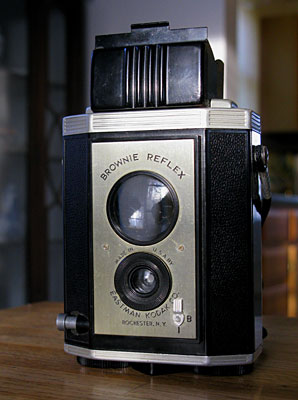
I shot the second roll of Konica 160 in my Kodak Brownie Reflex.  This was the first opportunity I have had to shoot color in the little 127 box camera, and I was quite pleased with results obtained from the expired film which seemed a good fit with the camera.  My judgment in this regard may be a bit clouded by sentimentality; the Brownie Reflex was produced in the year of my birth.


The elegant little Brownie Reflex was in production from 1940 to 1941. In 1942 Kodak added a capability to use flash in the succeeding "Synchro" model; that became one of the company's longest lived cameras, being produced in Great Britain until 1960. The camera's compactness was owed to its use of the 4cm-square 127 roll film format. The unique style is attributable in part to the fact that the inventor, Henry O. Drotning, came to Kodak with a background in designing mechanical music toys. Drotning filed his patent for the Brownie Reflex early in 1940, making it one the early roll film designs featuring a large and brilliant reflective viewfinder which would become very prevalent in the post-war years. (The British Ensign Ful-Vue came along slightly earlier in 1939, but the first was probably the Voigtländer Brillant in 1932.)


The non-flash model of the Brownie Reflex is uncommon. I was pleased to find myself on ebay as the only bidder on one, and I got it for just five dollars. The camera's exterior had only small blemishes from use. Inside, however, I discovered that the bakelite film carrier had broken away from the base. Someone, many years previously, had repaired the damage quite carefully with glue and cellophane tape. However, the tape and glue were yellow and brittle, and no longer held the parts together. I cleaned up the break, glued the parts together and added a bead of JB Weld all around the seam. Dismantling the camera was uncomplicated and enabled cleaning of the optics and the simple shutter.

The manual for the Kodak Brownie Reflex is available at the Butkus site.

Tuesday, January 24, 2017

Winter Flowers

I look forward every year to the winter blooming of the African Forest Lily in the Mediterranean Conservatory at Albuquerque's Botanic Garden.  I have photographed them before with several of my old cameras, usually with black and white film as I like the way it renders the forms and tones of the blossoms.  This year, I decided to document the flower's colors with my Pentax Spotmatic.


The character of the flower clusters changes as they mature, so I will try to get back to photograph them again in a week or two.


Some other stuff at the garden today:


Saturday, April 12, 2014

Spring...


... means car shows.


The first big show of the season took place on the grounds of Albuquerque's Balloon Museum.  It was sponsored by the Classic Chevy Club.


I didn't stay to see which car took the top honors.  The real show stealer for me was the 1934 Studebaker.  I had photographed it before, a few years ago, with my Pentax K1000 at the yearly Art Museum car show.


My camera at the show this time was my Mamiyaflex II, loaded with TMAX 400.
The tulips were shot at the Botanical Garden with the Vivitar Ultra Wide & Slim, loaded with Fuji 200.

Tuesday, November 19, 2013

End to End

Albuquerque's BioPark is anchored on the north end by the Botanical Garden and the Aquarium, and on the south end by the Zoo.  I got to both with my Ikonta 520.  The fishing boat is moored permanently in an artificial lagoon at the Aquarium.


The Zoo's new star is little Jazmine.  According to the keeper, she weighs about 350 pounds at present.  I snapped her picture with the last frame of a roll of Tri-X in my Ikonta 520.  I shot a few more with the digital and put the pictures on my other blog.


I was pleased to see that my bottle of Adonal developer is still working well.  I've had it in the refrigerator for about a year, and I wasn't sure how well it was holding up.  Everything I have read says the Adox Adonal is an exact replica of Rodinal which had a near infinite shelf life, and that seems to be true.

Friday, April 13, 2012

Shooting the JEM JR.

I shot a roll of TMAX 100 this morning in the JEM JR. 120. I had forgotten what a quirky camera it is.


There was a lot of flare to contend with in all the images from the JEM, and I had to make some considerable contrast adjustments to get anything usable. It occurred to me after the fact that a lot of the flare was probably being created by the cover plate in front of the lens; some improvement could likely be gained from removing the largely decorative glass from the front of the camera.  The real lens is quite far back behind the shutter, so it should actually be pretty well shielded from flare.  

There is a manual available on the Butkus site for the JEM JR., but it has quite a bit of misleading information about the camera's features.  The manual states that the cameras shutter speed is 1/25 and the aperture is a fixed f16.  It then suggests that ASA 50 film be used in bright sun; of course that is going to yield a stop over-exposure.  A warning is included that the photographer should stay at least six feet from the subject, but that is wrong as well.  As shown on any of the on line depth of field calculators, the hyperfocal distance for a 90mm lens at f16 is about 24 feet, with the closest sharp focus at 12 feet.  While the expectation was that images from the camera would only be destined for contact prints, it still seems very optimistic to expect anything to look sharp at six feet from the camera.

Wednesday, September 30, 2009

At the Conservatory


I've attempted four or five times to clean up my old Contaflex 1. The last try seems to have gotten the shutter and aperture mechanisms functioning properly. I like these pictures mostly for that, but I was also pleased with the tonal qualities obtained from the C41 Kodak film.

Tuesday, August 11, 2009

Lunch at the Aquarium


Tuesday, June 30, 2009

f233


I went to the nearby botanical gardens this morning with a newly installed pinhole with a 0.150 mm aperture. That is a little small from my focal length of around 35 mm, but it seems a bit sharper to me than the recommended 0.220 mm aperture. I do need to blacken the back side of the pinhole disk as I got a narrow, arcing flare in a couple frames. The sunny scene exposure at 100 ISO with this f-stop is two seconds.