Saturday, March 23, 2024

Old Town Shadows

 A brilliant Spring morning created some new perspectives on familiar subjects around the Plaza Vieja.


The Leica IIIa and the 3.5/50 Elmar performed well as expected, but the combination of Kentmere 100 and HC110b made me work a bit harder in Silverfast and Photoshop to get the middle gray tones I wanted.

* * *

This post was provided courtesy of Windows XP.  I flipped my old Dell desktop on its head a couple times.  Once upright again it started up and performed normally.  I'm thinking the good outcome indicated a loose connection somewhere, but maybe it was just the threat of further violence.

Thursday, March 21, 2024

Looking at Art in New Mexico

 Margaret and I spent a lot of time in galleries and museums in the last month.  The exhibition of Canadian Indigenous Art at the Albuquerque Art Museum was excellent.  A show of Black and White drawings and photographs at the New Mexico Art League was great fun.  

Margaret at Arts Thrive

Two exhibitions with great promise mostly brought disappointment.  The annual Arts Thrive benefit exhibit at the Albuquerque Museum had way too much art on the walls.  The Ways of Seeing exhibit at the New Mexico Museum of Art in Santa Fe assembled classics from three private photography collections, but what might have been a great experience was ruined for me by abysmal lighting.  

New Mexico Museum of Art, Santa Fe

 At the Santa Fe exhibit there were prints from many of Photography's great pioneers including Alfred Steiglitz and Ruth Berhard.  Gertrude Kasebier's small photogravure, "Blessed are thou amongst women", was so poorly lit that I was left wishing I had brought a flashlight.  In fact, all the galleries in the great old Santa Fe building  were dim and dingy looking.  The big palladium prints by David Michael Kennedy at least showed that there is still good work being done today in the State.

Sunday, March 10, 2024

Some Black & White from the Pentax ME

 I walked around the neighborhood with my Pentax ME loaded with a roll of Kentmere 400, and then revisited the current exhibition of Canadian Indigenous Art at the Art Museum.


I was pleased to get some usable images of the masks on film given the dim light in the Museum.
 

The black & white worked well for the shot of the visitors, but the masks really needed color.  Luckily, I had my little Canon digital in my pocket, so I made shots of the indigenous art collection with that camera, and they are posted on my other blog.

Wednesday, March 06, 2024

Resurrection? Maybe, Maybe Not

wtf ?    I thought this was supposed to be a blog about film photography.

 I tipped over my old Dell desktop computer on its side so I could take off the side panel.  I could not see any obvious reason why it would not boot up, so I replaced the panel, plugged it in and pressed the Start button.  The computer started up normally.  

 I moved the computer back to its place on my desk, hooked up monitor and keyboard and pressed the Start button again.  The cooling fans roared for about five seconds and then everything went quiet.   Another four or five tries produced the same result, leaving me again without access to Photoshop CS2 and the Silverfast scanning program which runs my old Epson flatbed.

Acquiring a copy of CS5 that would run on my IMAC provided a considerable improvement over GIMP for photo editing on the IMAC, but I was still left relying on VueScan, which I find to be much slower and unintuitive in use compared to Silverfast.  I was motivated to take one last stab at getting the old Dell to come back to life. 

I laid the computer over on its side again, plugged it in and pressed the Start button.  The fans and the hard drive came back to life along with the Windows XT splash screen.  I did a test scan with Silverfast and then did a software restart which worked fine.  At that point I was tempted to just leave the Dell running, but that just seems too wasteful.  So I am shutting it down and we'll see what tomorrow brings.

* * *

  Thursday Morning:  I attached the power cord to the back of the Dell and then pressed the Start button on the front panel.The computer made a low moaning sound and went silent.  I'll probably try a few more times to get it going today  Looks like a nice day coming up.  The sun is out.  No wind.  I still have half a roll of Kentmere to shoot in the Pentax ME.
 Thursday Night (6 PM):
Back in business.  It seems to matter how I plug in the power cable and how I press the Start button.  This time I first connected the power cable to the back of the computer.  Then I plugged the cable into the power strip and immediately pressed the Start button briefly.  Not sure if this is evidence of some short circuit, or some other issue.


Tuesday, February 27, 2024

Moving Along

 The f2/38mm lens on the Pen-FT continues to impress me with its performance in a wide variety of situations.


I met three of my fellow film photographers for coffee at a shop on Central in Albuquerque.  The half-frame vertical format encourages this kind of composite of adjacent frames.

I've shot about ten rolls of Kentmere in the Olympus Pen-FT now, and it and the fine F.Zuiko lens have performed faultlessly.  I am, however, hearing some faint grumbling comments coming from the cabinet holding my other old cameras about neglect.  I'm out of 35mm film at the moment, but I have quite a pile of Kentmere and Fomapan 120 in the refrigerator's film drawer, so there is likely some medium format in my near future.

I've run into a bump in the road regarding film scanning.  My ancient Dell computer running XT is again refusing to boot up.  That means I have lost access to my favored Silverfast for scanning and Photoshop CS2 for editing.  The pictures in this post were done with VueScan and Gimp on my old IMAC. The results aren't awful, but it takes me a lot more time and effort to get to images I consider acceptable.

Saturday, February 24, 2024

Two Favorites


There are a lot of people collecting vintage photo gear these days.  

Not many make the old cameras sing like these two:


Rick Drawbridge From NZ on Photo.net


SBA73  From Catalunya on Flickr

Monday, February 12, 2024

Leah - Idaho - 1980

 Margaret made a deep dive into the clutter on her desk and turned up this photo made beside the corral of our house in King Hill.  I don't recall the details of this bow, but the size seems to suit her.  I would have still been shooting my 30# Fred Bear brought from San Francisco.  Must have been a drugstore print as I was not doing any film processing in those days, and certainly no scanning.  The camera could only have been our Spotmatic.

Saturday, February 10, 2024

Zorki 6 and Jupiter 8

The Zorki 6 has just about every imaginable improvement over its Barnack-style predecessors: 

  • Easy loading hinged back
  • Fixed film take-up spool
  • Lever advance
  • Large combined viewfinder/rangefinder window
  • Viewfinder diopter adjustment

My only complaint with the camera's design is the forward placement of the strap lugs.  When you hang the camera strap over your neck the camera is left pointing upward at about 45 degrees.  That results in the lens pointing upward in the direction of the sun and a possible danger of burning holes in the shutter curtain.

I took the Zorki 6 on a walk through Old Town Albuquerque loaded with Kentmere 400 which I processed at home with HC-110b.  What showed up in the results was a remaining intermittent light leak and a bit of shutter capping.  So, still a bit of work to be done on this camera.

I was pleased with the performance of the Jupiter 8 lens which I used on this occasion. 


The last time I used the lens it was mounted on my Leica IIIa.  I had intended to make some shots from the top of the Chaco Hotel, but when I got out of the car there the camera fell out of my pocket and onto the pavement.  The camera was unhurt as the lens landed nose first, but there was a substantial dent in the lens's filter ring.  The Jupiter 8 is probably my best Soviet-era lens, so I decided to get a proper tool to make the needed repair.

The tool straightened out the dent perfectly, and I used it on a couple other damaged lenses as well.  Given my history of dropping things, it seems like a good investment.

Friday, January 26, 2024

Trash Cans of Tiguex

 and some other stuff.


I saw some nice work on the Facebook Pen-F group done on Kentmere processed in Ilfosol 3.  I wanted to see how that combination compared to what I get with developing in PMK Pyro.  I thought the results weren't bad, but they don't seem to me to be quite as nice in regard to tonality and fine grain.  I'm thinking I may try the Ilfosol 3 with some medium format Fomapan next.

Tuesday, January 23, 2024

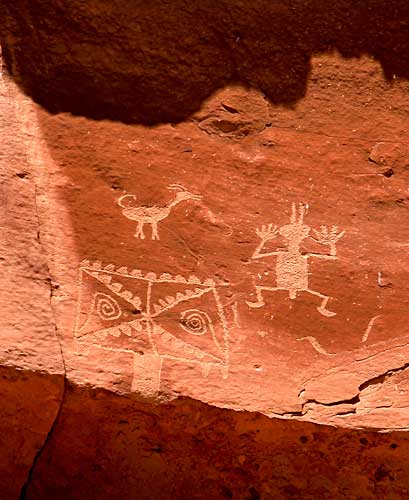
Tlaloc

 I first came across Tlaloc, the Rain God, in an arroyo near Rincon in southern New Mexico.  The depiction of Tlaloc was on a rock face overlooking a hueco, a natural rock tank that collects rainwater and holds it long after the late summer monsoons.


According to rock art expert, Polly Schaafsma, Tlaloc representations with their rectangular heads and goggle eyes can be found throughout southern New Mexico wherever there are Jornada-style petroglyphs. The Rain God may have come along with the corn that found its way north from Mexico around two thousand years ago.

There are certainly mask-like designs everywhere I have found rock art, but the only other one I have seen that was clearly Tlaloc was high on a rock wall in Chaco Canyon. That unusually ornate example inspired me to offer a haiku in tribute:


Tlaloc, the Rain God,

Sometimes dons strange disguise

To walk among us


When I was in the process of redesigning the web site I maintained for displaying my rock art images I decided to create a Tlaloc-like figure as the favicon, the icon for the site that is displayed in the head of the browser. At the time, New Mexico was deep in a long drought and it occurred to me that each time a visitor clicked on the url of the site, the Rain God would be called. Perhaps not a guaranteed drought remedy, but it seemed like it was worth the gamble.

I closed down the rock art web site not long after moving to Albuquerque.  Mike Elek picked up the html code and images and preserved Sacred Places: New Mexico Rock Art as part of his vintage camera site, but the Tlaloc favicon did not go along. I then decided to reuse the Tlaloc favicon for my Everything Else website that I use for digital photography and various other purposes.  So, Tlaloc is still working to ameliorate our dry spells.

Monday, January 22, 2024

Endurance

 My recent visits to view the rock art at a couple sites that are part of the Petroglyph National Monument got me to thinking about the production and life span of images.  Indigenous people throughout the world created compelling visual records of important aspects of their cultures which in many cases have endured for thousands of years.  They did so using the simplest of tools along with patience and perseverance.  This petroglyph found at Crow Canyon, for instance, depicts important qualities of Navajo culture including their reflex-recurve bow design which they brought centuries ago from the far North.

By contrast, the millions of images produced daily using our technologically advanced methods and tools have life spans which can mostly be measured in hours, or even less.  Publishing them online or storing them on hard drives enhances longevity only an insignificant amount.  If a lasting impact is a goal, then trading a camera collection for a chisel and hammer would probably be a good choice.

Friday, January 19, 2024

Piedras Marcadas

Albuquerque had a fine sunny Wednesday, so I decided to take a hike through the Piedras Marcadas section of the Petroglyph National Monument.  Access to much of the site is limited by rope barriers, so photography is best undertaken with the help of a telephoto lens.  With my camera of the day, a No.1-A Folding Pocket Kodak Special, I had to limit most of my photo making to panels close to the trail.


The film was Fomapan 100, processed in HC-110b.  In the camera, FPP 120 to 116 spool adapters were used to hold the roll film firmly in place.  Eight rotations of the winder takes the film to the first frame.  Two-and-one-half rotations separates succeeding frames.

I also made quite a few shots of the rock art with my little digital Canon A1000 IS and I'll post some of those on my other blog.

Thursday, January 04, 2024

Time Flies

 The arrival of wintering Sandhill Cranes is usually heard before it is seen. Their strange, trilling calls carry for great distances in the winter blue sky. It is a sound that came from the sky a million years before the first humans appeared anywhere on the planet.

I have seen fewer cranes this year in the usual places I find them.  I attribute that to the fact than no corn was planted this year at the Los Poblanos Open Space. It took me a week of walking around the Open Space fields and through the riverside forest to get close enough for a few shots of the birds with my longest telephoto.