Monday, May 16, 2022

The Show

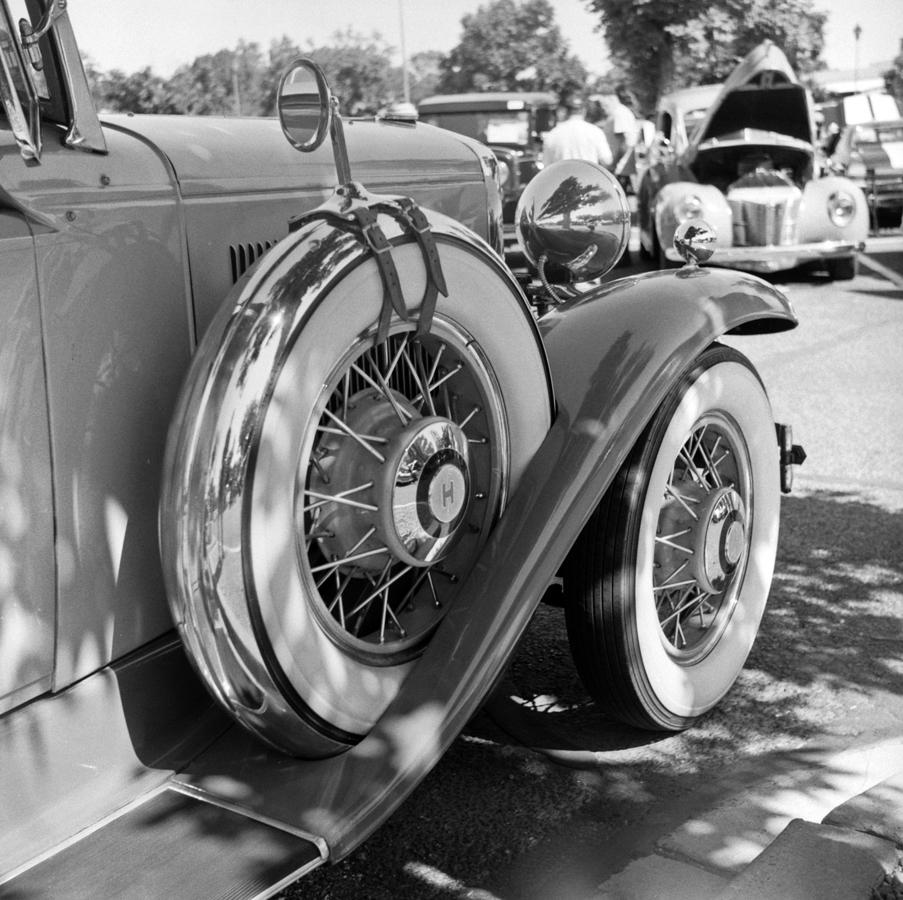
 On a Sunday in May the parking lot and the street in front of the Albuquerque Art Museum are populated by the automotive treasures of the area.  There are an equal number of opportunities and challenges for photographers at the event.  The sun is always very bright and it shines on acres of chrome, producing dazzling reflections interspersed with deep shadows.  The cars, probably around a couple hundred, are packed side by side in each parking lane.  The free show draws a big crowd and it is often difficult to get an unobstructed view of the cars.


I think I logged a couple miles up and down the lanes over a couple hours, so I was glad I chose my lightweight Argoflex Forty to make my pictures of the show.  Quite a few people asked me about the camera.  One fellow took a picture of me and the Argoflex.  Most seemed somewhat surprised to find it was still possible to make pictures with such an instrument.

Wednesday, May 11, 2022

Riverdance

 I took a morning walk along the river.  A lot of water has been let through the dams for irrigation, so the bosque is getting the benefit too.  There is strong growth in the patches of yerba mansa and there a few flower buds on the plants.  I expect the flowering of the yerba mansa will reach its peak in a couple weeks.  So, I'll look forward to getting back soon, probably with the same camera and film.


The cat gets the last frame.

Sunday, April 24, 2022

Zoom at the Zoo

I have made pictures I like at the zoo with quite a variety of old film cameras.  In terms of productivity, the champ is my Pentax SP with the Yashica Auto Yashinon Zoom 1:4.5 f=75mm~230mm.  I've used the big old zoom for little else, but at the zoo where the subject distance is largely under control of the animals the zoom gets me the tight compositions that I am looking for.   The maximum 4.5 aperture provides a slightly dim image in the viewfinder; that, along with the limited depth of field at 230mm, makes focusing on moving targets challenging.  However, with proper focus and an adequate shutter speed the resolution of the lens leaves little to complain about.


Savannah Dreams


Matilda will be a year old on July 20th.


* * *
The Wikipedia page on the Hippo is worth a look:

... After the elephant and rhinoceros, the hippopotamus is the third-largest land mammal and is the heaviest extant land artiodactyl. Despite their physical resemblance to pigs and other terrestrial even-toed ungulates, the closest living relatives of the Hippopotamidae are cetaceans (whales, dolphins, porpoises, etc.), from which they diverged about 55 million years ago ...

Thursday, April 21, 2022

Miles gone by

 I revisited the southernmost section of the Petroglyph National Monument.  It has been quite a while -- five years? ten? -- I'm not sure.  Memories of the place were sparked by a recent discovery of the photographic work of David Grant Noble who spent about forty years documenting ancient ruins and rock art of the Southwest. I'm not sure how I missed seeing Noble's excellent pictures sooner; I only became aware of them because the Maxwell Museum has scheduled an exhibit and artist talk in May. I was pleased to find a couple copies of Noble's book, In the Places of the Spirits, in the Albuquerque Library.


I was also delighted to find that Craig Childs has published several books since I read House of Rain twelve years ago. I decided to start catching up with Childs by reading Tracing Time; Seasons of Rock Art on the Colorado Plateau. Childs' approach to thinking about the ancient cultures of the Southwest is informed by familiarity with the academic research, but it is fundamentally the product of a unique personal immersion in the region's arid environment.


One of the topics Childs deals with in Tracing Time is the destruction of the ancient petroglyphs and pictographs.  In previous books he made the case for leaving any traces of past cultures completely undisturbed.  In this later work he suggests that those who deface and destroy ancient rock art are motivated by assertions of power and ownership which likely were behind similar destruction in ancient times.  It is not uncommon to find rock art panels with many layers of pecked or painted designs laid down over centuries.  The difference, of course, is that the destructive process has been greatly speeded up by exponential population growth along with greatly more efficient tools of destruction including firearms, spray paint and off-road vehicles.


Over the years I have maintained this blog I have at regular intervals acknowledged the idea that my photographic efforts would be enhanced by a more focused and deliberate approach, as opposed to just walking for miles and recording interesting sights I came across.  My journey back to Mesa Prieta yesterday was a concrete expression of that strategic option, brought about now by necessity.  I just can no longer wander for miles at a time to indulge an urge to record serendipitous discoveries.  I'll likely get back to National Petroglyph Monument again soon, and also hope to visit some of the many other rock art sites within a day's drive from Albuquerque.

I am also thinking I will try to narrow my choice of cameras to a few which are likely to produce reliable results to match my current photographic ambitions.  I exposed my recent roll of slightly expired Tri-X in my Mamiya C330, first on a walk beside the river, and then during my visit to the rock art site.  What I found in the process was that it would have been wise to quickly review the camera's manual before setting out as I encountered some problems with lens swapping which I was not prepared for. The C330 is the most versatile tlr available, but the controls are decidedly unintuitive.


Saturday, April 09, 2022

Nikon Lightweight

I carried around my Nikon EM for a week loaded with Kentmere 400.  I usually shoot the camera with the Series E 50mm lens as it makes a nice lightweight kit, but this time I mounted the 50/1.8.  I processed the film with some Ilford Ilfotec DD-X which produced ok results in subdued light, but too much grain and contrast in full sun. 


Mad Cat

Cattle Drive

Casamero Pueblo

Fairlane 500

Wednesday, March 30, 2022

What's in a name?

RETO is the latest name stamped on the face of the little point&shoot film camera with a 22mm lens. However, the camera was on the market over a period of more than fifteen years with a long list of other names.  When I acquired mine close to its debut in the U.S. it bore the Vivitar brand name along with "Ultra Wide & Slim" which has persisted through most of the naming permutations.

All of the versions of the camera have seemed nearly identical except for minor cosmetic differences, and all appear to have been made in the Sunpet Industries factory in Zhongshan, China. Reviewers over the years have used terms like "toy" and even "crappy" to describe the camera, but the Ultra Wide & Slim actually embodies some very sophisticated design enabled by high-tech machinery for the production of ultra-precision plastic aspherical lenses and other camera components as illustrated in the company's website.

Sunpet Industries Limited

In the years I've had an Ultra Wide & Slim it has made more pictures for me than any of the other cameras in my collection including some high-end models with sophisticated features and advanced lens designs.  So, the little plastic camera has met and often bested some serious competition. Some of that, of course, can be attributed to my own biases and infatuation with the seductive combination of sharpness and a wide-angle perspective.  Many others, however, have experienced the same thing; the Vivitar Ultra Wide & Slim group on Flickr is home to over forty-five thousand images.

My latest images with the Vivitar Ultra Wide & Slim were made on some expired Kodak Gold 200.


* * *

Sunpet's decision to revive the Ultra Wide & Slim line has clearly stimulated some interest and enthusiasm for the outwardly simple but capable camera, as well as for film photography in general.  How durable that interest will be is uncertain.  When the camera first appeared the digital revolution was not far beyond its infancy and there were still many choices in photographic films available at nearly negligible prices. Today, many varieties of films have disappeared and those remaining are priced beyond what seems reasonable to many of us who cling to the analog traditions.

Sunday, March 27, 2022

South

We spent four days visiting family and friends in Las Cruces.  I managed to fit in a couple of hours in the Organ Mountains and a morning walk in Old Mesilla.


Monday, March 14, 2022

Spring Forward

The fine Spring weather has brought the old cars back to the Plaza Vieja in Old Town.


The pretty red '40 Ford is a newcomer to the informal weekend car show in Old Town.  I asked the owner about it and he said he had bought the car recently from a fellow in Rio Rancho for the modest sum of twenty thousand.  


The stylish little Bilora Bella offers some basic controls over aperture, speed and focusing, and it makes maximal use of the 127 format, producing negative images that measure 4x6.5cm.  That is nearly three times the size of the 35mm format, although the camera is no bigger than a compact 35.
+That is nearly three times the size offered by the 35mm format though the camera is no larger than a compact 35.  

I am able to shoot my 127 cameras using some old bulk Portra 160 which I roll into backing paper from a couple defunct film brands.  I am always a little surprised to get eight mostly ok images from such an effort as fumbling in the dark through the process of getting the film properly onto the little 127 reels seems a real hit-or-miss project.