Sunday, April 19, 2020
El Malpais
Saturday, April 11, 2020
Stretching Film
In regard to general cost containment, home processing makes film use orders of magnitude more economical than sending out film for commercial processing. With careful technique and attention to adjusting C-41 times to account for use, a roll of color can be processed at home for about a buck per roll. Using high-dilution black and white developers like Rodinal and HC110 along with stand development can make processing costs nearly negligible.
Because of the rising costs of old favorites like TMAX and Tri-X I have already switched to using some lower-cost alternatives like HP5 and Kentmere which work well with HC-110, L110 and PMK Pyro developers. I am also looking forward to experimenting more with some other film choices like Ultra Fine Extreme and Fomapan. Buying any of those films in bulk will also help to tame costs.
A simple way to cut cost per exposure is through the use of half-frame cameras. Many film camera producers came up with compact and elegant camera designs which allow getting up to twice the number of exposures normally available on a roll of film.
My Certo Dolly SuperSport has removable frame masks which give me either twelve 6x6 negatives or sixteen 6x4.5 frames. The SuperSport's film compartment is also big enough to accommodate a 35mm cartridge, which produces an interesting sprocket hole border and a lot of exposures per session.
My humpback Mercury II-CX is the only 35mm half-frame I have at present. The camera doesn't quite double the number of frames from a 35mm cartridge because of the added spaces between frames, but it still takes me quite a while to work through a full roll. The Mercury's rotary shutter is ultra-reliable and accurate, and it has a 1/1000 top speed. The f2.7/35mm Tricor is coated and produces surprising sharpness.
My Zeiss Ikon Ikonta A 520 was an early acquisition when I got back to film photography. Using only the 6x4.5 format, the camera can fold up to fit easily into a pocket and yet provide medium format negatives from 120 roll film. My example has the uncommon combination of a Compur-Rapid shutter with an f3.5/7cm Tessar. Most of the black trim paint on the little Ikonta wore away a long time ago, but the camera's high-quality construction and reliability make it an enduring favorite.
Friday, April 03, 2020
Shut Down
The dog and I took a walk into Old Town last Saturday. At 3:00 in the afternoon, the stores were closed and the streets empty. Normally, the area under the covered walk would be full of jewelry vendors and their tourist clients. I've shot the red chairs empty of diners before early in the morning before the restaurant was open.
Though there was no one around to appreciate it other than me, a fine old Oldsmobile was parked at the curb in front of the church. I didn't see the owner.
We try to get out to the river with the dog a couple times a week. This is one of the locations where there is a big sandbar where the dog can get in a run.
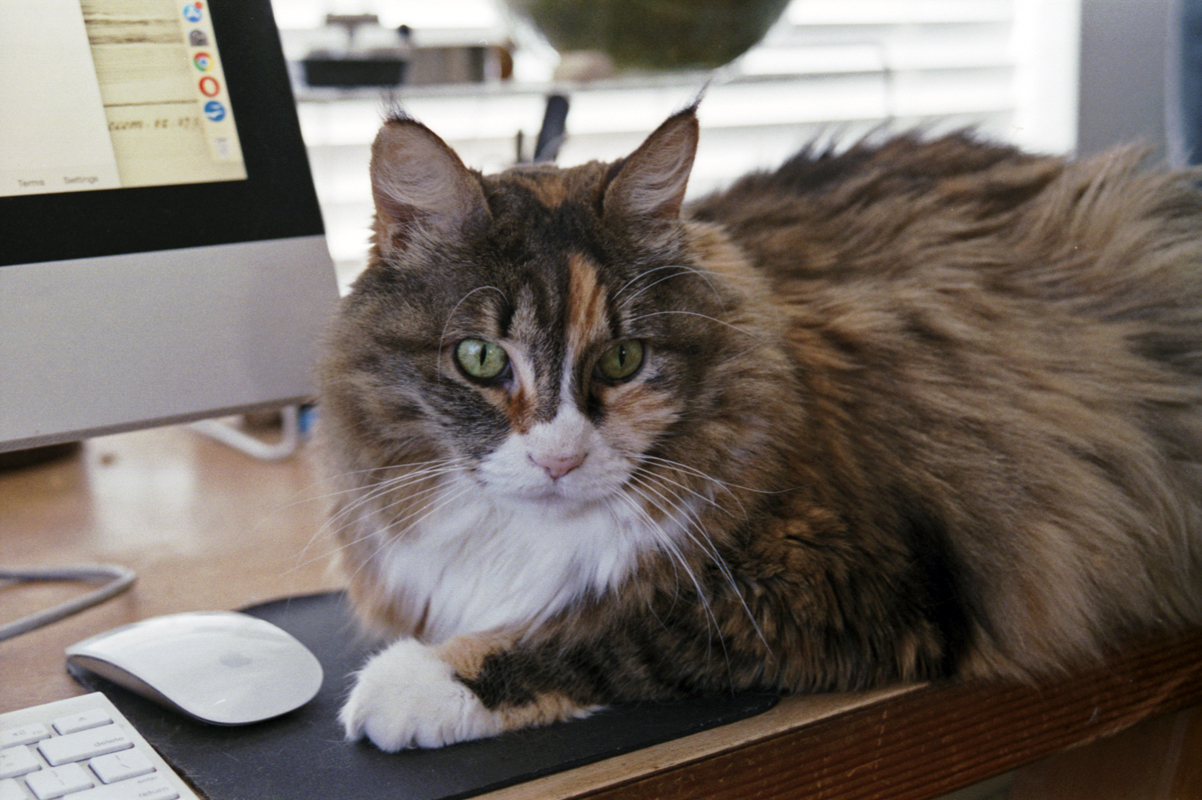
We have mostly stayed close to home this week. That doesn't suit the dog, but the cat is fine with the current arrangement.
Thursday, March 26, 2020
Things are sometimes not as they seem.
There are some signs of Spring, however, which precede those developments.
Many people start coughing as the local junipers start producing berries. My own awareness of the season is awakened by the light of the sun which comes streaming in my east window as the sun moves northward.
(The tousled morning hair is real. The facial features are refractive artifacts from my glasses as I sit at my computer catching up on the day's news.)
Albuquerque's streets, like those of many other towns, are mostly empty. Of course, that has its upside. Walking and biking are pleasant ways to pass the time. Yesterday, I got to take a long ride beside the river with three lovely ladies. How good is that?
Last Sunday our local film photography group met on line using the Google Hangouts conferencing program. The session went pretty smoothly for a first try. The face to face meetings typically feature little in the way of an agenda. We usually just start off by going around the group to hear what people have been up to with their photography over the preceding month. That is pretty much the way it went in the on line experience. We are going try another on line meeting on the first Sunday of next month.
Tuesday, March 24, 2020
Flickr
One of the non-film photography accounts I have added recently to my follow list is that of the Biodiversity Heritage Library which provides several views daily from the collection of illustrations from natural history journals published in the centuries prior to the invention of photography. The digital copies of the illustrations are presented at a high enough resolution to allow the making of good sized prints if desired. I do not have a color printer any longer to take advantage of that opportunity, but I do occasionally save a copy to my hard drive to use as a desktop background. My IMAC desktop is currently home to a wonderful drawing of a carp made in the 18th Century.
Monday, March 23, 2020
Walking the Dog
The Vivitar Ultra Wide and Slim if often along for the trip, even if I have another camera hanging from a neck strap. The thing I always have to remind myself about is the need to frame very tightly because the Vivitar's viewfinder only shows about 75% of what is going to be on the film.
Monday, March 16, 2020
6x4.5
I recently shot a roll of HP5 in my Duo Six-20 that has a Tessar lens and a Compur shutter with a 1/300 top speed. That 3.5/70mm Tessar is a bit inconsistent in its results, possibly due to the fact that it is uncoated, though I have gotten better and more consistent pictures in regard to sharpness and contrast with the same lens on my older Model I.
My liking for the Duo Six-20 got me started re-rolling 120 rollfilm onto 620 reels. That turned out to be a lot simpler than I had imagined for a long time, and it only takes me a few minutes now to get ready for an outing with the camera.
It has been a while since I shot any of my fully manual cameras and I'm finding I have gotten a bit careless in making sure I have focus, aperture and shutter all properly set before making an exposure. There is also the issue of getting the frame spacing correct through the ruby windows when most modern paper-backed films have frame numerals that can only be seen dimly in bright ambient light. However, those are all issues which get resolved with more frequent use.
Thursday, March 12, 2020
2926
I made these shots with a Minolta Celtic 2.8/28mm on HP5 and processed in LegacyPro L110b. The overcast sky provided particularly good light for this subject, and the wide-angle lens along with the fast film ensured good depth of focus.
Tuesday, March 10, 2020
Sunday, March 08, 2020
Museum Pieces
In the upstairs photo gallery there was an Ansel Adams exhibit. The point of the exhibit was a demonstration of how Adams created differing versions of images from the same negatives by cropping, dodging and burning. That is not surprising for photographers, but I think it was probably instructive for people not familiar with photo processing techniques. The most dramatic example of Adams' skill was his famous Moonrise, Hernandez, New Mexico print which looked very bland before he darkened the sky and burned in the details of the clouds.
It seems there is always at least one big mistake in the captions that accompany any large exhibit like this Adams show. In this case it involved a portrait of Alfred Stieglitz made by Adams in the late 1930s. The caption correctly stated that Adams made the picture with a Contax I 35mm rangefinder, but then asserted that the image which was about 8x10 was a contact print!
( 3/24/25: On giving this some more thought, there is a possibility of the image having been produced as a contact print if an enlarged internegative was made in the same way Weston usually made 8x10 prints from smaller medium-format negatives.)
![]() |
| Stieglitz by Adams |
![]() |
| Adams by Weston |