Wednesday, January 28, 2015

Kodak 35

I picked up another Kodak 35 recently on ebay.  I have another very similar, but this one has some interesting differences and is likely the first model which Kodak made in 1938.  


The most obvious difference in this early model is a frame with rollers which holds the film down over the film transport sprockets which both activate the film counter and cock the shutter.  Later models dispensed with the frame, but they all had a tendency to chew up the film strip along the edges.  After I cleaned up this one it seemed to be operating pretty smoothly, but it did tear out a couple edge perforations and caused some difficulties in loading the film on the developing reel leading to the loss of several frames. 


The pictures I got from the camera showed the Kodamatic shutter and the Anastigmat Special lens to be performing well.


Kodak continued production of the camera after WWII and beefed up the design with flash synchronization and a rangefinder.  However, those improvements did not allow Kodak's offering to catch up to the popularity of the Argus C-3 which had interchangeable lenses and no film transport issues.  In spite of the quirky design, the Kodak 35 is interesting historically, and it is pretty easy to work on.  I posted some notes on servicing the camera on Photo.net about eight years ago.  That model had a simpler lens and shutter than my recent acquisition, but the sunny day pictures it made seemed no less sharp to me.

Monday, January 19, 2015

diy color

This is my setup for color film processing.


If you search the web for tips on doing your own C-41 color film processing you will find people suggesting rather elaborate temperature control schemes, often involving aquarium heaters, turkey roasters or expensive rotary agitators.  None of that is necessary if, like me, you are mostly processing one roll at a time.  I just run some hot water into a plastic pan into which I put the developer, blix and stabilizer to warm to the recommended temperatures.  When the developer reaches 102 deg. I pour it into the developing tank, turn off the hot water and set the tank in the pan.  Since development only takes 3.5 minutes, there is very little temperature change that takes place.  The blix phase is less critical in regard to time and temperature, and the stabilizer goes in at room temperature.   I have developed nineteen rolls of color film using this method and the one-liter Unicolor kit and have not seen any unusual color shifts or other processing problems.  Below are some shots from my last roll shot on Fuji 200 in my Contessa 35.


Thursday, January 15, 2015

velvet

We are pleased to see a rebirth of our favorite local coffee shop in a corner of Old Town Albuquerque.


The new owner is Greg Smith.  His enthusiasm for the place seems a good omen.


The pastry also provides some positive reinforcement.


Pull up a stool and I'll buy you a cup of coffee.


The last shot below is from my Contessa 35.  The rest were all from my Pentax Spotmatic with the 24mm Super Takumar.

Saturday, January 10, 2015

Argoflex Forty Fix

The Argoflex Forty is one of my favorite cameras, but I haven't shot it much as it has been plagued by an intermittent light leak.  I thought I fixed it several times with layers of black tape over the back, but sunny day photo outings proved me wrong.


I finally figured out with the help of a bright little LED that the light was sneaking by the side of the slightly loose-fitting shutter release button.  The inner cone of the camera comes out with the removal of two screws, revealing the shutter release and double-exposure prevention mechanism.  I glued a small square of fuzzy light seal material beside the shutter release shaft and that seems finally to have done the trick.


None of the pictures on the last roll through the camera showed any light leaks.


Wednesday, January 07, 2015

xpro

A local pro gone digital gave me a big bunch of film about five years ago.  I used up most of it except for a couple rolls of Provia slide film which I chucked in the bottom drawer of my refrigerator.  Since I've started doing my own color recently, it seemed like the time had come to try cross processing the Provia.


I loaded the film in my Ansco Panda and shot up the roll between my place and the Old Town Plaza.


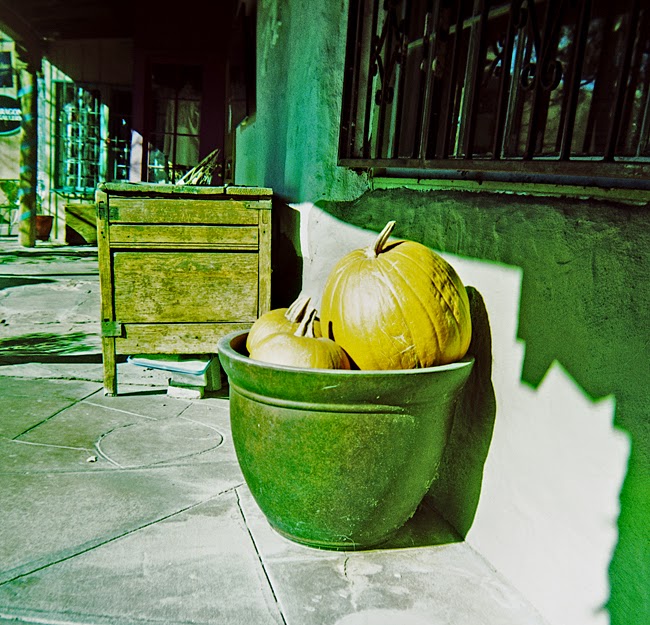
The outdoor shots were all over-exposed and green tinged.  The indoor shots showed much less of a color shift.  I'm not a big fan of cross processing, but it was an interesting experiment.  I might just try the remaining roll of Provia for some interior or night shots.

Tuesday, January 06, 2015

keeping it simple


One advantage of using film cameras is that it facilitates an examination and understanding of photography's fundamentals which are largely hidden under layers of technology in the digital age.  The basics include some way to hold film, a light tight box with one hole to permit the entry of light and some way to control the amount of light reaching the film.  Once those elements are in place, you can then move on to adding some niceties to facilitate the capturing of images such as lenses, viewing systems, and frame spacing and counting.

The Vivitar Ultra Wide & Slim (vuws) offers no adjustable features such as variable focus, speeds or apertures, but it does have many enhancements over pinhole or box-camera basics incorporated into a design characterized by a high level of innovation.  While the feature list is based on a century of design precedents, it also includes materials and construction expertise which could only be dreamed about prior to the late Twentieth Century.


The extreme light weight and compactness of the vuws camera is primarily a product of sophisticated plastics molding technology.  I don't know if the lens is glass or plastic, but modern computer-aided design and manufacturing certainly played an important role in its realization.  At the same time, the actual lens formula likely goes back to the mid-Nineteenth Century.  There are two lens elements, located in front of and behind the shutter/aperture; this is basically the same symmetrical configuration found in the Steinheil Periscopic lens which was in production around the time of the U.S. Civil War.

Looking in at the open back of the camera, you can see that the film rails are gently curved, as are the ribs on the back.  That curved film plane is a feature often built into many simple box cameras, mainly for the purpose of compensating for the edge distortion inherent in simple meniscus lens designs.  While that objective may also have figured into the vuws design, it is also possible that its curved film plane was dictated by a desire to reduce apparent vignetting which is the result of a combination of a small aperture and a very short (22 mm) focal length, rather than any deficiency in the lens.

Some other important features of the vuws include coupled film advance, shutter cocking and frame spacing, all facilitated by the two plastic gears above and below the frame mask.  Just above the top gear is a slot matching a tab on the camera's back which automatically resets the frame counter when the back is opened for film loading.  In spite of the very light-weight materials used in the camera's body, it has great structural integrity which enables smooth operation and a light tight container which requires none of the foam seal material that was essential in most of the metal-bodied cameras of previous eras.

What this all adds up to for the vuws user is a camera that can be slipped in a pocket and that is instantly ready to record high-quality images with very little need to think about photography's technical details.  In combination with the wide exposure latitude of modern films, the fixed focus, shutter speed and aperture are transformed from weaknesses to strengths in support of the creative task of image making.
* * *
I bought my first vuws camera for ten bucks new on ebay.  I later found a couple in thrift stores for which I paid 99 cents.  Then, the would be hipsters found the camera and prices shot up to over $40.  Demand has since nose-dived as film and processing possibilities have dried up.  Superheadz is still trying to peddle them for $36.99, but I've seen them listed but unsold on ebay for as little as eight bucks.

Saturday, January 03, 2015

Richard's New Chair


He doesn't care much for the reclining back, but the rest seems to suit him.  Luckily, he is willing to share with the rest of us.


I could have bought a used Leica for what I spent on the chair, and I plan on spending quite a bit of time in it.

Wednesday, December 24, 2014

lucky me

Spent much of the morning going through boxes of old papers and photographs. Threw out a lot.
Kept this one.

Monday, December 15, 2014

Fix that old camera!

My rudimentary mechanical skills dictate a cautious approach to camera repair.  My goal is not perfect restoration, but rather a working camera that will let me approximate the results the camera could yield when it was in the hands of its first owner.


I am indebted for my small successes to advice gleaned from the internet.  One of the best sources for film camera restoration on the web was the Classic Camera Repair Forum (CCRF).  That on-line site for many years provided a place to exchange information on fixing old cameras that was unequaled.  The site's operators eventually ran out of server space to maintain the data, and, fortunately, the information was preserved on the RangefinderForum site.  It is still possible to browse through the vast trove of postings, but new queries cannot be made, and the search link goes nowhere.

Luckily for posterity, making the CCRF archive visible on the web made the data available to indexing by the big search engines.  So, for instance, if you want to do a search on fixing a particular old camera and confine the responses just to postings from the old Forum, you can use the "site:" modifier in your Google search query.  An example of this approach for a search of the archive for all references to "Retina" would be to go to Google and enter the following in the Google Search box:

site:www.rangefinderforum.com/classics/forum retina

You can substitute any other term(s) in place of "retina" and likely turn up some useful gems of information about dealing with any old camera repair problem.

In the interest of making the search of the CCRF archive even easier I have created a small html form widget in which the desired terms can be entered and the information retrieved by just clicking on the "submit" button.  The search form is over in the right-hand column on this blog.  Just scroll down past the "Popular Posts" listing and try it out.

Saturday, December 13, 2014

Flash Bantam on the Front Page

My favorite little American-made folding camera, the Kodak Flash Bantam, has been featured on The Guardian.

The Guardian -- 12-12-14
The picture was illustrating a brief history of time capsules, and the camera is part of a stash in a capsule buried under the site of the 1939 World's Fair in Flushing, New York.  The capsule is scheduled for opening in the year 6939.  Given humanity's current trajectory, it seems rather optimistic to imagine that anyone will be around to dig up the treasure.  Clearly, however, a high degree of optimism about the future is the whole point of such exercises.

There is an interesting fact about the camera and the date of the capsule's burial which was not noted in the Guardian article.  The Bantam model actually in production at the time of the 1939 World's Fair was not the Flash Bantam, but rather the Bantam 4.5.  The Flash Bantam was not marketed until 1947.  Given the similarity of the two cameras, it is certainly not unlikely that the company had a pre-production example ready to go into the capsule, but I have not seen any evidence of that before.

Wednesday, December 10, 2014

Vivitar Ultra Wide & Slim

I've been making an effort recently to promote the Vivitar Ultra Wide & Slim group at Flickr. The little vuws is my all-time favorite point-and-shoot, and participants in the Flickr group have produced some of the most interesting images you can find on the big photo sharing site.  Like a lot of other groups there that focus on a specific film camera, the vuws group over the past year or so has seen a drastic diminution in participation.  I've blamed that mostly on the increasing scarcity of places to get film and processing, but there may be other dynamics at work in the ways that people make and share images.  Whatever the case, it seems worthwhile to me to support the survival of a virtual meeting place for people around the world who are still interested in shooting the little ultra-wide.

I have a lot of nice old film cameras which I've enjoyed shooting over the years.  I put what I consider to be my best pictures in my Flickr photostream.  The largest number from a single camera were made with my vuws.

undercover cadillac

Tuesday, December 09, 2014

Kodak Duo Six-20

One of my three Duo Six-20 cameras.  This one has a distance scale in meters, an older Compur shutter with a 1/300 top speed and a Tessar f/3.5 lens.  The four-element design of the Tessar yields good correction and resolution, but the added lens-air surfaces increase the likelihood of reflective flare in an uncoated lens. The old Compur's top speed is about a stop slow, but the lower speeds are all close to being correct.

I decided to get a lens hood in order to get the best results from the Tessar, but the only ones I found in the right size on line were expensive and located in Europe.  The local Camera and Darkroom shop did not have any that would easily fit the Duo Six-20 either, so I settled for a standard Series Five hood.  I cut a small strip of black foam and glued it to the inner rim of the hood to provide a good press fit.  I also picked up a selenium cell light meter at the same time to replace my old Sekonic which has gotten lazy in its readings.


I shot all of the pictures on this roll at 1/100 with the Tri-X rated at 200 ASA and processed in Ilfosol 3 at 1:14 dilution.

Friday, December 05, 2014

Sandia Wilderness


First roll of color processed with my second Unicolor kit

Friday, November 21, 2014

autumn leaves

"I photograph to find out what something will look like photographed."
Garry Winogrand


Taken out of context, Winogrand's statement may appear flip and cynical.  I think, however, that he meant it quite sincerely.  He actually made similar statements on many occasions which alluded to photography as a way of investigating the world and the mind's perception of it.  The fact that Winogrand worked primarily in black and white is particularly relevant because of the often unexpected transformations which the extraction of color produce in a photographed scene.


Photographing leaves as they change color in the Fall is illustrative of the nuances of translating from color to monochrome.  Much of the immediate visual impact we experience in viewing Autumn foliage is due to the interplay of colors in the leaves.  Monochrome translation reveals that distinct hues may appear undifferentiated depending on surface reflectivity in the subject and on the chromatic sensitivity of films and lenses.  The challenge then for the monochrome photographer is to look beyond the immediate impact of Autumn's colorful displays to explore some of the other visual components of the observed scenes including form, texture and contrast.

Saturday, November 15, 2014

Kodak Bantam RF

I recently acquired a Kodak Bantam for a ridiculously low price on ebay.


Mine looks pretty much like new, and everything works more or less as it should.  Aside from the Bantam name and the 828 film format the RF model had almost nothing in common with the  Bantam strut folders which first appeared in the mid-1930s.  Kodak continued producing the 828 folders for a few years after WWII; the name was then passed on to a new line of fixed lens, bakelite-bodied cameras designed by Arthur H. Crapsey.


The Bantam RF design and the supporting Kodak publicity reflected and helped define the '50s aesthetic.


As I had done with my Flash Bantam, I covered the ruby window on the back of the camera and taped a 24-exposure strip of 35mm film onto the 828 reels.  One nice innovation in the RF model is a roller-based frame spacing mechanism which eliminates the guess-work in advancing the film by counting turns.  The removable back presented a bit of a challenge in the process of film loading inside a dark bag, but I think it will be less of a problem with subsequent rolls.  I exposed the first roll of film through the camera at one of my regular test sites, the National Museum of Nuclear Science and History.

F-16 - new paint job and accessories

USS James K. Polk Submarine Sail - surfaced

B-52B Stratofortress