![]() |
| Savannah Dreams |
![]() |
| Matilda will be a year old on July 20th. |
![]() |
| Savannah Dreams |
![]() |
| Matilda will be a year old on July 20th. |
I revisited the southernmost section of the Petroglyph National Monument. It has been quite a while -- five years? ten? -- I'm not sure. Memories of the place were sparked by a recent discovery of the photographic work of David Grant Noble who spent about forty years documenting ancient ruins and rock art of the Southwest. I'm not sure how I missed seeing Noble's excellent pictures sooner; I only became aware of them because the Maxwell Museum has scheduled an exhibit and artist talk in May. I was pleased to find a couple copies of Noble's book, In the Places of the Spirits, in the Albuquerque Library.
I am also thinking I will try to narrow my choice of cameras to a few which are likely to produce reliable results to match my current photographic ambitions. I exposed my recent roll of slightly expired Tri-X in my Mamiya C330, first on a walk beside the river, and then during my visit to the rock art site. What I found in the process was that it would have been wise to quickly review the camera's manual before setting out as I encountered some problems with lens swapping which I was not prepared for. The C330 is the most versatile tlr available, but the controls are decidedly unintuitive.
![]() |
| Mad Cat |
![]() |
| Cattle Drive |
![]() |
| Casamero Pueblo |
![]() |
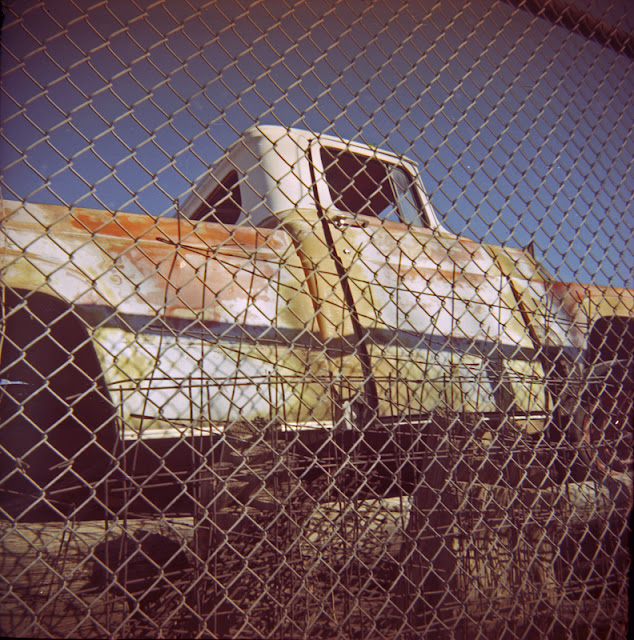
| Fairlane 500 |
RETO is the latest name stamped on the face of the little point&shoot film camera with a 22mm lens. However, the camera was on the market over a period of more than fifteen years with a long list of other names. When I acquired mine close to its debut in the U.S. it bore the Vivitar brand name along with "Ultra Wide & Slim" which has persisted through most of the naming permutations.
All of the versions of the camera have seemed nearly identical except for minor cosmetic differences, and all appear to have been made in the Sunpet Industries factory in Zhongshan, China. Reviewers over the years have used terms like "toy" and even "crappy" to describe the camera, but the Ultra Wide & Slim actually embodies some very sophisticated design enabled by high-tech machinery for the production of ultra-precision plastic aspherical lenses and other camera components as illustrated in the company's website.
![]() |
| Sunpet Industries Limited |
In the years I've had an Ultra Wide & Slim it has made more pictures for me than any of the other cameras in my collection including some high-end models with sophisticated features and advanced lens designs. So, the little plastic camera has met and often bested some serious competition. Some of that, of course, can be attributed to my own biases and infatuation with the seductive combination of sharpness and a wide-angle perspective. Many others, however, have experienced the same thing; the Vivitar Ultra Wide & Slim group on Flickr is home to over forty-five thousand images.
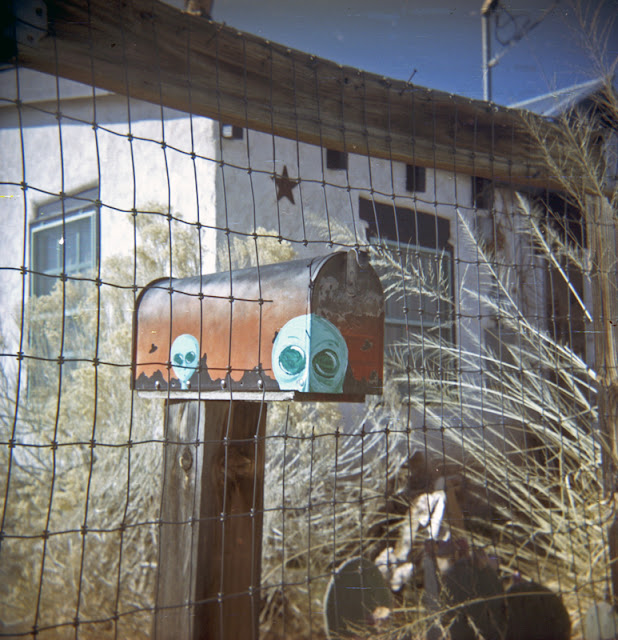
My latest images with the Vivitar Ultra Wide & Slim were made on some expired Kodak Gold 200.
Sunpet's decision to revive the Ultra Wide & Slim line has clearly stimulated some interest and enthusiasm for the outwardly simple but capable camera, as well as for film photography in general. How durable that interest will be is uncertain. When the camera first appeared the digital revolution was not far beyond its infancy and there were still many choices in photographic films available at nearly negligible prices. Today, many varieties of films have disappeared and those remaining are priced beyond what seems reasonable to many of us who cling to the analog traditions.
We spent four days visiting family and friends in Las Cruces. I managed to fit in a couple of hours in the Organ Mountains and a morning walk in Old Mesilla.
The fine Spring weather has brought the old cars back to the Plaza Vieja in Old Town.
I am able to shoot my 127 cameras using some old bulk Portra 160 which I roll into backing paper from a couple defunct film brands. I am always a little surprised to get eight mostly ok images from such an effort as fumbling in the dark through the process of getting the film properly onto the little 127 reels seems a real hit-or-miss project.
The compact size and brilliant viewfinder of the Kodak Brownie Reflex make it one of my favorite cameras using 127 film. I still have most of a refrigerated bulk roll of 127 Portra 160 , so I wound up a couple two-foot lengths of the film on 127 reels along with some old 127 backing paper. The Portra would have given me over-exposed images in a box camera when new, but the film is well-expired and seems about right for the slow shutter in the little reflex box.
The metal bodied Flash Six-20 was an outlier in Kodak's post-war plastic Brownie lineup. Perhaps the choice of materials was related to the sudden availability of steel for consumer products. I loaded mine with a roll of well-expired Ilford Pan F 50 for a neighborhood stroll. As I walked out the door I was thinking about the fact that I had not tried the camera's built-in close-up lens, so I snapped a shot of our deck furniture as a test, which the Six-20 passed comfortably. The next two shots gave me some dull, blurred results. I'm not sure if I misjudged the distance, or just didn't hold the camera steady enough to accommodate the slow shutter speed.
I switched back to the camera's "Beyond 10 Feet" setting and got a nicely sharp rendering of some winter- bare trees. However, the left fifth of the image was black -- don't know why.
I stuck with the non-close setting for the rest of the roll and the following full-frame images nicely illustrate the central sharpness of the meniscus lens along with some corner vignetting and blurred periphery.
I got to the Plaza Vieja in Old Town with just one frame left, which was good luck as Elvis was making a rare appearance there for a small group of devoted fans.
We took a walk around the neighborhood with the Kodak No.2 Folding Autographic Brownie.
Kodak applied the Brownie name to quite a variety of cameras. This was one of the more capable ones with zone focusing and multiple shutter speeds and apertures. The Rapid Rectilinear lens is quite good.
The Henry Mann House is just across the street from our place. It was built in 1905. The heavy wooden gate is a block north of us next to a big adobe brick house that also looks to be quite old.
We had a couple inches of snow overnight in Albuquerque. It seemed like a good excuse to make some pictures for February's International Brownie Camera Days. I found one more roll of Acros in the refrigerator, rolled it onto a 620 reel and loaded it into my Brownie Hawkeye Flash. I shot half the roll on a walk around the neighborhood, and finished it off with some shots of Roxie in the yard using the No.13 close-up attachment.