


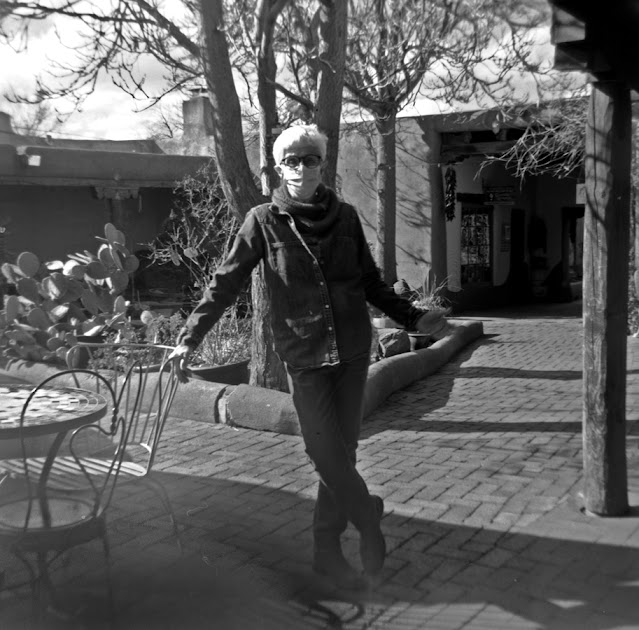


The modular construction of the Kodak Brownie Hawkeye Flash makes it easy to disassemble for cleaning or modification. The easiest and most common mod is to reverse the lens front-to-back. With the lens unmodified, the minimum distance for sharp focus is about eight feet. Flipping the lens brings the minimum for sharp focus down to about 3.5 feet. However, only the center of the image will be seen to be sharply rendered, while the periphery becomes progressively blurred.
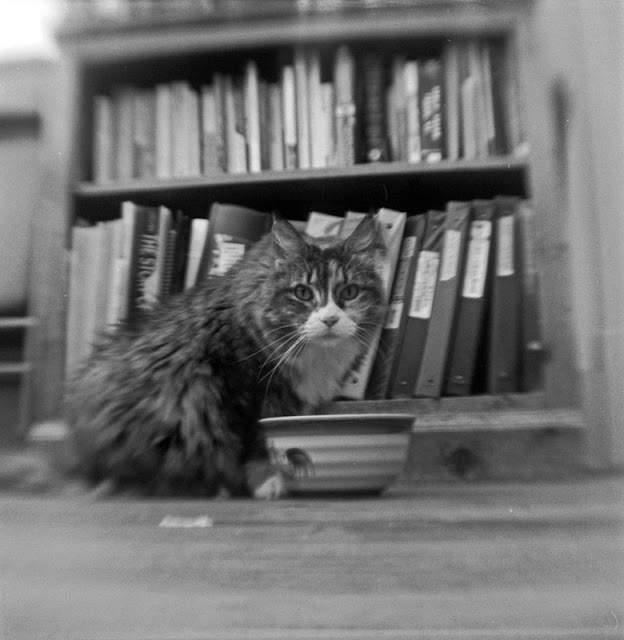
I loaded a roll of slightly expired Tri-X into my Brownie Hawkeye Flash and made twelve exposures in the house in about five minutes. Because of the low light I set the camera to use the shutter's time mode to permit an exposure of an estimated one second; the camera was braced solidly on the floor to avoid camera movement. The first shot caught Ruthie, my cat, unawares at her water bowl. She was a bit irritated with that intrusion and threatened to leave the room. I apologized, convincing her to stay, and she composed herself and assumed a more dignified pose.
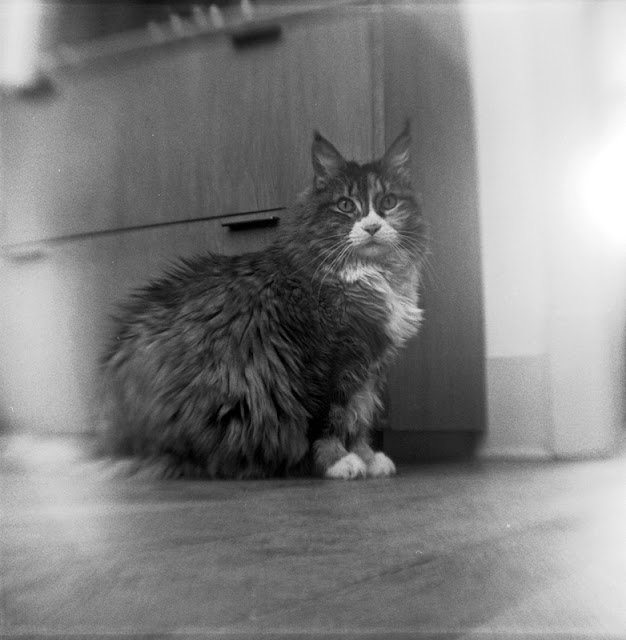
In addition to the peripheral defocusing the flipped lens also seems to have an increased tendency to flare with back lighting.
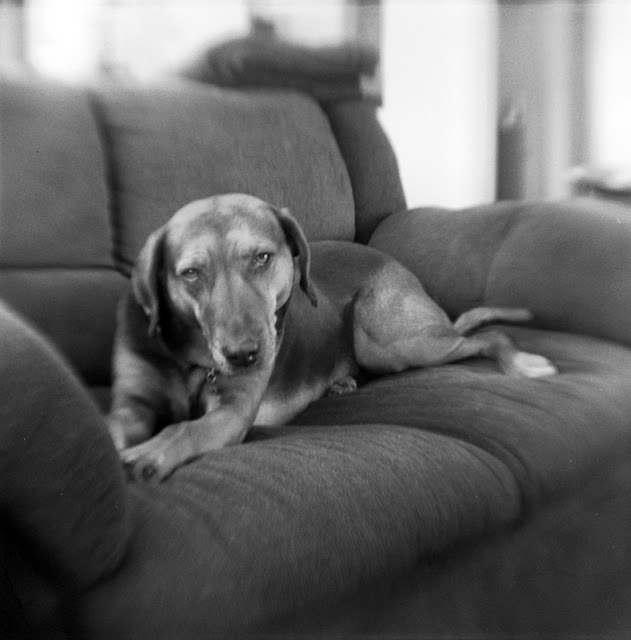
I took the camera into the living room and made a couple shots of Roxie with the camera braced on a chair . Her skepticism about the process seems emphasized by the sharpness of the eye closest to the center of the image compared to the slight blur of eye closer to the edge.
I have made thousands of pictures with well over a hundred cameras, so no real need to make more. However, I enjoy the process as much as the end product. I took along a Kodak Brownie Hawkeye Flash box camera yesterday while walking the dog.

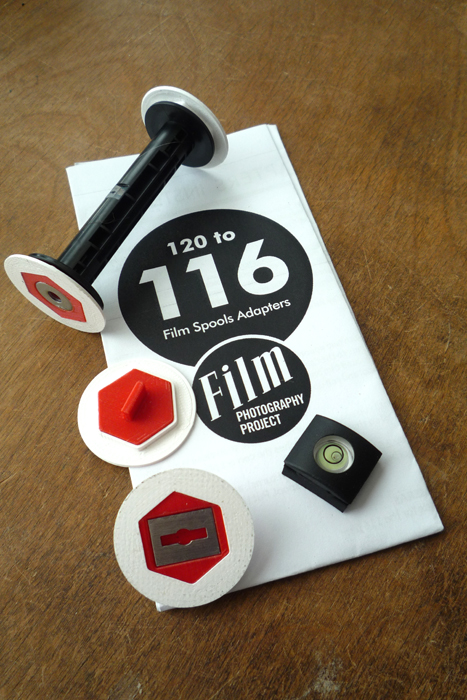
While this simplest procedure mostly works, a few glitches can degrade the results. The film rolls onto the take-up reel rather loosely and it can drift sideways, causing some misalignment of the image on the film. An easy fix for that problem is to acquire some 120 to 116 film adapters like the ones sold by the Film Photography Project.
I found the small bubble level on ebay for just a few dollars. Since the old folders have no accessory holders I just attached the level to the top deck of the camera with a piece of double-sided tape.
I have not seen any problem with film flatness even without a 120 mask for the film plane. It would be helpful to accurate composition though to make a mask for the viewfinder.
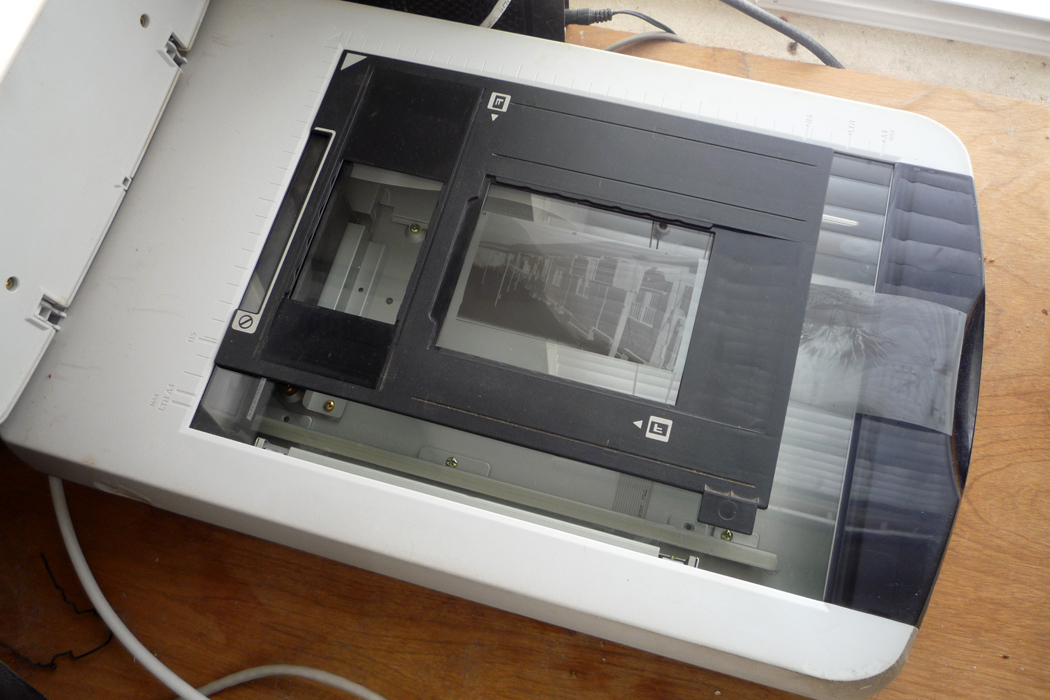
Scanning the long negatives can be a bit of a challenge. My old Epson Perfection 2450 flatbed scanner has a film holder with a 4x5 frame, so I make use of that to hold the negatives in place by placing them directly on the scanner's glass and laying the film holder on top of the film. With the emulsion side of the film toward the glass, the upward curve of the film helps to avoid Newton rings on the scanned images.


The best part of Albuquerque's Balloon Fiesta for me is actually not the balloons, but the Flamenco dance performances in the Old Town Plaza Vieja which are staged by the National Institute of Flamenco. I believe the small woman in the picture is Eva Encinias who founded the Institute as well as the unique Flamenco dance program at UNM. The tall woman beside her is the head teacher at the Institute.

I shot a roll of Kentmere 100 and another of Kentmere 400 this time around. Since I had two rolls of film to process I decided to try them both together using semi-stand processing in HC110 at 1:100 for an hour. I was very pleased with the results which this choice yielded for the Kentmere 400. The tonal qualities were very good and the grain was nearly undetectable. I have mostly used PMK Pyro as a developer for Kentmere in the past with good results, but I thought the quality of the HC110 pictures made with my Nikon FE were just as good if not better.


The Kentmere 100 shot in my FED 1g rangefinder responded less well to the HC110 stand development, so I'll likely stick with PMK Pyro processing for that film which seems better able to handle the higher contrast of the slower speed film.


I can't say that the new Acros is the same as the old, but it is nice stuff in terms of grain and tonalities. I processed these shots in Rodinal 1:50. My old Silverfast scanning software does not have an Acros profile, so I tend to skip around to find one that produces what I want from the negatives.


 |
| Duotone |
 |
| Ringtone |
I bought five rolls of the Acros 100-II from Adorama where it was on sale at about half the current price, probably due to the fact that it was close to the expiration date. I have several rolls left, so I'll likely try the film in additional developers includiing PMK and HC110.
I took a long walk with my 1A Pocket Special in the riverside forest at the east end of the Paseo del Norte bridge. I saw some bike riders and skaters on the paved path that parallels the river, but no other people after that.

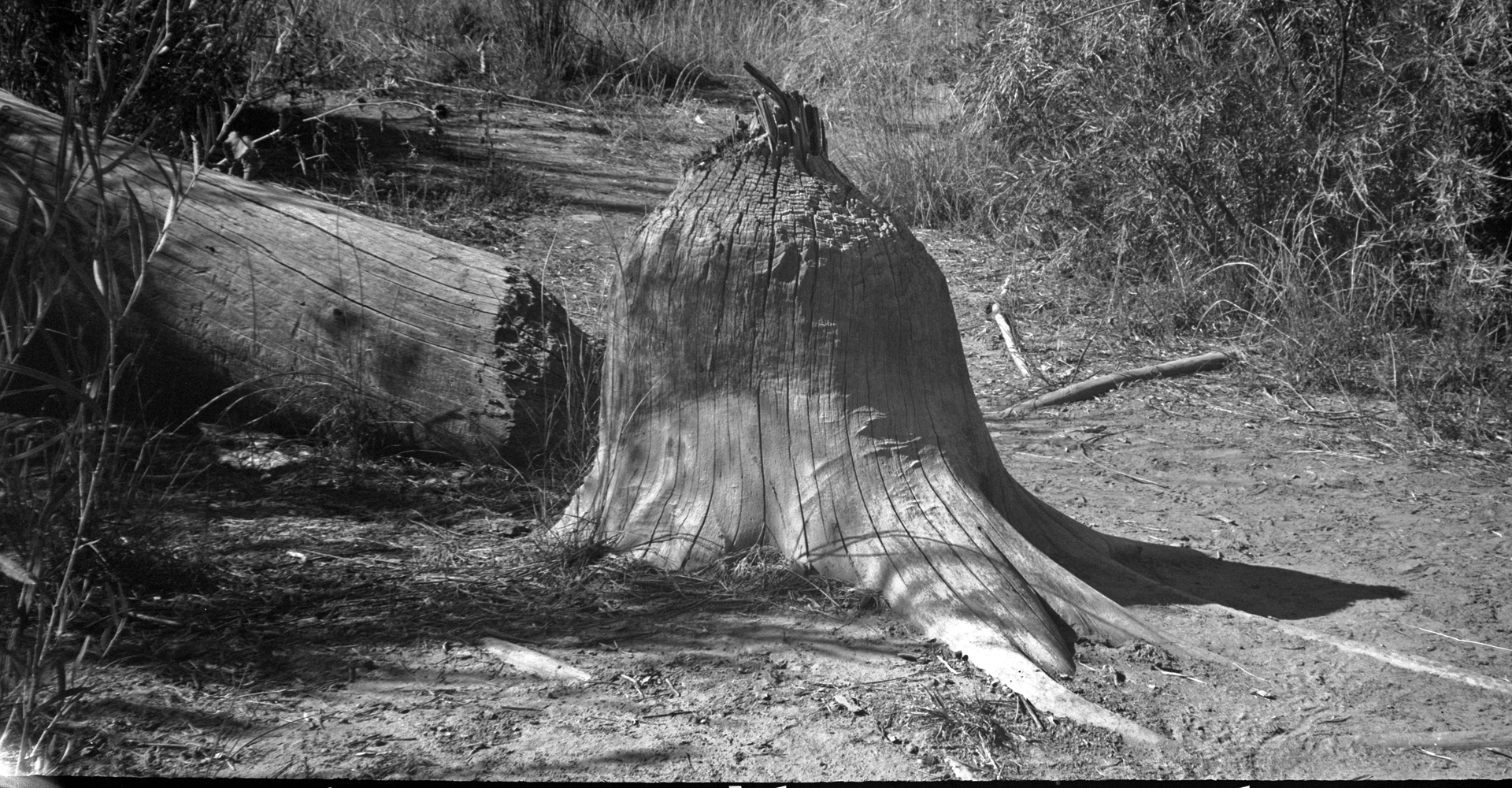

I wasn't happy with some images on Fomapan 400 shot recently with my 1A Pocket Special and put them aside. I started playing around with them again in Photoshop this evening and discovered that some rather radical adjustments to contrast, highlights and shadows revealed that there was quite a lot of useful detail available in the negatives.


The adjustments to the images got me a lot closer to what I want from my black and white medium format pictures in regard to sharpness and tonal range. I'm thinking now that I need to take a close look at my Silverfast settings when I do the initial scans of the Fomapan 400 negatives.

The 116 to 120 adapters from the Film Photography Project look like they are going to make using 120 film in the 1A Pocket Special a lot more practical. I also spent some time today in getting a better handle on advancing the film blindly since the red window is not of any use. It seems that if I am careful in the advance process I could get as many as seven frames from a roll of 120.
I spent an hour at the Botanical Garden with my Kodak Reflex II. I shot a roll of Fomapan 400 with the continuing hope that one of my usual developers would yield results that I can live with. I processed this roll in PMK Pyro.


I tagged along with a fellow New Mexico Film Photographer on a visit to the Old San Ysidro Church and Cemetery in the community of Corrales.


We managed to get to the place shortly after sunrise and found some very nice light. I was pleased to get seven frames from a roll of 120 in my 116-format Kodak No.1A Folding Pocket Special. Unfortunately, the film rolled crookedly onto the take-up spool, so all the shots were a bit cockeyed. I had taped the film backing to the take-up spool to try to avoid that, but to no avail.

When I first began using this camera I had put some foam padding on the end caps to keep the 120 ilm from getting off track. That reel got lost along the way, and I don't have any suitable material on hand to duplicate that arrangement. I decided I would try some 116 to 120 3D-printed adapters which would let me use actual 120 film spools on both ends. I ordered the adapters from the Film Photography Project at a cost of $20, and I should have them in about a week.
I shot a roll of the expired Gekko film in my Kodak Signet 35 and developed in HC110b for five minutes as indicated by the chart on the inside of the box. The grain seemed pretty pronounced for 100-speed film, and it took some heavy adjustments in Photoshop to approach the correct tonal balance.


