Sunday, February 26, 2012

Off to the Races


The boats being raced this Saturday were of the One Meter Soling Class.  Colors vary, but all boats are identical in construction; so sailing skill is the key to winning (along with a little luck).


The racing captains control their boats with radio transmitters and receivers which activate solenoid movements of the rudder and sails.


The breezes over the ponds are always unpredictable; some sharp gusts had the boats moving along nicely.


The competition is keen and requires intense concentration to keep the boats on course to properly round the buoys at each end of the pond.


If boats pass the marker buoy on the wrong side, they must go back and try again.


The boat owners are mostly middle-aged and up; they all seem to having a very good time.


There is always a good crowd around the ponds on the weekend, with many enjoying the races and others interacting with the big flocks of waterbirds attracted by copious distributions of bread crumbs.


I was pleased with this first performance by my new Yashinon Zoom on my Pentax Spotmatic.  All the shots were hand-held at f8 and 1/500.  The film was Kodak Gold 100.

Friday, February 24, 2012

Shooting the Finetta IV D

Early on a Thursday morning, Albuquerque's Old Town was mostly deserted, with just me and my Finetta to appreciate the morning light.


I shot a roll of Fomapan 100 which I processed in HC-110, dilution B.  


These shots were mostly at f16 and 1/100.  The shutter release on the Finetta is a little rough, so it is important to pay attention to keeping the camera as steady as possible during exposure to get the most from the Finetar lens.


There is no auto-reset on the Finetta film counter.  Before you load your film you need to turn the Advance  knob to set the counter a couple stops ahead of the number one.  That is best done by pulling up and twisting the knob to hold it in the rewind position, making it easy to turn as needed to reach the starting point.  


The viewfinder is small on the Finetta, but seems bright enough.  The framing seems pretty accurate, and I did not encounter any problem with parallax in the close shots.  The frame spacing on rolls through the Finetta are a little variable from start to finish because the advance spindle seems to turn through an identical arc on each winding.  I did, however, get the full 24 frames from the roll with no over-laps.


I believe my Finetta dates from about 1950.  The company made several earlier and later models, and the last one was quite sophisticated with a motor wind, interchangeable lenses and a focal plane shutter.  While mine is a lot more basic in its feature set, it is still a very serviceable compact camera.


Thursday, February 23, 2012

Uniquely Modest

The Finetta IV D, produced in Goslar, Germany in 1950, was a camera clearly designed to be an affordable  image maker which would make sharp pictures reliably throughout the life of a family. The bakelite and metal construction is solid, and the coated Finetar f4.5/43mm lens yields very respectable results.


I acquired my Finetta some years ago.  Nothing worked quite right on it when received, but I reset the infinity focus, cleaned the shutter and advance mechanism, and got it working well enough to shoot a single test roll.  The pictures I got were sharp enough, but not very interesting -- not the fault of the camera, of course.  So the camera was unjustly condemned to years on the shelf, and I only got back to it again today.


When I examined the camera again in preparation for using it, I found that the film rewind mechanism was not working right.  When you lift and turn the Advance knob on the right it is supposed to release the film spindle to turn freely so the film can be wound back into the cassette on the left.  It turned out that the little screw you can see at the lower right above had worked loose.  The result was that the bottom of the take-up spool was not getting above the brass lever assembly which prevents the spool from turning backward.  Tightening down the screw fixed the problem, and I loaded up a roll of Fomapan 100.


That little lever in the picture above flips down to hold the film cassette in place so you can slide the back on  without having the film fall on the floor, a simple but effective design feature that is typical of the camera's construction throughout.


Getting the back of the Finetta off and on again is a little counter-intuitive for most people today.  Like my little Ansco Panda, that knob on the camer's bottom plate is turned in a clockwise direction to open the back and counter-clockwise to close.  My wife tells me the letter indicators stand for Auf and Zu, which translate roughly as Open and Close.  Someone obviously took a screwdriver to the back of my Panda, trying to pry it open, and left some pretty ugly scars.  The Finetta did not suffer the same fate.  Perhaps the last owner was a German speaker.

Tomorrow: Actual pictures made with the Finetta IV D !!!


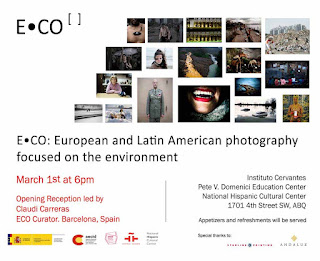
Exhibit at the National Hispanic Cultural Center


Click graphic for the complete announcement.

E•CO - Environmental Graphic Exhibition from Europe and Latin America

exhibition

E • CO presents photographic projects, made by twenty Latin American and Europeans photographic collectives, whose works have been commissioned by the Ministry of Culture of Spain, under the Spanish Presidency of the European Union and within the celebrations of bicentenary of many Latin countries’ independence.

Dates

Del 01/03/2012 al 31/05/2012

Inauguración

01/03/2012
(18:00 h)

Visiting Hours

Lunes a viernes, 9 am - 5 pm. Sábados de 8 a 12

Location

Instituto Cervantes - Pete V. Domenici Education Center (NHCC)
1701 4th St SW
87102 Albuquerque Nuevo México
(ESTADOS UNIDOS)

Monday, February 20, 2012

Boat #73

We went to the sailboat races on Saturday.  The Duke City Model Yacht Club puts them on at 1:00 pm each weekend at Tingley Beach.


The boats share the pond with a lot of ducks and geese this time of year.  The birds don't seem to mind, perhaps because the boats move rather quietly and gracefully.  The boat pictured is in the RG-65 class.  I'll try to get back next weekend when the Soling One Meter class is racing.


nuts and bolts

This is a message for the authors of all the blogs I follow.

One of the few rewards of maintaining a blog is the possibility of a dialog with readers. That dialog can be hampered by excessive security measures including moderation and captcha features. I turned off moderation from the beginning, meaning that comments on my postings immediately appear. I have not seen any ill result from this decision to date, though blogs with more controversial content may show a different result.

I have also today turned off the captcha feature which requires commenters to type in some nonsense words which are displayed on their screen before a comment will be recorded. This seems like a good way to avoid robot spammers, and it probably does discourage them. However, the captcha feature on blogger has recently become excessively burdensome in my opinion. One is now required to discern and reproduce two nonsense words that are often very hard to interpret. It routinely takes me three or four tries to get the captcha message right when I leave comments on blogs. That has got to be cutting into the exchange of ideas. Of course, if I now start seeing massive spam attacks on my blogs, I'll have to reconsider my decision. In the meantime, I hope others will give it a try. You can always revert to heavier security if it is really needed.  Note too that Blogger has built-in comment spam detection and will flag suspicious comments and hold publication for your express approval.

Since blog authors don't see the captcha feature when they make a comment on their own blogs, they may not be aware of how irritating this feature can be. If you check it out and want to turn off captcha, it is easily done, but you may have to reactivate the old blogger interface if you have switched to the new one. Here is a helpful set of instructions for doing that which I found in the blogger help forum from "Late Night Guy":

Unless DarkUFO knows of a way on the new interface, there isn't one. You need to go back to the old interface to turn off word verification. From the new Blogger dashboard page, click the gear symbol under your profile picture and select "Old Blogger interface." On the old dashboard page, click on "Settings" then click on the "Comments" link below the tabs. That will get you to where you can unselect word verification. Click "Save Settings" at the bottom of that page when you are done. there is a link in the upper right hand corner of the old dashboard page so you can get back to the new interface. I hope this helps.


Update:
I still have the policy in place and after nine days it seems to be working fine.  Comments with links, usually to some Viagra pitch, are automatically routed to my email inbox where they can be easily deleted.  So the Google/Blogger spam filter seems to be working fine as far as I'm concerned.  Since I also have the ability to delete comments which I deem inappropriate for whatever reason, I feel I am still in control of the situation.

Sunday, February 19, 2012

Winery

The Casa Rondeña Winery is about ten minutes north of Old Town in Ranchos de Albuquerque.


A long driveway through the vineyard leads to the owner's home which is now a club for wine enthusiasts.


Between the home and tasting room is a park with a pond; a very nice place to enjoy a glass of wine on a sunny afternoon.

Saturday, February 18, 2012

Tuesday, February 14, 2012

If you happen to be in Valencia

There is a show of Cuban pre-revolution photography at the Instituto Valenciano de Arte Moderno (IVAM).


The 1939 photo above appeared in an article in El País about the show. The girl is posing with a Plaubel Makina which used 6x9 plates or cut film, and could also be outfitted with a 120 rollfilm back.  I always wanted one of these fine rangefinders, but the shutters and rf mechanism are somewhat delicate, and the cameras tend to go for more than my budget allows.

Saturday, February 11, 2012

My Panda likes the winter light.


If you are looking for a camera that's fun to shoot, it is hard to beat the little Ansco Panda box camera.

This was Fuji Acros processed in D-76 at 1+1 dilution.

Sunday, February 05, 2012

Shooting the Beast

The Mamiya-Sekor lens on the C330 can produce extremely nice results, and the camera has some unusual and useful features including a bright view screen and a bellows allowing extreme close-ups.  I also have the 180 mm lens which provides additional versatility.


Ergonomics are the weak point; the camera is big and heavy.  I'm not able to get through a roll without at least once catching the shutter cocking lever with a finger.  It is a camera that is more comfortable on a tripod in the studio.  Two accessories are nearly mandatory to realize the camera's potential: an eye-level prism finder, and a paramender for properly framing close-ups.  The viewfinder does have a auto-adjusting bar that helps compensate for parallax, but that doesn't fully correct the view, and one must also remember to properly adjust the aperture if the bellows is cranked out.  I'm too cheap to put out the bucks that the accessories for this camera require, but I am going to try harder to get used to the quirks of shooting it as it really can produce some good pictures.


These images were made on Tri-X and developed in D-76.  I processed the previous roll with this same combination at a 1+1 dilution and got some uneven development, with light stripes showing on the left and right sides of the negatives.  For this roll I used the D-76 in stock solution and gave a little more agitation.  That showed some improvement, though not to perfection.

Some previous images from the C330 are in my Flickrstream.

Wednesday, February 01, 2012

Albuquerque Shows

The UNM Art Museum is coming out of the winter doldrums with a couple interesting photo shows:

* Reconsidering the Photographic Masterpiece

* Hiroshi Sugimoto


 Edward Weston, Artichoke Halved, 1930
Museum re-opening Friday, February 10th from 5:00-7:00pm

* * *

Also showing: The Mind's Eye, a juried show at the Albuquerque Photographers Gallery in Old Town; the opening is Friday, February 3rd, 5:00 to 8:00 pm.

Monday, January 30, 2012

mju


The last time I used my Olympus Infinity Stylus (mju ) the shutter release was not working properly.  It often required several presses of the button to fire -- not what you want in a small camera.


When I got home I checked the battery voltage, but it was still at 3 volts even after about a year of use.  Leaving the battery out, I dribbled a little Radio Shack electrical cleaner around the edges of the shutter button.  I let the camera dry out for a couple hours and then replaced the battery.  The action of the shutter release was much improved, though still not perfect.  I may try another round of the electrical cleaner.  I'll also not pass up the next five-dollar mju I come across at a thrift store.

Sunday, January 29, 2012

custom car

I picked up a copy of Salman Rushdie's The Enchantress of Florence at a yard sale down the street. This VW was parked at the entrance.


Here's the explanation.

Friday, January 27, 2012

Learning to be a photographer


From the Ceiling Lamp Series -- Cole Thompson

I recently  came across the work of Cole Thompson in an interview which appeared on Aline Smithson's LENSCRATCH.  Thompson shoots and processes his images digitally, but only shows black and white as a final product and his work is clearly informed by a great depth of knowledge of and appreciation for photography's long history.  The photographer is also a gifted writer, and he is very generous in sharing information about his techniques and the sources of his inspiration.  I've added a link to Cole Thompson's blog over in the right-hand column, and I'll be following his work closely from now on.

Tuesday, January 24, 2012

Kodak Duo Six-20


The Kodak Duo Six-20 is perhaps the most elegant of the company's medium-format folding cameras; it was made in the NagelWerk factory in Stuttgart. This Series II model has a Compur-Rapid shutter with speeds from 1 sec. to 1/500. The lens is a unit-focus f3.5/75mm Anastigmat. The camera was built to accomodate 620 roll film and yields 16 frames in 6x4.5 format. The flip-up  finder provides a bright view of the subject.

San Felipe de Neri Church, built 1793

The materials and construction quality of the camera is first-rate throughout.  The lens and shutter at this point in time may need light cleaning, but the camera's basic simplicity makes serious problems unlikely.  Aside from the need to re-roll 120 film onto 620 spools, about the only problem that is likely to arise is with the long mechanical linkage of the shutter release.  Extending the lens to the closest focusing position may push the shutter release lever beyond the reach of the linking lever and lead to additional alignment problems.  On my camera, I have also found that I need to avoid closing the front door with the shutter cocked as the cocking lever may get hung up on the door latch.

Wednesday, January 18, 2012

Zeiss Ikon Ikonta 35


I found my little Ikonta 35 in a Las Cruces pawn shop about nine years ago. Its small size along with many of its features make it well-suited to travel and street photography. A very large number of these cameras were sold in military post exchanges in Europe in the '50s. Most had the three-element Novar, but this one is fitted with a front-focus, four-element Tessar. The Synchro-Compur shutter has speeds from 1-second to 1/500; the f-2.8 Tessar will stop down to f-22. The camera's size makes it unobtrusive, and the strap lugs make it possible to hang it around your neck for hip shooting.

Las Cruces Street Fair, September 2003
Once you get used to the camera, the Ikonta 35 is a good-handling, quick shooter.  Unlike the Kodak Retinas from the same period, the Ikonta does not require the lens to be set back to the infinity focus position before closing.  So, you can preset focus, speed and aperture; if you also wind on after each shot, then getting to the shooting position means just flipping open the front and cocking the shutter.  Like most of the compact cameras of the time the Ikonta has a very small viewfinder window compared to any modern camera, but that is something one gets accustomed to with use.

The following pictures were made recently  on Albuquerque streets.

There is quite a lot of film and TV production going on in and around the city. There is a large studio complex south of town and these big trucks are often found supporting location shooting in Albuquerque neighborhoods.