Tuesday, November 29, 2016

Winter Morning

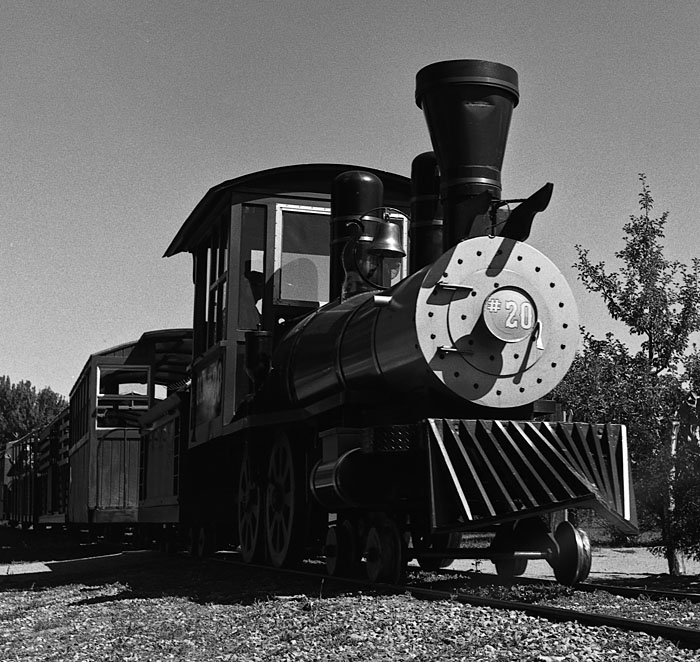
Almost nobody but me and the keepers on a cool morning at the zoo.


I used the Pentax Spotmatic with my Auto Yashinon Zoom1:4.5 f-75mm~230mm.  It is a lens well suited to the venue in many respects, but also one that requires an intense level of concentration, and reflexes quicker than what I may be able to manage these days.  I haven't used the lens much, and don't even remember how I acquired it.  Perhaps I'll feel more comfortable with it with more practice.

Tuesday, November 22, 2016

Jack London's Camera

A friend picked up this camera at a yard sale in Truth or Consequences, NM some years ago and gave it to me.


The No. 3-A Folding Pocket Kodak was made from about 1903 to 1915.  It was pretty close to state-of-the-art with a shutter going up to 1/100 and a two-element Rapid Rectilinear lens.  The camera produced a postcard-sized negative on 122 roll film.  In the picture below, the 122 reel is on the left.  Next to that in order is a 116 reel from my 1-A Special, a 120 reel and a 35mm cartridge.


Now, I'm pretty sure that the camera in my possession is not Jack's because the last patent number inside the back is 1909.  However, it does appear to be the same or very similar to the camera London can be seen holding in a picture that appeared today in the NY Times Lens blog.  The picture was snapped in 1904 while London was in the process of being arrested by Japanese military authorities for taking unauthorized pictures during the Russo-Japanese War.


While the details are a little hard to discern, you can see in a zoomed-in view that there are great similarities to my No. 3-A, including the rounded form, the two slim struts at the front which hold the lens board, and the pneumatic bulb shutter release which juts down to the left from the camera's front.  There is also the possibility that London's camera is the slightly smaller No. 3 Kodak which used 118 film, based on a comparison of the camera's length to the length of London's right hand.  My 3-A model is 9.5 inches long which seems to me a little more than the camera London holds.


My own No. 3-A would need a little restoration work before it could make pictures.  It has a small tear in the bellows.  The lens is clear and the shutter seems to work well.  The 122 roll film for the No. 3-A has not been available for many decades, but adaptations for shooting still-available 120 roll film are not terribly difficult.  I'm thinking maybe I should give it a try.

Wednesday, November 09, 2016

Marigolds

Albuquerque's South Valley celebrates the Day of the Dead each year with the Marigold Parade.  This year's celebration took place on the weekend before the national elections.


The last shot is from my Zorki 2C with the Jupiter 12 35mm.  The rest are made with the Pentax Spotmatic and the Mamiya 135mm.

Saturday, November 05, 2016

Valle de Oro

I've seen and heard a few sandhill cranes recently, so I decided to load some color in my Sears/Ricoh TLS with the 400mm Tele Vivitar and headed down to the Valle de Oro seven miles south of central Albuquerque.  There was not a bird in sight when I got to the old dairy farm that has recently become a National Wildlife Refuge.  So, I left the tripod and the long lensed camera in the truck and headed down  with my Pentax and a normal lens to the riverside bosque there which I had not visited before.  It turns out to be a spectacular place, and I'm looking forward to getting back there again soon.


The Refuge is adjacent to the Rio Grande Valley State Park which is populated by a mature cottonwood forest.  Most of the old giants were holding onto to their leaves still, but they are quickly turning to gold.  The forest floor is covered by a thick carpet of newly fallen leaves as well as those from years past.


When I first spotted this skull in the leaf litter I thought it was a coyote because of the size.  Looking closer, however, I saw that the two biggest teeth were right up front.  Turning the skull right side up showed a flattened shape rather than the domed and ridged cranium that drives the coyote's massive biting capacity.  So, my guess is that I had found a beaver.


Friday, November 04, 2016

Exhibit

One of my photos was selected to be in an exhibit at the National Museum of Nuclear Science & History.


 The photo is a pinhole image of an F-105 on display at the museum.  I'm pretty sure it was the only pinhole image on film in the show, and I was pleased that it turned out looking pretty good at 11x14.  The exhibit will be up until the end of the year.

Sunday, October 30, 2016

Now is the Time

If you have ever been inclined to visit Albuquerque this would be a good time, particularly if you are interested in Twentieth Century American Art and Art History.  I say this because I just visited the current exhibit at the Albuquerque Museum of Art, Mabel Dodge Luhan & Company: American Moderns and the West.  This is a gigantic show with over 150 pieces related to Mabel Dodge Luhan and her artist friends who gravitated toward Taos, New Mexico in the first half of the last century. 

The exhibit started off at the Harwood Gallery in Taos; it will be in Albuquerque until January 22nd and will then go to Buffalo on March 10th.

As luck would have it I came across a copy of Mabel's biography at my local used bookstore and am about half way through it at the moment.  The author, Lois Rudnick, is one of the curators of the exhibit.

While the show has virtually something for everyone given Mable's vast circle of friends, what interested me of course was the photography.  There are fine examples in the show of work by Ansel Adams, Alfred Stieglitz, Paul Strand and many others.  A portrait of Tony Lujan, Mabel's last husband, has made me rethink my ideas about Adams who has worn a bit thin for me, particularly his later portraits.  The Lujan picture is very strong and clearly shows the influence of Strand who mentored Adams in Taos.

Tony Lujan, Taos, New Mexico 1929 by Ansel Adams

Saturday, October 29, 2016

Resurrection: K1000

I was sent a Pentax K1000 to evaluate for use by a photographer new to film photography.  The camera had a working shutter and a lens that could be cleaned up, but the the meter and the frame counter were inoperative.  It could make pictures, but seemed a poor choice to start with.  So, I sent off my own K1000 kit to the new user and kept the slightly lame camera.

The meter on the old camera looked like a lost cause, but I was able to clean up the lens.  The frame counter also proved to be an easy fix.  I shot a test roll of Fuji 200.


This Pentax does not have as sharp a focus screen as I remember in my other one.  The rubber cover on the focus ring is a bit loose.  Two frames in my test roll showed a severe light leak.  So, there is still some work that could be done on the camera.  I'm not sure I'll get around to that, but at least I got some pictures that will keep the camera from going in the blue recycle bin out back.

Saturday, October 15, 2016

Chaco Skies

We drove to Chaco Canyon and spent the afternoon walking through the three Anasazi Great Houses that are close together near the end of the loop road: Pueblo Bonito, Chetro Ketl and Pueblo del Arroyo.


All the pictures were made with my Pentax Spotmatic and the 24mm Super-Takumar lens.  The Fuji 200 film was processed with the Unicolor C-41 kit.

Tuesday, September 27, 2016

Alternate Realities

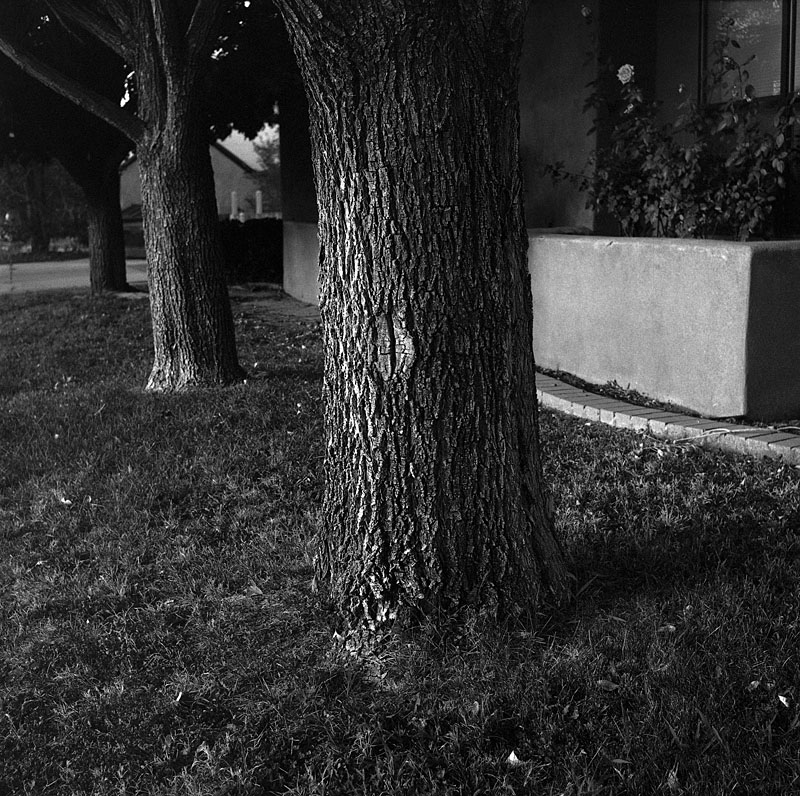
When I placed an order recently with B&H Photovideo for some Tri-X I added in a couple rolls of Arista Edu 400.  I loaded the 120 format Arista Edu in my Yashica-Mat and took a couple morning walks around town.  The resultant images seemed a little grainier than Tri-X, and I was not able to get the combination from it I expect from Tri-X in regard to contrast and subtle tonalities.  Still, the results weren't bad, and I don't think the differences I am perceiving probably count for much.


I processed the film with Kodak HC-110-B as I would for Tri-X.  However, that is likely not the optimal developer for the Arista Edu 400.  On top of that, there are the usual variables of scanning and post processing which can make a big difference in the final images.  I also noticed that there was quite a difference in the appearance of the images displayed on my old XP machine, and on the monitor attached to my newer Windows 7 computer.  Much of this could be sorted out if the ultimate objective was a print on paper.  It seems, however, that digital image displays are always going to be a moving target.


Mural by Virgil Ortiz

Sunday, September 18, 2016

Shooting the Yashica-Mat

I took my Yashica-Mat for a walk this morning at the Albuquerque Botanic Garden.  It is a camera that deserves more attention than I have given it.  The medium format negatives and the excellent resolution of the Lumaxar lens yield startling sharpness.
    The camera is light for its size, but still a bit awkward to handle, like most twin lens reflex cameras.  With the shutter release on the right and the focus on the left, one is constantly juggling the camera to arrive at an exposure.  What overcomes most of that problem is the addition of a hand grip.  With that accessory in place, it is then possible to reach all the controls without moving either hand very much.  A Bay 1 lens hood is also a worthwhile addition.
    A tangential benefit of carrying the Yashica-Mat is that it never fails to attract interest and friendly conversation.  Many younger people have obviously never seen a tlr before, and the camera often sparks nostalgia in the older photographers.