Monday, February 08, 2010

Agfa Clack


From the mid-'50s to the mid-'60s the Agfa Clack was the pre-eminent family camera for many Europeans. The camera occupied a niche which in the U.S. was dominated by the Kodak Brownie Hawkeye Flash. Both of these simple box cameras were exceedingly well designed to appeal to their markets, and they produced images of approximately equal quality.

While I have great affection for the Hawkeye Flash, I have to admit that in several ways, the Clack is the better camera. The Agfa camera's eye-level viewfinder is easier to use in bright daylight. A single lever allows both aperture and distance adjustment. There is a tripod mount on the Clack to go along with the B shutter setting and the cable release fitting. And, finally, the efficient curved film path yields both a very compact, ergonomic design and excellent edge-to-edge image sharpness from a single-element meniscus lens. The Clack produced eight big 6x9 frames per 120 film roll, while the Hawkeye Flash yielded twelve 6x6 frames on 620-format film. One use for which I definitely prefer the Kodak box to the Agfa is for portrait work. I discussed the reasons for that along with some other technical considerations in a thread on photo.net's Classic Cameras Forum.

Pictures from the Clack:


Sunday, February 07, 2010

Agfa Ansco Box Camera


A lot of nice box cameras listed on ebay fail to find loving homes.
One has to hope they are humanely euthanized. I found this Agfa-Ansco box camera just as it was about to drop off the screen on ebay at less than $2.00.

The last patent date inscribed on the camera was 1924; it hardly seems to have gotten any use since then. This is the first old camera I've found with a wooden return spool. The interior film-holding cone is also wood; it is very light and fine grained, possibly boxwood.

The front panel on the Agfa-Ansco is held on with brads, so I decided not to try removing it for cleaning of the shutter. Fortunately, the lens is behind the shutter, so I was able to go in with some lighter fluid on a brush through the front opening to clean the shutter mechanism.

Box cameras have their focus set to capture either closeups and middle distance features, or else scenic compositions. This one takes a broad view, with the closest sharp focus at about 15 feet. In practice at the time it was intended to be used, the issue was largely academic as most users would have gotten contact prints which would show about everything to be equally in sharp focus.

The camera is very tightly constructed. While the viewfinders on the top and side seem tiny, the lenses and mirrors are faultless and perfectly useable. The shutter has the usual Instant and Time release, and in this camera the shutter is actuated on both the up and down swing. I estimated the shutter speed at 1/30 sec. and used Adox 50 for the first roll. Development was in D-76 , 1:1 for 9 minutes.


Below are the results of the roll of film I put through the camera, probably the first to come out of it since the 1920's. They were made along the Rio Grande near my home and in the village of Doña Ana, north of Las Cruces, New Mexico.


Friday, January 22, 2010

Break

I'm taking a break from regular posting on this blog. I invite visits to my web site, and I'll continue to respond to emails on photography and vintage cameras.

Meanwhile, for an excellent illustrated account of the intricacies of getting aid to Haiti by air, see the Vintage Aeroplane Writer blog.

Tuesday, January 19, 2010

instant flirtation


A few years ago when we still lived in our home in the desert of southern New Mexico I bought several old polaroid cameras for about a buck each at the local Goodwill. My purpose was to use pieces of the mirrors in the cameras to restore the small reflex viewers in some of my old cameras. I think that, at the time, the Polaroid Corporation was about to go belly-up, and film packs were being offered at somewhat reduced prices. So, I picked up a pack and shot it around the house. I wasn't comfortable with the inexactitude of the process of making photos with the simple cameras, and the price was still too high. Looking at the images now, though, I rather like them and wish I could have talked myself into doing a few more.


Sunday, January 17, 2010

Saturday, January 16, 2010

borders and sprockets

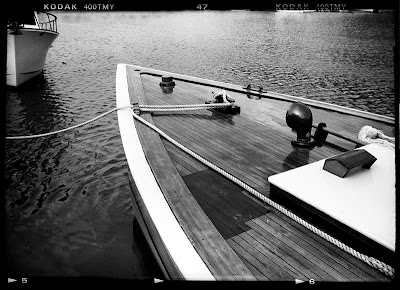
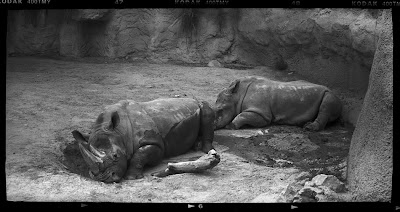
I went to some trouble, as I described in my last post, to eliminate the sprocket holes from my Fed-1g images. On other occasions I have done just the opposite, incorporating into my images the film negative borders with their lettering and numerals or the sprocket holes from 35mm film. I think the first time I used this style was in an image made with my No.2 Folding Autographic Brownie. I decided I wanted a very large print to hang over my desk, so I took a scan of the image to a fellow in the Las Cruces downtown mall who had an Epson printer about two yards wide. As he was preparing the image for printing, I saw him start to crop out the film borders. I hastened to tell him I wanted the borders left in the print. He gave me a quizzical look, and I muttered something about the framing effect. So he proceeded as directed with only a slight curl of the lip.

Kodak No.2 Folding Autographic Brownie

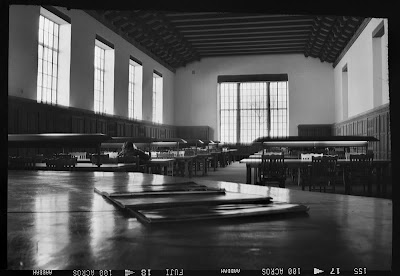
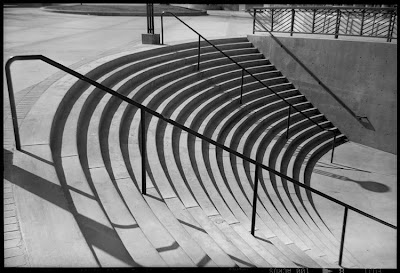
It is not immediately apparent to everyone why including the film borders and sprocket holes into an image is a good idea. I think the creation of a natural framing device is part of the appeal. The border inclusion also calls attention to the photographic process and further differentiates the image from those created by other means such as painting or drawing.
    In the case of my No.1A Autographic, the negative frame borders also document the panoramic format which results from using 120 film in an old 116-format camera.

Kodak No.1A Folding Pocket Special

I think another aspect of appeal in the use of negative frame borders resides in a declaration of authenticity. One sees that the entire image recorded by the film is displayed with no cropping. I'm usually perfectly willing to crop for compositional value, but it is nice to have an example or two from an old camera which clearly show the unaltered proportions of the images.

Ansco Folding Buster Brown

Negative frame borders are sometimes useful in identifying the type of camera that has made the image. For instance, the film holders for large-format cameras leave a very distinctive impression on the film. The upside-down lettering at the bottom of the images from both the Buster Brown and the Clack result from the fact that the advancing film travels from right to left.

Agfa Clack

The Certo Dolly is a particularly versatile shooter, offering two formats, 6x6 and 6x4.5, and one can further emphasize the proportional possibilities with inclusion of the frame borders in the images.

Certo Dolly Supersport, 6x4.5 mask

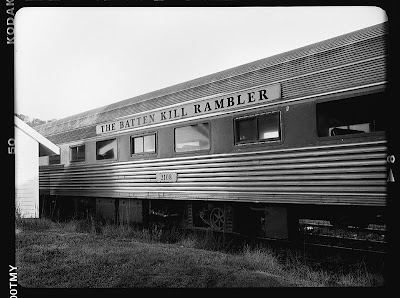
Although the Dolly is built to use 120 film, it is also easily possible to use 35mm film in the camera. The 35mm cartridge fits with no problem into the feed compartment. One needs to be careful to keep the ruby windows well covered with black tape, and it is necessary to advance the film blindly with a couple of turns each time to keep the frames separated. What you get with this technique is an image that extends out over the sprocket holes. In addition to the graphic interest this produces, I think it is also a useful way to help create a link between pictures in a series. An example of this can be seen in a roll from the Dolly shot along Route 66 in Albuquerque.
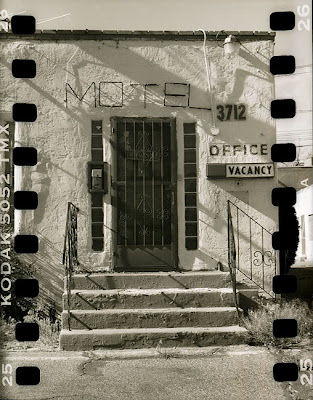

Certo Dolly Supersport, 35mm film

Thursday, January 14, 2010

one cent camera repair


My Soviet Leica-copy Fed-1g has an accurate rangefinder and shutter, and a terrific Tessar-type lens. It also has an odd problem with film alignment. The sprocket holes intrude into the image area on one side of the frame. It may be a case of overly-generous manufacturing tolerances, or perhaps it is just that modern film cartridges don't quite fit the camera.


I was able to push the film cartridge down into the compartment and the film would track ok if I maintained some pressure. I decided that what I needed was a thin spacer to take up the extra space over the cartridge. It turned out that a penny fit perfectly in the available space.


Some post-fix images from this morning:


Saturday, January 09, 2010

more geese


The ducks and geese were well fed at Albuquerque's Tingley Beach on a cool but sunny Saturday afternoon. Click for the full size images to see the nice qualities which the Tessar lens imparts to the photos.

Friday, January 08, 2010

Special

The Kodak No.1 Autographic Special is the most interesting camera in my collection. It was built about 1915 and represented the state of the art at the time in many respects. Few other cameras then had shutters like the dashpot-operated Optimo with speeds from 1 second to 1/300. The Bausch and Lomb Tessar, licensed from Zeiss, was recomputed to allow a fast f4.5 aperture. The camera's overall construction was of very high quality and included features that put it into the luxury class including a finely-textured sealskin covering. The resolution of the images from the lens combined with the 6cmx9cm format is astounding.


Shooting a 6x9 with no rangefinder is a challenge I haven't really mastered. I've found it generally a good idea to put the camera on a tripod and shoot at small apertures, so subjects that lend themselves to a slow and careful approach usually work out best.


To enhance my chances a bit more I also recently did a little work on the shutter, and I recollimated the lens. Setting the infinity focus is a little difficult on this camera. One has to loosen a screw that is beneath the flip-out tab on the cover, and then adjust the little stop button fore and aft in front of the lens mount.


I think I've got it right now, so we'll see if I can make some pictures that do justice to this fine old Kodak.

Wednesday, January 06, 2010

fun in the sun

Lief Peng's fine blog about Twentieth Century illustration this week is featuring the work of Al Dorne. The first example of the artist's work is a 1946 ad which includes an accurate representation of the Kodak 35 camera.


I have acquired three examples of the Kodak 35 over the years. One is the infamous rangefinder version which was cobbled together to compete with the Argus C3. The other two, shown below, are earlier scale-focus models.
    The camera on the left with the accessory rangefinder has the Kodamatic shutter with speeds from 10 to 200 plus B and T, and the f3.5/50mm Kodak Anastigmat Special lens. The camera on the right has the No.1 Diomatic shutter with speeds from 25-150 plus B and T, and the f4.5/50mm Anastigmat lens. As can be seen in the sample photos posted on my web page about the Kodak 35, all are very capable performers.


The Anastigmat lens is a three-element design that was used on cameras made by nearly every manufacturer. As can be seen in the diagrams below, the Kodak Anastigmat Special is a four-elements-in-three-groups design very similar to the Tessar. The main difference seems to be the reversed orientation of the second and third groups. I don't know if there was any real advantage to the Kodak variation on the classic Zeiss Tessar design, but my own experience has shown it to compare very favorably with the great European classic lens.


The unusual appearance of the Kodak 35, reminiscent of the design of the company's medium-format cameras, is not immediately appealing to many classic camera enthusiasts, but it fits nicely in the hands and will produce excellent results if given the chance.

Tuesday, January 05, 2010

snowsuit


This is my first try at stand development. I was pleased that it turned out reasonably well using Tmax 100 in Rodinal at 1:160 for 75 minutes. I've gotten nicer results from 1:50 at the recommended time, however, so I don't know if it is really worth experimenting further with this technique.

Monday, January 04, 2010

high tech


This picture of downtown Albuquerque was made last Fall. It was selected recently to appear in an Albuquerque City Guide application for the iPhone called "Schmaps".


Not one of my best shots of the city, perhaps, but it does have graphic qualities that suit it to display on a two-inch screen. I'm guessing it is also the only Schmaps photo made with a 1939 Argus A2F camera.