Showing posts with label rotary shutter. Show all posts

Wednesday, November 01, 2023

Pen-FT - Roll 2

 The Day of the Dead events got underway during the weekend with a line of pickups in the Plaza Vieja decked out with ofrendas.  I had the Pen-FT loaded this time with Kentmere 100.  That gave me finer grain images than the 400-speed film of the previous roll, though in this instance I think I prefer the deeper tonal range and the enhanced depth of field provided by the faster film.  Too early to make any judgements about those issues, but I think it will be interesting to try some C-41 in both b&w and color.


The obligatory final picture of my cat was made with the F. Zuiko lens wide open at f1.8.

Saturday, October 21, 2023

Half the size, Twice the fun

 The upside of the increase in film prices is that it gave me an excuse to acquire another half-frame camera.  It is one of Maitani's masterpieces, the Olympus Pen-FT.

The Pen-FT is only marginally larger than my Leica IIIa.  It seems amazing that Maitani was able to fit a single lens reflex system into such a small container.

On the morning after the camera's arrival I loaded it with a roll of Kentmere 400, first shooting a few frames near home, and then going down to the Plaza Vieja to finish off  the roll.  


The F Zuiko Auto-S 1.8/38mm lens focuses down to about one foot.


Finishishing off the Kentmere in the Plaza Vieja took a while as the 24-shot roll yielded 53 images!

It being a Friday morning, the old cars were lined up in front of the church waiting for their pictures to be taken.


'86 El Camino

'32 Ford Victoria


I bumped into my friend, Bob, in the Plaza so we took pictures of each other with the Pen-FT.

Bob

Mike

The camera worked perfectly.  I have ordered six rolls of Kentmere 100 and two of Kodak Gold 200 which I think will be well-suited to the half-frame capability.  I will probably also get some bulk film so I can make up some film rolls with a smaller number of frames.

The manual has illustrations showing the great array of lenses and accessories made by Olympus for the Pen-FT including adapters allowing the use of many standard 35mm lenses from Nikon, Practica, Leica and Exakta.


And, of course, this:

Sunday, July 25, 2021

An American Favorite

The Universal Mercury II CX has always seemed to me to be one of the most interesting camera designs produced in the U.S.  or anywhere.

The half-frame format was uncommon at the time, the rotary shutter was rugged and accurate up to 1/1000, the coated Tricor lens was sharp, and the price was very competitive.  In spite of those unique qualities, the camera today is frequently the target of derision on photography forums.  The criticisms seem to come most often from people with little or no actual experience with the camera.  While I sometimes feel a slight urge to post responses to some of those opinions, it always seems more worthwhile to just go out and make some pictures with the camera.  These latest were made on a recent outing to Albuquerque's Rio Grande Zoo.


The film was some well-expired Fuji 400, the twelfth roll processed in my current batch of Cinestill C-41.

Thursday, February 13, 2014

Faces from Mercury

My Mercury II is one of those cameras that seems to demand color.  


Saturday, February 16, 2013

half scenic


I took the Mercury II on a morning walk at the edge of the Sandia Wilderness east of Albuquerque.  I was pleased with this shot as it shows the rather good resolution from the Tricor lens and the half-frame format.

The image is also helped out by the capacity of Photoshop CS2 to tame the highlights which often look blown out in Fuji 200 color negative film.  Selecting Image/Adjustments and then Shadow/Highlight brings up a multi-slider box that permits useful alteration of shadows, highlights and mid-level contrast.  Adobe recently made CS2 available as a free download and it is worthwhile just for this one option, I think.  I appreciate any help I can get as my scenic efforts are generally pretty pathetic.

Thursday, February 14, 2013

café bébé


I'm usually partial to cameras that are more compact than the Mercury II, but it has some redeeming features.  The shutter accuracy and reliability are outstanding.  The lens is very good.  The half-frame format requires some extra care in framing to get acceptable image smoothness, but the doubling of the capacity for a roll of film also encourages a more spontaneous approach to image making.

Tuesday, October 23, 2012

Rotary Shutters

Becoming familiar with the operation of the Univex Mercury II got me looking into the history of the rotary shutter in photography.  It is a shutter type that has been common since photography's very early days and there is a lot on the web about it.  I'm just going to summarize some of my more interesting web finds here with links to the sources.

Most box cameras are equipped with rotary shutters; they are simple and extremely reliable, and give an exposure time of 1/30-1/60 second.  Here is an illustration of the shutter in my Kodak Brownie Hawkeye Flash; the shutter is held open with the "B" setting to give a clear view of the parts.


The round black hole is the aperture allowing light into the lens. When the shutter release is activated, the cover paddle is lifted and the kidney-shaped opening in the circular shutter plate rotates past the aperture, with the time of its passage being determined by the spring tension and the length of the kidney-shaped hole. At the end of the cycle, the paddle flips back down to cover the opening and the shutter disk rotates back to the starting position.

I picked up an old windup Kodak motion picture camera in the 1960s.  Even though it was about 30 years old when I got it, the camera ran very smoothly.  I didn't give the mechanics of it much thought at the time, but it very likely had a rotary shutter like all the mechanical movie cameras of the time.


The rotating shutter mechanism in a modern sound-synched movie camera is usually a half circle set to operate at 24 frames per second and giving an exposure to each frame of about 1/50 second.  The purpose of this timing is not only to achieve the correct exposure, but also to yield the illusion of smooth, natural movement when the images are projected.  The animated gif below from Wikipedia illustrates the action of the motion picture shutter; the film is advanced one frame during the closed phase of each rotation.

Joram van Hartingsveldt
Perhaps inspired by motion picture technology, Heinz Kilfitt designed the Robot, a 35 mm motorized-advance still camera  in about 1930.  A very nice article about this long-lived precision camera is at the Dieselpunks  site.


By locating the shutter just behind the lens, Kilfitt was able to achieve a very compact camera design that gave a relatively large, square image measuring 24x24 mm.


"The rotary shutter and the film drive are like those used in cine cameras. When the shutter release is pressed, a light-blocking shield lifts and the shutter disc rotates a full turn exposing the film through its open sector; when the pressure is released the light-blocking shield returns to its position behind the lens, and the spring motor advances the film and recocks the shutter. This is almost instantaneous. With practice a photographer could take 4 or 5 pictures a second. Each winding of the spring motor was good for about 25 pictures, half a roll of film. Shutter speed was determined by spring tension and mechanical delay since the exposure sector was fixed. The Robot I had an exposure range of 1 to 1/500 s plus the usual provision for time exposures."

The rotary shutter reached an apex of sophistication in 1963 when Olympus introduced the Olympus-Pen F, a half-frame single lens reflex design by Yoshihisa Maitani. 

Wikipedia
It seems remarkable that Maitani could fit a focal plane rotary shutter and a Poro prism slr viewfinder into a camera of such diminutive size.  Much of the success of the effort was due to the development of an exceedingly thin and lightweight titanium shutter disk which allowed a top speed  of 1/500 second.

U.S. Patent Office

In some ways the Universal Camera Corporation Mercury camera was even more remarkable than the earlier Robot and the later Pen F.  The large diameter focal plane shutter devised by George Kende was extremely robust and accurate, achieving a reliable top speed of 1/1000 second.  The relative simplicity of the shutter design facilitated low-cost construction and made the Mercury much more likely to be successfully repaired and renovated by the DIY enthusiast.
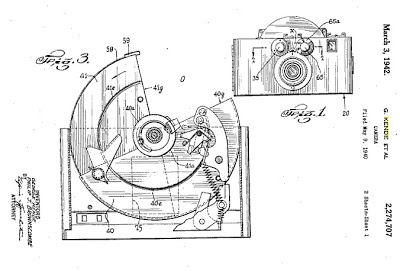
U.S. Patent Office
The shutter in my Mercury II was sluggish when I received it.  A little lighter fluid applied with a small brush was all that was needed to bring it back to life, and the resultant pictures show it to be operating as designed.

Sunday, October 21, 2012

Nice Day for a Ride

Perfect weather today for a ride up Route 66 to take in the car show at the Santa Ana Star Casino, and a good excuse to exercise the Mercury II.