Thursday, November 08, 2012

Early Morning Walk

We went to the Los Poblanos Open Space this morning to see the Sandhill Cranes.


There is a cold front moving into New Mexico this weekend, so I expect it will bring along more birds.  I may try a 2x and 3x telextender with the Zoom to see if I can pick up a bit more detail that way.  Focusing is a challenge, though, as the Pentax has a rather dull screen and the depth of field is very narrow.

Tuesday, November 06, 2012

más muertos

20th Annual South Valley Día De Los Muertos Marigold Parade


Photographing events like this parade is always something of an emotional rollercoaster for me.  When I first come on the scene, everything seems chaotic and unphotographable.  I wander around in somewhat of a panic state until I manage to get a picture of the first thing which catches my eye.  That seems enough to connect my eyes to my brain, and I am able to start finding subjects and themes to explore.  I get a bit manic at that point and tend to make a pest of myself, poking my camera in people's faces.

Back home with whatever pictures I've harvested, I often get obsessed in thinking about all the pictures I missed.  Depending on the quality of the results I've gotten, that obsession might last through the night.  Usually, by the next day I've found some images I like well enough to show.

As always with the Ansco Panda box camera, I like these pictures.  I think it is partly that the Panda always surprises me by making pictures better than I expect.  I often miss a few shots due to camera or subject movement, but most of the images have a sweet spot that can be enlarged to surprising size for a picture made by a simple meniscus lens.

My obsessive phase was lengthened a bit when I was processing the pictures.  About half-way through the Panda shots, my ten-year-old scanner stopped working.  On lifting the lid I could clearly see through the window that the drive band had come off the capstan.  Luckily, if improbably, there is a Yahoo group for the Epson 2450 photo scanner, and I was able to figure out from that how to open up the thing for repairs.  Took me a couple of tries, but it was also a good excuse to get the underside of the glass clean, and the scanner seems to be working for now.  Hard to say how much longer, though.

Well, to top it off, my barber who doubles as my wife informs me that the hair on the back of my head is getting thin.  Also, I find myself at times carrying around three pair of glasses.  So there you have it.

Thursday, November 01, 2012

artful disguise


Mesozoic New Mexico

A hundred million years ago New Mexico was tropical and wet and full of dinosaurs.  Quite a lot of them have been dug up and hauled to the New Mexico Museum of Natural History just a couple of blocks from my house.


The fossilized remains arrive encased in thick plaster which is broken open at these work tables.  Chipping away the rock in which the bones are embedded is a process that can take years to reveal a single specimen.

Tuesday, October 30, 2012

muscle cars

I've had fun learning to use the Mercury II.  Part of the challenge is to figure out which subjects will fit well within the half-frame format and resolution.  People and vehicles seem to work well.

I have added a page to my vintage cameras web site about the Mercury II.


Monday, October 29, 2012

Best of Albuquerque

The Bébé Cafe is in a niche off the Old Town Plaza Vieja.  I'm mostly there for coffee and pastry in the morning, but they also have some great lunch-time sandwiches, and none of the tourist kitsch of most of the eateries in the neighborhood.


For a substantial breakfast or lunch, the Cafe Lush is hard to beat.  Close to the center of town, but remarkably quiet and relaxing at the sidewalk tables.

Wednesday, October 24, 2012

Anscoflex II

Ansco introduced its new Anscoflex camera with a full-page ad in the July 19, 1954 issue of Life Magazine:
"...Styled by Raymond Loewy, this completely new reflex camera combines smart good looks with modern technical advances and sturdy metal-clad construction to bring you everything you've ever wanted in an easy-to-use snapshot camera!..."
Raymond Lowey, the renowned industrial designer, probably did have something to do with some of the design aspects of the Anscoflex, but most of the camera's features were already present in a 1948 Ansco prototype camera called the Shurflex. Ad hype aside, there was a lot that was new and interesting in the design of the Anscoflex. The modular construction of the all-aluminum case was a sharp contrast to the molded plastic cases featured in most of the inexpensive snapshot cameras of the era. When most of Ansco's competition had persisted in using singe-element meniscus lenses in their inexpensive cameras, the Anscoflex featured a two-element symetrical lens design with an additional close-up lens that could be swung into position with the turn of a dial on the camera's front.

Some of the new Anscoflex features, however, offered more novelty than usefulness. The tripod socket was unaccompanied by a cable release socket, and the side-mounted shutter plunger was stiff and likely to lead to blurred shots. While the ad copy likens the ratcheting film advance to winding a watch, it was really more like winding a grandfather clock, with about fifty quarter-turn rotations required to get the film to the first frame on the 620 roll. The built-in yellow filter was something of an anachronism at a time when photography was moving quickly toward the universal use of color.

The most distinctive feature of the camera, the sliding front cover connected to the flip-up barndoors over the viewfinder was something of a gimmick too, though a useful one. What was really important, though, was the extremely large and brilliant view provided by the reflex viewing system with its mirror and massive lenses. Even in the dimmest scenes where the flash would be a necessity to obtain an exposure, the view through the big top window was crystal clear. That brilliant viewfinder was also the feature of the Anscoflex which would lead to a sort of rebirth of the camera a half century after its introduction.

If you visit the Flickr photo sharing site and do a search on the term, Anscoflex, you will turn up thousands of recently made pictures tagged "Anscoflex". However, probably not one in a hundred of the photos were made with film in the camera. Instead, the great majority are the result of pointing a digital camera at the brilliant view screen of the Anscoflex to directly capture the image using the through-the-viewfinder (ttv) technique.

For those willing to re-roll some 120 film onto 620 spools it is still possible to do real photography with the Anscoflex. It won't be a process that is quick, easy or very predictable, but some distinctive images and some satisfaction are guaranteed.

Some examples from the Anscoflex II:


Should your Anscoflex need some cleaning there is an excellent detailed tutorial by Shane Blomberg at Flickr. The manuals for the Anscoflex and the Anscoflex II are at the Butkus site.

Tuesday, October 23, 2012

Rotary Shutters

Becoming familiar with the operation of the Univex Mercury II got me looking into the history of the rotary shutter in photography.  It is a shutter type that has been common since photography's very early days and there is a lot on the web about it.  I'm just going to summarize some of my more interesting web finds here with links to the sources.

Most box cameras are equipped with rotary shutters; they are simple and extremely reliable, and give an exposure time of 1/30-1/60 second.  Here is an illustration of the shutter in my Kodak Brownie Hawkeye Flash; the shutter is held open with the "B" setting to give a clear view of the parts.


The round black hole is the aperture allowing light into the lens. When the shutter release is activated, the cover paddle is lifted and the kidney-shaped opening in the circular shutter plate rotates past the aperture, with the time of its passage being determined by the spring tension and the length of the kidney-shaped hole. At the end of the cycle, the paddle flips back down to cover the opening and the shutter disk rotates back to the starting position.

I picked up an old windup Kodak motion picture camera in the 1960s.  Even though it was about 30 years old when I got it, the camera ran very smoothly.  I didn't give the mechanics of it much thought at the time, but it very likely had a rotary shutter like all the mechanical movie cameras of the time.


The rotating shutter mechanism in a modern sound-synched movie camera is usually a half circle set to operate at 24 frames per second and giving an exposure to each frame of about 1/50 second.  The purpose of this timing is not only to achieve the correct exposure, but also to yield the illusion of smooth, natural movement when the images are projected.  The animated gif below from Wikipedia illustrates the action of the motion picture shutter; the film is advanced one frame during the closed phase of each rotation.

Joram van Hartingsveldt
Perhaps inspired by motion picture technology, Heinz Kilfitt designed the Robot, a 35 mm motorized-advance still camera  in about 1930.  A very nice article about this long-lived precision camera is at the Dieselpunks  site.


By locating the shutter just behind the lens, Kilfitt was able to achieve a very compact camera design that gave a relatively large, square image measuring 24x24 mm.


"The rotary shutter and the film drive are like those used in cine cameras. When the shutter release is pressed, a light-blocking shield lifts and the shutter disc rotates a full turn exposing the film through its open sector; when the pressure is released the light-blocking shield returns to its position behind the lens, and the spring motor advances the film and recocks the shutter. This is almost instantaneous. With practice a photographer could take 4 or 5 pictures a second. Each winding of the spring motor was good for about 25 pictures, half a roll of film. Shutter speed was determined by spring tension and mechanical delay since the exposure sector was fixed. The Robot I had an exposure range of 1 to 1/500 s plus the usual provision for time exposures."

The rotary shutter reached an apex of sophistication in 1963 when Olympus introduced the Olympus-Pen F, a half-frame single lens reflex design by Yoshihisa Maitani. 

Wikipedia
It seems remarkable that Maitani could fit a focal plane rotary shutter and a Poro prism slr viewfinder into a camera of such diminutive size.  Much of the success of the effort was due to the development of an exceedingly thin and lightweight titanium shutter disk which allowed a top speed  of 1/500 second.

U.S. Patent Office

In some ways the Universal Camera Corporation Mercury camera was even more remarkable than the earlier Robot and the later Pen F.  The large diameter focal plane shutter devised by George Kende was extremely robust and accurate, achieving a reliable top speed of 1/1000 second.  The relative simplicity of the shutter design facilitated low-cost construction and made the Mercury much more likely to be successfully repaired and renovated by the DIY enthusiast.
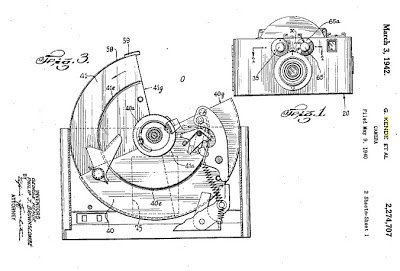
U.S. Patent Office
The shutter in my Mercury II was sluggish when I received it.  A little lighter fluid applied with a small brush was all that was needed to bring it back to life, and the resultant pictures show it to be operating as designed.

Sunday, October 21, 2012

Nice Day for a Ride

Perfect weather today for a ride up Route 66 to take in the car show at the Santa Ana Star Casino, and a good excuse to exercise the Mercury II.


Saturday, October 20, 2012

Phoenix in a Box


My latest yard sale find, the Genos Rapid.


Thursday, October 18, 2012

Four more from Phoenix

From a roll of Fuji 200.


The f2.7 Tricor lens seems a little soft around the edges, but I thought it handled a variety of subjects and conditions very well. I changed the focus with a shim behind the lens, but have decided now that it was unnecessary.  I'll try to make some controlled test shots with my next roll of film to get a better idea of the accuracy of the focus.