Tuesday, November 10, 2020

Panatomic-X

Thanks to my generous friend, Kodachromeguy, I was able to shoot a roll of Kodak Panatomic-X with an expiration date of 09/1991.  At his suggestion, I shot the film at 25 ASA.  Having just mixed up my first batch of Kodak XTOL I decided to use that developer to process the Panatomic-X.  I took the suggestion from the FilmDev site to develop in XTOL 1:1 for 7.5 minutes at 20°C.  Also helpful for a general introduction to XTOL  was the Covington Innovations site.


The results seemed pretty extraordinary for a film nearly three decades past its expiration date.  XTOL may not be the optimum developer for Panatomic-X, but I was pretty pleased with the outcome.  I'm not sure when I'll get another chance to shoot a roll of Panatomic-X, but I am looking forward to trying XTOL with several of the modern b&w films I often shoot, including HP5 and Kentmere.

Saturday, November 07, 2020

Monday, November 02, 2020

C-41 Roundup

 I'm proceeding with C-41 experimentation with mixed but encouraging results.  This roll of Fuji 200 with my mju was processed for six minutes at 95F.  The shadows lost a little detail, so I may need to add a minute for the next roll.  The good part was that I had to spend very little time stamping out little white spots in the skies.  The lower processing temp does seem to help quite a bit in keeping the emulsion intact.

Albuquerque got some snow last week, but we're now back to 70 deg. temps like much of the Mountain West.


I've spent a lot of time over the years we've lived in Albuquerque at the National Hispanic Cultural Center.  They have frequently hosted very good photo exhibits, and we have enjoyed a lot of films and live performances on the indoor and outdoor stages.  I have also benefitted from the Spanish language course offerings at the Cervantes Institute.

I have not been inspired to take many pictures of the Cultural Center.  The architecture of the main buildings clearly incorporates features from both Native American and Hispanic sources, but it seems to me the architects chose  to focus on aspects of those two cultures which prioritized size and power assertions over functional quality.  

I was pleased to see recently that the Center had inaugurated a new outdoor gallery with the first exhibit being about the architecture of the site.  I thought that perhaps I would gain a new appreciation of the visual appearance of the place that has so far escaped me.  I was disappointed to find that the information presented on metal panels hung on the site's west side fence were more about the history of the site's development than about the architectural features.  Even more distressing is the fact that viewers of the exhibit are slow-moving targets on a very busy bike path.  That is something that can be easily corrected by just flipping the panels so they would be viewable from the safety of the site on the other side of the fence.  Hopefully, that will happen before someone is run down.

I have not got back inside the Albuquerque Art Museum since it reopened recently, but I have made a couple more shots of the museum shop window in an effort to capture some of the interesting colors and reflections.

Monday, October 26, 2020

Walking my mju


The Olympus Infinity Stylus (mju) metering system has an uncanny ability to get the exposure right under any condition of lighting.  

This was my fourth roll of color film in my current Unicolor C-41 kit.  I was pleased to see that the kit is mostly performing as it should.  I decided to see how it would work at a lower temperature and longer time, so I processed for six minutes at 95F.  That seemed about right,  so I'm going to stick with that time and temp, adding 2% on the time for each subsequent roll.  The normally recommended developing time of just 3.5 minutes at 102F is a little too short for comfort, and I'm thinking that a lower temp will also be a little gentler on the emulsion.

Saturday, October 24, 2020

Chaco Architecture

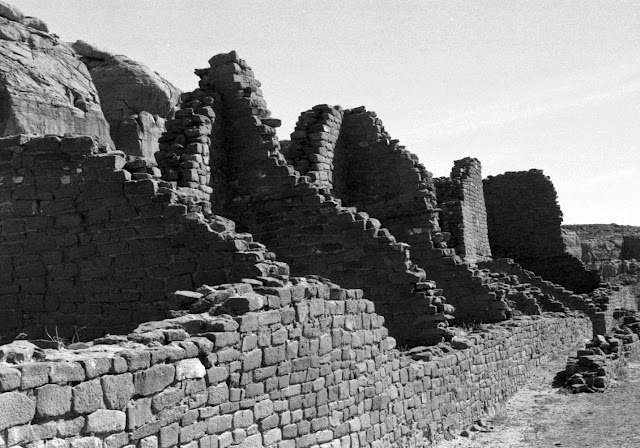
 I finished a roll of color on our walk through the great houses of Chetro Ketl and Pueblo Bonito.  Then we got back in the car and drove to the end of the loop road to visit the Kin Kletso and Pueblo del Arroyo sites.  For that part of our tour I shot Fomapan 200 in my Leica IIIa with the Elmar 3.5/50.  

While there are similarities in the layouts, there is an obvious difference in the architectural styles of these two great houses from the larger ones to the east.   The source of the stone walls at these western sites was the talus slope rubble at the base of the great cliffs, while the two large sites to the east used a lot of thin, tablet-like masonry mined from higher up in the cliffs.

Archaeologists in the past sorted the dozen Chaco sites into three different phases, but I think subsequent dendrochronological analysis determined that the building styles were actually contemporaneous.  In addition to the stonework, all of the sites made extensive use of wood for door and window lintels,  floors, ceilings and platforms.

While I was walking through the Pueblo del Arroyo site a couple passed by and I heard the man comment that it seemed unlikely the many wood beams in evidence were original to the site given the thousand years since the great house was built.  While it is true that there has been some reconstruction and stabilization, there are still a lot of wooden elements that have been preserved by burial in a dry climate.  In fact, thousands of timbers have been cataloged and examined to determine species, age and origins.
Near Pueblo del Arroyo is a stone stairway which leads up over the cliffs to the beginning of one of the ancient roads which radiate out from Chaco Canyon.  In Great Pueblo Architecture of Chaco Canyon,  Stephen H. Lekson mentions that one important use of the roads was the transportation of timber from forty or more kilometers from the Chaco sites.  In browsing around on the net for further information about those roadways I came across the interesting thesis that the big logs were probably rolled down the roads rather than being carried as is often asserted.  That certainly fits with the width and smoothness of the roads and the fact that the Ancestral Puebloans had no beasts of burden or wheeled vehicles to assist with transport.

Time and the elements have sculpted the walls of the great houses into shapes which invite photographic interpretation while also obscuring the original forms and surface appearances of the structures.  I'm thinking it would be rewarding to print out the pdf of Lekson's book and take it along on the next trip to Chaco to help in achieving a more coherent understanding of this extraordinary place.

Some Illustrations from Lekson (National Park Service, Dept. of the Interior - 1984):


Thursday, October 22, 2020

Chaco

 Chaco was one of our first stops on our way to choosing New Mexico as the place we wanted to live.  We ended up living in southern New Mexico, but we returned to the Canyon every four or five years.  Now, living in Albuquerque, we can get to Chaco in three hours for a day trip.  It is much more satisfying, though, to stay overnight to fully appreciate the spectacular landscape and the unobstructed night skies.


Fajada Butte is visible for many miles on the way into Chaco.  


The long wall at Chetro Ketl is one of the most impressive structures in the canyon.


The circular subterranean kivas were originally roofed with logs hand carried to the site from many miles away.


Doorways throughout the site are all under five feet in height.


Pueblo Bonito is the largest great house in Chaco with 650 rooms.


The aligned doorways in Pueblo Bonito are emphasized by the light from above thanks to missing roofs.  Less obvious is the interesting remnant on this room's wall of the smooth plaster surface which was likely typical of both internal and external walls throughout Chaco.


Each of the great houses at Chaco have different styles of masonry, depending on the number of stories and the time in which they were built over several centuries.  The sandstone walls at Pueblo Bonito feature thin, neatly laid courses.


Flash floods still occasionally course through the arroyo in the canyon's center during the summer rainy season.  Diminished rainfall in the 14th Century may have contributed to the final abandonment of the site by the Ancestral Puebloan people.

Tuesday, October 13, 2020

Barelas

 All the old cars in Albuquerque showed up in the historic Barelas neighborhood on Saturday for a cruise and curbside show -- restored classics, customs, and low riders.


There were a lot of bystanders and car owners on the sidewalks, so I made just quick passes up and down 4th Street shooting with my Olympus Infinity Stylus.  The little camera's sharp 35mm lens, autofocus and autoexposure easily coped with the picture opportunities and the contrasty late-afternoon lighting.  It was nice to get back to shooting color and the Unicolor kit got the job done for me.

Wednesday, October 07, 2020

Verichrome Pan - Roll 2

 This roll of Kodak Verichrome Pan was also fifty years beyond its expiration date.  I processed in LegacyPro L110b (1:31) for six minutes at 20C.  The density seemed a bit better than the previous roll which had been processed semi-stand in Rodinal 1:100 for 50 minutes.


The camera for this roll was my Ilford Sporti, a Cold War relic "Made in Western Germany".  It features zone focusing and just two aperture choices, Sunny and Cloudy.  The single speed shutter looks to be operating at about 1/30.