Thursday, February 27, 2014

The folder's last gasp

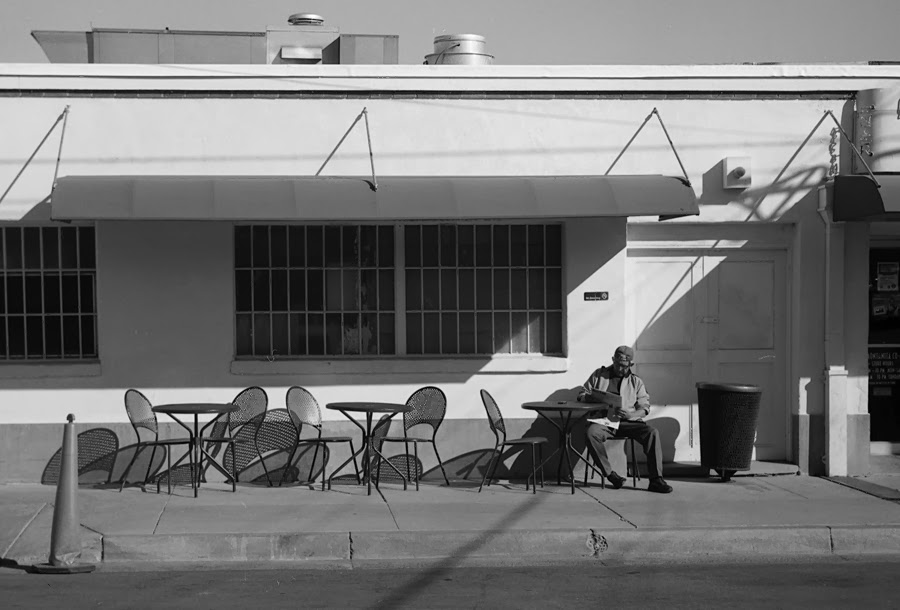
The Kodak Vigilant Six-20 and the slightly more upscale Monitor were the company's last stab at marketing a medium-format folding camera.  By 1948 when the line came to an end, people were ready to move on to new paradigms in photography.  The Anastigmat Special lens and the Supermatic shutter were as about good as anything available at the time, but the ergonomics of the Vigilant left a lot to be desired.  Estimating focus with a 101mm lens is not for the faint of heart, and neither the flip-up finder on the top deck nor the tiny reflex viewer over the lens offered much help in accurately framing the composition.


I have the top-tier lens and shutter on both the Vigilant and the Monitor.  I acquired them each for a song before anyone realized they were rather hard to find.  Unfortunately, my restoration skills were pretty rudimentary at the time and I haven't come close yet to allowing them to express their full potential.


These shots are from a brief morning stroll in the Nob Hill district of Albuquerque.  I'll try to get back there again soon to see if I can get a little more from the last of the Kodak folders.

Monday, February 24, 2014

Dark Eyes


Dark Eyes (Ochi Chornyye)
- Evheniy Grebenka

Dark and burning eyes, Dark as midnight skies
Full of passion flame, full of lovely game
Oh how I'm in love with you, oh how afraid I am of you.
Days when I met you made me sad and blue.

Oh, not for nothing are you darker than the deep!
I see mourning for my soul in you,
I see a triumphant flame in you:
A poor heart immolated in it.

But I am not sad, I am not sorrowful,
My fate is soothing to me:
All that is best in life that God gave us,
In sacrifice I returned to the fiery eyes!

(wikipedia article)

Sunday, February 23, 2014

Too many people, not enough cats.

I spend quite a bit of time looking at my own pictures and rearranging how they are presented in different venues.  Since most of my photo efforts involve making pictures with old film cameras, I often organize images according to which of my cameras they are made with.  I've done that with my image stream at Flickr too, but also have recently composed some additional image sets organized by subjects. Here are the lead pictures from each thematic group linked to each of the sets:

people

cats

cars

aircraft

balloons
When Flickr limited free accounts to 200 uploaded photos, I decided I would use that limit as a way to exercise some self-discipline in what I displayed of my work -- hopefully showing only my best pictures.  Now that there are no imposed limits, I have relaxed my selection criteria a bit.

People have assembled groups of photographs for a long time in many different ways.  Albums and scrapbooks were the media of choice up to about twenty years ago.  Computers and networks have facilitated storage and display, as well as allowing the reshuffling of image collections in nearly infinite ways.  The process is responsible for much of the enjoyment I get from my own image collection.  I also feel it helps me to evaluate my photographic effort and sometimes to see it in new ways.

(title contributed by Richard)

Thursday, February 20, 2014

Europe and America

I got some nice shots from my first Kodak Duo Six-20, but it developed a problem with the shutter linkage which ended up damaging the shutter.  I replaced some of the shutter parts recently and took the camera along on a walk to the Tingley Beach ponds in Albuquerque.  I was pleased to see that everything seemed to be working properly again.


As I reported in the previous post, I have a second Series II camera, seen below on the right, which is an example built for the European market with distance scale marked in meters and a Carl Zeiss Tessar lens.  On the left is my American market camera with a distance scale in feet and a Kodak Anastigmat lens.


Some slight differences can be seen in the lens mounts of the two examples, but I think the lens formula is essentially the same -- four elements in three groups.  A comparison of the images from the two cameras show no differences in quality that I can see.

Sunday, February 16, 2014

Another German Kodak

I recently acquired another Kodak Duo Six-20 Series II.  This one has the older Compur shutter with a 1/300 top speed coupled to a Carl Zeiss Jena f3.5 Tessar lens.


The camera arrived in good cosmetic and functional condition and required only a superficial cleaning to ready it for a test run.  I re-rolled some Tmax 400 onto a 620 spool, loaded the camera and strolled over to the Santa Fe 2926 locomotive restoration project that is not far from where we live.


Quite a lot of work has been done on the locomotive since I last visited the site.  Some important components were stolen about a year ago by scrap metal thieves, but those have now been replaced.


The big oil and water tender was hauled down the track to the old AT&SF shops for the National Railroad celebration last year.  It will go again in May, and there is a possibility that the locomotive will accompany it too, though not yet under its own power.


Some of the old guys who were there five years ago when I first started visiting the project are still there working.  They have also recruited a couple high school kids who have been given the job of conducting Sunday tours.


 Both kids were totally into the locomotive's extensive lore and were able to talk easily and at great length about the history and operation of 2926.  It was great to see such a couple bright kids so passionately involved in a worthwhile project.


I was also very pleased with the performance of the Duo Six-20 and the Tessar.  The uncoated lens clearly will benefit from the addition of a lens shade, but the resolution was very good, as would be expected of a Tessar.  I'm looking forward to working with it more.

Saturday, February 15, 2014

sawmill village

Sawmill Village is a recently erected apartment complex that resemble several others that have sprung up around central Albuquerque.  The site was occupied early in the Nineteenth Century by a huge sawmill, hence the  name.


Salient design features include bright colors and exposed duct work.  The Sawmill site also incorporates some artifacts presumably salvaged from its industrial past.  I'm uncertain to which architectural style the buildings should be assigned, perhaps IKEA with some assembly required.


Most of the people one sees at the site are workmen who are still in the process of completing the ground-floor shops.  The place does seem to have tenants; there are cars in the parking lot and bikes in the racks.


The crisp, new look of the place and the rather isolated location suggest a movie lot, which actually fits well with Albuquerque's aspirations to become the new Hollywood.  For me, the place brings to mind Sweethaven Village, the set built on the island of Malta for the 1980 musical, Popeye.

Thursday, February 13, 2014

Faces from Mercury

My Mercury II is one of those cameras that seems to demand color.  


Monday, February 10, 2014

dolly

I shot a roll of TMAX 400 in my Dolly Super-Sport after doing a little work on the shutter recently.  It may need a little more tuning still, but this is close enough to show some of the nice characteristics of the three-element F2.8 Trioplan lens.  


I was surprised and pleased to find some TMAX developer recently at the local Camera and Darkroom store just off Menaul in Albuquerque. The bottle showed an expiration date of Feb. 2014; I opened it to process this roll.  HC-110 and TMAX have always been my preferred developers for this film, but both have been discontinued.  The film may remain available for some time, but I doubt that I'll find either of those excellent Kodak developers again.

Sunday, February 09, 2014

a family affair

I had the good fortune yesterday of attending a presentation at the Hispanic Cultural Center by Dyanna Taylor, film-maker and grand-daughter of Dorothea Lange.  She showed some clips from a film she made which I believe is scheduled to show on PBS at some point soon.  There is also a book with the same title Dorothea Lange: Grab a Hunk of Lightning authored by Elizabeth Partridge who is the daughter of Rondal Partridge, Lange's assistant and son of Imogen Cunningham.

Migrant Mother -- Nipomo, Calif. 1936
The film contains some restored footage which was shot as Lange, with Rondal Partridge's assistance, was sorting through her negatives, selecting images to be included in the first solo exhibit by a woman at the Museum of Modern Art.  Lange had been seriously ill for twenty years before that historic show and died a couple months before the opening.  However, as can be seen in the clips, she retained her amazing vitality and lucidity right to the end.

As impressive as her talent was, Lange often had to fight to get her pictures published.  In Dorothea Lange: A Life Beyond LimitsLinda Gordon recounted how Lange's insightful captions to her pictures made for the FSA were often censored through the influence of right-wing Agricultural Dept. bureaucrats.  Lange ran into even more egregious censorship when she was hired by the Office of War Information to document the relocation and internment of Japanese-Americans to the Manzanar camp at the beginning of WWII.

The intent of the government's propaganda machine was to emphasize the humane manner in which the imprisonment was conducted, but they soon realized they had made a serious mistake in hiring a whistle-blower to do the job.  Taylor recounted how minders were assigned to follow Lange everywhere she went, and how they constantly interfered with her efforts to portray anything they thought hinted at the crimes that were being committed against Japanese-Americans.  The experience was devastating for Lange, but she stuck it out until the OWI finally fired her.  Her pictures of the internment were suppressed for about a decade and some have never been found.

Friday, January 31, 2014

FED 3

The FED 3 was produced in the Soviet Union from 1962 to 1980. The long production run can be accounted for by the incorporation of a number of design enhancements that were lacking in earlier Leica-copy cameras. In addition to a solid, well-made feel and uncluttered look, the camera by 1964 had a rapid advance lever. There was also a removable back, a fixed take-up spool, and shutter speeds from 1 to 1/500 seconds. A variety of Leica-thread-mount (LTM) normal lenses were supplied with the camera over the years; mine came with an Industar 3.5/50. The viewfinder/rangefinder is reasonably bright, but lacks paralax correction or a bright-line frame. Lateral adjustment of the rangefinder on this camera is done very easily with an adjustment screw from the camera front after the removal of a small cover screw.

While a lot of thought went into the FED 3 design to make it better than its predecessors, there are a couple small feature changes which many users would have liked. A rewind crank would have speeded things up, though that may have been purposefully omitted in the interest of robustness. From a functional standpoint, the omission of strap lugs may be more significant, and that is compounded by a never-ready case with the top section riveted to the back of the case. One way to sling the camera more handily around your neck is to cut around the rivet/snap to separate the back from the rest of the case; there's an illustration at Matt Denton's site of that procedure.

Perhaps the best reason for getting one of the LTM cameras is the availability of some very nice and inexpensive Soviet-era lenses, most of them copies of Leitz and Zeiss designs. I received as a gift from a generous on-line friend the highly regarded 2.8/55 Industar-61. I also obtained a recently-serviced 3.5/35mm Jupiter 12 in trade for my old Dolly Super Sport. The latter wide-angle lens is one of my favorites for 35mm work, and I already had a very nice accessory viewfinder which I had used with my other FSU camera, a Kiev IIa.

I've been impressed with the FED 3's operation in the short time I have worked with it. The film advance is quite smooth and snaps back well. The shutter appears accurate, and it seems somewhat less noisy than earlier models. The camera's controls are easily accessed. Like most of these Soviet era cameras, the FED 3 shutter demands that the shutter be cocked with the film advance prior to setting or changing the shutter speed. I did see small amount of light leakage evident along one edge of the film I put through the camera. According to a note a saw by Rick Oleson, the light may be coming in over the edge of the shutter curtain. I added a little light seal along the shutter curtain channel, but haven't yet tested the effectiveness of that fix. I later learned that an easier fix might just be to put on a lens cap before rewinding the film.

Some examples from the FED 3 fitted with the Jupiter 12 lens:


A copy of the FED 3 Owner's Manual may be viewed on line.

Wednesday, January 15, 2014

C-41 B&W

Digging around in my refrigerator bin for film, I found a roll of Kodak B&W 400, a C-41 film that is processed in the same chemistry as color negative film.  I shot the roll in my Kodak Retina lla and took it along with the color roll from my Vito II to Picture Perfect.

Railrunner -- Santa Fe to Belen

Albuquerque Station

Explora -- the Albuquerque Science Museum

Tiguex Park and the NM Museum of Natural History

I used to shoot a lot of this stuff as it was cheap, nearly grainless and wide-latitude.  You can still get it on line, but the cheapest I've seen is $6.50 per roll at B&H Photo Video.  Add in shipping and processing, and you're looking at fifteen bucks for a roll of negs -- more than I'm willing to spend these days.  It does make some nice pictures, though.

Local Color

The only place I know in Albuquerque that will still locally process film is Picture Perfect at the corner of Menaul and Juan Tabó.


Picture Perfect will process any kind of film.  If you get it in early, you might get it back the same day.  They also do digital, and they will accept work by snail mail or email.  Film processing costs $7 per roll.

Here are some samples of their processing, shot with my Voigtlander Vito II on Fuji 200:


I only used Picture Perfect a few times in the past when I could still go down to my corner Walgreen's and get my color negs back in as little as twenty minutes.  Of course, that was only good for 35mm, and Picture Perfect could dunk my medium format color and get it back within a day.  I would have been happy to use them for all my color work, but they are located clear across town and there was considerable added time and expense as a result.  Now, I'm having to rethink the process since Walgreens, Walmart, Target, CVS and Costco have all gotten out of the 1-hour film business.

Monday, January 13, 2014

Still Special


I took my No.1 Autographic Kodak Special to the Albuquerque train station.  The Amtrak Express was being fueled for a trip north.


With its high-res Tessar lens and a snappy Wollensak Optimo shutter, this is my favorite Kodak.  I would shoot it more often were it not for a persistent light leak that I haven't been able to stamp out.  That is not for lack of trying.  The commonest source of such problems is pinholes in the bellows.  I did find some early on which I was able to eliminate with opaque fabric paint.


My usual routine in looking for the source of light leaks is to extend the bellows, open the camera back and hold the camera up to the sun.  Usually, pinhole leaks will be visible as bright specks of light in the corners and creases of the bellows.  Not all can be found in that way, however, so I usually then go on to inspect the bellows in the dark using a small led light like the keychain flashlight above.  Having meticulously examined the bellows, I'm suspicious that the light leak in the No.1 Special may be somewhere in the slide-open back.  I've added some light seal material to the back as well as half-covering the ruby window from the inside and putting a strip of black tape over the outside which I lift only when advancing the film.  No luck so far.

Sunday, December 29, 2013

Goodbye to Craig

Craig Nelson was a fine photographer and a fine fellow. He had an insatiable urge to connect with other people which fueled his development as a photographer.  He shared his passions freely, enriched many lives and left behind an inspiring body of work.


CE Nelson at Flickr

Tributes to Craig at Nelsonfoto Forums