I received this nice catalog of upcoming exhibits and workshops today in the mail. Seems like it offers something for everyone with an interest in the photographic arts Information about the scheduled events is available on line at photosummer.org.
This year, PhotoSummer is organized by The University of New Mexico Art Museum and 516 ARTS in Albuquerque and CENTER in Santa Fe.
Saturday, May 07, 2016
Saturday, April 30, 2016
The Versatile Dolly
The Certo Dolly Super Sport
is one of my favorite old folding cameras. I did not realize that until I had traded away my first one, and I ended up buying four more. Some of my other medium format cameras are more compact and have somewhat more sophisticated lenses and shutters. The Dolly, however, can do a variety of things the others can't.
For starters, the Dolly originally came equipped with two frame masks which allowed putting 12 6x6 frames on a roll of 120 film, or by clipping in the 6x4.5 mask, getting 16 shots on a roll. Certo also offered a amazing array of accessories for that time for the Dolly, including interchangeable lenses, and camera backs which allowed the use of sheet film and plates. As it turns out, it is also easily possible to use 35mm film in the Dolly.
The Dolly film compartment, unlike those in most medium format cameras, will actually allow dropping in a standard 35mm cartridge with no modifications needed. Then, you thread the film leader into the take-up spool, give it a few turns and close the back. Since there is no paper backing on the 35mm film, it is a good idea to tape over the three windows on the camera back to insure that no light leaks in to ruin your film. If you have the 6x6 cm mask in place, the exposures you make in the Dolly using 35mm film will give you panoramic frames nearly twice the width of a normal 35mm shot, as well as showing an interesting line of sprocket holes along the top and bottom borders.
The final thing to bear in mind about using 35mm film with no paper backing in the Dolly is that you must come up with some way to advance the film for each frame by turning the film advance knob just the right amount to ensure proper frame spacing. I've done this with a number of other medium format cameras by experimenting with a roll of film with the back open to determine the right amount to turn the advance knob as I work through the roll. The amount of turns does vary slightly due to the increase in diameter of the film roll as it goes onto the take-up reel.
The clever Dolly as it turns out has a built-in solution to the film advance problem. There is a circular index dial on the face of the take-up knob which allows advancing the film without reference to the numerals imprinted on the paper backing of the 120 film normally used in the camera.
After you load the 35mm cartridge into the Dolly, you will want to give the advance knob several full turns to bring an unexposed section of film into position. As you are coming to that point, just be sure that you end the last turn with the numeral "1" at the index mark on the post beside the knob. After making the first exposure, you will then turn the advance knob a full 360 degrees plus a little more to get to the numeral "2" on the dial. And so on up to the twelfth exposure. Examining the dial closely, you wil see that the amount indicated to turn decreases slightly on each exposure so that by frame 10 you will actually be turning the advance knob less than a full turn.
Well, so that has gotten you to the twelfth frame with very precise spacing. After that you're on your own, assuming you have loaded a 24 or 36-exposure roll of 35mm. If you still have some unexposed film left I guess you could engage in some higher mathematics to calculate the advance routine for any remaining length of the roll, but I think I'd just go with around three-quarters of a turn for any remaining frames and accept the fact that the spacing is going to get a bit wider as you go.
I only tried 35mm in my Dolly on one occasion a few years ago. I shot with the 6x4.5 mask, so I did not get the nice panoramic effect, but I thought having the image overlap the full width of the fillm and show the sprocket holes was pretty neat. I also just took a best guess on the film advance. It was a lot of fun and gave me a series of images I liked.
is one of my favorite old folding cameras. I did not realize that until I had traded away my first one, and I ended up buying four more. Some of my other medium format cameras are more compact and have somewhat more sophisticated lenses and shutters. The Dolly, however, can do a variety of things the others can't.
For starters, the Dolly originally came equipped with two frame masks which allowed putting 12 6x6 frames on a roll of 120 film, or by clipping in the 6x4.5 mask, getting 16 shots on a roll. Certo also offered a amazing array of accessories for that time for the Dolly, including interchangeable lenses, and camera backs which allowed the use of sheet film and plates. As it turns out, it is also easily possible to use 35mm film in the Dolly.
The Dolly film compartment, unlike those in most medium format cameras, will actually allow dropping in a standard 35mm cartridge with no modifications needed. Then, you thread the film leader into the take-up spool, give it a few turns and close the back. Since there is no paper backing on the 35mm film, it is a good idea to tape over the three windows on the camera back to insure that no light leaks in to ruin your film. If you have the 6x6 cm mask in place, the exposures you make in the Dolly using 35mm film will give you panoramic frames nearly twice the width of a normal 35mm shot, as well as showing an interesting line of sprocket holes along the top and bottom borders.
The final thing to bear in mind about using 35mm film with no paper backing in the Dolly is that you must come up with some way to advance the film for each frame by turning the film advance knob just the right amount to ensure proper frame spacing. I've done this with a number of other medium format cameras by experimenting with a roll of film with the back open to determine the right amount to turn the advance knob as I work through the roll. The amount of turns does vary slightly due to the increase in diameter of the film roll as it goes onto the take-up reel.
The clever Dolly as it turns out has a built-in solution to the film advance problem. There is a circular index dial on the face of the take-up knob which allows advancing the film without reference to the numerals imprinted on the paper backing of the 120 film normally used in the camera.
After you load the 35mm cartridge into the Dolly, you will want to give the advance knob several full turns to bring an unexposed section of film into position. As you are coming to that point, just be sure that you end the last turn with the numeral "1" at the index mark on the post beside the knob. After making the first exposure, you will then turn the advance knob a full 360 degrees plus a little more to get to the numeral "2" on the dial. And so on up to the twelfth exposure. Examining the dial closely, you wil see that the amount indicated to turn decreases slightly on each exposure so that by frame 10 you will actually be turning the advance knob less than a full turn.
Well, so that has gotten you to the twelfth frame with very precise spacing. After that you're on your own, assuming you have loaded a 24 or 36-exposure roll of 35mm. If you still have some unexposed film left I guess you could engage in some higher mathematics to calculate the advance routine for any remaining length of the roll, but I think I'd just go with around three-quarters of a turn for any remaining frames and accept the fact that the spacing is going to get a bit wider as you go.
I only tried 35mm in my Dolly on one occasion a few years ago. I shot with the 6x4.5 mask, so I did not get the nice panoramic effect, but I thought having the image overlap the full width of the fillm and show the sprocket holes was pretty neat. I also just took a best guess on the film advance. It was a lot of fun and gave me a series of images I liked.
Wednesday, April 27, 2016
a sweet goodbye
My Pentax K1000 is going to a new home in Arizona. I decided to run one last roll of film through the camera, the cheap but colorful Lomography 100 which has always given me good results with the Unicolor C-41 color negative chemistry kit.
The 36-exposure roll includes two trips to the Rio Grande bosque, a walk in the Sandia Mountain foothills, and a brief visit to Santa Fe.
I haven't made a lot of pictures in the past year. The outings with the K1000 were a good reminder of what I like about photography. While making pictures is the goal of the effort, the bigger reward is the opportunity which photography provides to become totally immersed in the moment; I am able to focus my attention completely on the details of my surroundings with no other concerns of life crowding my consciousness. Photography allows me to partake in a small way in the Navajo aspiration to walk in beauty.
The 36-exposure roll includes two trips to the Rio Grande bosque, a walk in the Sandia Mountain foothills, and a brief visit to Santa Fe.
I haven't made a lot of pictures in the past year. The outings with the K1000 were a good reminder of what I like about photography. While making pictures is the goal of the effort, the bigger reward is the opportunity which photography provides to become totally immersed in the moment; I am able to focus my attention completely on the details of my surroundings with no other concerns of life crowding my consciousness. Photography allows me to partake in a small way in the Navajo aspiration to walk in beauty.
Saturday, April 09, 2016
Rock Art Morning
I enjoyed a morning outing to the Piedras Marcadas rock art site on the west side of Albuquerque thanks to being able to participate in a free photo workshop there conducted by Mark Bohrer. I reaffirmed the fact that I am constitutionally unable to walk around taking pictures with a group of other photographers. I did, however, appreciate Mark's fine introduction to the subject. I was also inspired to look at the familiar site in a somewhat different way than I have in the past, and I explored some new ideas using color and filters that I hadn't got around to trying before. Splendid weather and a fine experience.
Monday, April 04, 2016
Voigtländer Vitomatic II
A friend recently passed along this nice Voigtländer Vitomatic II to me. The camera shows little signs of use since it was made in 1959. The rangefinder patch is a little dim and the vertical alignment is off, but it still works pretty well. All the normal shutter speeds look close to accurate. The most impressive feature of the camera is the very fine F2.8/50mm Color Skopar lens. I was pleased to get the Vitomatic as the precursor Vito II with the Color Skopar is probably my favorite camera and I did not have a representative of this crucial develpment period in camera history.
All the other major German camera manufacturers including Zeiss Ikon, Agfa, and Braun made similar cameras for the upscale amateur market with coupled rangefinders and selenium light meters. There was also quite a race underway between German and Japanese companies at the time to see who could come up with the most advanced features. Subsequent models of the Vitomatic, for instance, would add exposure read-outs to the viewfinder and faster shutters. However, in spite of the advancements in feature additions, 1959 would turn out to be a watershed year in the camera industry as the Japanese surged ahead from there in terms of both design and price competitiveness.
I tend to prefer the more compact design of the earlier Vito folding cameras, but that compactness probably was not sustainable for adding the coupling for the rangefinders and light meters. Even with much of the focusing, shutter and aperture mechanism moved out to the protruding lens mount of the Vitomatic, the additional mechanism under the top deck became very dense. As a result, present day restorers and users of the camera will encounter some difficulties in making repairs and adjustments. The weight to size ratio also took an upward leap; the Vitomatic feels at first heft like it might be crafted from depleted uranium.
I loaded a roll of Kodak Tri-X into the Vitomatic and took it to Albuquerque's Rio Grande Zoo.
The smiles on the faces of the kids riding the zoo's new carousel brought back happy memories of the extraordinary exhilaration of that experience.
All the other major German camera manufacturers including Zeiss Ikon, Agfa, and Braun made similar cameras for the upscale amateur market with coupled rangefinders and selenium light meters. There was also quite a race underway between German and Japanese companies at the time to see who could come up with the most advanced features. Subsequent models of the Vitomatic, for instance, would add exposure read-outs to the viewfinder and faster shutters. However, in spite of the advancements in feature additions, 1959 would turn out to be a watershed year in the camera industry as the Japanese surged ahead from there in terms of both design and price competitiveness.
I tend to prefer the more compact design of the earlier Vito folding cameras, but that compactness probably was not sustainable for adding the coupling for the rangefinders and light meters. Even with much of the focusing, shutter and aperture mechanism moved out to the protruding lens mount of the Vitomatic, the additional mechanism under the top deck became very dense. As a result, present day restorers and users of the camera will encounter some difficulties in making repairs and adjustments. The weight to size ratio also took an upward leap; the Vitomatic feels at first heft like it might be crafted from depleted uranium.
I loaded a roll of Kodak Tri-X into the Vitomatic and took it to Albuquerque's Rio Grande Zoo.
The smiles on the faces of the kids riding the zoo's new carousel brought back happy memories of the extraordinary exhilaration of that experience.
Friday, April 01, 2016
Zeiss Ikon Box-Tengor
Zeiss Ikon started its line of Box-Tengor cameras in 1926. Many different models featuring a variety of film formats were offered. I have the last three models including the second version of the model 54/2 which was produced from 1934 to 1938, the 55/2 appearing in 1939, and the post-war 56/2 with a production run from 1948 to 1956. All of these used 120-size film and produced eight 6x9cm negatives per roll. All three models share the Goerz Frontar lens, a cemented doublet design that is supplemented by two accessory lenses on a rotating disk just behind the main lens which allow focusing for middle-distance and close-up. Another rotating disk, adjusted with the tab below the lens, allows a choice of three apertures.
My 54/2 Box-Tengor came to me from the former British colony of Cyprus, and probably for that reason has a three section focal distance scale marked in feet rather than meters. The indicated focal ranges are 3-6 feet, 6-20 feet, and 20 feet to infinity. Examining the actual image projected to the film plane on a ground glass showed those setting to be only approximate, and they varied from one camera to the next. Even at the smallest f-stop, the depth of field is nowhere near three feet at the near setting, so the user is best advised to keep close-up subjects at a range of 4-5 feet. Focusing for subjects at greater distances is less critical, and using smaller f-stops further enhances the chances of keeping middle distance and scenic subjects in focus.
The last two models of the Box-Tengor incorporated some feature enhancements including a large round film advance knob and double exposure prevention. While those changes were no doubt appealing to consumers, they may have had somewhat of a negative effect on durability and reliability. Though undeniably elegant and feature-laden, the Box-Tengors are still relatively inexpensive cameras, and the moving parts are made largely from soft sheetmetal held together by rivets.
Complicating the basic design with additional user-friendly additions put a lot of strain on a delicately balanced mechanism which can lead ultimately to failure under heavy use. For those reasons, the oldest of the three in my possession, the 54/2 model, is a clear favorite due to its simpler and solid design integrity.
The 55/2 model was introduced in 1939, and produced only for a year before WWII buried it. While it incorporated the main design enhancements which would appear in the post-war model, the bent tab shutter release and the time/instant selector at the top of the camera seem entirely out of character, and may have been compromises forced by war-time industrial production priorities.
In the final 56/2 model, the f-stop range was changed to f/9, f/11 and f/16. A little sliding door was installed over the back panel ruby window to give greater light leak protection for the faster films available after the war. The shutter release became an elegant little knurled knob, again located on the front lower right of the camera body. When looking at the camera from the front, it appears that the lens has been coated, but it turns out that is just a reflection from a deceptively tinted shield which flips over the aperture during the return rotation of the shutter disk.
The Box-Tengor shutter can be held open with the Time setting for low light exposures, or it can be used in Instant mode which gives an exposure of about 1/30th of a second. I can get sharp pictures from some of my small cameras at that speed, but a bulky box camera with a side-mounted release is just not conducive to capturing sharp images at slow shutter speeds. Getting in the habit of using a cable release and a tripod with the Box-Tengor will go a long way toward realizing the true potential of this elegantly styled box camera.
My 54/2 Box-Tengor came to me from the former British colony of Cyprus, and probably for that reason has a three section focal distance scale marked in feet rather than meters. The indicated focal ranges are 3-6 feet, 6-20 feet, and 20 feet to infinity. Examining the actual image projected to the film plane on a ground glass showed those setting to be only approximate, and they varied from one camera to the next. Even at the smallest f-stop, the depth of field is nowhere near three feet at the near setting, so the user is best advised to keep close-up subjects at a range of 4-5 feet. Focusing for subjects at greater distances is less critical, and using smaller f-stops further enhances the chances of keeping middle distance and scenic subjects in focus.
The last two models of the Box-Tengor incorporated some feature enhancements including a large round film advance knob and double exposure prevention. While those changes were no doubt appealing to consumers, they may have had somewhat of a negative effect on durability and reliability. Though undeniably elegant and feature-laden, the Box-Tengors are still relatively inexpensive cameras, and the moving parts are made largely from soft sheetmetal held together by rivets.
Complicating the basic design with additional user-friendly additions put a lot of strain on a delicately balanced mechanism which can lead ultimately to failure under heavy use. For those reasons, the oldest of the three in my possession, the 54/2 model, is a clear favorite due to its simpler and solid design integrity.
The 55/2 model was introduced in 1939, and produced only for a year before WWII buried it. While it incorporated the main design enhancements which would appear in the post-war model, the bent tab shutter release and the time/instant selector at the top of the camera seem entirely out of character, and may have been compromises forced by war-time industrial production priorities.
In the final 56/2 model, the f-stop range was changed to f/9, f/11 and f/16. A little sliding door was installed over the back panel ruby window to give greater light leak protection for the faster films available after the war. The shutter release became an elegant little knurled knob, again located on the front lower right of the camera body. When looking at the camera from the front, it appears that the lens has been coated, but it turns out that is just a reflection from a deceptively tinted shield which flips over the aperture during the return rotation of the shutter disk.
The Box-Tengor shutter can be held open with the Time setting for low light exposures, or it can be used in Instant mode which gives an exposure of about 1/30th of a second. I can get sharp pictures from some of my small cameras at that speed, but a bulky box camera with a side-mounted release is just not conducive to capturing sharp images at slow shutter speeds. Getting in the habit of using a cable release and a tripod with the Box-Tengor will go a long way toward realizing the true potential of this elegantly styled box camera.
* * *
All of these pictures were made with the 54/2 Box-Tengor on a tripod. The portrait is Tri-X, while the rest are on TMAX 100.
![]() |
| Margaret |
![]() |
| National Hispanic Cultural Center |
Lewis Antique Auto & Toy Museum, Moriarty
User Manuals for the Box-Tengors are at the Butkus site.
Labels:
54/2,
55/2,
56/2,
archive,
box camera,
Zeiss Ikon,
Zeiss Ikon Box-Tengor
Tuesday, March 29, 2016
Zeiss Ikon Ikonta B (521/16)
The post-War medium-format Ikontas retained most of the fundamental design characteristics of previous decades, but new materials and design ideas did take hold as the German camera industry struggled to reassert its place in the market. The 521/16 model, produced from 1948 to 1953, is notable for its compactness and light weight. The imitation leather covering no longer induces "Zeiss bumps" over rivet heads. A simple module under the winding key provides double-exposure prevention, and the plate at the front of the bellows to which the shutter attaches now has a charteristic folded tab with two rivets.
Some of the 521/16 models came with the high-end Tessar lens, but mine is an economy model with a 3-element 4.5/7.5cm Novar Anastigmat, and a Klio shutter with speeds from 1 second to 1/200th. Fortunately, a minimum aperture of f22 allows easy use of modern 400-speed film. The shutter and lens required only routine cleaning. The double-exposure module wasn't working properly, but it was easily disassembled, and bending up a leaf spring restored the proper functioning. Combined with the big 6x6cm format, the Novar lens cedes no ground in image quality.
The Ikonta B is a nice option for anyone who might just be starting with film cameras, or perhaps someone who would like to graduate from using the more simple box cameras from those times which lacked full control of focusing and exposure. Unlike the Kodak-made cameras of the period, Zeiss Ikon did not choose the doomed path of the 620 format, and instead went right on making their cameras suitable for use with standard 120 roll film. So, with the Ikonta B there is no need to worry about the inconvenience of re-rolling 120 film onto 620 reels. The Ikonta's strap lugs, light weight and good ergonomics also encourage a readiness to confront any photographic opportunity. I think I paid about $25 for my camera; that was some years ago, but I still see them offered occasionally on ebay at that same price.
I never put many rolls of film through my Ikonta B, mostly because I had too many other great old cameras distracting my attention. The results I got from the camera certainly showed that I should have given it more opportunities to show its stuff.
The largest and most impressive of the thousands of petroglyphs at Tres Rios is located at the top of the long ridge at the site. It is usually alleged to depict a cougar, but I'm calling it as a jaguar because of the cross-hatching that fills in the figure.
The stairway leads down into the sunken courtyard of George Pearl Hall which houses the UNM School of Architecture. It was designed by Albuquerque architect, Antoine Predock.
The Lobo is the UNM mascot, chosen originally no doubt because of its fierceness. A more current association should probably take into account the Mexican Wolf's endangered status along with a similar situation among UNM faculty which has experienced many recent layoffs due to budget cuts.
If you come across a fire engine on the street and you have an old camera with film in it, you have to take a picture. That's the law.
Some of the 521/16 models came with the high-end Tessar lens, but mine is an economy model with a 3-element 4.5/7.5cm Novar Anastigmat, and a Klio shutter with speeds from 1 second to 1/200th. Fortunately, a minimum aperture of f22 allows easy use of modern 400-speed film. The shutter and lens required only routine cleaning. The double-exposure module wasn't working properly, but it was easily disassembled, and bending up a leaf spring restored the proper functioning. Combined with the big 6x6cm format, the Novar lens cedes no ground in image quality.
The Ikonta B is a nice option for anyone who might just be starting with film cameras, or perhaps someone who would like to graduate from using the more simple box cameras from those times which lacked full control of focusing and exposure. Unlike the Kodak-made cameras of the period, Zeiss Ikon did not choose the doomed path of the 620 format, and instead went right on making their cameras suitable for use with standard 120 roll film. So, with the Ikonta B there is no need to worry about the inconvenience of re-rolling 120 film onto 620 reels. The Ikonta's strap lugs, light weight and good ergonomics also encourage a readiness to confront any photographic opportunity. I think I paid about $25 for my camera; that was some years ago, but I still see them offered occasionally on ebay at that same price.
I never put many rolls of film through my Ikonta B, mostly because I had too many other great old cameras distracting my attention. The results I got from the camera certainly showed that I should have given it more opportunities to show its stuff.
* * *
Wild Bill arrived in our southern New Mexico rural neighborhood driving a team of donkeys hitched to a little trailer similar to that used by Basque sheepherders. He squatted on some land beside the old highway by the Rio Grande. He bought an old pickup and used it daily to visit a cousin a mile down the road. Bill had served quite a time in the Marines running a motor pool; I think he had some retirement income from that and maybe some Social Security as well. He was kind to his animals and a good neighbor.The largest and most impressive of the thousands of petroglyphs at Tres Rios is located at the top of the long ridge at the site. It is usually alleged to depict a cougar, but I'm calling it as a jaguar because of the cross-hatching that fills in the figure.
The stairway leads down into the sunken courtyard of George Pearl Hall which houses the UNM School of Architecture. It was designed by Albuquerque architect, Antoine Predock.
The Lobo is the UNM mascot, chosen originally no doubt because of its fierceness. A more current association should probably take into account the Mexican Wolf's endangered status along with a similar situation among UNM faculty which has experienced many recent layoffs due to budget cuts.
If you come across a fire engine on the street and you have an old camera with film in it, you have to take a picture. That's the law.
Monday, March 28, 2016
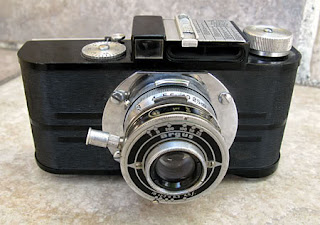
Argus A-Series Resources
The U.S. patent for the original Argus A showed C.A. Verschoor as the
inventor, but the drawings and the design were surely the work of
Gustave Fassin.
Literature on the Argus A cameras is not as copious as that for the later C3, but there are still some excellent resources available for learning about the first Argus cameras and their use.
1. Glass, Brass & Chrome: The American 35mm Miniature Camera by Kalton C. Lahue and Joseph A. Bailey includes a good historical overview of the development of the Argus cameras. While the book's editing leaves something to be desired, the great virtue of the book is that the authors write from personal experience, providing real insights into the features and foibles of the cameras discussed A lengthy preview of the book is available on line through Google Books.
2. 35mm For the Proletariat: A Modern User's Guide to the Argus A/A2 Camera by Hrad Kuzyk is a welcome recent addition to Argus lore . The author, improbably, took his ancient Argus A along on a tour of duty in Iraq. I had it in the back of my mind to get an Argus A for a long time, and this book pushed me over the edge. As the author explains in his preface:
"This book is intended to be a user's guide, not a collector's guide. As such, it does not concern itself with current street value, scarcity, condition rating, or other such collector-related information. While there is much of this text of interest to a collector of Argus cameras, this book concentrates predominantly on those issues that would be of importance to a user."
Some features of the A-model Argus are not very intuitive, so this guide is a big help in getting started with the camera. The excellent illustrations of repair procedures just about guarantee that nearly any Argus A can be made functional. The book is available in its entirety on line as a pdf file at TheArgusA.com.
3. Complete disassembly instructions for the Argus ILEX Precise shutter is available at the Camera Collecting and Restoration web site. Most Argus A cameras will not require that level of intervention, but the well-illustrated, step-by-step procedures provide the ultimate resource for the worst-case scenario.
4. All the A-Series Argus cameras are illustrated on a page at the Argus Collectors Group site
5. View the Argus A2F User Manual.
All of my A-Series photographs have been made with the Argus AF and the Argus A2F cameras.
And, here is the real me, exposed at arm's length by the Argus A2F:
Saturday, March 26, 2016
Right time, right place, and good enough.
![]() |
| Argus A2F |
In the 1930s, Leica was the standard setter. It doesn't take much imagination to see that the Leitz cameras were the primary inspiration behind the the original Argus A. In fact, Leica-copies of varying degrees of fidelity appeared in many national guises. The most notable Leica-like cameras were made in the Soviet Union in vast numbers over a period of decades. It is interesting to compare the efforts in the U.S. and the Soviet Union to appropriate the Leica mystique. The Soviet response was driven by ideology and resulted in copies that were very faithful to the original German design and of quite good quality. Given the huge production and the somewhat inferior materials and workmanship, it is tempting to assume that the Soviet cameras were produced at a low cost compared to the Barnack originals. But, how does one make that determination in an economy that is totally State-run?
In the free-market economy of the U.S., costs, competition and demand were clearly the drivers of production, and the result from Argus (then, the International Radio Corp.) was a camera of more modest aspirations that resembled the Barnack Leicas only in rather broad terms. Charles Verschoor, the IRC president, avoided the mistake made by a number of other American industrialists of going head to head with the European camera makers who followed a tradition of ultra-high quality production aimed at satisfying the needs of a wealthy elite. Instead, the Argus A was conceived from the beginning as a product that would be widely accessible to middle-class photo enthusiasts, even in the midst of the world-wide Depression.
Verschoor made good use of previous production and marketing experience acquired in the making of low-cost radio sets. The cheap bakelite plastic cases of the radios provided a useful model for camera body construction using a proven, mature technology. Mass marketing acumen was clearly demonstrated in the choice to publicize the debut of the Argus A in the first issue of Life Magazine. Of course, making and marketing a cheap camera is one thing, while making a profit selling a good, cheap camera is quite another.
Verschoor's entrepreneurial genius was evident in his choice of a chief designer capable of finding just the right balance between frugality and quality. Gustave Fassin was a designer of precision optical instruments who had learned his craft in Belgium where he taught at the Technical School of Ghent and had charge of workshops in the Societe Belge d'Optique before emigrating to the U.S. in the 1920s. Fassin took up residence in the capital of the U.S. photographic world, Rochester, NY, and taught at the University of Rochester Institute of Applied Optics. Fassin also worked for both of the giants of the photo world based in Rochester, Kodak and the Bausch & Lomb Company.
By the mid-1930s, Fassin held an impressive number of patents for optical devices, and he also clearly made good use of opportunities to learn about resources and production techniques that the big U.S. companies used to succeed in a very competitive industry. Although the patent application for the Argus A bears only Verschoor's name, the design similarities with the later Argus C3 carrying only Fassin's name shows that the first Argus was the Belgian's design. At the same time, there is little doubt about the importance of Verschoor's abilities to read the market and to marshal resources in making it possible to produce a pretty good miniature camera that cost one-fifth the price of Kodak Retina, and one tenth that of the Leica A with essentially the same basic features. The Fassin design even surpassed the high-priced competition in a couple respects, including the removable back that made film loading a snap compared to the Leica, and neither Kodak nor Leitz standard lenses provided the kind of extreme close-up capability of the Argus f4.5 Anastigmat on the AF in 1937 and A2F in 1939.
In truth, the Leitz company leadership quite likely lost little if any sleep over the pretender from Ann Arbor. The Leica was never aimed at the kind of market that Argus captured, and in Europe Argus cameras were virtually unknown. Kodak's reaction to the competition from the Argus was more complicated. The Kodak 35 and the Kodak 35 Rangefinder cameras seem clearly to have been designed in response to the quickly building popularity of the Argus A, and later the C3. The domestically produced Kodaks featured some superior lens opitions and they sold reasonably well, but they didn't come close to achieving the popularity of the Argus cameras, and somehow Kodak never really caught up. Perhaps the company didn't try as hard as it might have to quash the competition. Kodak,after all, was more of a film producer than a camera manufacturer. In the U.S., Kodak's film manufacturing, distributing and processing capabilities gave it a market dominance similar to what Microsoft enjoys today. What that meant in terms of practical economics was that nearly every time an amateur photographer pressed the shutter release of an Argus A or C3, it was money in the bank for Kodak .
The compact simplicity of the Argus A2F is very appealing to me. The appearance and over-all ergonomics seem to me to be superior to the later and more popular C3. I don't mind the lack of double-exposure prevention, I like the self-cocking shutter, and the close-focusing capability of the camera makes it hard to beat in regard to versatility. The lens is adequately sharp, with no obvious spherical aberration. Being a pre-war design, there is no anti-glare coating on the lens surfaces. Images from the Argus tend to be a little soft around the margins. Images from the camera show a slight amount of corner vignetting, probably caused by the shadow of the large coil spring that held the lens in the open position. The focus ring of the A2F is a little difficult to get at and tends to slow shooting a bit as a result. I'm not sure what to make of the extinction meter and exposure calculator on the top deck; it seems to me to offer little over just making a best guess about proper exposure. I wonder if the extinction meter wasn't conceived of more as a marketing ploy rather than as a practical picture making aid as was the case with the much-touted Autographic feature on the early Kodaks.
I'm sure the amateur photographers of the '30s, '40s and '50s argued at length over the merits of the Argus A and its descendants; and those who get around to trying the camera now probably can find some things to disagree about too. What seems inarguable, however, is the role played by the modest Argus A line in revolutionizing the way that Americans pictured life. Picking up an early Argus camera is a way of taking history into your hands, and making pictures with one provides a tangible link to a past that is otherwise largely beyond reach.
I put quite a few rolls of film through the Argus A2F and posted many of them on the blog. The pictures from the camera show good resolution; they are notable for a unique tonal character, due in part to the low-contrast optics. The capability to shoot very close to the subject in a simple, early 35mm camera makes shooting the Argus A2F an interesting experience.
Sunday, March 20, 2016
History In Hand
A neighborhood friend came to dinner the other night. Knowing I was a photographer she brought couple cameras along to show me. One was her Canon digital which she uses often. The other she said her husband had found while working on an abandoned house in California some dozen years ago. She reached in her bag and pulled out a Leica A, the first production model which Leica made from 1925 to 1936.
The camera showed some brassing and discoloration, but only from many years of use and not from any abuse. The original Elmar lens extended smoothly without and resistance or wobbling and the glass was unmarred. The focusing helical seemed only a little stiff. I put a small amount of pressure on the advance knob, but it did not want to turn. I flipped forward the little rewind lever, but the rewind knob also resisted movement. It seemed possible there was still a roll of film in the camera.
As I held the Leica in my hand my mind was immediately flooded with a parade of images by all the great mid-Century photographers like Cartier-Bresson, Kertesz and Rodchenko who used the then-new miniature camera to revolutionize photographic image making. It was a thrill to hold the camera which had been used by a contemporary of those pathfinders. I hope to have a chance to examine it more closely sometime.
The camera showed some brassing and discoloration, but only from many years of use and not from any abuse. The original Elmar lens extended smoothly without and resistance or wobbling and the glass was unmarred. The focusing helical seemed only a little stiff. I put a small amount of pressure on the advance knob, but it did not want to turn. I flipped forward the little rewind lever, but the rewind knob also resisted movement. It seemed possible there was still a roll of film in the camera.
As I held the Leica in my hand my mind was immediately flooded with a parade of images by all the great mid-Century photographers like Cartier-Bresson, Kertesz and Rodchenko who used the then-new miniature camera to revolutionize photographic image making. It was a thrill to hold the camera which had been used by a contemporary of those pathfinders. I hope to have a chance to examine it more closely sometime.
Subscribe to:
Posts (Atom)


