Some media attention has been given lately to the discovery and dating of the preserved footprints of humans and extinct animals in the dry bed of an ancient lake in White Sands National Monument. The DNA of pollen associated with the prints suggests an age of twenty thousand years. That puts the arrival of humans in the New World much further back in time than previously thought. It also means that the humans were coexisting with some fearsome large predators including Saber-toothed Cats and Dire Wolves.
The Dire Wolf exhibit at the Natural History Museum is nicely lit by large nearby windows, making it an attractive subject for my cameras. On this occasion I was shooting my Olympus Pen-FT with the 1.8/38mm lens.Tuesday, July 30, 2024
Friday, July 26, 2024
One of My Hunters
Another image found in the recesses of my hard drive. I doubt I'll ever find the negative as it was made many years before I got my negative files in some kind of proper and retrievable order. There is likely a drugstore print in a box somewhere.
I took my first Red-tailed Hawk from California to Idaho and I had another there which I rehabed from a gunshot that blew off some wing feathers. Both birds were enthusiastic about bunnies and jackrabbits.
This shot was certainly from my Pentax Spotmatic as that was the only camera in the house for about twenty years.
Sunday, July 21, 2024
Lost and Found
I found these in a neglected corner of my hard-drive. They were made around twenty years ago at a field west of the Organ Mountains. No info attached to the photos -- they were likely made with the Spotmatic. I will try to track down the negatives to make some new scans.
UPDATE:
I was right about the timeframe; the pictures were made in February of 2004. However, the camera was not my Spotmatic, but rather the Kiev IIa loaded with Tri-X. Rescanning did not gain anything of interest beyond image size.
Still, I'm pleased I was able to find the negatives from twenty years ago.
Sunday, July 14, 2024
Inside and Out
I suspect a lot of people, when they first encounter a Minolta Hi-Matic 7s wonder if the fully automatic exposure system is really going to work. It just seems too easy to simply press the shutter release and get a perfectly exposed picture every time.
I experimented a bit with mine, checking the metered values when the camera was on full auto, and then with the shutter and aperture set manually. It did seem to be consistent in its performance, so it seemed the next step should be a real-world test. I started a roll of Kodak UltraMax 400 on Wednesday at the National Hispanic Cultural Center, and then took the camera on Friday for a walk around Old Town Albuquerque.
I could not find anything to complain about in how the HiMatic 7s handled the full range of lighting from dim interiors to full sun in the Plaza Vieja.
No camera, of course, is perfect. The display of EV values only in the meter leaves one wishing for aperture and shutter numbers. Size and weight are the other big issues. The camera, while of extraordinary build quality, is a heavy-weight among rangefinders. Here is a comparison picture showing the HiMatic 7s next to the little Olympus 35 RC, also having auto-exposure.
Seeing that Olympus was racing ahead in its light-weight design, Minolta did make the next model of the HiMatic much closer in size to the 35 RC. With use, though, one does get used to a bit of added bulk. And, the 1.8/45mm Rokkor lens on the Minolta has got to be one of the best lenses to emerge from the 1960s.Saturday, July 06, 2024
Small, But Mighty
I loaded a roll of Kodak UltraMax 400 and carried the 35RC around for a week, visiting my usual haunts around Albuquerque's Old Town. I've gotten in the habit of giving most of the films I use an extra stop of exposure beyond the box speed. However, the UltraMax 400 really seems to yield better results without that extra push.
I particularly like 400-speed film for sunny day hip shooting. With the focus set to ten feet, the shutter at 1/500 and a f16 aperture, about anything you point the camera at is going to be focused and sharp .
I finished off the roll on a Friday morning in the Plaza Vieja. The sleek Pontiac hardtop was one I hadn't seen there before. The little '32 Ford Victoria got to show off its engine.
Thursday, July 04, 2024
Close to Home
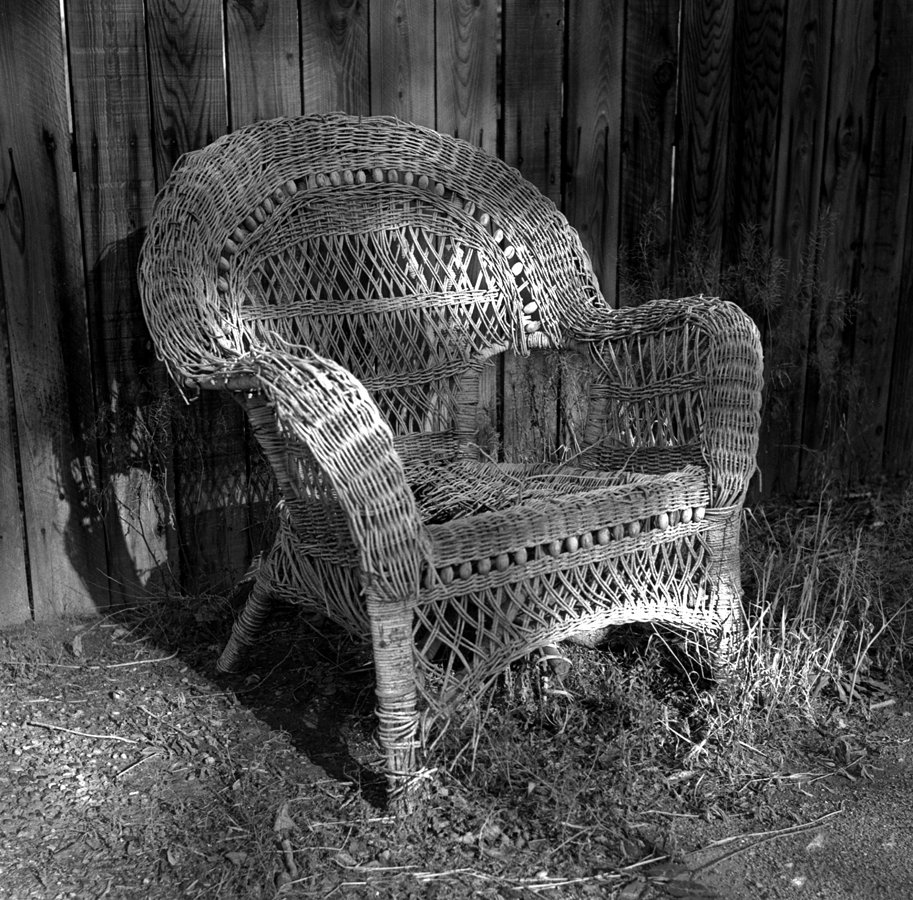
This wicker chair has been sitting for months beside the road a half block from my house; I pass by it daily when I'm walking the dog. I have made pictures of the chair with several cameras. This is the one I have liked most so far; it was shot on Kentmere 400 in my Yashica-Mat.
The summer monsoon weather pattern has been bringing some nice clouds overhead. I saw these above the alley a half block to the west of our place late in the afternoon.
Saturday, June 29, 2024
The Stylus Epic
I decided I really needed to put more film through my Olympus Stylus Epic so I loaded a roll of Kodak UltraMax 400 and carried the camera in my pocket for a week, with walks through Old Town and the UNM campus.
![]() |
| Dane Smith Hall |
![]() |
| A lawn art statue representing the UNM Lobo mascot |
I had not been on the campus in some time and it seemed a lot bigger than I remembered it. I visit the Plaza Vieja in Albuquerque's Old Town at least weekly and it is much less of a challenge to my limited mobility.
As usual on a Friday morning there was a long line of restored classic cars in front of the church.
![]() |
| 1938 Chev |
![]() |
| upholstery talk |
All of the cars are ones I had seen and photographed before, except for
the little blue Mercury Comet, perhaps the most modest model to carry
the Mercury name; I think this was an early one.
The camera seems to work perfectly. Its only issue is a small light leak, and a narrow stip of electrical tape easily deals with that. The Stylus Epic is even smaller than the compact Infinity Stylus and the 4-element 2.8/35mm lens is a bit more sophisticated than the earlier mju's 3.5/35mm, though I don't see a significant difference in the quality of the pictures between the two. I actually prefer the handling of the earlier Infinity Stylus, but it may be I am just more familiar with the older camera because I have put a lot of film through it over the last fifteen years.
Sunday, June 23, 2024
Twin-Lens at the River
I took my Yashica-Mat twin-lens reflex to the river to make a few more pictures of the Yerba Mansa in bloom. There are still abundant flowers, but many are starting to turn red now as their seeds mature.
It was nice to get back to shooting with my Yashica-Mat, which has a very sharp lens and a bright viewing screen.
I have not made a lot of pictures with this TLR, but I am motivated to do more with it now since I have acquired a No.2 close-up accessory lens, which allows focusing as close as 14 inches.
With the accessory lens the Yashica-Mat still does not have the focal range of the Mamiya C330, but the viewing lens requires no adjustment for parallax and there is no need to adjust exposure as is the case when the C330's bellows is extended.
Monday, June 10, 2024
Good for Anything That Ails You
The Yerba Mansa has bloomed along the Rio Grande a little earlier than usual this year, perhaps because of the unusually warm weather and high water.
From a 2009 blog post:
I first encountered Yerba Mansa in a little bog between the road and the Rio Grande about twenty miles north of Las Cruces. The photo of the flower was made on June 9, 2002 using a little 1.3 megapixel OLYMPUS D360-L. A lot of water has flowed down the river since then.
So my initial knowledge of the plant coincided with the beginning of digital photography. Since I made that first picture with the simple little Olympus D360 I have photographed the plant nearly every year since with many of my old film cameras.
Modern medicine has not found a useful remedy in the Yerba Mansa, but many Native American peoples used all parts of the plant to treat every imaginable ailment. I'm thinking perhaps I'll try it this year in a tea.
Tuesday, June 04, 2024
Vivitar PN2011
I picked up a Vivitar PN2011 twenty years ago at a Las Cruces thrift shop for two bucks. I was impressed with the sharp pictures that the simple point-and-shoot could produce. I only shot a couple rolls with that camera before I got distracted with all the others I was finding at bargain prices at that time on ebay. The best of the PN2011 pictures came from a Campo Santo in Las Cruces and from a trip to the most southern Chaco outlier on Alamosa Creek.
I turned that original PN2011 into a pinhole camera and never used the panoramic format option. I found another in Albuquerque at about the same price as the first and decided to try it as a panoramic shooter during a walk through the Botanic Garden. The film on this occasion was Kodak Gold 200.
The pictures from this second PN2011 don't seem as sharp to me as the ones I got from the first one, so I may have to look for another.
Switching to panoramic mode changes the view through the finder and narrows the image width on the film with a couple movable panels. The altered view may help a bit with visualizing the panoramic potential of the scene, but not much is gained in camera that can't be achieved by just cropping the full image.