 |
| Photo by Junfu Han |
Showing posts with label Ansco Folding Buster Brown. Show all posts
Showing posts with label Ansco Folding Buster Brown. Show all posts
Tuesday, July 10, 2012
slow news day
A reporter from the UNM student paper, the Daily Lobo, stumbled on my blog recently. He came by, we chatted about old cameras for an hour and he took some ttv shots through the viewfinder of my Mamiya camera.
My grandmother's old Ansco Folding Buster Brown somehow got transformed into a "professional" camera in the course of the interview. Still, it's nice to see the picture of her holding the camera while sitting in the canoe. It seems likely that my grandfather was the photographer on that occasion, though there is no way of verifying that now nearly a century later. I'm guessing that would have been one of my grandmother's favorite pictures of herself.


Tuesday, February 09, 2010
Ansco Folding Buster Brown No.1, Model B

The lens on my camera is a nicely ground and mounted, single-element menisicus which is located behind the shutter and aperture. The shutter, with options for "T,B and I", was probably manufactured by Wollensak. The aperture offers Universal System choices of "8,16,32 and 64", which correspond to the f-stops, f11, f16, f22 and f32.

My camera came to me in pretty good shape considering its age. I glued down a few loose edges of the black exterior covering, and I soaked the shutter overnight in lighter fluid to get it operating properly. The "Instant" setting appears to be about 1/25th of a second.

My inspiration for acquiring the Buster Brown was the photo below of my grandmother, taken as she sat in a canoe on a Wisconsin pond, possibly before the birth of my mother in 1917.

Looking at the proportions of her camera, I think it was probably not the same 120-format as mine, but rather one of the larger, now obsolete formats which yielded post-card size contact prints.
More photos from the Buster Brown:


Early Ansco cameras (Butkus)
Saturday, January 16, 2010
borders and sprockets
I went to some trouble, as I described in my last post, to eliminate the sprocket holes from my Fed-1g images. On other occasions I have done just the opposite, incorporating into my images the film negative borders with their lettering and numerals or the sprocket holes from 35mm film. I think the first time I used this style was in an image made with my No.2 Folding Autographic Brownie. I decided I wanted a very large print to hang over my desk, so I took a scan of the image to a fellow in the Las Cruces downtown mall who had an Epson printer about two yards wide. As he was preparing the image for printing, I saw him start to crop out the film borders. I hastened to tell him I wanted the borders left in the print. He gave me a quizzical look, and I muttered something about the framing effect. So he proceeded as directed with only a slight curl of the lip.
Kodak No.2 Folding Autographic Brownie
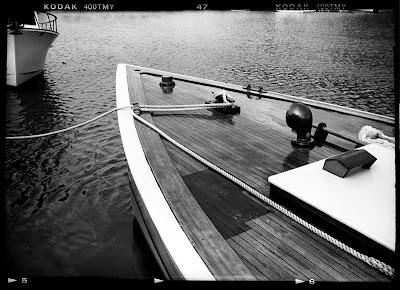
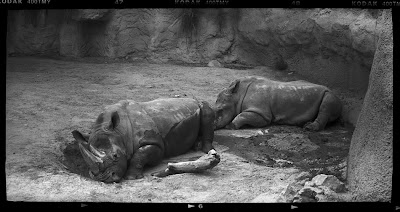
It is not immediately apparent to everyone why including the film borders and sprocket holes into an image is a good idea. I think the creation of a natural framing device is part of the appeal. The border inclusion also calls attention to the photographic process and further differentiates the image from those created by other means such as painting or drawing.
In the case of my No.1A Autographic, the negative frame borders also document the panoramic format which results from using 120 film in an old 116-format camera.
Kodak No.1A Folding Pocket Special
I think another aspect of appeal in the use of negative frame borders resides in a declaration of authenticity. One sees that the entire image recorded by the film is displayed with no cropping. I'm usually perfectly willing to crop for compositional value, but it is nice to have an example or two from an old camera which clearly show the unaltered proportions of the images.
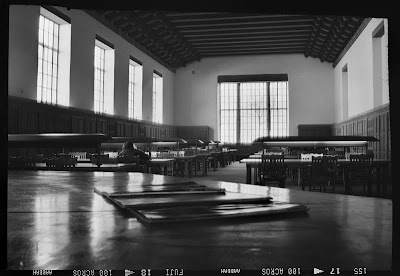
Ansco Folding Buster Brown
Negative frame borders are sometimes useful in identifying the type of camera that has made the image. For instance, the film holders for large-format cameras leave a very distinctive impression on the film. The upside-down lettering at the bottom of the images from both the Buster Brown and the Clack result from the fact that the advancing film travels from right to left.
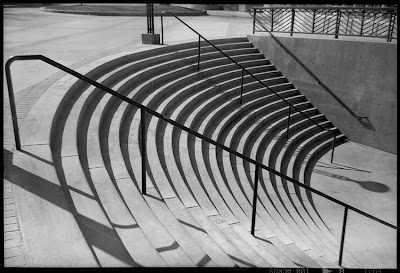
Agfa Clack
The Certo Dolly is a particularly versatile shooter, offering two formats, 6x6 and 6x4.5, and one can further emphasize the proportional possibilities with inclusion of the frame borders in the images.
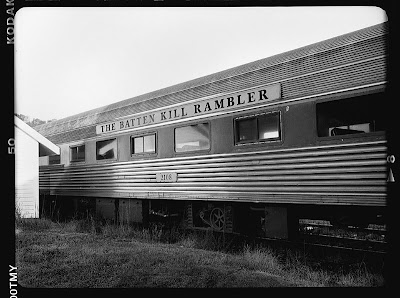
Certo Dolly Supersport, 6x4.5 mask
Although the Dolly is built to use 120 film, it is also easily possible to use 35mm film in the camera. The 35mm cartridge fits with no problem into the feed compartment. One needs to be careful to keep the ruby windows well covered with black tape, and it is necessary to advance the film blindly with a couple of turns each time to keep the frames separated. What you get with this technique is an image that extends out over the sprocket holes. In addition to the graphic interest this produces, I think it is also a useful way to help create a link between pictures in a series. An example of this can be seen in a roll from the Dolly shot along Route 66 in Albuquerque.
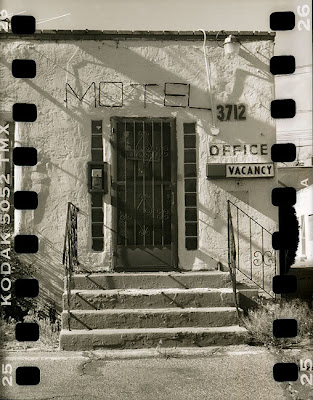
Certo Dolly Supersport, 35mm film

Kodak No.2 Folding Autographic Brownie
It is not immediately apparent to everyone why including the film borders and sprocket holes into an image is a good idea. I think the creation of a natural framing device is part of the appeal. The border inclusion also calls attention to the photographic process and further differentiates the image from those created by other means such as painting or drawing.
In the case of my No.1A Autographic, the negative frame borders also document the panoramic format which results from using 120 film in an old 116-format camera.

Kodak No.1A Folding Pocket Special
I think another aspect of appeal in the use of negative frame borders resides in a declaration of authenticity. One sees that the entire image recorded by the film is displayed with no cropping. I'm usually perfectly willing to crop for compositional value, but it is nice to have an example or two from an old camera which clearly show the unaltered proportions of the images.

Ansco Folding Buster Brown
Negative frame borders are sometimes useful in identifying the type of camera that has made the image. For instance, the film holders for large-format cameras leave a very distinctive impression on the film. The upside-down lettering at the bottom of the images from both the Buster Brown and the Clack result from the fact that the advancing film travels from right to left.

Agfa Clack
The Certo Dolly is a particularly versatile shooter, offering two formats, 6x6 and 6x4.5, and one can further emphasize the proportional possibilities with inclusion of the frame borders in the images.

Certo Dolly Supersport, 6x4.5 mask
Although the Dolly is built to use 120 film, it is also easily possible to use 35mm film in the camera. The 35mm cartridge fits with no problem into the feed compartment. One needs to be careful to keep the ruby windows well covered with black tape, and it is necessary to advance the film blindly with a couple of turns each time to keep the frames separated. What you get with this technique is an image that extends out over the sprocket holes. In addition to the graphic interest this produces, I think it is also a useful way to help create a link between pictures in a series. An example of this can be seen in a roll from the Dolly shot along Route 66 in Albuquerque.

Certo Dolly Supersport, 35mm film
Wednesday, January 21, 2009
Zimmerman Library, UNM
Zimmerman Library, UNM


These images were made today with my new hundred-year-old camera, an Ansco Folding Buster Brown, Model B. I'll be adding a page on it to the vintage cameras section of my web site shortly.


These images were made today with my new hundred-year-old camera, an Ansco Folding Buster Brown, Model B. I'll be adding a page on it to the vintage cameras section of my web site shortly.
Subscribe to:
Posts (Atom)