Showing posts with label Bentzin Primar. Show all posts

Saturday, April 11, 2026

A Bentzin Folder

I had just one roll of 120 Kentmere in my refrigerator so I dicided to use it in my Bentzin Primar folding camera which I had used only once before since its acquisition in 2018.  I bought the camera on ebay because I had been very impressed with the quality construction of my Benzin plate camera.  The camera's features are an interesting pre- and post-war mix.  The Compur shutter and the uncoated Meyer Gorlitz Trioplan lens definitely look  to be from the 1930s.  

 On the other hand the self-erecting feature and the plastic advance knob are typically found on folding cameras made after 1945.  This camera also has two ruby windows on the back, indicating an option of getting sixteen frames from a roll of 120 film.  However, my camera did not come with the half-frame mask which would enable that choice.  The Bentzin looks like it was little used, including a faultless bellows and no Zeiss bumps in the covering.


 Being a Friday morning, the old guys and their restored classic cars were available in the Plaza Vieja to help with camera testing.   

 
 One of the old guys had come for his last ride.
 
For a three-element lens, the Meyer Gorlitz Triplan lens delivers impressive performance.  I have the same lens on one of my KW Patent Etui plate cameras and on my Certo Dolly SuperSport, and they make images as sharp and undistorted as the four-element Tessars.

I remembered that the Rada rollfilm adapter for my  Bentzin plate camera came to me with a thin cardboard mask for half-frame images.  It does not quite fit in the Bentzin folder, but it would be just a few moments work to cut one to fit.

Tuesday, May 13, 2025

A Plate Camera Outing

 Out for the dog's morning walk I noticed that the historic Henry Mann house was nicely lit by the low sun.  It occurred to me that it might be a scene well suited to the capacities of my Bentzin Primar plate camera. 


Back home I quickly checked the bellows for pinholes and then loaded a roll of Kentmere 400.  I made a couple quick shots of the Mann house. 


It seemed too nice a day to stop with just that. so I headed down to Old Town to see what else I might find to finish off the roll of Kentmere.

The Albuquerque Museum was built in 1979, with the design by Albuquerque architect Antoine Predock.


 Old Town's Plaza Vieja and San Felipe de Neri is just a block west of the Museum.

 
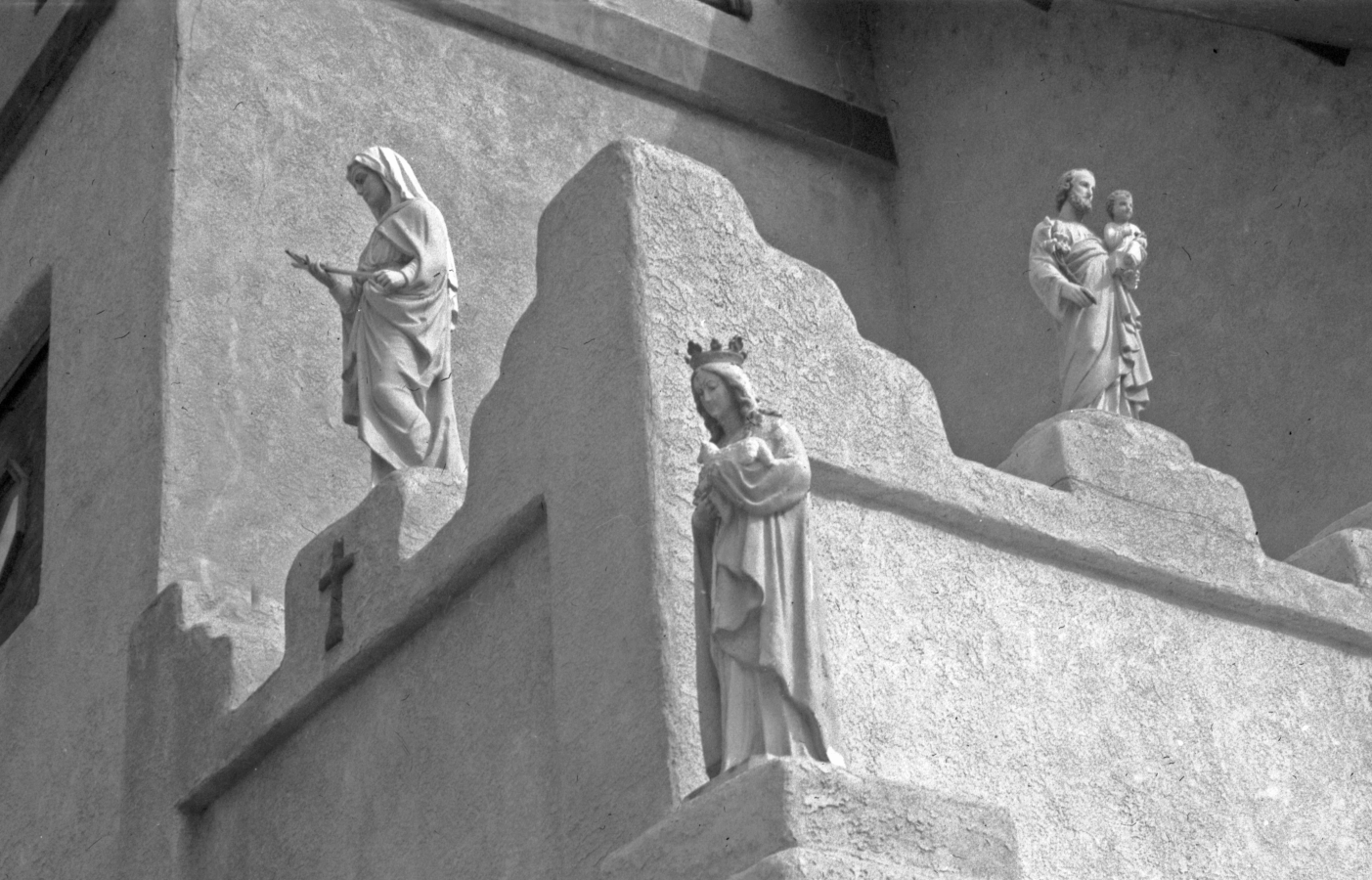
The entrance to the church is currently adorned with a big white sash honoring the new Pope.

* * *

All the plate cameras were originally designed to accommodate glass plates, film packs, or sheet film in film holders.  Soon after the cameras appeared on the market several companies started making roll-film backs which were a bit more convenient to use than the single-sheet holders.  I have a Rada Rollfilm back for use with the Bentzin Primar.

The Rada back loaded with a roll of 120 film can make eight 9x12cm or sixteen 6x4.5cm images with an adapter frame.  For the full 9x12cm size I use the odd numerals from 1 to 15  on the film's paper backing which are shown in the right-side ruby window

Back in the days when the plate cameras were originally on the market I'm sure the Rada was easy to use.  Today, however, the framing numerals  on roll film backing paper are low contrast and can be very difficult to make out through ruby windows.  Knowing that, I took along a small flashlight to help me properly advance the film.  That, however, turned out to be of little help and I only managed to get six out of the eight possible images on the roll.

Inside, under a lamp, the frame numerals are easily seen.  Outside, however, the characters are obscured by glare on the glass and plastic surfaces, and film advance becomes something of a guessing game.  The problem is further complicated for me by my old eyes which do not quickly adjust to changes in light intensity.  When I visit exhibits in the Museum, for instance, it always takes fifteen to twenty minutes before I can clearly see what is on the walls.

I need a better strategy for advancing film in the Rada.  I have considered just removing the ruby window.  I think that would not result in any light leak problems because the red color really serves no purpose with modern films, and the windowed compartment presses down quite firmly on the backing paper.  I'm reluctant to go to that extreme, however, as I hate the idea of compromising the film back's integrity.

Another possibility might be to use some kind of small hood in conjunction with the flashlight.  Just how exactly that would be configured is something I have yet to work out.

Any suggestions will be welcomed.

Thursday, November 03, 2022

San Ignacio

 I took two cameras to photograph the interesting little San Ignacio church about a mile from our home.

The No.3A Folding Pocket Kodak was again loaded with a sheet of postcard-size photo paper.  I made an eight second exposure at f64 under a lightly overcast sky.  I developed the paper negative in HC110b, stopped in some water with a little vinegar and fixed for about five minutes.


I also shot a roll of Fomapan 400 in my Bentzin Primar Folder.  I was pleased with the results from the film and the sharpness obtained from the Meyer Gorlitz Trioplan lens.  However, the open frame viewfinder on the folder will need some adjustment so that it more closely shows what will end up on the film.


Update
*********************
I have made some small changes to the images in this post, increasing the contrast slightly.  I recently got my old Dell XP computer running again, so am getting back to using my preferred CS2 and Silverfast programs.  I have also made an effort to better match the screens on my Windows and MAC computers. 

Saturday, August 13, 2022

Friday Morning

  I took my Bentzin Primar plate camera to the Plaza Vieja to catch the old cars and a couple of the old car guys.


The roll of Fomapan 400 was processed in HC110b.  I was pleased with image quality from the low-cost Fomapan, but found I was really out of practice in using the plate camera.  Both the wire frame finder and the little reflex viewer provide a somewhat vague idea of where the camera is pointed, and achieving sharp focus by estimation is always tricky at less than the smallest apertures.  It took some careful cropping of the negatives to get some reasonable compositions.

Friday, July 02, 2021

Back to the Plate Cameras

 After talking recently with Vince Lupo about the nice results he has gotten from his Ermanox I was inspired to get back to shooting with my own plate cameras.  They are not as exotic as the Ermanox, but the lenses are good and the big negatives from 120 film produce very nice images. 

Since I had not used the plate cameras in some time I had to go through them to check functionality and make sure no pinholes had appeared in the bellows.  The Patent Etui looked pretty good, but I'm going to have to clean the shutter before it can make pictures for me again.  I couldn't find any pinholes in the Bentzin Primar bellows, and the big old Compur shutter remains very reliable, so that was it.  I loaded the camera with my last roll of HP5+ and went to the Botanical Garden which is now fully open again.


It took me half the roll of eight shots to get back into something approaching a competent performance with the Bentzin.  I'm looking forward now to shooting more soon with the plate cameras so that I can take advantage of my renewed familiarity with the old folders.  I'm thinking I may use the half-frame mask with the Rada film back so that I can get sixteen shots from the 120 roll.  I would also like to try shooting some sheet film and some glass plates, but I'll need to look for some good advice on getting set up properly for that.

Monday, May 21, 2018

The Car Show

Perfect weather for the annual car show at the Albuquerque Museum; lots of sun, but not too hot.  The sun, of course, does pose some difficulty for photography as the reflections of the sun on the acres of chrome are just about impossible to avoid.  I could actually deal with that with the use of a polarizing filter on an slr, but I always end up choosing to use my older rangefinder and scale-focus cameras for which a polarizer is not very practical.  On this occasion I shot Tri-X in the Benzin Primar plate camera and Fomapan 200 in the Leica.  Here are some from the Bentzin Primar, which always amazes me.


It is not hard to imagine why the plate cameras became so popular for a time in the 1930s.  The 6x9 or 9x12 format behind a 4-element Tessar produces images of extraordinary resolution, and the camera folds flat enough to slip comfortably into a coat pocket.  The Rada rollfilm adapter I use adds a considerable amount of bulk to the outfit, but it is quite a bit more convenient in use than a stack of individual film holders.


Thursday, March 15, 2018

Bentzin X 2

Bentzin cameras were produced in Görlitz for over fifty years.  There were many models, but production runs were relatively small compared to the other major manufacturers like Zeiss and Voigtlander.  All of the Bentzin cameras featured innovative design and excellent materials and construction.  Because of their high quality and relative scarcity, most of the Bentzin models command high prices from collectors.  However, the company did devote some production to meeting the needs of average amateur photographers, and even the "economy" models from the company showed a lot of originality in design.  I was very impressed with the small size and sturdy construction of my Bentzin plate camera, so when I found a listing for a 6x9 roll film model from the company at less that $40 I grabbed it.


My Bentzin roll film folder looks like it hardly had any use; the exterior metal parts showed only a very little tarnish, and the bellows are perfect.  I did open the Compur shutter to clean it and the Meyer Gorlitz Trioplan lens.  I also adjusted the infinity focus on the lens, and that is a rather difficult hit-or-miss procedure.  Like the same lens mount on the Certo Dolly Super-Sport, the focus stop is on a ring underneath the front lens group and keeping it in position while tightening down the lens is a tricky affair.  Bentzin made a very similar model throughout the 1930s, but mine is clearly a post-war camera as evidenced by the self-erecting lens mount which clicks into position as the front is opened.  Once I had everything properly adjusted, I loaded some Tri-X and took the camera for a test drive to the Tingley Beach station of the little railroad that runs between Albuquerque's Botanic Garden and the Zoo.


I decided to process the Tri-X in hc-110 so that I could take advantage of the film's full box speed.  That let me shoot in bright sun at 1/250 and f-22.  The results were satisfyingly sharp, pretty much what I expected given my previous experience with the same lens on my Super-Sport Dolly.


My Bentzin 6x9 folder is superficially similar to a lot of other European and American cameras of the period, but there are many small details in the camera's construction which set it a step above the ordinary of its time.  There is no wasted space at all in the design and the result is a level of sleekness and reliability that was not often equaled.  The two ruby windows on the back indicate that there was a frame mask accessory for allowing 16 shots in 6x4.5 format rather than the full 2-1/4 x 3-1/4 negative size.


Both of my Bentzin cameras have "Bentzin Primar"  embossed on the backs.  Ads from the time refer to the plate camera as the Bentzin Plan-Primar. 

Monday, May 15, 2017

More Plate Camera Work

I decided a good first step in working more with my collection of plate cameras would be to examine each of them thoroughly and make whatever adjustments and repairs were needed to get the best performance from them.

The Bentzin Primar at the Velvet Cafe - (picture from the Olympus mju on Fuji 200 film)

I found a few overlooked pinholes in all five cameras.  To my surprise, when I fully extended the bellows of my Benzin Primar I found a torn front corner causing a hole that I could poke a finger into.  I removed the lens and shutter assembly to free up the front end of the bellows, and a little super glue closed up the hole nicely.  I loaded a roll of Tri-X in the camera and took  it out for a test drive.

On a bright Spring morning Aspen shadows dance at my window.

Back to the Plaza Vieja for the little Friday car show.

jimmy

BelAir (Tessar lens - f11 at 1/250)

100% enlargement at 1200dpi

I've gotten good results in the past with the combination of  Tri-X film and Rodinal developer, but I was not real pleased with it on this occasion.  I'm willing to chalk this up to operator confusion, but I still have a complaint against Kodak.  The frame counting numerals have been made so dim on the paper backing that it is just about impossible to see them through the ruby window of a folding camera.  That would not be a problem with a camera like the YashiaMat which has auto-frame-spacing, but I'm going to need to find some other option for any of my folders.


This is my essential tool set for getting my folding cameras up to speed.  Tiny pinholes in the bellows can be very difficult to track down.  I have tried several lighting methods in this quest, but the best so far has been a very small flashlight with exposed LED bulbs.  The little "BE VISIBLE" bike light lets me press the bulbs right into the bellows creases.  Once found, the pinholes are painted over with Tulip ebony fabric paint.  The fabric paint stays a little tacky even after drying, so it is best applied judiciously.  I have tried other products, but the Tulip paint stores better than anything else, and I've had this bottle for years.  The needle nose pliers with the tips filed down are especially useful for loosening the retaining ring that couples the bellow to the shutter and lens assembly while the bellows is partially extended. If the job is attempted with the bellows fully collapsed there is a danger of damaging the fabric with the rotating tool.

nice doggie

Saturday, May 06, 2017

Working on my plate camera skills

I have decided I need to spend more time with my plate cameras.  I have acquired five of the compact folders over the past several years.  All have good shutters and lenses, and bellows needing just minimal patching to be usable.  My first, the Kodak Recomar 18, was in great shape as it came to me from a fellow who was a very competent camera repairman.  The others had small issues that I was able to handle myself, and I was able to find two roll film adapters which made it practical to shoot all the cameras.


Yesterday, I loaded a roll of Fuji Acros in the Bentzin Primar and took it for a walk around Old Town.  As usual on a Friday morning, some of the local classic car enthusiasts had parked their treasures on the west end of the Plaza Vieja.  As much as I like the 100-speed Acros/Rodinal combination, it turns out to be something of a challenge to shoot in the plate cameras in anything less than full sun.  A shutter speed of 1/100 is about as low as I can go when hand-holding a 105mm lens, and opening the lens past f16 gives very shallow depth of field when distance has to be estimated.  I still have several rolls of Tri-X in the refrigerator, so I'll likely use that in my next round with the plate cameras.

Saturday, March 25, 2017

my photo consultant

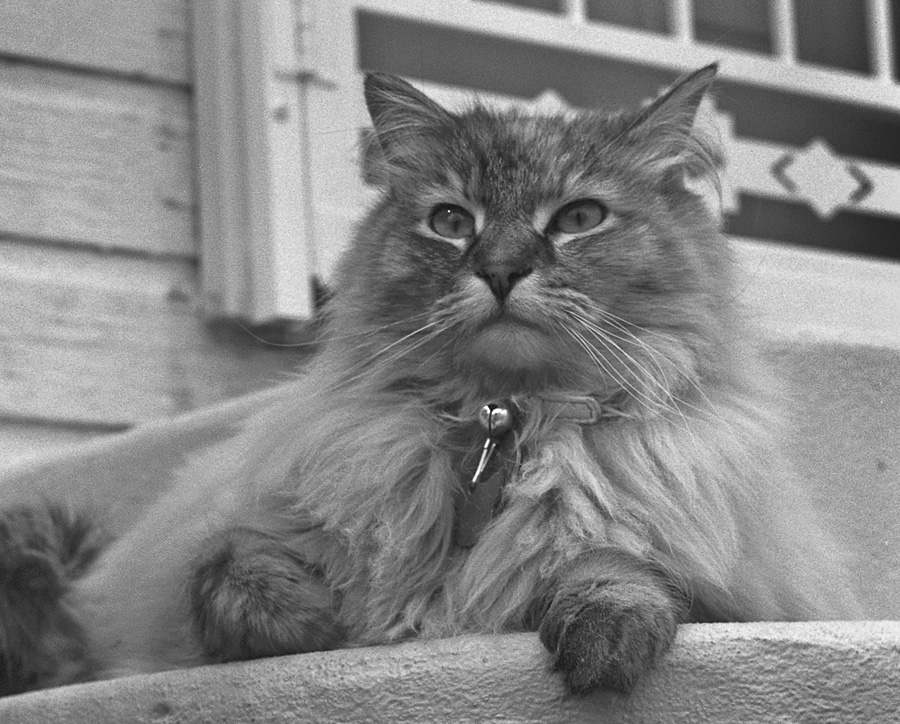
The neighbor's cat has been very patient in helping me to sort through some problems I've been experiencing in processing Kodak Tri-X.  I managed to use up a five-pack of the film before I finally figured out that the inconsistent results seemed due mostly to the film not loading properly onto the metal reel in my steel developing tank.

I have processed a lot of 120 roll film in my steel tank with very few failures, so I'm inclined to think at this point that the film has undergone some changes which have prompted the problem.  While I'm not totally sure on the details, my guess is at this point that the film has more of a curve across the width which is causing it to slip out of the spaces in the wire reel, preventing proper exposure to the developer.

So, today I shot a quick roll in the Bentzin plate camera and loaded the film into the plastic reel of my Paterson developing tank.  I processed the film in HC-110b for six minutes at 20 deg. Centigrade and got pretty good consistency in negative density from beginning to end.

I still have four rolls of 120 Tri-X in the refrigerator, so I'm looking forward now to trying some different developers and processing, possibly including some stand development.

Wednesday, March 22, 2017

Bentzin Primar

I was pleased recently to come across a Bentzin Primar on ebay.  It is a compact plate camera, this one likely from the early to mid-1930s.  The dial-set Compur shutter having a top speed of 1/250 could have been made as early as 1914 based on the serial number.  The lens is a 10.5cm f4.5 Tessar.  The Bentzin closely resembles the KW Patent Etui, but has a somewhat more robust design.

Bentzin Primar 6.5x9
I was relieved to find that the Bentzin accommodates the Rada roll film adapter which is a much sturdier  than the Rollex adapter which is required for the Patent Etui with its very narrow back rails.

Box-top
The Bentzin needed just a light cleaning of the lens to be ready to make pictures.  I loaded the Rada back with some Tri-X 120 and strolled around Albuquerque's Old Town on a warm afternoon, and then again the following morning to finish off the roll of eight 6.5x9 frames.


My afternoon walk took me by some cottages near Tiguex Park which have undergone a lengthy restoration over the past year.  I snapped a couple shots, but the light was past its prime for this subject.


By pure good luck, a summer visitor to one of the cottages happened by and treated me to a quick tour of the furthest west cottage known as The Priest's House.  She said that the place was about 140 years old and that it had in fact been a priest's residence at one time.

click for 100% enlargement
I recalled making a picture of The Priest's House some time ago with better light.  After some searching through my blog, I found the picture made about six years ago with my No. 1 Series 3 Kodak.


The place does not look much different today from the outside, but the interior has been done over very nicely.  We are thinking we may lodge our daughter there when she comes for a visit from Phoenix.

Folded up, the Bentzin Primar fits easily in the hand or the pocket.


The plate cameras were originally designed to be used with glass plates or sheet film, either in sheet film holders or in film pack adapters.  This shows the Bentzin with a couple of film holders to the left and a film pack adapter at the top.


I believe the film pack adapter for this model held ten sheets.  After the exposure, a paper tab attached to the sheet was pulled to move the exposed negative through rollers to the back of the adapter and to make the next one available for use.  The film packs were fast and convenient, but expensive as they needed to be factory assembled by hand.

Sheet film is no longer available in the 6.5x9 size used in my small plate cameras.  It is still possible, however, to get 9x12 format film for the larger plate cameras from some European sources.

The only practical way to make photos with the small plate cameras like mine today is with a 120 roll film adapter like the Rada or the Rollex.  The roll film adapters work well in these cameras, though they add some bulk.  When putting the film adapter or the ground glass back onto any of the plate cameras it is important to do so only with the bellows extended.  If the back is slid on or off the camera when it is folded up, the back can snag the folds of the bellows and damage them.

All my compact plate cameras.
Kodak Recomar 18, Zeiss Ikon Maximar, KW Patent Etui, KW Patent Etui (w/Trioplan), Bentzin Primar
 Now, these old folding view cameras seem quaint and a little awkward in use.  In the 1920s and '30s, however, they were a big deal; perhaps the equivalent of today's iPhones and Androids.