As World War II began to wind down, all the major American camera
makers including Kodak, Ansco and Argus were aiming to capture the
entry-level niche with simple roll film cameras equipped with brilliant
reflective viewfinders. Kodak's entry into the revived consumer market
would by brought into existance by one of their experienced designers,
Miller R. Hutchison, Jr.
A 1940 Census enumerator, finding Hutchison at home on a tree-shaded
street in a Rochester residential neighborhood, recorded the family's
essential data (and slightly misspelled the name). Miller, it was
noted, was employed as a mechanical engineer with a $5000+ yearly
income. A crucial additional detail indicated that the family had
resided previous to coming to Rochester in Morris County, New Jersey.
What that points to is the likelihood that M.R. Hutchison, Jr. was the
son of
M.R. Hutchison, Senior,
who invented the first electric hearing aid in 1902, the year of
Miller,Jr.'s birth. By 1909 Miller, Senior would be associated closely
with the Edison Lab in West Orange. So Miller, Jr. clearly had some
powerful inspiration which propelled him toward a career as an
innovative design engineer.
The patent for the orginal Duaflex was filed by Hutchison on March 15, 1945.
The camera featured, along with the large and brilliant finder, a
simple meniscus lens with a focal length of approximately 70mm. Like
all the medium format Kodaks of the era, the Duaflex could only
accomodate 620 roll film. The modular construction and the metal,
bakelite and glass materials were also typically well grounded in the
Kodak design tradition. What was innovative in Hutchison's design for
the Duaflex was not the basic feature set shared with many other cameras
of the time, but rather the construction methodology that produced a
reliable snapshot machine at a modest cost of manufacture. How that was
to be accomplished is laid out in great detail in the
patent abstract.
Subsequent Duaflex models which included the designations II, III and IV
added numerous features to the basic design including a flip-up
viewfinder hood, a double-exposure prevention module, variable aperture
and in the III-model a multi-element and fully focusable lens. All
models, however, retained Hutchison's original basic box camera shutter
design with its plunger-style shutter release button. The shutter was
factory-set to a speed of about 1/30 sec. plus a "Bulb" setting, and it
was wired for synchronization to a flash unit which plugged into the
side of the camera opposite the shutter button.
I have had opportunities to handle all models of the Duaflex, but I
particularly like the simplicity and integrity of Hutchison's orginal
1947 design. I've only put one roll of film through the camera as of
this writing, but I'm looking forward to further exploring the
capabilities of this interesting little camera.
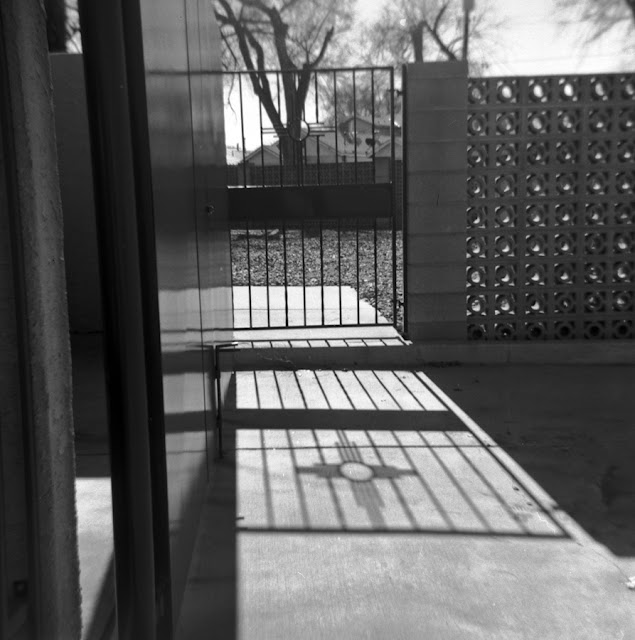
Pictures from the first Duaflex: