Showing posts with label Fed-1g. Show all posts

Tuesday, October 05, 2021

Kentmere

The best part of Albuquerque's Balloon Fiesta for me is actually not the balloons, but the Flamenco dance performances in the Old Town Plaza Vieja which are staged by the National Institute of Flamenco.  I believe the small woman in the picture is Eva Encinias who founded the Institute as well as the unique Flamenco dance program at UNM.  The tall woman beside her is the head teacher at the Institute.

I shot a roll of Kentmere 100 and another of Kentmere 400 this time around.  Since I had two rolls of film to process I decided to try them both together using semi-stand processing in HC110 at 1:100 for an hour.  I was very pleased with the results which this choice yielded for the Kentmere 400.  The tonal qualities were very good and the grain was nearly undetectable.  I have mostly used PMK Pyro as a developer for Kentmere in the past with good results, but I thought the quality of the HC110 pictures made with my Nikon FE were just as good if not better.


The Kentmere 100 shot in my FED 1g rangefinder responded less well to the HC110 stand development, so I'll likely stick with PMK Pyro processing for that film which seems better able to handle the higher contrast of the slower speed film.


Sunday, May 27, 2018

2926

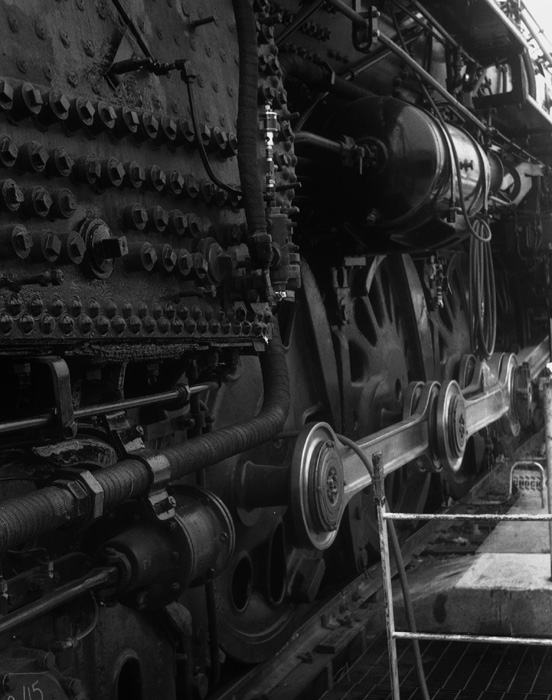
I've been watching the restoration of the 2926 locomotive for the ten years we've been in Albuquerque.  It looks like all the parts are back together.


On the day of my visit the task being worked on was making the whole thing water-tight.  That is quite a challenge as there are hundreds of old brass fittings that must withstand very high pressures.


The camera was my Fed-1g with the Fed 3.5/50 lens.

Tuesday, November 14, 2017

El Tecolote

Tecolote Mesa is fifteen miles west of Grants, New Mexico.  The name is associated with a geological feature on the mesa's rim thought to resemble the eyes of an owl.  On the slopes below there are the thousand-year-old remains of Casamero Pueblo.   The site, administered by the BLM, is a few miles off of Highway 40.  We have been the only visitors during our two visits.

The main pueblo structure is said to have contained about twenty rooms and possibly a second story with a few more.  A nearby depression marks the site of a large unexcavated kiva.  Casamero is one of the southernmost outliers of the Chaco Canyon complex, which is about forty miles to the north.


The camera used to make these pictures was my FED 1g, fitted with the 35mm Jupiter 12 and an accessory viewfinder.  This Barnack-style bottom loader has made some nice pictures for me over the years, and also provided me with numerous opportunities to learn about camera maintenance and repair.  I have had the shutter crate out of the camera several times, the last to try to figure out how to keep it from chewing up film.  I've also had to adjust the shutter tension and seal up some pinholes in the shutter curtains.  I did manage to get through a whole roll of film on this occasion with no advance or framing problems, but I am seeing some evidence again of shutter capping in the form of dark edges on the images.  Judging by the near complete absence of paint on the camera's back it has had a long and productive life, so it is not surprising that some of the fixes are breaking down.  Luckily I have several other Soviet-era rangefinder cameras including a Zorki 2C which functions perfectly, so I am still able to easily put to use my fine FED, Jupiter and Industar lenses.


Sunday, July 24, 2016

La Cieneguilla

I first visited the petroglyph site at La Cieneguilla shortly after we moved to Albuquerque in the Fall of 2008.  I was pleased sometime later when one of my shots of the Autumn foliage there was featured on the BLM web site for the area.  Recently, though, I noted that the picture has been reduced to a size which leaves much to the imagination, so I'm posting it here again.

The Cieneguilla site is a few miles south of the Santa Fe Airport at the west end of Galisteo Basin.

I drove up to La Cieneguilla again yesterday.  I was climbing up to the rimrock by 6:30, but it was already getting warm, and clambering over the rocks to get close to the petroglyphs was a challenge.  It is an effort worth making, however, because of the quantity and variety of rock art on display.  The site is particularly renowned for the large number of hunchback flute player images, but there are representatives of a great many of the designs found all along the valley of the Rio Grande and its tributaries.

Kokopeli

Procession


Whimsically recumbent Kokopeli


The Elk Hunter


I shot the Fuji 200 color in my Leica-copy FED 1g with the Jupiter-12 35mm lens and the matching wide-angle viewfinder.  My shutter repair seems to be holding up well, but I did get a little over-lap in a few frames.  Probably time for a more thorough cleaning.


I also exposed ten shots on TMAX 100 in one of my Kodak Duo Six-20 folders.  I have four of these 6x4.5 Kodaks which I like very much.  The one with the Anastigmat 4.5 lens and the Compur shutter works well.  I was planning on giving it some more exercise, but the heat and the terrain got the best of me. Next time, I'll take less gear and more water.


Monday, March 09, 2015

Shooting the FED 1g

The FED 1g is the last in a long line of Barnack-style Leica copies produced in the Soviet Union.  Mine, according to the serial number, was produced in 1955.  I haven't used the camera in quite a while because of a maladjusted shutter which caused a dark line to appear along one edge of the negative.


The explanation of the problem is that the second of the two cloth curtains in the shutter is under too much tension and it catches up to the first curtain a little too soon after the shutter is tripped.  The solution to the problem is to slightly decrease the tension on the second curtain.  The picture below shows the two little knobs with a screw in the middle of each which allow the adjustment of the tension on the two curtains.  The one closest to the lens controls the second curtain.  There are several places on the net where you can get instructions for making the adjustment.  I used the one at rangefinderforum which can be found in the Russian FSU RF forum.


Truth be told, the instructions are pretty opaque.  I removed the little locking screw while holding onto the big round nut with some pliers and keeping the tip of my screwdriver planted in the central screw head.  The whole thing rotated a bit on its own, so when it got to about 180 deg. from the starting point, I returned the nut to its original position by twisting counterclockwise and put the locking screw back in place.  I'm still not sure if what I did corresponded to the intent of the instructions, but I don't see any dark line  as before in the negs, so I guess the problem is fixed.  Below are a couple full neg scans from the roll I put through the camera following the repair.


There are a couple other common problems with these cameras.  The film cassette tends to ride a little high in the chamber because of a slight difference between modern film canisters and the reusable metal one the Russians used.  There is a little extra black light seal material in the modern cassettes which protrudes at the ends.  That can be cut off to allow the cassette to seat better.  If that doesn't do it, you can lay a penny on top of the cassette before you replace the back.

The other common issue is pinholes in the rubberized cloth shutter curtains. Provided the deterioration is not too advanced, you can fix that problem with a light application of black fabric paint which you can get at any crafts store.

In addition to the FED 50mm collapsible lens I have a 35mm Jupiter 12 and the corresponding wide-angle accessory finder.  Both lenses are of excellent quality and I'm pleased to once again have an opportunity to put them to use.

Sunday, August 01, 2010

black and white

Margaret
Rio Grande Bosque
B-29 Engines

Thursday, January 14, 2010

one cent camera repair


My Soviet Leica-copy Fed-1g has an accurate rangefinder and shutter, and a terrific Tessar-type lens. It also has an odd problem with film alignment. The sprocket holes intrude into the image area on one side of the frame. It may be a case of overly-generous manufacturing tolerances, or perhaps it is just that modern film cartridges don't quite fit the camera.


I was able to push the film cartridge down into the compartment and the film would track ok if I maintained some pressure. I decided that what I needed was a thin spacer to take up the extra space over the cartridge. It turned out that a penny fit perfectly in the available space.


Some post-fix images from this morning:


Tuesday, January 05, 2010

snowsuit


This is my first try at stand development. I was pleased that it turned out reasonably well using Tmax 100 in Rodinal at 1:160 for 75 minutes. I've gotten nicer results from 1:50 at the recommended time, however, so I don't know if it is really worth experimenting further with this technique.

Monday, November 30, 2009

Sunday, November 29, 2009

Hudson


I had one of these briefly while still in high school. It was slightly earlier than this 1951 model. Mine was about ten years old at the time and generally the subject of jokes, including a feature in the April Fools edition of the student newspaper. In fact, the Hudson had a ground-breaking design that was soon followed by the big auto makers. The car's good handling, light weight, and efficient engine allowed it to capture numerous racing titles.

The camera is the Soviet-era Fed-1g with the collapsible F2 50mm lens, also a ground-breaking design originating in Germany and improved upon by the Reds.

Saturday, November 28, 2009

totem


Maxwell Museum of Anthropology, Albuquerque

Friday, March 27, 2009

Old Town Albuquerque


Albuquerque has a pretty tenuous grasp on Spring right now. Still, this Mariachi group made an appearance at several places around the Old Town Plaza to try to warm up the tourist trade, and they seemed to be having some success.